We look forward to showing you Velaris, but first we'd like to know a little bit about you.


Segmenting Users by Behavior: A guide for CSMs
Discover the benefits of segmenting users based on their behavior for Customer Success.
The Velaris Team
March 6, 2026
Behavioral segmentation is a customer success strategy that groups users based on how they actually use your product rather than firmographics like industry or company size. It’s designed for Customer Success Managers and CS leaders who want to proactively reduce churn, increase expansion, and prioritize accounts using real engagement data. Use behavioral segmentation when you need to identify at-risk accounts early, personalize outreach at scale, and move from reactive firefighting to data-driven account management.
Key Takeaways
- Behavioral segmentation groups users by product usage, not demographics. It tracks real engagement signals like logins, feature adoption, and support activity to predict retention outcomes.
- CSMs should segment users into five core behavioral groups. Active, at-risk, power, new, and churning users each require distinct engagement strategies.
- Early risk detection depends on tracking usage trends. Declining logins, reduced feature adoption, and negative sentiment are leading churn indicators.
- Automation is essential for scalable behavioral segmentation. Trigger-based workflows ensure accounts move between segments in real time without manual reporting.
- Segment-specific playbooks drive consistent outcomes. Standardized workflows help CSMs tailor onboarding, retention, and expansion efforts to each user group.
- Behavioral segmentation should supplement firmographic segmentation. Company size and industry guide resource allocation, but user behavior determines day-to-day engagement strategy.
What is behavioral segmentation in customer success?
Behavioral segmentation groups your customers based on how they actually use your product, and not who they are on paper. While traditional segmentation might split accounts by industry or company size, behavioral segmentation answers a more valuable question: what are customers doing right now?
This approach tracks real product interactions, engagement patterns, and usage behaviors to create segments that tell you who needs help, who's thriving, and who's about to leave. Instead of guessing which accounts need attention, you're working with concrete signals that predict outcomes.
The difference matters because two enterprise customers might look identical on a spreadsheet but behave completely differently in your platform. One would log in daily and use advanced features while the other may not have touched the product in weeks. Behavioral segmentation catches that gap before it becomes a churn problem.
What are the main types of user segments?
Understanding the core behavioral segments helps you build targeted strategies for each group. Here's how to think about the five primary segments every CS team should track:
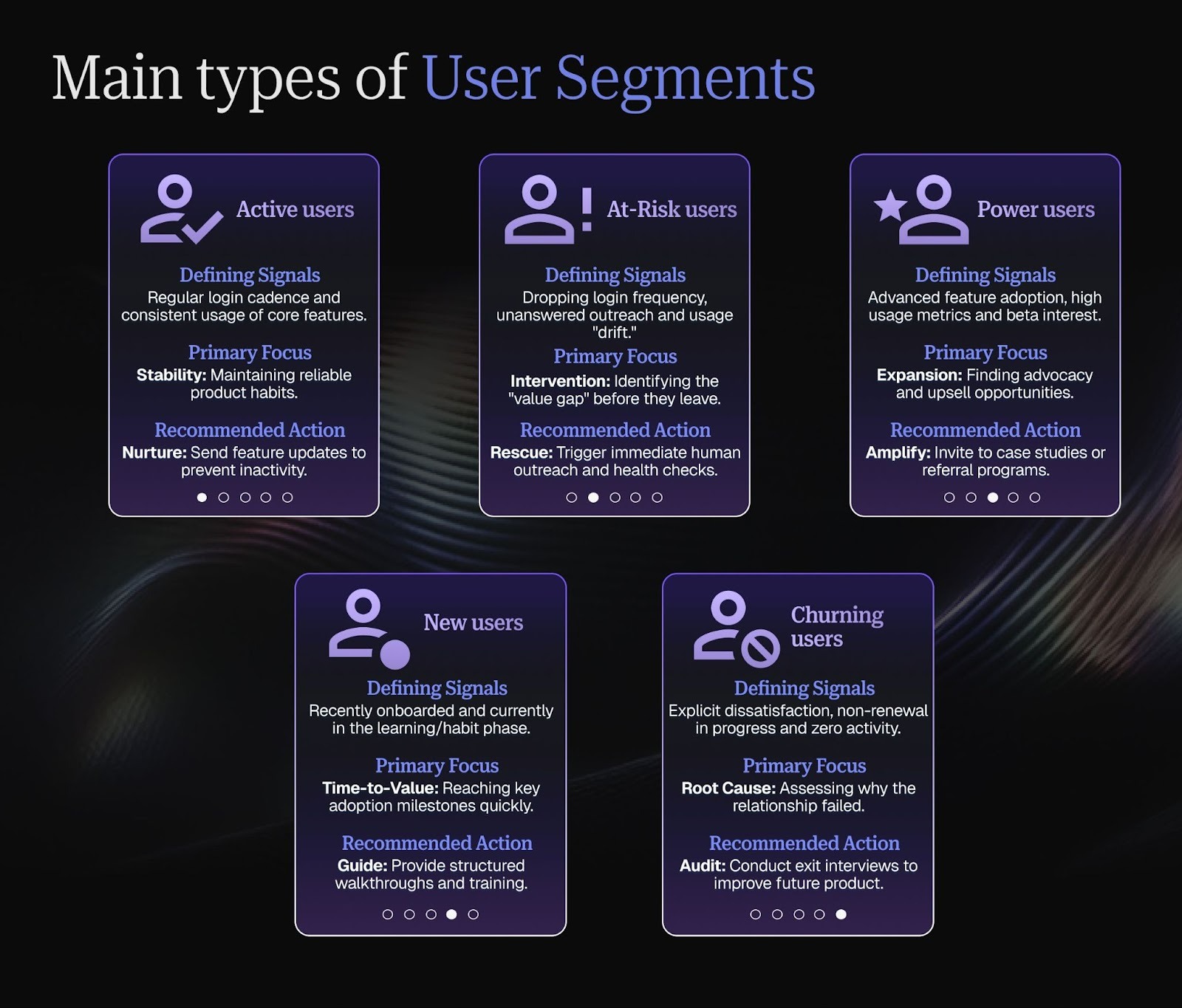
- Active Users
These customers log in regularly, engage with your core features, and show consistent usage patterns. They're not necessarily power users yet, but they've established reliable product habits. Active users typically represent your stable revenue base, since they're getting value and staying engaged without immediate risk signals.
Track login cadence, session duration, and breadth of feature adoption to identify this group. They may not need constant attention, but they do need nurturing to prevent drift toward inactivity.
- Inactive or At-Risk Users
These accounts show declining engagement, reduced login frequency, or drops in key feature usage. They might still be customers technically, but their behavior suggests they're not getting value anymore. This segment requires immediate intervention because they're your highest churn risk.
Look for signals like missed scheduled check-ins, unanswered outreach, or sudden changes in usage patterns. The earlier you catch declining engagement, the better your chances of turning it around.
- Power Users
Power users don't just use your product, they maximize it. They engage with advanced features, explore new capabilities quickly, and often exceed typical usage metrics. These customers have found deep value in your platform and represent your best expansion and advocacy opportunities.
This segment is ideal for beta programs, case studies, and referral programs. They already understand your product's full potential and can articulate that value to others.
- New Users
Recently onboarded customers are still in the learning phase. They're figuring out your platform, establishing usage patterns, and deciding whether your product will deliver on its promise. This segment has the highest variance. Some will quickly become active users, while others will struggle and churn early.
Time-to-value matters most for new users. Track whether they're hitting key adoption milestones within expected timeframes and whether they're building the habits that lead to long-term success. If you want to go deeper on the mechanics, How to Reduce Time-to-Value: Strategies for Faster Customer Success covers the tactical side in detail.
- Churning Users
These customers are actively showing late-stage churn signals: contract non-renewals in progress, explicit dissatisfaction, or complete disengagement. While similar to at-risk users, churning users have typically crossed a threshold where standard retention tactics may not work.
This segment requires honest assessment. Sometimes the best move is understanding why they're leaving to improve your product or process. Other times, there may still be an opportunity to retain them if you can address root issues quickly.
For a broader look at how to structure these groupings, The Ultimate Guide to Customer Segmentation Frameworks is worth a read before you start building your own.
Why is user segmentation crucial for customer success teams?
Segmentation transforms CS from reactive firefighting into strategic account management. Companies like PocketSuite have cut churn by 30% through behavioral segmentation, and SaaS businesses with proactive behavioral strategies routinely outperform industry-average churn benchmarks by several percentage points.
Here's why it fundamentally changes how effective teams operate:
How does segmentation enhance proactive engagement?
Without segmentation, every customer looks equally important until they're actively churning. That's too late. Behavioral segmentation lets you spot trends before they become crises like declining usage in previously active accounts, stalled onboarding for new users, or underutilization of key features in expansion-ready accounts.
Proactive engagement means you’re reaching out when data suggests intervention will help, and not when the customer is already frustrated. You're acting on leading indicators instead of lagging ones, which means you can actually prevent problems instead of just managing damage.
The data backs this up. Teams using mature behavioral monitoring consistently achieve 120-140% NRR compared to sub-100% in reactive models, and early warning systems that flag risk 60-90 days out measurably improve save rates. That gap between proactive and reactive is the difference between a retention strategy that compounds and one that's always playing catch-up.
How does segmentation personalize customer journeys?
A new user trying to learn your platform needs completely different support than a power user asking about API access. Segmentation lets you match your engagement level, communication style, and resource allocation to where each customer actually is in their journey.
Personalization at scale becomes possible when you can create standardized playbooks for each segment. This allows your team to know that at-risk accounts need specific interventions, new users need educational content, and power users need strategic conversations about expansion, all without having to reinvent the approach for each account.
How does segmentation drive product adoption and feature utilization?
Segmentation reveals adoption gaps you'd otherwise miss. When you can compare usage patterns across segments, you see which features drive retention, which ones confuse users, and which capabilities remain undiscovered by accounts that would benefit from them.
This visibility lets you run targeted adoption campaigns. Instead of generic feature announcements to everyone, you can promote advanced analytics to active users ready for the next step while focusing basic workflow features for struggling new accounts. That precision increases adoption rates and reduces the noise customers experience.
For a more focused look at this, The Feature Adoption Guide for Customer Success Managers breaks down how to identify and close adoption gaps at the segment level.
What behavioral data should you track for user segmentation?
Effective segmentation relies on tracking the right signals. Focusing on these four categories of behavioral data helps you build meaningful segments:
- Feature Usage Patterns
Track which features each customer uses, how frequently they use them, and how deeply they engage with different capabilities. Feature usage reveals both value realization and adoption gaps.
The threshold matters here. Analysis of feature adoption data suggests that usage drops of 30% or more are a reliable churn signal, and active accounts typically need core feature adoption above 80% to show strong retention. Below that, even accounts that appear "active" by login metrics are quietly at risk.
Pay attention to patterns like breadth of adoption (how many different features are they using) versus depth (how thoroughly are they using their primary features). Customers using only one or two features are vulnerable even if their usage appears "active" by login metrics.
Look for correlations between specific features and retention. If customers who adopt Feature X within 30 days have dramatically better retention, that feature becomes a critical milestone to track across all segments.
- Login Frequency
Login patterns provide a simple but powerful engagement signal. Regular logins suggest habit formation and ongoing value, while declining frequency often predicts churn weeks before a customer expresses dissatisfaction.
Track both absolute frequency and trends. Research into login pattern analysis shows that accounts falling below two logins per month carry significantly elevated churn risk, and predictive models combining login frequency with cohort behavior have improved retention by 20% in documented case studies. A customer who logged in daily last month but only twice this week needs attention, even if twice per week might be acceptable for a different user.
Don't stop at counting logins. Try and understand session patterns. Are they logging in for five-minute sessions or hour-long working sessions? The depth of this engagement matters as much as the frequency.
- Support Interactions
Support ticket volume and type reveal a lot about user success. High ticket volume might indicate either deep engagement (they're using the product enough to find edge cases) or serious adoption struggles (they can't figure out basic functionality).
Context matters here. Look at ticket resolution rates, time-to-resolution, and whether customers keep running into the same issues. Repeat tickets about the same topic suggest a training gap or product usability problem, not just normal support needs.
Also track positive support interactions. Customers asking about advanced features or integration options are probably ready for deeper engagement conversations, not just technical support.
- Survey Responses
Direct feedback from NPS, CSAT, or custom surveys adds qualitative context to quantitative behavior data. A customer with declining usage who also reports low satisfaction is clearly at-risk. But a customer with declining usage who rates you highly might just have seasonal patterns or has already extracted their primary value.
Connect survey sentiment to behavioral segments. If your power users consistently report high NPS while at-risk users report low scores, you've validated that usage correlates with satisfaction, which strengthens the case for adoption-focused interventions.
Act on the patterns you see in collected survey data. If new users consistently report confusion about a specific workflow, that's a segmentation signal that this group needs better onboarding around that feature.
To get a better understanding of NPS and CSAT scoring, check out our guide to measuring customer satisfaction and loyalty.
How do you set up behavioral tracking infrastructure for segmentation?
Building reliable segmentation requires solid data infrastructure. Here's how to set up tracking systems that actually work:
What tools should you use to capture behavioral data?
Your tracking infrastructure needs to pull data from everywhere customers interact with your product: your application, support systems, CRM, marketing automation, and any other touchpoints. Look for platforms that can aggregate these data sources into unified customer profiles.
Modern customer success platforms should handle most of this automatically through pre-built integrations. You need product analytics data, CRM information, support ticket histories, and engagement metrics all flowing into one place. If you're manually exporting and combining data sources, your infrastructure isn't scalable.
Prioritize real-time or near-real-time data syncing. Behavioral segmentation loses effectiveness if you're working with week-old information. At-risk signals need to trigger interventions quickly, not after the customer has already decided to leave.
How do you ensure data quality and accuracy in behavioral tracking?
Bad data creates bad segments, which leads to misguided outreach and wasted effort. Start by defining clear standards for what each metric actually measures. "Active user" means nothing if different teams define it differently.
Implement data validation at the source. If usage data from your product doesn't match what your analytics platform reports, you have a tracking problem to fix before you build segmentation on top of it. Regular audits catch drift in data quality before it undermines your strategy.
Watch for common data pitfalls: bot traffic inflating usage metrics, test accounts skewing cohort analysis, or timezone issues making login patterns misleading. Clean, accurate data takes ongoing maintenance, not just initial setup.
How do you maintain privacy compliance while tracking user behavior?
Behavioral tracking must respect privacy regulations and customer expectations. Know what data you're allowed to collect, how long you can store it, and what rights customers have regarding their information.
Build consent management into your tracking from day one. If customers opt out of certain data collection, your systems need to honor that automatically. Manual compliance processes don't scale and create legal risk.
Be transparent about what you track and why. Most customers understand that usage data helps you serve them better, but surprising them with unexpected tracking creates trust issues. Clear privacy policies and opt-in mechanisms protect both your customers and your business.
How do you overcome integration challenges across data sources?
Different systems structure data differently, use inconsistent customer identifiers, and update on different schedules. Your integration strategy needs to handle these mismatches without creating data silos or requiring constant manual intervention.
Establish a single source of truth for customer identity. Whether it's email address, customer ID, or account number, every system needs to reference the same identifier so you can link behaviors across platforms. Identity resolution problems are the number one reason segmentation initiatives fail.
Plan for API rate limits, data sync failures, and schema changes in third-party systems. Your infrastructure should handle these gracefully rather than breaking your segmentation every time Salesforce pushes an update.
How do you implement user segmentation in customer success strategies?
Moving from theory to execution requires a systematic approach. Here's how to actually implement behavioral segmentation in your CS workflows:
- Gather and Unify Customer Data
Start by breaking down data silos across your organization. Sales has CRM data, product has usage analytics, support has ticket histories, and marketing has engagement metrics; but nobody has the complete picture. Your first step is consolidating these sources into unified customer profiles.
Focus on the data that actually matters for segmentation: product usage metrics, engagement patterns, support interactions, health scores, and key account milestones. Don't try to track everything. Just track what predicts outcomes and informs action.
This is what CS platforms like Velaris are built for. Rather than manually stitching together CRM exports, product analytics, and support tickets, Velaris pulls all of this into a single customer record, synced in real time from every tool in your stack, which is part of why it holds a 4.7 rating on G2 from CS teams who've made the switch.
- Analyze Behaviors and Create User Segments
With unified data, start identifying patterns that differentiate customer groups. Look for natural clusters in the data: accounts that show similar usage patterns, engagement levels, or risk signals.
Your segments should be actionable, not academic. "Users who log in daily and use at least five features" is actionable. "Engaged users" is too vague. Define each segment with specific, measurable criteria that your team can use to identify accounts and trigger appropriate workflows.
Start with broad segments (active, at-risk, new, power users, churning) then refine based on what you learn. If your "at-risk" segment is too large to manage, split it into early-warning accounts versus critical intervention cases. Let your capacity and resources guide how granular your segments become.
- Automate Processes and Outreach for Each Segment
Manual segmentation doesn't scale. Once you've defined your segments, build automation that assigns accounts automatically and triggers appropriate workflows. When a customer's behavior shifts them from "active" to "at-risk," your system should flag that change and initiate outreach without anyone needing to run reports.
Create trigger-based campaigns for each segment. New users get onboarding sequences. At-risk users get re-engagement campaigns. Power users get expansion conversations. The triggers should be behavioral (usage dropped 50% this month) not arbitrary (it's been 30 days since last contact).
This is especially critical for new users, who have an 85% 30-day retention if they experience value within 5 minutes, compared to 35% for teams requiring 30+ minutes. Behavioral triggers tied to onboarding milestones over arbitrary timelines are what move the needle.
Automation handles the routine, but keep humans in the loop for complex situations. Tools like Velaris make this kind of trigger-based automation accessible without engineering resources. You can build multi-step workflows with branching logic so when a customer's usage drops, the right CSM gets alerted, an outreach sequence kicks off, and the account is automatically re-prioritized in your queue. No manual report-running required.
- Standardize Your Customer Success Workflows with Playbooks
Create documented playbooks that define how your team engages with each segment.
Playbooks ensure consistency even as your team grows. They capture best practices from your top performers and make them accessible to everyone. They also make it easier to measure what works because everyone's following the same process. New CSMs shouldn't have to guess how to handle an at-risk enterprise account. There should be a clear playbook outlining steps, timing, and escalation criteria.
Build playbooks around outcomes, not just activities. An at-risk playbook shouldn't just say "send three emails over two weeks." It should define what success looks like (reactivation, scheduled call, identified root issue) and give CSMs flexibility in how they achieve it.
If you're starting from scratch on playbook design, The Ultimate Guide to Customer Success Playbooks gives you both the framework and practical templates to work from.
- Measure Impact and Iterate
Track whether your segmentation strategy actually improves outcomes. Are at-risk interventions reducing churn? Are new user playbooks accelerating time-to-value? Are power user engagement programs driving expansion?
Define KPIs for each segment. For example, for at-risk users, you can track save rates and time-to-reactivation. For new users, you’d measure time-to-first-value and 90-day retention. For power users, you would look at expansion revenue and advocacy participation.
Review segment performance regularly and refine your approach. If a particular intervention isn't working, try something different. If one segment shows much better outcomes than expected, investigate what's working and apply those lessons elsewhere.
How do you align your team around behavioral segmentation?
Segmentation only works if your whole organization buys into it. Here's how to get everyone aligned:
How do you get cross-functional buy-in for behavioral segmentation?
Sales, product, and marketing all benefit from behavioral segmentation, but they need to understand how. Sales wants to know which accounts are expansion-ready. Product wants to understand feature adoption patterns. Marketing wants segmentation data for targeted campaigns.
Show each team what they gain from segmentation. Sales gets better qualified expansion leads. Product gets clear adoption metrics and feature feedback by user type. Marketing gets precise targeting that improves campaign performance. When everyone sees the value, adoption becomes easier.
Create shared definitions and segment criteria. If CS defines "power user" differently from how product does it, you'll have alignment problems. Build a common language around segmentation that works across teams.
How should you assign CSMs to different behavioral segments?
Decide whether to assign CSMs by account, by segment, or a hybrid approach. Some teams assign high-touch CSMs to enterprise accounts regardless of segment, while others create specialized roles focused on specific segments (onboarding specialists, retention specialists, expansion specialists).
Match CSM skills to segment needs. Your best educators should handle new users. Your most strategic thinkers should manage power users and expansion opportunities. Your most empathetic problem-solvers should work at-risk accounts.
Consider segment complexity and capacity when assigning workload. Managing 200 active, healthy accounts requires different skills and capacity than managing 50 at-risk accounts that need intensive intervention. Balance workload by effort required, not just account count.
How do you train your CS team on segment-specific strategies?
Each segment requires different skills and approaches. Train your team on the psychology and tactics specific to each user type. At-risk customers need empathy and problem-solving. Power users need strategic thinking and business acumen. New users need patience and education skills.
Create role-playing exercises where CSMs practice segment-specific conversations. Handling a power user expansion discussion feels completely different from conducting an at-risk save call. Practice builds confidence and competence.
Share wins and losses across the team. When someone successfully saves an at-risk account or converts a power user into an advocate, document what worked. When an intervention fails, analyze why. Build institutional knowledge around what each segment responds to.
How should you structure compensation for segment-based success?
Align compensation with segment outcomes. If you want CSMs focused on retention, weigh that heavily in their compensation plan. If expansion matters most, make sure successful upsells are rewarded.
Consider segment difficulty when setting targets. Saving churning accounts is harder than maintaining active ones. Make sure your incentive structure reflects that reality or CSMs will naturally focus on easier wins.
Balance individual and team incentives. You want healthy competition, but not CSMs hoarding high-potential accounts or avoiding challenging segments. Team-based goals around overall health score or segment performance metrics can offset purely individual incentives.
What are the best strategies for engaging each user segment?
Now let's get tactical. Here's how to actually engage with each behavioral segment:
What are the best practices for nurturing active users?
- Active users are succeeding, but they still need attention. The mistake teams make is ignoring healthy accounts until they become at-risk. Proactive nurturing keeps active users engaged and prevents backsliding.
- Focus on deepening product adoption. Active users have established basic habits—now help them discover features that deliver incremental value. Share use cases, best practices, and advanced workflows that build on what they're already doing.
- Create regular touchpoints that don't feel like sales calls. Quarterly business reviews should focus on value realization and goals, not just product usage. Help active users connect your platform to their broader business objectives.
- Watch for subtle engagement changes. Active users can drift toward at-risk without obvious red flags. Track trending metrics, not just point-in-time snapshots, so you catch gradual declines before they accelerate.
How do you re-engage inactive and at-risk customers?
- At-risk users need immediate, focused intervention. Start by understanding why they've disengaged. Is it a product issue, a personnel change, shifting priorities, or something else entirely? You can't fix the problem until you understand it.
- Reach out personally, and not through automated emails. At-risk accounts warrant direct CSM contact, ideally a phone call or video meeting. Show them their usage data, acknowledge the decline, and ask what's changed. Sometimes they're not even aware their team has stopped using the product.
- Offer specific, actionable solutions tied to their original use case. If they bought your product to solve a specific problem, reconnect them to that value. Sometimes customers just need a refresher on features they've forgotten about or help with a workflow that's become inefficient.
- Set clear milestones and follow-up commitments. Don't leave an at-risk conversation without agreement on next steps and what success looks like. If they can't commit to even basic re-engagement actions, that tells you something about save probability.
Platforms like Velaris surface this context automatically, flagging sentiment shifts, pulling together recent support interactions, and showing usage trends in a single account view before you ever pick up the phone. That preparation is what separates a generic check-in from a conversation that actually moves the needle.
How do you turn power users into customer advocates?
- Power users are your best advocates, but they won't volunteer themselves. You need to actively recruit them into advocacy programs. Start by identifying who's genuinely enthusiastic about your product versus who's just a heavy user.
Beyond advocacy, this segment is your highest-leverage expansion target. Account expansion data consistently shows high-usage customers convert on expansion at 60-70% rates, compared to 5-20% for new acquisition, making power user engagement one of the highest-ROI activities a CS team can prioritize.
- Offer exclusive benefits that appeal to power users: early access to new features, direct input into product roadmap, speaking opportunities, or community leadership roles. Make them feel valued and recognized for their expertise.
- Make advocacy easy. Don't ask power users to write case studies from scratch. Interview them and draft the content yourself for their review. Rather than directly asking them for referrals, invite them to customer events where they can naturally meet prospects.
- Track what motivates each advocate. Some want professional recognition and speaking opportunities. Others want deeper product access or influence over development. Some just want to help others succeed. Tailor your questions to what each advocate values.
How do you optimize onboarding for new users?
- New user success gets determined in the first 30-60 days. Focus ruthlessly on time-to-first-value. What's the fastest path to a meaningful success moment that proves your product works? Build onboarding around that.
- Segment new users by use case or role if possible. A marketing team using your product needs different onboarding than a sales team, even if they bought the same platform. 4 Steps to Implement High Touch Onboarding for Complex Clients is a useful companion read for anyone managing enterprise onboarding within this segment.
- Track leading indicators of onboarding success: first meaningful action taken, key features adopted, team members added, integrations completed. Use these milestones to identify which new users are on track versus who's struggling early.
- Don't stop at simply educating them. Ensure application. It's not enough for new users to attend training. You need to confirm that they're actually using what they learned. Follow-up training sessions with usage checks and support offers for specific implementation challenges.
What are effective win-back strategies for churned customers?
- Churned customers aren't lost forever. Some churned for reasons that no longer apply: budget cuts that have been restored, personnel changes where the new team might be more receptive, or product gaps you've since filled.
- Segment churned customers by reason for leaving. Technical limitations, price, poor onboarding, and competitive switches all warrant different win-back approaches. Don't use generic win-back campaigns. Customize based on why they left.
- Lead with what's changed. If they churned because your product lacked a key feature and you've since built it, that's a compelling re-engagement message. If they left due to bad onboarding and you've revamped your process, offer a fresh start with better support.
- Be honest about fit. Some churned customers left for legitimate reasons and won't be successful if they return. Focus win-back efforts on customers who could genuinely succeed now, not just anyone who might sign again.
What are common mistakes to avoid in behavioral segmentation?
Even well-intentioned segmentation strategies can fail. Here are the mistakes to avoid:
What are the risks of over-segmentation?
Creating too many segments makes your strategy unmanageable. If you have 15 different behavioral segments with unique playbooks, your team will struggle to execute consistently and you won't have enough data to validate what works.
Start simple with 4-6 core segments. You can always add nuance later, but beginning with too much complexity prevents you from ever building momentum. Focus on the segments that matter most for your business outcomes.
Test whether new segments actually improve outcomes before making them permanent. If splitting "at-risk" into "early warning" and "critical intervention" doesn't change how you engage or improve results, the added complexity isn't worth it.
How do you manage segment drift when customers move between segments?
Customers don't stay in one segment forever. Active users become at-risk. New users become power users. Your systems need to handle these transitions smoothly, not break when an account changes classification.
To manage this, build workflows that trigger when customers move between segments. When someone shifts from active to at-risk, that should automatically update their CSM's priority list and trigger intervention protocols. The segment change itself is a critical signal.
Avoid segment whiplash where customers bounce between classifications too frequently. If your criteria are so sensitive that accounts flip segments weekly, you're tracking noise rather than meaningful trends. Use trending data and thresholds that require sustained behavior changes before triggering segment moves.
How do you avoid false positives in at-risk identification?
Not every usage dip means an account is truly at-risk. Seasonal businesses have natural usage fluctuations. Companies on year-end budget freezes might pause usage temporarily. Vacation seasons affect login patterns. False positives waste CSM time and can annoy customers with unnecessary check-ins.
Build context into your risk scoring. If a customer has predictable seasonal usage patterns, account for that in your at-risk criteria. If entire segments show usage declines during specific months, that's probably environmental rather than a retention risk.
Validate your risk indicators against actual churn data. If your "at-risk" segment has the same churn rate as your "active" segment, your criteria aren't working. Continuously refine based on which signals actually predict churn versus which just create false alarms.
Churn prediction is part science, part pattern recognition. Churn Prediction Models: What They Are and How to Build Them gives you the analytical foundation for building more accurate at-risk criteria over time.
How do you account for seasonal and cyclical behavior patterns?
Many businesses have natural usage cycles: higher engagement during fiscal year planning, lower usage during summer months, surges around industry events or tax seasons. Your segmentation needs to account for these patterns or you'll misclassify normal fluctuations as risks.
Build year-over-year comparisons into your analysis. If a customer's Q4 usage drops but it's consistent with last year's Q4 pattern, that's not necessarily a risk signal. Compare current behavior to equivalent historical periods, not just to last month.
Create industry or use-case specific segment criteria when appropriate. Retail customers might show different seasonal patterns than professional services firms. One-size-fits-all thresholds miss these nuances and create inaccurate segments.
Conclusion
Behavioral segmentation transforms customer success from reactive account management into strategic, data-driven engagement. By focusing on what customers actually do rather than who they are on paper, you can identify risks earlier, personalize support more effectively, and drive better outcomes across your entire customer base.
Done well, behavioral segmentation gives your team clarity about where to focus, confidence in their approach, and evidence of impact. It turns customer success from an art into a science without losing the human judgment and relationship skills that make CS effective.
Ready to put this into practice? Velaris is rated 4.7 on G2 by CS teams who've replaced spreadsheets and gut instinct with real behavioral data. Book a demo and see how your team could be working.
Frequently Asked Questions
1. How long does it take to see results from implementing behavioral segmentation?
Most teams start seeing initial improvements within 60-90 days of implementation, though the timeline varies based on your customer base size and existing data infrastructure.
Meaningful impact on churn reduction and expansion revenue typically becomes measurable after 6-12 months, once you've collected enough data to refine your segment criteria and validate which interventions actually work.
2. What team size do you need to effectively manage behavioral segmentation?
Smaller teams (1-3 CSMs) benefit most from automation-heavy segmentation that helps prioritize which accounts need human attention versus which can be managed through digital touchpoints.
Mid-sized teams (4-15 CSMs) can start specializing roles around segments.
Larger teams (15+) can create dedicated segment owners with specific expertise.
3. Should behavioral segments replace or supplement firmographic segmentation?
Behavioral and firmographic segmentation work best together, not as replacements. Firmographic data (company size, industry, revenue) helps you set appropriate engagement models and resource allocation upfront.
Behavioral segmentation then tells you what to actually do within that engagement model. For example, an enterprise account showing at-risk behavior gets different (and more immediate) intervention than a small business showing the same signals.
4. How do you handle customers who fit multiple segment criteria simultaneously?
Multi-segment classification is common. A power user can also be up for renewal (making them expansion-ready and at-risk simultaneously). The solution is to build hierarchical rules that determine primary segment assignment while flagging secondary characteristics, so CSMs see the full context but have clear direction on which playbook to follow first.
Typically, risk signals override positive signals because preventing churn is more urgent than pursuing expansion. Similarly, lifecycle stage (new user) often takes precedence over engagement level since onboarding success predicts long-term outcomes.
5. What's the minimum customer base size needed to make segmentation worthwhile?
Segmentation adds value even with 20-30 customers, though the sophistication level differs. With smaller customer bases, you're primarily using segmentation to ensure systematic attention rather than statistical analysis, that is: making sure new users get onboarding support and declining accounts get intervention calls.
The real threshold is around 50-100 customers, where manual tracking becomes impossible and patterns start emerging that wouldn't be visible in smaller samples. Below that, focus on building good data hygiene and simple active/at-risk/new classifications rather than complex multi-dimensional segmentation schemes.
6. How often should you review and update your segment definitions?
Plan for quarterly reviews of segment performance and criteria, with annual comprehensive overhauls. Quarterly check-ins let you catch issues like segments growing too large to manage, false positive rates increasing, or intervention tactics losing effectiveness. Annual reviews are for bigger questions: are these still the right segments for our business model? Has our product evolved enough that usage patterns have fundamentally changed?
New product launches, pricing model shifts, or major customer base composition changes all warrant immediate segment definition reviews rather than waiting for the scheduled cadence.

The Velaris Team
A (our) team with years of experience in Customer Success have come together to redefine CS with Velaris. One platform, limitless Success.





Velaris is an AI-native Customer Success Platform built for mid-market and enterprise B2B SaaS teams. From customer health scoring and churn prediction to onboarding automation, renewals, and expansion workflows, Velaris helps recurring revenue teams understand account health, reduce churn, and scale customer success with greater visibility and control.