We look forward to showing you Velaris, but first we'd like to know a little bit about you.


High Touch Customer Onboarding: Everything You Need To Know
Take a more attentive approach to your complex customers by learning about high-touch onboarding and its role in Customer Success.
The Velaris Team
September 24, 2026
High‑touch customer onboarding is a personalized, hands-on approach to guiding new clients through setup and adoption of your product or service. While it delivers strong value by building trust and accelerating success, it also comes with challenges such as higher costs, resource demands, and scalability issues.
In this article, you’ll learn what high‑touch onboarding is, the common pain points businesses face, and the proven strategies, tools, and best practices you can use to make it work effectively at scale.
Key takeaways
- High‑touch onboarding is a hands-on, personalized process where customer success teams guide clients through setup, training, and adoption.
- It differs from low‑touch (automated), tech‑touch (automation + human support), and hybrid (mix of both) models by offering deeper personalization.
- Success comes from aligning stakeholders early, personalizing the journey, providing white‑glove support, and transitioning clients toward long‑term ROI.
- This model requires more time, staff, and cost, can be hard to scale, risks client fatigue, and may create dependency on support staff.
- Use playbooks, automate routine tasks, train internal champions, balance touchpoints, and leverage customer success tools like Velaris Canvas and Success Plans.
What is high touch onboarding
High‑touch onboarding is a personalized, hands-on process where your team works closely with new clients to guide them through setup, training, and early use of your product or service. The goal is to make sure they quickly see value, feel supported, and gain confidence in using the solution.
Hands‑on support
Unlike automated onboarding, this approach involves real people actively helping clients step by step. It can include live calls, workshops, and one‑on‑one sessions to walk through processes. This reduces confusion and ensures clients don’t feel left on their own.
Customer success manager involvement
A dedicated customer success manager (CSM) or team is assigned to the client. They act as the main point of contact, answering questions and solving issues quickly. This personal relationship builds trust and makes the client feel valued.
Best for complex clients
Works especially well for large organizations or industries with strict compliance needs. These clients often have multiple stakeholders, complex workflows, and integration requirements. High‑touch onboarding ensures these challenges are addressed with tailored solutions.
Focus on confidence and value
The ultimate aim is to help clients reach “first value” fast the moment they see real results. By guiding them through early wins, you build confidence and momentum. This sets the foundation for long‑term adoption and satisfaction.
How high-touch onboarding compares to other models
Steps to implement high-touch onboarding
Implementing high‑touch onboarding requires a clear plan that balances personalization with scalability. From kickoff calls and tailored training to playbooks, automation, and success plans, each step is designed to help clients feel supported, adopt faster, and build confidence in your solution. Here’s how you can put high‑touch onboarding into action:
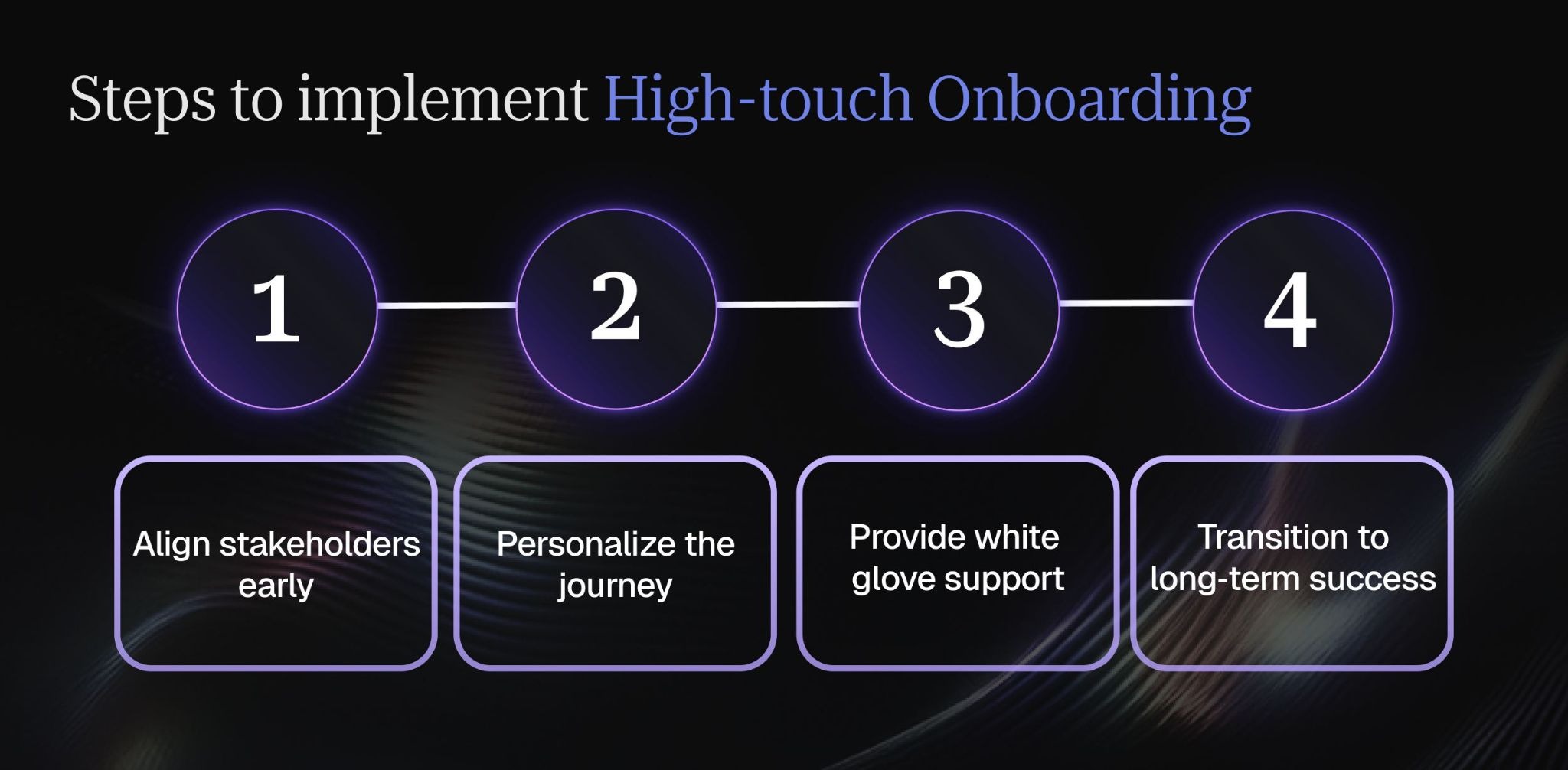
Align stakeholders early
- Kickoff meeting: Start with a structured kickoff session that brings together executives, project owners, and end‑users.
- Define success metrics: Agree on measurable outcomes such as ROI targets, adoption milestones, or compliance requirements.
- Assign responsibilities: Clarify who owns each part of the process data migration, training, reporting, and communication.
- Set communication cadence: Establish weekly syncs, executive check‑ins, and clear escalation paths to keep everyone aligned.
- Document workflows: Map the client’s internal processes to your product to avoid friction later.
Personalize the journey
- Segment by complexity: Tailor onboarding plans based on client size, industry, and technical needs.
- Role‑based learning paths: Provide customized training for executives, admins, and end‑users so each group gets what they need.
- Hybrid formats: Combine live workshops with self‑serve resources like guides, videos, and FAQs to reduce meeting fatigue.
- Milestone tracking: Use dashboards or visual roadmaps to show progress at 30‑60‑90 day intervals.
- Contextual guidance: Embed tooltips, in‑app tutorials, or micro‑learning modules for real‑time support.
Provide white‑glove support
- Dedicated contact: Assign a Customer Success Manager (CSM) or onboarding specialist as the single point of contact.
- Concierge services: Offer hands‑on help with integrations, compliance checks, and data migration.
- Centralized updates: Use shared workspaces or project trackers to keep communication transparent.
- Proactive risk management: Monitor adoption and flag potential issues before they escalate.
- Celebrate quick wins: Highlight early achievements (first workflow completed, first report generated) to build confidence and momentum.
Transition to long‑term success
- Shift focus to value realization: Once setup is complete, emphasize how the product drives business outcomes.
- Executive business reviews: Schedule regular reviews to showcase ROI and strategic alignment.
- Gradual feature rollout: Introduce advanced features step by step to avoid overwhelming users.
- Enable client champions: Train internal advocates who can drive adoption across teams.
- Automated health monitoring: Use dashboards, surveys, and analytics to track satisfaction, usage, and retention.
Challenges of high touch onboarding
High touch onboarding offers deep value for complex clients, but it also comes with practical challenges that organizations need to manage carefully. These challenges often relate to resources, scalability, client experience, and long‑term dependency.
Needs more time and staff
High touch onboarding requires significant human involvement. Customer success managers, trainers, and technical specialists must dedicate hours to guiding each client. This can stretch internal teams, especially when multiple enterprise accounts are onboarded at the same time.
Hard to scale for many clients
Because the process is highly personalized, it’s difficult to replicate across hundreds of clients. Scaling this model without losing quality often demands additional hires, specialized tools, or hybrid approaches that combine automation with human support.
Executive sponsor disengaging mid-onboarding
High-touch onboarding can lose momentum quickly when the executive sponsor who approved the purchase stops engaging before the customer has fully reached value.
The first step is to work out whether the disengagement is expected or risky. Some executives deliberately step back once implementation begins, while others go quiet because priorities have shifted, confidence has dropped, or the rollout is no longer getting internal attention.
CSMs should look for supporting signals before escalating. Has the day-to-day champion remained engaged? Are onboarding milestones still progressing? Has the customer missed decisions or approvals that only the sponsor can unblock? Is the original business outcome still being discussed?
If the sponsor’s involvement is genuinely needed, re-engage them around outcomes rather than implementation detail. A short executive update covering progress, early value, current blockers, and the next decision required is usually more effective than inviting them back into every onboarding meeting.
At the same time, avoid making the rollout dependent on one senior stakeholder. Strengthen relationships with the champion and other decision-makers, document the original business case, and make sure the success plan is visible across the account.
If executive disengagement starts affecting decisions, resources, or confidence in the rollout, treat it as an onboarding risk and create a specific recovery plan rather than allowing the project to drift.
Too many meetings can tire clients
While regular check‑ins are valuable, excessive meetings can overwhelm busy stakeholders. Clients may feel fatigued if the onboarding schedule is too heavy, which can reduce engagement and slow down adoption. Striking the right balance between support and efficiency is essential.
Costs more than automated onboarding
Compared to automated or low‑touch models, high touch onboarding is more expensive. The need for dedicated staff, customized training, and tailored resources increases operational costs. Organizations must weigh these expenses against the long‑term value of retaining high‑value clients.
Clients may depend too much on support staff
A potential risk is that clients become overly reliant on their customer success manager instead of learning to use self‑serve tools. This dependency can slow down independence and limit scalability. Encouraging client champions and embedding in‑product guidance helps reduce this risk.
Best practices for scaling high touch onboarding
High‑touch onboarding delivers strong results for complex clients, but scaling it across many accounts requires structure and smart use of technology. The following practices, supported by authoritative sources, show how organizations can balance personalization with scalability.
- Use playbooks to standardize repeatable parts.
One of the most effective ways to scale is by using playbooks to standardize repeatable parts of the process. Playbooks provide clear steps for kickoff meetings, training schedules, and reporting, ensuring consistency across accounts.
Platforms like Velaris, which is highly rated on G2, take this further by offering built in playbook functionality. Velaris playbooks allow customer success teams to embed best practices directly into their workflows. With these tools, teams can automate repeatable tasks, track progress against milestones, and deliver a consistent yet personalized onboarding journey.
- Automate routine tasks
Automation is another critical lever. Routine tasks such as reminders, surveys, and reporting can be automated to reduce manual workload.
Rocketlane found that 62% of onboarding professionals considered following up and chasing customers their biggest time sink, making routine coordination an obvious candidate for automation.
Automated workflows triggered by client behavior also ensure timely engagement without overwhelming staff.
- Formalize the sales-to-CS handoff
High-touch onboarding starts before the kickoff call. The CSM needs a structured handoff from Sales so they understand what was sold, why the customer bought, and what expectations have already been set.
At a minimum, Sales should pass across the commercial terms, agreed scope, implementation expectations, success criteria, important dates, stakeholder map, known risks, and any commitments or promises made during the sales process.
Many teams formalize this through a standard handoff document or internal call. A simple template can capture the customer’s goals, use cases, decision-makers, technical requirements, objections raised during the deal, and the outcomes the customer expects to achieve.
This also avoids the “re-discovery” problem where customers are asked to repeat information they have already shared with Sales. The kickoff should confirm and deepen existing context, not recreate the discovery process from scratch.
Finally, define exactly when ownership transfers. For example, Sales may remain responsible until the contract is signed and the handoff is complete, after which the CSM becomes the primary relationship owner.
Clear ownership prevents tasks or customer questions from falling into the gap between teams.
- Train internal champions
Training internal champions within client organizations is equally important. These champions act as advocates, helping their teams adopt the product more effectively and reducing dependency on external customer success managers.
BCG insights show that personalization at scale, often driven by internal champions, leads to 10% higher growth rates for leading firms.
- Feed onboarding data into the day-one health score
A customer’s health score should not start from zero the moment onboarding ends. The onboarding process already generates useful signals about how engaged, aligned, and prepared the account is for long-term success.
Teams can use factors such as stakeholder attendance, response times, milestone completion, implementation delays, training participation, and progress against the success plan to build an initial health profile before go-live.
An account that completed milestones on time with strong stakeholder participation should start in a different position from one that required repeated chasing or missed key decisions.
These signals should not permanently define the customer’s health. Instead, they act as the starting point until post-launch data such as product adoption, support activity, sentiment, and ongoing engagement becomes available.
This also makes the handoff from onboarding to long-term Customer Success much cleaner. Rather than relying on a subjective summary, the CSM inherits a health score already informed by the customer’s behavior during implementation.
Over time, teams can compare onboarding signals with later renewal and retention outcomes to identify which early behaviors are genuinely predictive, then adjust how heavily those signals influence the day-one score.
- Run a structured kickoff meeting
The kickoff meeting should turn everything gathered during the sales process into a shared onboarding plan.
Rather than treating it as a general introduction, use a repeatable agenda that covers introductions, customer goals, implementation scope, timeline, responsibilities, and the milestones that will define a successful launch.
Attendance should reflect both sides of the project. From the customer, this usually includes the day-to-day champion, project owner, relevant admins or technical stakeholders, and an executive sponsor where appropriate.
Internally, the CSM should be joined by anyone responsible for implementation, technical setup, or ongoing account ownership.
Use the meeting to agree on success criteria while everyone is in the room. Confirm what the customer wants to achieve, how progress will be measured, which milestones matter most, and who owns each part of the rollout. This avoids vague expectations later in the onboarding journey.
Within 24 hours, send a written recap covering decisions, responsibilities, timelines, risks, and next steps. That document should become the shared reference point for the onboarding process so both teams are working from the same version of the plan.
- Balance touchpoints
Balancing touchpoints is also essential to avoid client fatigue. While regular check‑ins are valuable, too many meetings can overwhelm busy stakeholders.
Surveys indicate that clients prefer a mix of 2 - 3 live sessions per month combined with self‑serve tools. This balance keeps engagement high while preventing burnout, ensuring that onboarding remains productive and client‑friendly.
- Define and track onboarding success metrics
High-touch onboarding should be measured against clear outcomes rather than whether a checklist was completed.
The most important metric is usually time-to-value, or how long it takes the customer to reach the first meaningful outcome they bought the product for. A shorter TTV generally indicates that implementation, training, and stakeholder alignment are working effectively.
Teams should also track activation and onboarding completion. Activation shows whether users have completed the key actions required to start getting value, while completion rate reveals how many customers successfully reach the end of the onboarding journey.
The right benchmark will vary by product and customer segment, so compare performance against your own historical cohorts rather than relying on one universal target.
These metrics become more useful when connected to what happens next. Compare faster onboarding, stronger activation, and higher completion rates with downstream renewal, retention, and expansion outcomes to understand which parts of the onboarding process actually influence long-term customer success.
Customer success software can automate much of this tracking by pulling together milestone completion, product usage, health scores, and account data in one place. This gives CSMs an ongoing view of which customers are progressing as expected and which accounts need intervention before onboarding starts to stall.
- Have a "graduation" checklist for onboarding-to-CSM handoff
Complex customers should not leave onboarding simply because the implementation timeline has ended.
Forrester specifically recommends a shared Sales-to-CS transition framework that transfers customer goals, stakeholders, use cases and promises made during the purchase process.
A formal graduation checklist helps confirm that the account is genuinely ready to move from a dedicated onboarding motion into ongoing Customer Success.
Before the handoff, confirm that the core implementation is complete, key users are activated, agreed success milestones have been reached, open technical issues are understood, and the customer knows what happens next. The ongoing CSM should also receive the stakeholder map, success plan, adoption targets, known risks, outstanding commitments, and any context about how the customer prefers to work.
It helps to include both internal and customer-facing handoffs. Internally, the onboarding owner should walk the ongoing CSM through the account rather than relying only on written notes. Externally, introduce the new primary CSM before the onboarding relationship ends so the transition does not feel abrupt.
Graduation should also have explicit completion criteria. If critical milestones are still incomplete, executive alignment is weak, or major blockers remain unresolved, the account may need to stay in onboarding longer or move into a structured recovery plan.
Once the checklist is complete, ownership can formally transfer. This creates a cleaner transition, preserves the context built during implementation, and reduces the risk of the customer feeling like they have to start over with a new CSM.
- Invest in customer success tools for tracking and collaboration.
Investing in customer success tools helps organizations track health scores, flag risks, and centralize communication. Shared dashboards and collaborative workspaces make it easier to manage multiple clients without losing visibility.
Velaris strengthens this with its Canvas feature, a shared workspace where teams and clients align on tasks, updates, and resources. It also offers Success Plans, which set clear goals, milestones, and measurable outcomes tied directly to ROI. T
Together, these features help scale high‑touch onboarding by combining visibility, collaboration, and accountability.
Right-sizing white-glove effort for complex-but-low-ARR clients
Technical complexity does not always line up neatly with account value. A lower-ARR customer may still need significant integration work, data migration, security review, or stakeholder coordination, which can make a standard onboarding motion unrealistic.
The economics of services are very different from software. Benchmarkit’s 2025 SaaS benchmarks put median professional-services gross margin at about 30%, compared with 81% for subscription revenue.
The challenge is deciding how much high-touch support the account actually justifies without allowing onboarding costs to become disproportionate to the commercial value of the customer.
Separate complexity from account value
Start by scoring the account on two dimensions: commercial value and onboarding complexity.
Commercial value can include ARR, expansion potential, strategic importance, and expected lifetime value.
Complexity should consider factors such as integration requirements, number of stakeholders, data migration, security processes, and the amount of configuration required.
An account that is both high-value and complex may justify a fully white-glove onboarding motion. A low-value but technically complex customer may need a different model entirely.
Identify where human support is genuinely necessary
High-touch does not have to mean a CSM manually owns every step.
Break the onboarding journey into tasks that require expertise and tasks that can be standardized.
Technical architecture decisions, complex integrations, and stakeholder alignment may need direct support, while training, documentation, status updates, and routine configuration can often be handled through templates, self-service resources, or automation.
This allows teams to concentrate expensive human time on the parts of onboarding where it materially changes the outcome.
Create a capped or hybrid onboarding model
For complex lower-ARR customers, define an explicit service boundary before onboarding begins.
This might include a fixed number of implementation sessions, clearly defined integration support, office hours, or a standardized onboarding package with paid professional services available beyond that scope.
A hybrid model can still feel highly supportive without providing unlimited bespoke assistance.
The important part is setting expectations early. If Sales promises enterprise-level customization to an account priced for a scaled service model, CS inherits an onboarding motion that may never be economically sustainable.
Measure the cost to serve alongside onboarding success
Track the amount of CSM, implementation, and technical time each onboarding requires alongside traditional metrics such as time-to-value, activation, and completion rate.
If a segment consistently reaches value but requires far more service hours than its revenue supports, the problem may be packaging rather than execution.
The company may need to change pricing, introduce implementation fees, simplify the product experience, or move certain services into a standardized package.
Right-sizing high-touch onboarding is therefore not about giving lower-value customers less support. It is about designing the level of support that helps them reach value without creating a cost-to-serve model that cannot scale.
Conclusion
High‑touch customer onboarding builds trust, accelerates adoption, and drives measurable value for complex clients. By balancing personalization with scalability through playbooks and automation, platforms like Velaris, which is highly rated on G2,can turn onboarding into a strategic advantage. Done right, it ensures short‑term success while laying the foundation for long‑term growth and loyalty.
Book a demo today to see how Velaris can help you deliver high‑touch onboarding at scale.
Frequently Asked Questions
Who benefits most from high‑touch onboarding?
High‑touch onboarding is best suited for enterprise clients, regulated industries, or customers with complex integrations who need personalized guidance to see value quickly.
Can high‑touch onboarding work alongside automated onboarding?
Yes. Many organizations use a hybrid approach high‑touch for complex phases like integrations or ROI reviews, and automated onboarding for routine tasks such as reminders or surveys.
What metrics should be tracked during high‑touch onboarding?
Key metrics include time‑to‑value (TTV), product adoption rates, customer satisfaction scores (CSAT), and early retention indicators. These help measure both efficiency and client success.
How can teams avoid client fatigue during onboarding?
The key is balancing live sessions with self‑serve resources. Limiting meetings to essential milestones and supplementing with dashboards or in‑product guidance keeps clients engaged without overwhelming them.

The Velaris Team
A (our) team with years of experience in Customer Success have come together to redefine CS with Velaris. One platform, limitless Success.




Velaris is an AI-native Customer Success Platform built for mid-market and enterprise B2B SaaS teams. From customer health scoring and churn prediction to onboarding automation, renewals, and expansion workflows, Velaris helps recurring revenue teams understand account health, reduce churn, and scale customer success with greater visibility and control.