We look forward to showing you Velaris, but first we'd like to know a little bit about you.


The Ultimate Guide to Customer Success Playbooks
Understand what Customer Success playbooks are and how they streamline strategies and boost satisfaction.
The Velaris Team
July 17, 2024
In an era where 89% of the market is more focused on improving customer experience in order to retain their customer base, the role of a Customer Success playbook is becoming more crucial. The playbook is a guide that will steer CSMs and their teams to proactively implement strategies that will ultimately strengthen their customer relationships and simultaneously increase growth and retention.
In this blog, we will equip you with all the information you need about Customer Success playbooks so you can create your very own or improve on your current one.
Key Takeaways:
- Customer Success playbooks act as a structured guide for managing every stage of the customer lifecycle, from onboarding to renewal and expansion.
- Having consistent processes improve team performance, ensuring consistent, high-quality experiences that reduce churn and build customer trust.
- Well-crafted playbooks allow teams to deliver personalized engagement even as the customer base grows.
- Clear segmentation, defined metrics, and proactive engagement tactics make playbooks measurable and adaptable to customer needs.
- Regularly review and update your playbooks based on performance data and feedback to maintain their effectiveness.
- Using tools like Velaris, a highly rated Customer Success platform on G2, can help automate playbooks, standardize workflows, and scale Customer Success operations efficiently.
What is a Customer Success playbook?
A Customer Success playbook is a comprehensive guide that outlines the processes and best practices for managing customer relationships effectively.

These playbooks are a vital part of getting your whole team on the same page about Customer Success. Think of them as the roadmap everyone follows, detailing step-by-step procedures for various interactions, from onboarding and engagement to renewal and upselling.
Benefits of using Customer Success playbooks
Can implementing a standardized process really make that much of a difference? Yes, it can. Here are three significant ways Customer Success playbooks benefit your team:
Performance
Playbooks make sure that everyone on your team is aligned and has the tools they need. This standardization is crucial to help them deliver high-quality, consistent service every time.
This alignment helps build trust with customers, reduces churn, and drives long-term growth.
Scalability
Playbooks provide a standardized framework that makes sure consistent service is delivered by your entire team, regardless of size. This approach allows your team to maintain high-quality interactions without falling back to square one, since they have a plan for every conceivable scenario.
A good playbook lets your team handle more customers without letting service quality drop. Plus, it makes training new hires much, much faster. This in turn helps you scale faster when your business grows.
Proactive engagement
When your CSMs work more efficiently (thanks to playbooks), they have more time. This allows them to shift from being reactive to proactive: anticipating needs, catching issues early, and finding upsell opportunities.
Ultimately, a Customer Success Playbook helps your team to deliver consistent value, turn customers into advocates, and drive the long-term success of your SaaS company.
Now that you know how playbooks can help, let’s get into the essentials for creating them.
Step-by-step guide to building a Customer Success playbook
To build a Customer Success playbook, you will need to understand your customer’s journey, set clear goals and make sure your team is on the same page around repeatable actions . Following these steps will guide you to create a structured, data-driven playbook that delivers consistent results and scales with the growth of your organization.
Map the customer journey and identify pain points
Firstly, start by mapping each stage in your customer lifecycle, from onboarding to renewal and expansion. Find the spots where customers get stuck. These problematic areas are the most important scenarios for your playbook to cover, giving your CSMs clear steps to follow.
Define your end goals for each playbook
You need to decide what success means for every playbook. For onboarding, maybe it's cutting down the time to first value. For renewals, maybe it's locking in more multi-year deals. Whatever it is, set clear, trackable outcomes so you can tell if your playbook is effective.
Segment your target customers
Don't use a one-size-fits-all playbook. Segment customers by size, industry, or stage, and adjust. High-touch accounts get more steps; tech-touch accounts get a lighter, automated version.
Create resources and guidance for your team
Don't make your team guess. Build all the resources they need to execute the playbook, like email templates, call outlines, and success plan checklists. When the steps are clear and the tools are ready, any CSM can follow the plan and deliver a consistent, high-quality experience.
Assign ownership and roles
For each step, define who owns it. Is it a CSM task? Does it need help from Sales? Can it be automated? Assigning owners keeps everyone accountable and prevents things from getting missed as you grow.
Types of Customer Success playbooks
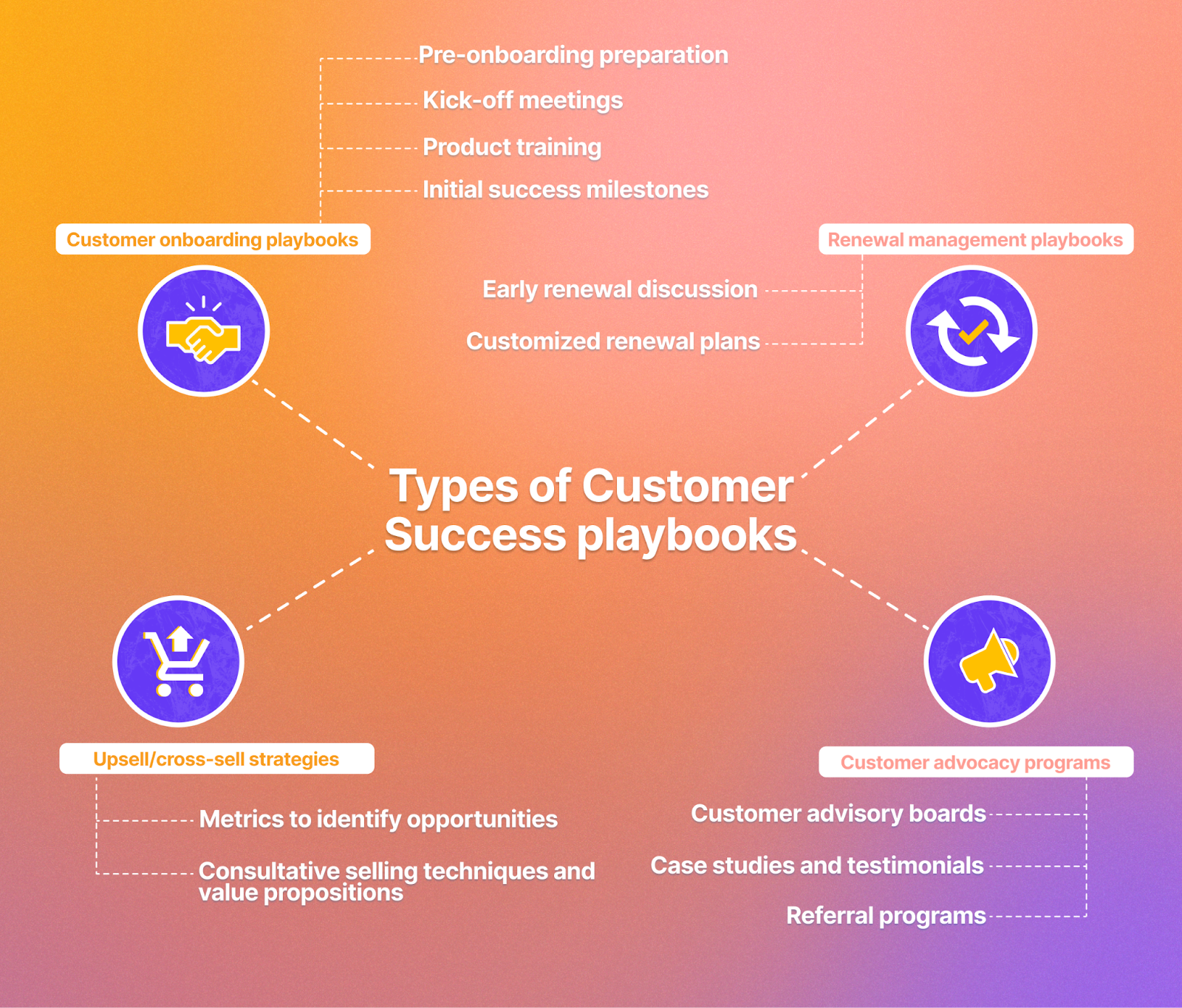
The type of playbook that you should use depends on the unique needs of your business. However, here are some of the most popular types of playbooks.
Customer onboarding playbooks
Proper Customer Onboarding is very important as this is the first impression that your customers get. You need this type of playbook to introduce customers effectively to your product, make sure they understand the proper value of it, and are set up for success from the start itself.
Key steps include pre-onboarding preparation, kick-off meetings, product training, and achieving initial success milestones.
Renewal management playbooks
Renewal management is essential for maintaining and growing your customer base. Proactive renewal strategies, such as early renewal discussions and customized renewal plans for different customer segments, help secure ongoing commitments and reduce churn rates.
If you need to quickly get started on managing renewals, check out this free renewal playbook for CSMs.
Upsell/cross-sell strategies
Identifying opportunities for upselling and cross-selling can significantly increase your revenue.
Use customer health scores, engagement metrics, and product usage patterns, to identify suitable opportunities. To drive these sales, use a consultative approach. Ask good questions, listen to their goals, and then build a compelling case for why this additional product or service is the right move for them.
Customer advocacy programs
Building strong customer advocacy programs transforms satisfied customers into brand ambassadors.
This includes creating customer advisory boards, developing case studies and testimonials, and establishing referral programs. Advocacy programs not only enhance customer loyalty, but also contribute to acquiring new customers through positive word-of-mouth.
By creating playbooks for each of these components, you create a structured approach which makes sure that your team can consistently deliver high-quality service and drive Customer Success.
How to measure the success of your Customer Success playbook
The key thing to remember is that a generic Customer Success playbook does not help every team the same way. So it is important to use Key Performance Indicators (KPIs) to track its success rate. This way, you can adjust your playbook and improve your processes. Below are the KPIs that will assist you with assessing your playbook;
Customer Churn Rate
The Churn rate is a key indicator you should check to see if your current success strategies are working. It's a quantitative indicator that shows the percentage of customers who have discontinued their subscription to your product or service over a given period.
If your churn rate is relatively high, it is best to adjust your current strategy to prevent it from worsening.
Customer Satisfaction Score (CSAT)
The CSAT measures your customers’ satisfaction with your product or service. According to industry standards, a score below 70% is a big red flag. As this metric is obtained through surveys shared with customers right after a key interaction with your services, it is key that the survey is well-made.
Customer Effort Score (CES)
This metric measures how easily your customers interact with your services. A low CES score is a good sign, as it indicates customers are not struggling to navigate your product.
Net Promoter Score (NPS)
NPS is a measurement of your customer base’s loyalty and satisfaction. A higher score means your customers are more likely to recommend you to others. A lower score indicates that most of your customers are dissatisfied with your services and are unlikely to recommend you to others.
Customer Lifetime Value (CLV)
Customer lifetime value is a metric that predicts the revenue you can expect from an account over the course of their relationship with you. This metric will help you identify high-value customers so you can ensure that extra attention is paid in order to retain them for longer.
By monitoring all of the above metrics, you will get a clear picture of how well your Customer Success strategies are working. Using the data obtained from these metrics, it is important that you update your strategies regularly. This way, you will ensure the adjustments to your strategies are made well in advance.
How cross-functional teams contribute to Customer Success playbook design
Cross-functional collaboration makes sure that Customer Success playbooks are grounded in real customer data, aligned with pre-sale promises, and responsive to post-sale needs. When Sales, Product, and Support teams all contribute, playbooks become more effective and representative of the full customer journey.
Sales: setting the foundation for alignment
Your sales team learns a lot of things during the buying process, what the customer's goals are, their expectations, and their biggest pain points.
When they share that information, your CSMs can build onboarding and success plans that actually match what the customer was promised.
For example, Sales can note the customer's goals in the CRM, which can then automatically kick off the right playbook in a tool like Velaris. This makes the handoff to onboarding very smooth and keeps everyone on the same page.
Product: translating usage data into value
Your Product team knows exactly how customers are actually using the product after they're onboarded.
Their input helps define adoption milestones, health score thresholds, and value metrics that CSMs can track through playbooks.
When CS and Product work closely together, they can spot features people are ignoring, nudge customers toward the high-value features, and build those adoption strategies right into the playbooks.
Support: identifying friction and risk signals
Support teams offer early warning signals of customer frustration through ticket trends and issue patterns. Involving Support in playbook design allows CSMs to proactively address recurring problems and reduce escalation risk.
For instance, if Support notices an uptick in configuration-related queries, that data can inform a proactive “setup checklist” playbook or automated education workflow for new customers.
Why cross-functional collaboration matters
When Sales, Product, and Support work together with Customer Success, we are able to use playbooks to their fullest potential using data driven insights.
Tools like Velaris, which allow you to efficiently get all the post-sales data in a single place, allow you to make full use of this data and incorporate them into automated playbooks, ensuring that every customer interaction shows them that they're valued.
Conclusion
B2B SaaS companies aiming to achieve consistent and scalable growth, need to understand that well-crafted Customer Success playbooks are necessary to achieve those.
By this point, it's evident that playbooks are the key to making your strategy repeatable. By clearly outlining your process for onboarding, engagement, renewals, and upselling, they help your team work more efficiently and get ahead of customer needs.
Furthermore, playbooks aren't set in stone, they are dynamic tools.They allow your organization to adapt to changing customer expectations and market conditions by using data-driven insights and feedback that you get from the process.
Ultimately, a comprehensive Customer Success playbook empowers your team to consistently deliver value, transform customers into advocates, and sustain the long-term success of your SaaS business.
Discover how Velaris, a highly rated Customer Success platform on G2, helps teams create effortless, automated playbooks that drive scalable growth. Book a demo today.
Frequently Asked Questions
What steps are involved in building a Customer Success playbook?
Key steps include mapping the customer journey, defining goals for each playbook, segmenting customers, creating supporting resources, and assigning ownership for each stage of the process.
What types of Customer Success playbooks should every team have?
Common playbooks include onboarding, renewal management, upsell/cross-sell, and customer advocacy. These cover the essential phases of the customer lifecycle and help teams deliver consistent experiences.
How can cross-functional teams contribute to playbook design?
Sales, Product, and Support teams each provide unique insights — Sales shares customer goals, Product brings usage data, and Support identifies recurring issues. Together, they help make playbooks more data-driven and aligned across the organization.
How often should Customer Success playbooks be reviewed?
Playbooks should be reviewed and updated regularly based on customer feedback, performance metrics, and product changes to ensure they remain relevant and effective.
What tools can I use to automate Customer Success playbooks?
Velaris enables teams to create playbooks, import SOPs, automate triggers, and measure effectiveness by centralizing live and historical data. This helps teams standardize workflows, track performance in real time, and scale their Customer Success operations efficiently.

The Velaris Team
A (our) team with years of experience in Customer Success have come together to redefine CS with Velaris. One platform, limitless Success.




Velaris is an AI-native Customer Success Platform built for mid-market and enterprise B2B SaaS teams. From customer health scoring and churn prediction to onboarding automation, renewals, and expansion workflows, Velaris helps recurring revenue teams understand account health, reduce churn, and scale customer success with greater visibility and control.