We look forward to showing you Velaris, but first we'd like to know a little bit about you.


Creating Data-Driven Customer Profiles to Elevate Customer Success
Learn how to create data-rich customer profiles that drive personalized interactions, identify risks, and uncover growth opportunities.
The Velaris Team
March 27, 2026
Customer Success Managers are expected to understand every account deeply. But in reality, that context is often scattered. Product usage lives in one tool, conversations in another, and business data somewhere else entirely.
Customer profiles solve this by bringing everything into one place. They give teams a clear view of each account’s goals, behaviour, risks, and opportunities, making it easier to personalise engagement, support customers proactively, and drive better expansion outcomes.
This is why customer profiles are the foundation of proactive customer success, enabling teams to see clearly, prioritise effectively, and deliver the right experience to every customer.
Key takeaways
- Customer profiles unify fragmented data into a single, actionable view of each account
- They combine usage, sentiment, and business context to enable proactive, data-driven decisions
- Profiles go beyond CRMs by being dynamic, real-time, and focused on what to do next
- Strong profiles help teams personalize engagement, detect churn risks early, and identify expansion opportunities
- Platforms like Velaris help teams bring this together by unifying data, surfacing AI-driven insights, and enabling action at scale
What is a customer profile in Customer Success?
Customer profile definition
A customer profile is a unified, real-time view of all the data that defines a customer account. It brings together behavioral data like product usage, operational data like support interactions, and strategic context such as goals, use cases, and business priorities.
Instead of looking at isolated data points, a customer profile connects everything into a single narrative. This gives customer success teams a clear understanding of how a customer is using the product, what they are trying to achieve, and where they may need support or guidance.
The result is a more complete and actionable view of each account, enabling better decisions, more relevant conversations, and stronger outcomes.
Customer profile vs CRM record
A CRM record typically stores static information such as company details, contract values, and contact information. While useful, it often lacks the depth and context needed to manage ongoing customer relationships effectively.
A customer profile, on the other hand, is dynamic and continuously updated. It reflects real-time usage, engagement, sentiment, and evolving business context. More importantly, it is designed to be actionable, helping teams identify risks, uncover opportunities, and decide what to do next.
In short, a CRM tells you who the customer is. A customer profile tells you what is happening with them and what you should do about it.
Customer profile vs. buyer persona
A customer profile and a buyer persona serve different purposes. A buyer persona is an aggregate archetype created to represent the type of person or company you want to attract before they become a customer.
A customer profile, on the other hand, represents a real account or contact and reflects what is actually happening in the relationship after the sale.
Personas are mainly used by marketing and sales teams to shape messaging, targeting, and acquisition strategy.
Customer profiles are more operational. They help customer success teams decide how to manage an account, which stakeholders to engage, what risks need attention, and where there may be opportunities to improve adoption or expand the relationship.
They also change at different speeds. Buyer personas tend to remain relatively stable and are revisited periodically as the market or ICP evolves.
Customer profiles should update continuously as usage changes, new stakeholders appear, goals shift, support issues emerge, or the commercial relationship develops.
Both are useful, but at different stages. Use personas to guide who you acquire and how you speak to them, then use customer profiles to manage the real relationship once they become a customer.
Why Customer Success teams need data-driven customer profiles
Challenges of fragmented customer data
Customer data is often spread across multiple tools such as CRM systems, product analytics platforms, and support tools. Each system holds a piece of the puzzle, but none provide the full picture.
This creates silos that make it difficult to understand what is actually happening with a customer. CSMs are forced to manually gather information from different sources before every call or decision, which is time-consuming and often inconsistent.
Salesforce's study, based on nearly 8,000 global executives, found that data leaders consider 26% of organizational data untrustworthy, while 54% of business leaders aren't fully confident the data they need is accessible.
As a result, important signals get missed, and teams end up relying on incomplete context.
Impact on customer experience
When teams don’t have a complete view of the customer, it shows in the experience.
Interactions become generic because they are not grounded in real usage or business context. Conversations lack depth, and recommendations can feel irrelevant or mistimed.
In fact, studies show that up to 80% of customers stop doing business with a company due to poor customer experience, highlighting how costly a lack of context can be.
Customers may have to repeat information across teams, and opportunities to deliver value in the moment are often missed. Over time, this can lead to disengagement and a weaker overall relationship.
How profiles improve decision-making
Data-driven customer profiles bring clarity and speed to decision-making.
Instead of piecing together information manually, CSMs can quickly access a complete view of the account. This leads to faster insights into what is working, what is not, and where attention is needed.
With better context, teams can take more relevant and confident actions, whether that’s addressing a risk, guiding adoption, or identifying an expansion opportunity.
Research consistently shows that it costs 5 to 25 times more to acquire a new customer than to retain an existing one, which makes understanding and growing existing accounts even more critical.
Role in scaling Customer Success
As customer portfolios grow, it becomes impossible to manage everything manually.
Customer profiles enable teams to scale by standardizing how data is organized and surfaced. They support proactive workflows by making key signals visible early, allowing teams to act before issues escalate or opportunities are missed.
This shift from reactive to proactive Customer Success is what allows teams to manage more accounts effectively without sacrificing quality.
Key components of an effective customer profile
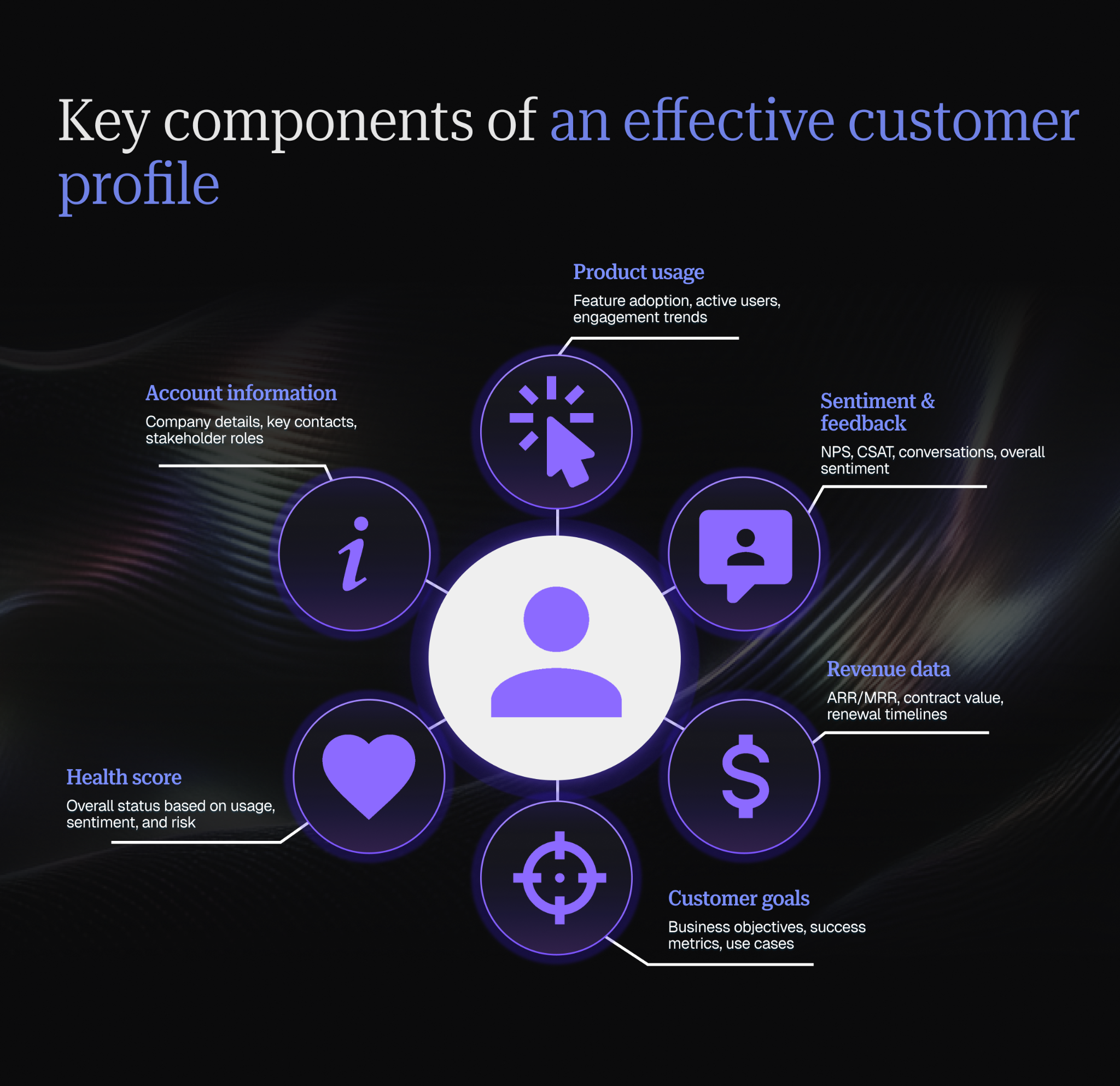
Basic customer and account information
Every customer profile starts with foundational details such as company information, key contacts, and stakeholder roles.
This includes who the decision-makers are, who uses the product daily, and who influences outcomes. Having this clarity ensures that communication is directed to the right people and that relationships are built across the account.
Product usage and behavioral data
Understanding how customers use your product is critical to identifying both value and risk.
This includes feature adoption, frequency of use, active users, and engagement trends over time. These signals show whether the customer is progressing, plateauing, or disengaging, and help guide conversations around adoption and growth.
Sentiment and satisfaction data
Customer sentiment adds an important layer of context that usage data alone cannot provide.
This can include NPS and CSAT scores, as well as signals from conversations such as emails, calls, and support interactions. Positive sentiment often indicates readiness for expansion, while negative sentiment highlights areas that need attention.
Revenue and account data
A strong customer profile also includes key commercial details such as ARR, MRR, contract value, and renewal timelines.
This information helps teams prioritize accounts, plan engagement strategies, and align expansion or renewal efforts with the customer’s lifecycle.
Customer goals and objectives
To deliver meaningful value, teams need to understand what the customer is trying to achieve.
This includes their business goals, success metrics, and desired outcomes. When these objectives are clearly documented, it becomes easier to align product usage with real-world impact and guide customers toward success.
Customer health score
The customer health score brings everything together into a single, high-level indicator.
It combines signals such as usage, sentiment, engagement, and risk factors to provide a quick view of the account’s overall status. This helps teams prioritize where to focus their efforts and take action before issues escalate or opportunities are missed.
To see how this translates into a team-wide view, customer health dashboards are a practical next step for turning individual scores into portfolio-level visibility.
How to build data-driven customer profiles
Step 1: Unify customer data across systems
The first step is bringing all relevant customer data into one place.
This includes data from your CRM, product analytics tools, support platforms, and communication channels. Each system holds valuable context, but on its own, it is incomplete.
By unifying these sources, you create a single, consistent view of the customer. This eliminates the need to switch between tools and ensures everyone on the team is working with the same information.
Step 2: Automate data collection and updates
Customer data should not rely on manual input to stay accurate.
Automating data collection through integrations, surveys, and AI analysis ensures that profiles are continuously updated in real time. For example, product usage can sync automatically, while sentiment can be captured through surveys or analyzed from conversations.
Automation reduces manual effort, improves accuracy, and ensures that customer profiles reflect what is happening now, not what happened weeks ago.
Step 3: Prioritize actionable data points
Not all data is equally useful.
Focus on the signals that directly impact retention, engagement, and expansion. This includes usage trends, sentiment changes, stakeholder activity, and business milestones.
Avoid overloading profiles with unnecessary information. The goal is to highlight what matters most so teams can quickly understand the account and take meaningful action.
Step 4: Customize profiles for your CS strategy
Customer profiles should reflect how your Customer Success team operates.
This means tailoring them to your business model, customer segments, and lifecycle stages. For example, enterprise accounts may require more strategic context and stakeholder mapping, while SMB accounts may focus more on usage and automation signals.
A well-designed profile aligns with your workflows, making it easier for teams to apply insights consistently and drive better outcomes.
Customer profile template
A well-structured customer profile brings together all the key information needed to understand, manage, and grow an account. Below is a practical template that Customer Success teams can use to standardize how they capture and use customer data.
Account overview
Basic information that provides context about the customer.
- Company name
- Industry
- Company size
- Region
Key stakeholders
Identify the people involved and their roles within the account.
- Decision-makers
- Champions
- End users
- Roles and responsibilities
Customer goals
Document what the customer is trying to achieve.
- Primary business objectives
- Success metrics (KPIs)
- Key use cases
Product usage
Understand how the customer is interacting with your product.
- Key features used
- Adoption level
- Active users
- Usage trends over time
Sentiment and feedback
Capture how the customer feels about your product and experience.
- NPS or CSAT score
- Recent feedback
- Support interactions
- Overall sentiment
Account and revenue details
Track commercial and lifecycle information.
- ARR or MRR
- Plan or tier
- Renewal date
- Contract value
Risk signals
Highlight early indicators of potential churn.
- Declining usage
- Low engagement
- Negative sentiment
- Open or unresolved issues
Expansion signals
Identify opportunities for growth within the account.
- Increased usage
- New teams or stakeholders involved
- Feature adoption growth
- Business expansion signals
Customer health score
Provide a high-level summary of account status.
- Overall health score
- Key drivers such as usage, sentiment, and engagement
Recommended actions
Turn insights into clear next steps.
- Next best action
- Follow-ups
- Expansion or support opportunities
This template helps ensure that customer profiles are not just a collection of data, but a structured and actionable view that drives better Customer Success outcomes.
How customer profiles improve Customer Success outcomes
Personalizing customer interactions at scale
Customer profiles make it possible to deliver such tailored experiences without increasing manual effort.
With full context on usage, goals, and engagement, teams can communicate in a way that feels relevant to each customer. Conversations are grounded in what the customer is actually doing and trying to achieve, rather than generic messaging.
This allows teams to scale personalization across large portfolios while maintaining quality and relevance.
Identifying churn risks early
Customer profiles help surface early warning signs before they become serious issues.
Signals such as declining product usage, reduced engagement, or negative sentiment can be identified quickly when all data is connected. Instead of reacting to churn after it happens, teams can step in early with targeted support.
This proactive approach gives Customer Success teams more control over retention outcomes.
Uncovering expansion opportunities
Expansion opportunities become much easier to identify when customer data is centralized and contextualized.
Trends such as increased feature adoption, growing usage, or new use cases can signal readiness for upsell or cross-sell. Profiles also highlight gaps where customers are not fully utilizing the product, creating opportunities to introduce additional value.
This shifts expansion from guesswork to a more structured, data-driven process.
Aligning cross-functional teams
Customer profiles create a shared understanding across teams.
Customer Success, Sales, and Product can all access the same up-to-date context, reducing misalignment and improving collaboration. Whether it’s preparing for a renewal, addressing a risk, or planning expansion, everyone is working from the same source of truth.
This alignment leads to more consistent customer experiences and better overall outcomes.
Best practices for maintaining customer profiles
Keep profiles dynamic and real-time
Customer profiles should reflect what is happening now, not what happened weeks ago.
IBM describes outdated data as data decay and notes that stale information can produce decisions that no longer reflect current circumstances.
Continuous updates from product usage, interactions, and customer feedback ensure that profiles stay relevant. This allows teams to act on current signals rather than outdated information, improving both speed and accuracy in decision-making.
Implement a conflict-resolution framework for disagreeing signals
Customer profiles become most useful when they help CSMs interpret conflicting signals rather than simply displaying them side by side. An account can show high product usage while sentiment is declining, or maintain a strong health score while key stakeholders stop responding to outreach.
When signals disagree, start by looking at recency, source, and context. A recent executive escalation may deserve more weight than a health score built partly from historical usage, while a temporary drop in activity may matter less if the customer is going through a known migration or reorganization.
Next, separate behavioral signals from relationship signals. Usage, feature adoption, and support volume show what customers are doing.
Sentiment, stakeholder engagement, survey responses, and CSM notes help explain how they feel about the relationship. Neither should automatically override the other.
The final step is to investigate the contradiction rather than averaging it away. High usage combined with worsening sentiment may indicate that the product is mission-critical but frustrating to use. A high health score combined with silence from a champion may point to stakeholder risk that the score has not yet captured.
Profiles should therefore make conflicting signals visible and give CSMs enough context to understand why they disagree, so the next action is based on the account’s real situation rather than a single headline metric.
Standardize data collection across teams
Consistency is key to making customer profiles reliable.
Establish clear guidelines for how data is captured across Customer Success, Sales, and Support. Whether it’s logging interactions, updating goals, or recording feedback, standardized inputs ensure that profiles are structured, comparable, and easy to use.
Without consistency, profiles become fragmented and less actionable.
Field-level ownership across CS, Sales, and Support
Customer profiles become unreliable when everyone can update them but no one is clearly responsible for keeping specific fields current. A simple way to prevent this is to assign ownership at the field level rather than treating profile maintenance as a shared responsibility.
For example, Sales might own contract details, buying committee information, and commercial terms captured during the deal.
Customer Success can own goals, stakeholder changes, health context, adoption status, and success-plan progress. Support can own recurring issue categories, escalation history, and service-related context.
The important part is making those responsibilities explicit. Each field should have a clear owner, an expected source of truth, and a defined update trigger, such as a renewal, stakeholder change, support escalation, or major account review.
This reduces duplicated updates and prevents teams from assuming someone else is maintaining the same information.
It also makes data-quality problems easier to resolve because there is a clear team responsible for correcting stale or conflicting profile data.
Designing profiles to survive stakeholder turnover
A customer profile should not depend too heavily on a single champion or point of contact. In B2B relationships, stakeholders change roles, leave the company, or disengage, and a profile built around one person can become outdated very quickly.
Gartner's 2025 survey of 632 B2B buyers found buying groups now range from five to 16 people across as many as four functions. It also found 74% of B2B buyer teams experience unhealthy conflict during the decision process.
Capture multiple contacts across the account and record the role each person plays in the relationship. That might include the executive sponsor, day-to-day champion, admin, technical owner, procurement contact, and key end users.
The profile should also reflect influence and engagement so the team can see which relationships are strong and where coverage is thin.
It also helps to define a simple handoff process for stakeholder changes. When a champion leaves, the profile should be updated with any known replacement, outstanding commitments, current goals, recent decisions, and important relationship history so the next contact can be engaged without restarting from scratch.
This makes stakeholder continuity part of profile design rather than something teams react to after a relationship gap has already appeared.
Use playbooks to guide data capture
Playbooks help make data capture repeatable and scalable.
By embedding data collection into key workflows such as onboarding, check-ins, and renewals, teams can ensure that important context is consistently recorded. This reduces reliance on individual habits and ensures that no critical information is missed.
Over time, this builds richer and more reliable customer profiles.
Use a profile design for multi-product accounts
A single account-level profile can become misleading when a customer uses several products or modules differently. Strong adoption in one product can lift the overall health score and hide the fact that another part of the account is barely being used or is becoming a renewal risk.
For multi-product customers, profiles should therefore separate product-level signals before rolling them up into an overall account view.
Track usage, feature adoption, support activity, sentiment, goals, and commercial value for each product line so CSMs can see where the relationship is healthy and where attention is needed.
This is particularly important when products renew separately or have different stakeholder groups. One module may have an active champion and strong adoption while another has lost its owner, stalled in implementation, or failed to demonstrate value.
The account-level profile should still provide a summary, but it should make those differences visible rather than averaging them away. That gives CSMs a more accurate view of both risk and expansion potential across the full customer relationship.
Leverage AI for deeper insights
AI can enhance customer profiles by analyzing both structured data and the large amount of unstructured information that would otherwise require manual review.
Natural language processing can extract sentiment, recurring themes, risks, goals, and product feedback from sources such as CSM notes, support tickets, emails, and call transcripts. This gives the profile a richer view of what the customer is saying, rather than relying only on fields like usage or contract value.
AI can also detect anomalies in customer behavior. A sudden drop in feature usage, an unusual increase in support activity, or a change in stakeholder engagement can be flagged automatically, helping teams spot meaningful shifts before they become obvious during a manual account review.
Predictive models can then combine these signals with historical patterns to estimate outcomes such as churn probability or expansion potential.
For example, the system might identify that an account showing strong adoption across several teams is approaching a good point for an expansion conversation, or that declining engagement combined with unresolved support issues is increasing renewal risk.
This turns the customer profile from a static record into a continuously interpreted view of the account that helps CSMs understand what is changing and decide what to do next.
Tools that help build and manage customer profiles
Customer success platforms
Customer success platforms act as the foundation for building and managing customer profiles.
They centralize customer data from multiple sources into a single view, making it easier to understand account context without switching between tools. These platforms also support workflows, health scoring, and account management, ensuring that profiles are not just informative but actionable.
Product analytics tools
Product analytics tools provide visibility into how customers are using your product.
They track feature adoption, engagement levels, and usage trends, which are critical inputs for any customer profile. These insights help teams understand whether customers are getting value and where there may be opportunities to improve adoption or drive expansion.
Feedback and survey tools
Feedback tools capture the customer’s voice, adding qualitative context to quantitative data.
Metrics like NPS and CSAT help gauge satisfaction, while open-ended feedback provides deeper insight into customer sentiment and expectations. This information is essential for understanding how customers feel, not just how they behave.
AI-powered insights tools
AI-powered tools help make sense of large volumes of customer data.
They identify patterns, surface risks, and highlight opportunities that may not be immediately obvious. This includes detecting changes in engagement, predicting churn risk, and recommending next best actions based on customer behavior.
AI turns raw data into insights that teams can act on quickly and confidently.
How Velaris supports customer profiles
Platforms like Velaris, a highly rated software on G2, bring these capabilities together into a single system designed for Customer Success teams.
Velaris creates a unified customer view by consolidating data from across your tech stack, eliminating silos and giving teams a complete understanding of each account. Its AI features, including Headlines, CallSense, and AI Topics, analyze customer interactions and surface key signals around sentiment, engagement, and potential risks or opportunities.
Customer profiles are continuously updated through integrations and automation, ensuring that data stays accurate and real-time. Health scoring provides a quick snapshot of account status, while Velaris Copilot offers contextual recommendations on what to do next.
This combination of unified data, AI-driven insights, and automation helps teams move from static profiles to dynamic, actionable customer intelligence.
Common mistakes to avoid when building customer profiles
Collecting too much irrelevant data
It’s easy to assume that more data equals better insights, but that’s not always true.
Overloading profiles with unnecessary information makes it harder to identify what actually matters. CSMs end up spending more time navigating data than acting on it.
Focus on signals that directly impact retention, engagement, and growth. A clear, focused profile is far more useful than a cluttered one.
Relying on static or outdated information
Customer profiles lose their value if they are not kept up to date.
Static data quickly becomes irrelevant as customer behavior, goals, and sentiment evolve. Decisions based on outdated information can lead to mistimed outreach or missed opportunities.
Profiles should be continuously updated through integrations, automation, and regular inputs from teams to ensure they reflect the current state of the customer.
Not aligning profiles with business outcomes
A customer profile should do more than describe the account. It should connect directly to outcomes.
If profiles are not tied to customer goals, success metrics, or business impact, they become informational rather than actionable. This makes it difficult to guide conversations or justify recommendations.
Aligning profiles with outcomes ensures that every insight can translate into meaningful action.
Failing to operationalize profile insights
Having a well-built customer profile is only useful if it drives action.
One of the most common mistakes is stopping at visibility without defining what to do next. Teams may have access to rich data but lack clear workflows or processes to act on it.
To avoid this, insights from customer profiles should be embedded into playbooks, workflows, and decision-making processes. This ensures that data consistently leads to action and measurable results.
Metrics to measure the effectiveness of customer profiles
Customer retention rate
Customer retention rate shows how well you are keeping customers over time.
If customer profiles are effective, teams should be able to identify risks earlier, engage more proactively, and prevent churn. The right renewal management software can work alongside customer profiles to automate renewal workflows and ensure no contract goes unnoticed.
Churn rate
Churn rate measures how many customers or how much revenue you are losing.
A decrease in churn suggests that teams are using customer profiles to detect issues early and take corrective action. It reflects how well profiles are supporting proactive Customer Success rather than reactive firefighting.
Expansion revenue
Expansion revenue tracks how much additional revenue is generated from existing customers.
Strong customer profiles make it easier to identify growth opportunities and time expansion conversations effectively. An increase in expansion revenue indicates that teams are successfully using profile data to drive account growth.
Customer satisfaction (NPS, CSAT)
Customer satisfaction metrics provide insight into how customers feel about their experience.
When profiles are used effectively, interactions become more relevant and timely, which can lead to higher NPS and CSAT scores. These metrics help validate whether personalization and proactive engagement are improving the customer experience.
Time to identify risks or opportunities
This measures how quickly teams can detect and act on important signals.
With well-structured customer profiles, teams should be able to identify risks and opportunities much faster, without needing to manually gather data. A reduction in response time shows that profiles are improving visibility and enabling quicker, more informed decision-making.
Conclusion
Customer profiles are the backbone of proactive Customer Success.
When teams have access to clear, unified, and real-time customer data, they can move from guesswork to confident decision-making. Every interaction becomes more relevant, every risk is identified earlier, and every opportunity is easier to act on.
Platforms like Velaris, a highly rated software on G2, help bring this to life by unifying customer data across systems and turning it into actionable insights. With AI features such as Headlines, CallSense, and AI Topics, teams can quickly understand what is happening across accounts.
Book a demo to see how Velaris helps teams unify customer data, surface insights, and take action faster.
Frequently Asked Questions

The Velaris Team
A (our) team with years of experience in Customer Success have come together to redefine CS with Velaris. One platform, limitless Success.





Velaris is an AI-native Customer Success Platform built for mid-market and enterprise B2B SaaS teams. From customer health scoring and churn prediction to onboarding automation, renewals, and expansion workflows, Velaris helps recurring revenue teams understand account health, reduce churn, and scale customer success with greater visibility and control.