We look forward to showing you Velaris, but first we'd like to know a little bit about you.


The Complete Guide to Customer Expansions: Strategies and Tools
Learn the importance of customer expansion, strategies like cross-selling and up-selling, and the role of technology in facilitating these efforts.
The Velaris Team
September 24, 2026
Customer expansion is the fastest way to grow revenue by increasing value from existing customers through upsells, cross-sells, and deeper product adoption.
As a Customer Success Manager, you’re often juggling a large portfolio of accounts, each with different goals, usage patterns, and levels of engagement. Expansion opportunities don’t always present themselves clearly. You spot them late, or worse, miss them entirely.
On top of that, expansion conversations can feel uncomfortable. Upsells risk coming across as sales-driven rather than value-driven, especially when there isn’t a clear link to the customer’s outcomes.
This is why customer expansion needs to be treated as a structured, repeatable process rather than a one-off opportunity. In this guide, we’ll break down how to identify expansion signals early, align recommendations with customer value, and build a scalable expansion motion that feels natural, not forced.
Key takeaways
- Customer expansion is the most efficient way to grow revenue by increasing value from existing customers rather than relying solely on new acquisition
- There are multiple expansion paths including upselling, cross-selling, usage growth, and expanding into new teams
- The best expansion opportunities are driven by clear signals such as product usage, customer sentiment, stakeholder engagement, and business growth
- Proactively demonstrating ROI and personalizing recommendations significantly increases the likelihood of expansion
What is customer expansion?
Customer expansion definition
Customer expansion is the process of increasing revenue from your existing customers by growing the value they get from your product.
It goes beyond simply retaining customers. Expansion focuses on deepening the relationship by helping customers adopt more features, solve additional use cases, or scale their usage over time.
This can happen through upselling higher-tier plans, cross-selling complementary products, or increasing usage through additional seats or consumption.
Customer expansion vs retention vs acquisition
Customer expansion is often discussed alongside retention and acquisition, but each plays a distinct role in growth.
Retention is about keeping customers and preventing churn. It ensures that the value you’ve already created is sustained over time.
Expansion is about increasing the value of those existing relationships. It builds on retention by helping customers grow, adopt more, and invest further.
Acquisition focuses on bringing in new customers or new logos. While important, it is typically more expensive and resource-intensive compared to expanding existing accounts. Research typically shows that the cost of acquiring a new customer can be five to twenty-five times more than retaining an existing one.
High-performing SaaS companies don’t treat these as separate motions. They build a system where retention creates the foundation, expansion drives growth, and acquisition adds new opportunities on top.
Types of customer expansion
Customer expansion can take several forms depending on how customers adopt and grow with your product. Understanding these different types helps Customer Success teams identify the right opportunities and approach them in a way that feels aligned with customer value.
Upselling
Upselling involves moving customers to higher-tier plans or introducing premium features that provide additional value.
This typically happens when a customer has outgrown their current plan or is ready to unlock more advanced capabilities. For example, a team using basic reporting might benefit from upgrading to a plan with advanced analytics or automation.
Effective upselling is not about pushing a higher price point. It’s about recognizing when a customer’s needs have evolved and offering a solution that helps them achieve better outcomes.
Cross-selling
Cross-selling focuses on introducing additional products, modules, or features that complement what the customer is already using.
This type of expansion works best when there is a clear connection between the customer’s current use case and the additional offering. For instance, a customer using a core platform might benefit from an add-on that improves collaboration, reporting, or integration with other tools.
The key to successful cross-selling is relevance. Recommendations should feel like a natural extension of the customer’s existing workflow rather than a separate or disconnected product.
Usage-based expansion
Usage-based expansion occurs as customers increase their consumption of the product. This can include adding more users, increasing data usage, or scaling activity within the platform.
Unlike upselling or cross-selling, this type of expansion often happens organically as the customer grows or sees more value in the product. For example, as more teams adopt the platform internally, the number of seats increases.
Customer Success teams can support this by encouraging broader adoption and ensuring customers are getting consistent value from their usage.
Expansion through new teams or departments
This is often referred to as the land-and-expand motion. A product may initially be adopted by a single team, but over time, other departments begin to see its value and adopt it as well.
For example, a tool initially used by Customer Success might expand into Sales, Support, or Operations. This type of expansion can significantly increase account value while strengthening the overall relationship.
To enable this, CSMs need to build multi-threaded relationships, understand cross-functional use cases, and demonstrate how the product can deliver value across the organization.
Key signals that indicate expansion opportunities
Customer expansion should never feel like guesswork. The strongest expansion opportunities are usually visible in the signals customers are already giving you through their behavior, engagement, and business context.
Recognizing these signals early allows CSMs to approach expansion conversations at the right time, with the right context, and in a way that feels aligned with customer value.
Product usage and adoption signals
One of the clearest indicators of expansion potential is how customers are using your product.
When usage is increasing or customers are adopting more features, it often means they are seeing value and integrating the product more deeply into their workflows. This creates a natural opportunity to introduce additional capabilities or scale usage further.
For example, consistent login activity, increased feature adoption, or more users joining the platform are strong signals that the customer is ready to expand.
Customer health and sentiment signals
Customer sentiment plays a critical role in expansion readiness.
Customers who are engaged, responsive, and expressing positive feedback are far more likely to consider expanding. Strong health scores, positive survey responses, and constructive conversations indicate trust and satisfaction.
Dedicated customer health dashboards make it easier to monitor these signals across your entire portfolio at a glance.
On the other hand, even if usage is high, negative sentiment can signal underlying issues that need to be addressed before any expansion conversation takes place.
Business growth signals
Expansion opportunities are often driven by changes within the customer’s business.
Signals such as hiring new team members, securing funding, entering new markets, or launching new initiatives suggest that the customer’s needs are evolving. These moments create opportunities to position your product as a solution that supports their growth.
Staying informed about these changes helps CSMs proactively identify where additional value can be delivered.
Stakeholder engagement signals
When more stakeholders start engaging with your product, it’s a strong indicator of expansion potential.
This could include new teams attending meetings, additional users joining the platform, or increased involvement from decision-makers. As more people see value in the product, the likelihood of expanding across departments increases.
Building relationships with multiple stakeholders also makes it easier to identify new use cases and align expansion with broader organizational goals.
Timing signals
Timing is often the difference between a successful expansion and a missed opportunity.
Certain moments in the customer lifecycle naturally lend themselves to expansion conversations. Renewal periods, successful onboarding milestones, and the completion of key projects are all ideal times to introduce growth opportunities.
Approaching expansion during these moments ensures the conversation feels timely and relevant, rather than forced or premature.
Proven strategies for customer expansion
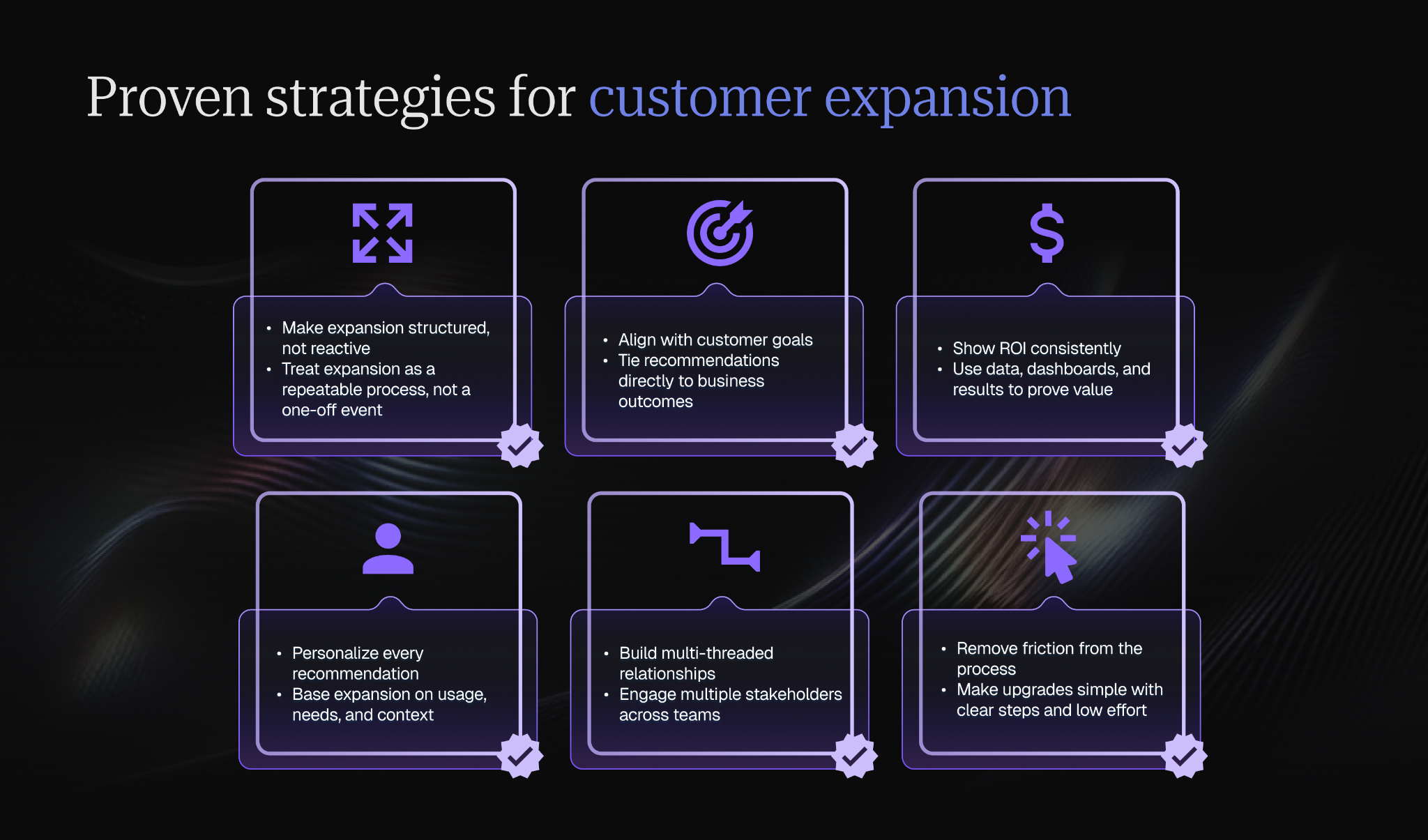
Customer expansion becomes much more effective when it’s approached as a structured process rather than a one-off opportunity. The most successful teams focus on delivering value first, then guiding customers toward growth in a way that feels natural and aligned with their goals.
Align with customer goals and outcomes
Expansion should always be tied to what the customer is trying to achieve, not just what your product can offer.
This starts with understanding their business objectives, whether that’s increasing efficiency, reducing costs, or driving revenue. When expansion is positioned as a way to help them reach those outcomes faster or more effectively, it shifts the conversation from selling to solving.
Customers are far more receptive when they see a clear connection between the recommendation and their own success.
Proactively demonstrate ROI
Customers are more likely to expand when they can clearly see the value your product is already delivering.
This means regularly sharing metrics, dashboards, and reports that highlight tangible outcomes such as time saved, revenue generated, or process improvements. The more visible the impact, the easier it becomes to justify further investment.
Instead of waiting for renewal conversations, make ROI an ongoing part of your engagement. This builds confidence and creates a natural foundation for expansion discussions.
For inspiration on how to structure these, exploring customer success dashboard examples can help teams build more compelling ROI views.
Personalize expansion recommendations
Generic upsell suggestions rarely work. Expansion opportunities need to be tailored to how each customer is using the product and where they can gain additional value.
Personalization often drops after the sale. Forrester found that while 92% of companies personalize marketing, only 54% apply personalization to customer engagement.
By analyzing usage patterns, engagement levels, and customer goals, you can identify specific gaps or opportunities. For example, if a customer is heavily using one feature but not another that could enhance their workflow, that becomes a relevant recommendation.
Personalization ensures that expansion feels helpful and timely rather than intrusive.
Build multi-threaded relationships
Expansion often requires buy-in from multiple stakeholders, not just a single point of contact.
Building relationships across different teams and roles within an organization helps you understand a broader range of needs and priorities. It also reduces risk, as you’re not dependent on one champion.
Engaging with decision-makers, end users, and leadership creates more opportunities to identify cross-functional use cases and expand the product’s footprint within the organization.
Reduce friction in the expansion process
Even when customers see value, a complicated expansion process can slow or prevent growth.
Making it easy to upgrade, add users, or adopt new features is critical. This can include streamlined approvals, clear pricing structures, and offering trials or pilot programs to demonstrate value before commitment.
The goal is to remove any barriers that make expansion feel like a heavy decision. When the process is simple and aligned with customer needs, growth becomes a natural next step rather than a forced conversation.
Common challenges in customer expansion
Even with a strong product and engaged customers, expansion doesn’t always happen naturally. Many teams struggle not because opportunities don’t exist, but because they’re hard to identify, position, or execute at the right time.
Understanding these challenges is the first step toward building a more predictable expansion motion.
Lack of visibility into expansion signals
One of the biggest barriers to expansion is not knowing where to look.
Customer data is often spread across multiple tools, making it difficult to connect signals like product usage, sentiment, and engagement. As a result, expansion opportunities either go unnoticed or are identified too late.
Without clear visibility, CSMs are forced to rely on intuition rather than data, which makes expansion inconsistent and reactive.
Accounts being disguised as expansion-ready
Not every account showing strong usage is ready for an expansion conversation. An account may be adopting more features or adding users while still carrying unresolved churn risk, serious support escalations, poor stakeholder sentiment, or uncertainty around renewal.
Before progressing an expansion opportunity, check both growth signals and stability signals. Strong usage growth, seat pressure, and broader adoption might suggest readiness, but those indicators should be weighed against recent health-score declines, open escalations, executive dissatisfaction, or unresolved implementation issues.
If the stability signals are weak, pause the expansion motion and focus on repairing the relationship first. Trying to sell more into a fragile account can make the conversation feel mistimed and may damage trust at exactly the point when retention needs attention.
The decision should also be documented rather than left in a CSM’s head. Record why expansion was deferred, which risks need to be resolved, who owns those actions, and what conditions would make the account eligible for expansion again.
This creates a clear distinction between “high potential” and “ready now,” helping teams avoid over-expanding accounts that still need to stabilize.
Customers not understanding full product value
Customers can only expand if they see value beyond their current usage.
In many cases, customers are not fully aware of all the capabilities your product offers or how those capabilities could help them achieve more. This leads to underutilization and missed opportunities for growth.
If the value is not clearly communicated and demonstrated, expansion conversations can feel premature or unnecessary from the customer’s perspective.
Champion leaving mid-cycle
An expansion opportunity can lose momentum quickly when the stakeholder driving it leaves before the deal is closed. The commercial need may still exist, but the internal advocate who understood the value, coordinated stakeholders, and helped build the case is suddenly gone.
Stakeholder turnover can materially change the commercial outlook of an account. Sturdy found that 65% of accounts experiencing an executive change churned within 12 months, while teams acting within 48 hours saw a 33% higher likelihood of renewal.
The first step is to preserve the context of the opportunity. Capture what problem the expansion was meant to solve, which products or seats were being discussed, who else was involved, what objections had already been addressed, and how far the conversation had progressed.
Next, identify whether someone has inherited the champion’s responsibilities or whether the account now needs a new sponsor entirely. If possible, use existing relationships to secure an introduction rather than restarting the conversation cold.
The expansion case may also need to be rebuilt. A new stakeholder may have different priorities, so revisit the business outcome and value already demonstrated rather than assuming the previous pitch still applies.
Finally, widen stakeholder coverage before pushing the deal forward again. An expansion motion that depends on one person is fragile. Bringing in additional users, managers, executives, or procurement contacts makes the opportunity more resilient if another stakeholder changes mid-cycle.
Resistance to change or added complexity
Expansion often introduces change, whether it’s new features, workflows, or processes.
Customers may hesitate if they feel that adopting additional capabilities will require significant effort or disrupt their current operations. Even if the long-term benefits are clear, the perceived short-term complexity can act as a barrier.
Reducing this resistance requires clear guidance, support, and a smooth path to adoption.
What happens to an expansion motion when the champion leaves mid-cycle
An expansion opportunity can lose momentum quickly when the stakeholder driving it leaves before the deal is closed. The commercial need may still exist, but the internal advocate who understood the value, coordinated stakeholders, and helped build the case is suddenly gone.
The first step is to preserve the context of the opportunity. Capture what problem the expansion was meant to solve, which products or seats were being discussed, who else was involved, what objections had already been addressed, and how far the conversation had progressed.
Next, identify whether someone has inherited the champion’s responsibilities or whether the account now needs a new sponsor entirely. If possible, use existing relationships to secure an introduction rather than restarting the conversation cold.
The expansion case may also need to be rebuilt. A new stakeholder may have different priorities, so revisit the business outcome and value already demonstrated rather than assuming the previous pitch still applies.
Finally, widen stakeholder coverage before pushing the deal forward again. An expansion motion that depends on one person is fragile. Bringing in additional users, managers, executives, or procurement contacts makes the opportunity more resilient if another stakeholder changes mid-cycle.
Disguised expansion-ready accounts
Not every account showing strong usage is ready for an expansion conversation. An account may be adopting more features or adding users while still carrying unresolved churn risk, serious support escalations, poor stakeholder sentiment, or uncertainty around renewal.
Before progressing an expansion opportunity, check both growth signals and stability signals. Strong usage growth, seat pressure, and broader adoption might suggest readiness, but those indicators should be weighed against recent health-score declines, open escalations, executive dissatisfaction, or unresolved implementation issues.
If the stability signals are weak, pause the expansion motion and focus on repairing the relationship first. Trying to sell more into a fragile account can make the conversation feel mistimed and may damage trust at exactly the point when retention needs attention.
The decision should also be documented rather than left in a CSM’s head. Record why expansion was deferred, which risks need to be resolved, who owns those actions, and what conditions would make the account eligible for expansion again.
This creates a clear distinction between “high potential” and “ready now,” helping teams avoid over-expanding accounts that still need to stabilize.
Misaligned pricing and packaging
Pricing plays a critical role in expansion decisions.
If pricing does not clearly reflect the value being delivered, or if packaging feels rigid or confusing, customers may be reluctant to expand. This is especially true when the cost increase is not directly tied to a visible outcome.
Well-structured pricing and packaging should make it easy for customers to understand what they’re getting and why it’s worth the investment.
Poor timing of expansion conversations
Timing can make or break an expansion opportunity.
Approaching customers too early, before they’ve experienced enough value, can lead to resistance. Waiting too long can result in missed opportunities, especially if the customer has already plateaued or disengaged.
The most effective expansion conversations happen at the right moments, such as after a successful milestone, during periods of high engagement, or leading into renewal discussions.
Who owns expansion: CS, Sales, or both?
There is no single right ownership model for customer expansion. The best structure depends on how complex the sale is, how much commercial responsibility sits with Customer Success, and whether expansion feels more like helping an existing customer realize more value or closing a new deal.
What matters most is removing ambiguity. Expansion opportunities are easy to lose when CS assumes Sales will take over, Sales assumes the CSM is still nurturing the account, and nobody clearly owns the next step.
The CSM-led expansion model
In a CSM-led model, Customer Success owns most or all of the expansion motion. The CSM identifies the opportunity through usage, customer goals, stakeholder conversations, or unmet needs, develops the business case with the customer, and may also handle the commercial conversation.
This works particularly well when expansions are relatively straightforward, such as adding seats, upgrading a plan, or extending an existing product to another team. The CSM already understands the account and can connect the expansion directly to the value the customer is receiving.
The tradeoff is that commercial responsibility can distract CSMs from adoption, retention, and strategic account work, particularly if expansion deals involve complex procurement or negotiation.
The AM-led expansion model
In an Account Manager or Sales-led model, the CSM identifies and nurtures expansion potential but hands qualified opportunities to someone whose primary responsibility is closing commercial deals.
The CSM remains involved because they hold the customer context and relationship, while the AM takes responsibility for pricing, negotiation, procurement, forecasting, and closing.
This model is often better suited to large or complex expansions, particularly when additional products, significant contract changes, or multiple decision-makers are involved.
Split ownership by deal size or complexity
Many teams use a hybrid model rather than choosing one owner for every expansion.
A CSM might close simple seat increases or plan upgrades below a defined threshold, while larger cross-sells or contract expansions are passed to Sales or Account Management. The trigger can be based on deal value, product complexity, procurement requirements, or the number of stakeholders involved.
Whatever threshold you choose, document it clearly so everyone knows when ownership changes.
Build a clear CS-to-Sales handoff
A handoff should transfer more than the name of an interested customer. Sales needs to understand why the opportunity exists, what value the customer has already achieved, which additional need has emerged, who supports the expansion internally, and whether any risks could derail the deal.
Define when an opportunity becomes qualified, who creates it in the CRM, when commercial ownership transfers, and what role the CSM continues to play after the handoff.
RevOps can support this by keeping expansion opportunities, account health, product usage, renewal timing, and pipeline stages visible across both CS and Sales systems. That prevents opportunities from disappearing into separate workflows or conflicting forecasts.
Align incentives with the ownership model
Compensation should reinforce the behavior you expect from each team. If CSMs are expected to identify expansion but receive no recognition for doing so, opportunities may be deprioritized. If they carry aggressive sales quotas, however, customer conversations can become overly commercial.
Teams might compensate CSMs for sourced or influenced expansion while paying Account Managers on closed revenue, or give CSMs direct expansion targets where they own the entire motion.
The goal is to make incentives match responsibility. Whoever owns identification, qualification, and closing should understand exactly what success looks like and how their contribution is measured.
How to build a customer expansion playbook
Customer expansion becomes predictable when it’s supported by a clear, repeatable playbook. Instead of relying on individual intuition, teams can standardize how they identify opportunities, engage customers, and drive growth across the portfolio.
A strong playbook ensures consistency, improves collaboration, and makes expansion scalable.
Step 1: Define expansion signals
Start by identifying the signals that indicate a customer is ready to expand.
These signals should go beyond revenue and include a combination of product usage, engagement, and business context. Common indicators include increased feature adoption, high product usage, positive sentiment, or new stakeholders getting involved.
The goal is to create a clear set of criteria that helps CSMs recognize expansion opportunities early rather than relying on guesswork.
Step 2: Segment accounts by expansion potential
Not all customers are equally likely to expand, so it’s important to prioritize.
Segment accounts based on their likelihood to grow using factors such as:
- Product adoption levels
- Customer health and sentiment
- Business growth signals
- Current account value
This allows teams to focus their efforts where they will have the most impact, ensuring high-potential accounts receive the right level of attention.
Step 3: Create expansion workflows
Once opportunities are identified, define how they should be handled.
Expansion workflows should outline the steps CSMs take from identifying a signal to closing the expansion. This can include internal reviews, customer conversations, value demonstration, and follow-ups.
Having a structured workflow ensures that opportunities are acted on consistently and don’t fall through the cracks.
Step 4: Align CS and sales teams
Expansion often sits at the intersection of Customer Success and Sales, which makes alignment critical.
Clearly define ownership, responsibilities, and handoff points between teams. For example, CSMs may identify and qualify opportunities, while Account Executives handle pricing and closing.
Strong alignment ensures a smooth customer experience and prevents internal friction that can delay or derail expansion efforts.
Step 5: Track expansion metrics and iterate
A playbook should evolve based on performance.
Track key metrics such as expansion revenue, conversion rates, and time to close. Analyzing these metrics helps identify what’s working and where improvements are needed.
Regularly refining your playbook based on real outcomes ensures that your expansion strategy becomes more effective over time, rather than remaining static.
Sequencing expansion conversations across a full portfolio
Even when several accounts look expansion-ready, a CSM rarely has time to pursue all of them at once. With a portfolio of 40 or more customers, the question becomes which opportunities deserve a conversation now and which can wait.
Start by ranking accounts using both expansion potential and timing. An account with strong usage growth, unused budget, multiple active teams, and an upcoming planning cycle may deserve attention ahead of an equally healthy customer whose contract or budget window is still six months away.
Then factor in the likely value and effort of each opportunity. A straightforward seat increase that can be progressed in one conversation may be worth prioritizing alongside a larger cross-sell that requires multiple stakeholders, procurement, and a longer sales cycle.
This prevents the portfolio from becoming dominated only by the biggest theoretical opportunities.
It also helps to create a fixed quarterly expansion capacity. If a CSM can realistically run five meaningful expansion motions at once, identify the five highest-priority accounts and place the next group into a monitored queue rather than treating every positive signal as an immediate task.
Revisit that priority list regularly as usage, health, stakeholder engagement, budget timing, and renewal dates change. The goal is not to pursue every possible expansion, but to spend limited CSM time on the accounts where the combination of readiness, timing, and commercial upside is strongest.
Building an expansion scoring model to prioritize accounts
Not every healthy customer is equally ready to expand. A simple expansion scoring model helps CSMs rank accounts based on the signals that make additional revenue more likely, instead of relying on instinct or reviewing every account manually.
Start by combining a few weighted inputs into one expansion-readiness score. These might include overall health, product usage growth, breadth of feature adoption, account tenure, number of active teams, and recent stakeholder engagement.
For example, strong health and rising usage might carry more weight than tenure alone because they indicate both satisfaction and increasing reliance on the product.
Next, define thresholds for different actions. A high-scoring account might trigger a CSM review and personalized expansion conversation, while a medium score could trigger an automated educational campaign or product recommendation designed to build readiness.
The model also needs guardrails to avoid false positives. A customer can be highly engaged but still unable to expand because of a fixed contract, budget freeze, procurement restriction, or strategic decision to consolidate vendors.
These constraints should be captured separately so they can suppress or qualify the score.
Finally, revisit the model regularly. Compare the accounts it flags with actual expansion opportunities and win rates each quarter, then adjust the weighting where the model consistently over- or under-predicts readiness.
Tools that enable customer expansion
Customer expansion becomes significantly easier when supported by the right technology. As portfolios grow, it’s no longer feasible to track signals, manage workflows, and identify opportunities manually.
The right tools help centralize data, surface insights, and ensure that expansion opportunities are acted on consistently.
Customer success platforms
Customer success platforms act as the foundation for expansion by bringing all customer data and workflows into one place.
They provide a unified view of accounts, combining product usage, communication history, and account data. This makes it easier for CSMs to understand the full context of each customer and identify where additional value can be delivered.
By organizing workflows such as check-ins, success plans, and renewals, these platforms ensure that expansion opportunities are not missed.
If you're still evaluating platforms, our roundup of the top customer success software tools covers the leading options and what to look for.
Product analytics tools
Product analytics tools provide visibility into how customers are using your product.
They help teams track feature adoption, engagement levels, and usage trends, which are key indicators of expansion potential. For example, increased usage or adoption of advanced features often signals readiness for an upgrade or additional investment.
These insights allow teams to move beyond assumptions and base expansion decisions on actual behavior.
Automation tools
Automation plays a critical role in scaling expansion efforts across large customer portfolios.
Instead of manually tracking every account, automation tools can trigger actions based on specific signals, such as increased usage, milestone completion, or approaching renewals. This ensures timely and consistent engagement without adding manual workload.
Automation also helps maintain momentum by ensuring follow-ups, reminders, and outreach happen at the right time.
AI-powered insights
AI takes expansion to the next level by identifying patterns and opportunities that may not be immediately obvious.
By analyzing large volumes of customer data, AI can surface signals such as rising engagement, positive sentiment, or emerging use cases. It can also help prioritize which accounts are most likely to expand, allowing teams to focus their efforts more effectively.
This shifts expansion from reactive to predictive, enabling teams to act earlier and with more confidence.
How Velaris supports customer expansion
Platforms like Velaris, a highly rated software on G2, bring these capabilities together into a single, unified system designed specifically for post-sales teams.
Velaris consolidates data from across your tech stack, giving you a complete view of each customer without needing to switch between tools. Its AI capabilities, including Headlines, CallSense, and Trending Topics, analyze customer interactions and surface key signals related to sentiment, engagement, and potential opportunities.
These insights make it easier to identify expansion opportunities early and understand the context behind them. At the same time, Velaris Bridge enables teams to automate workflows, ensuring that actions such as follow-ups, alerts, and expansion processes are executed consistently.
By combining unified data, AI-driven insights, and workflow automation, Velaris helps Customer Success teams move from reactive expansion to a structured, scalable growth strategy.
Sequencing expansion conversations across a full portfolio
Even when several accounts look expansion-ready, a CSM rarely has time to pursue all of them at once. With a portfolio of 40 or more customers, the question becomes which opportunities deserve a conversation now and which can wait.
Start by ranking accounts using both expansion potential and timing. An account with strong usage growth, unused budget, multiple active teams, and an upcoming planning cycle may deserve attention ahead of an equally healthy customer whose contract or budget window is still six months away.
Then factor in the likely value and effort of each opportunity. A straightforward seat increase that can be progressed in one conversation may be worth prioritizing alongside a larger cross-sell that requires multiple stakeholders, procurement, and a longer sales cycle. This prevents the portfolio from becoming dominated only by the biggest theoretical opportunities.
It also helps to create a fixed quarterly expansion capacity. If a CSM can realistically run five meaningful expansion motions at once, identify the five highest-priority accounts and place the next group into a monitored queue rather than treating every positive signal as an immediate task.
Revisit that priority list regularly as usage, health, stakeholder engagement, budget timing, and renewal dates change.
Building an expansion scoring model to prioritize accounts
Not every healthy customer is equally ready to expand. A simple expansion scoring model helps CSMs rank accounts based on the signals that make additional revenue more likely, instead of relying on instinct or reviewing every account manually.
Start by combining a few weighted inputs into one expansion-readiness score. These might include overall health, product usage growth, breadth of feature adoption, account tenure, number of active teams, and recent stakeholder engagement.
For example, strong health and rising usage might carry more weight than tenure alone because they indicate both satisfaction and increasing reliance on the product.
Next, define thresholds for different actions. A high-scoring account might trigger a CSM review and personalized expansion conversation, while a medium score could trigger an automated educational campaign or product recommendation designed to build readiness.
The model also needs guardrails to avoid false positives. A customer can be highly engaged but still unable to expand because of a fixed contract, budget freeze, procurement restriction, or strategic decision to consolidate vendors. These constraints should be captured separately so they can suppress or qualify the score.
Finally, revisit the model regularly. Compare the accounts it flags with actual expansion opportunities and win rates each quarter, then adjust the weighting where the model consistently over- or under-predicts readiness.
Who owns expansion: CS, Sales, or both?
There is no single right ownership model for customer expansion. The best structure depends on how complex the sale is, how much commercial responsibility sits with Customer Success, and whether expansion feels more like helping an existing customer realize more value or closing a new deal.
What matters most is removing ambiguity. Expansion opportunities are easy to lose when CS assumes Sales will take over, Sales assumes the CSM is still nurturing the account, and nobody clearly owns the next step.
The CSM-led expansion model
In a CSM-led model, Customer Success owns most or all of the expansion motion. The CSM identifies the opportunity through usage, customer goals, stakeholder conversations, or unmet needs, develops the business case with the customer, and may also handle the commercial conversation.
This works particularly well when expansions are relatively straightforward, such as adding seats, upgrading a plan, or extending an existing product to another team. The CSM already understands the account and can connect the expansion directly to the value the customer is receiving.
The tradeoff is that commercial responsibility can distract CSMs from adoption, retention, and strategic account work, particularly if expansion deals involve complex procurement or negotiation.
The AM-led expansion model
In an Account Manager or Sales-led model, the CSM identifies and nurtures expansion potential but hands qualified opportunities to someone whose primary responsibility is closing commercial deals.
The CSM remains involved because they hold the customer context and relationship, while the AM takes responsibility for pricing, negotiation, procurement, forecasting, and closing.
This model is often better suited to large or complex expansions, particularly when additional products, significant contract changes, or multiple decision-makers are involved.
Split ownership by deal size or complexity
Many teams use a hybrid model rather than choosing one owner for every expansion.
A CSM might close simple seat increases or plan upgrades below a defined threshold, while larger cross-sells or contract expansions are passed to Sales or Account Management. The trigger can be based on deal value, product complexity, procurement requirements, or the number of stakeholders involved.
Whatever threshold you choose, document it clearly so everyone knows when ownership changes.
Build a clear CS-to-Sales handoff
A handoff should transfer more than the name of an interested customer. Sales needs to understand why the opportunity exists, what value the customer has already achieved, which additional need has emerged, who supports the expansion internally, and whether any risks could derail the deal.
Define when an opportunity becomes qualified, who creates it in the CRM, when commercial ownership transfers, and what role the CSM continues to play after the handoff.
RevOps can support this by keeping expansion opportunities, account health, product usage, renewal timing, and pipeline stages visible across both CS and Sales systems. That prevents opportunities from disappearing into separate workflows or conflicting forecasts.
Align incentives with the ownership model
Compensation should reinforce the behavior you expect from each team. If CSMs are expected to identify expansion but receive no recognition for doing so, opportunities may be deprioritized.
If they carry aggressive sales quotas, however, customer conversations can become overly commercial.
Teams might compensate CSMs for sourced or influenced expansion while paying Account Managers on closed revenue, or give CSMs direct expansion targets where they own the entire motion.
The goal is to make incentives match responsibility. Whoever owns identification, qualification, and closing should understand exactly what success looks like and how their contribution is measured.
Metrics to track customer expansion success
Customer expansion efforts need to be measured consistently to understand what’s working and where improvements are needed. Tracking the right metrics helps teams move beyond intuition and build a more predictable, data-driven expansion strategy.
Net revenue retention (NRR)
Net revenue retention (NRR) measures how much revenue you retain and grow from your existing customers over time, including expansion, contraction, and churn.
It’s one of the most important indicators of expansion success. ChartMogul's analysis of more than 2,500 SaaS companies found that among businesses with NRR of at least 100%, expansion accounts for more than half of revenue growth.
When NRR is above 100%, it means expansion revenue is more than offsetting any losses, allowing your existing customer base to grow on its own.
Expansion revenue
Expansion revenue tracks the additional revenue generated from existing customers through upsells, cross-sells, or increased usage.
This metric provides a direct view of how much growth is coming from your current customer base. Monitoring it over time helps teams understand whether their expansion strategies are effective and where the biggest opportunities lie.
Customer lifetime value (LTV)
Customer lifetime value (LTV) represents the total revenue a customer generates throughout their relationship with your business.
Expansion plays a key role in increasing LTV by growing the value of each account over time. Tracking LTV helps ensure that expansion efforts are contributing to long-term profitability, not just short-term gains.
Product adoption metrics
Product adoption metrics provide insight into how deeply customers are using your product.
This can include feature adoption, frequency of use, or the number of active users. High adoption often signals strong product-market fit and a higher likelihood of expansion, while low adoption can indicate risk.
Monitoring these metrics helps teams identify both expansion opportunities and areas where additional support may be needed.
Expansion rate by segment
Expansion rate by segment measures how different groups of customers are growing over time.
By analyzing expansion across segments such as SMB, mid-market, and enterprise, teams can identify which segments are performing well and which require adjustments in strategy.
This level of visibility allows for more targeted improvements, ensuring that expansion efforts are aligned with the unique needs of each customer segment.
Conclusion
The most effective teams don’t rely on chance or timing to drive growth. They build structured systems that help them identify opportunities early, align recommendations with customer outcomes, and act with consistency across their portfolio.
When expansion is systemized, it becomes predictable. Teams gain better visibility into customer signals, reduce missed opportunities, and scale their efforts without compromising on personalization. Velaris, a highly rated software on G2, can make this process feel easy.
Book a demo to see how Velaris helps teams identify expansion opportunities earlier, automate workflows, and scale customer growth.
Frequently Asked Questions
How do you know when a customer is ready for expansion?
Customers are typically ready for expansion when they are consistently using the product, achieving their initial goals, and showing signs of growth. This can include increased usage, positive sentiment, or new teams getting involved. The key is to look for signals that indicate they are getting value and are ready to build on it.
Who should own customer expansion: Customer Success or Sales?
Customer expansion is usually a shared responsibility. Customer Success teams identify opportunities and build the relationship, while Sales teams often handle commercial conversations such as pricing and contracts. Clear alignment between both teams is essential to ensure a smooth customer experience.
How do you make expansion conversations feel natural?
Expansion conversations feel more natural when they are tied directly to customer outcomes. Instead of leading with features or pricing, focus on the customer’s goals and show how additional capabilities can help them achieve better results. Timing and context play a big role in making these conversations feel relevant rather than forced.
What is the biggest mistake teams make with customer expansion?
One of the most common mistakes is approaching expansion too early or without clear value. If customers have not fully realized the benefits of the product, they are unlikely to invest further. Ensuring strong adoption and demonstrated ROI before initiating expansion discussions is critical.
How can you scale customer expansion across a large portfolio?
Scaling expansion requires a combination of segmentation, automation, and clear workflows. By identifying high-potential accounts, standardizing processes, and using tools to surface signals and trigger actions, teams can manage expansion across many customers without losing focus.
How do you prioritize which accounts to focus on for expansion?
Prioritization should be based on a combination of product usage, customer health, growth potential, and business context. Accounts that are highly engaged and aligned with your product’s value are typically the best candidates for expansion.
How often should you review expansion opportunities?
Expansion opportunities should be reviewed regularly as part of ongoing account management, not just during renewal periods. Monthly or quarterly reviews help ensure that signals are identified early and acted on at the right time.

The Velaris Team
A (our) team with years of experience in Customer Success have come together to redefine CS with Velaris. One platform, limitless Success.





Velaris is an AI-native Customer Success Platform built for mid-market and enterprise B2B SaaS teams. From customer health scoring and churn prediction to onboarding automation, renewals, and expansion workflows, Velaris helps recurring revenue teams understand account health, reduce churn, and scale customer success with greater visibility and control.