We look forward to showing you Velaris, but first we'd like to know a little bit about you.


Why Customer Lifetime Value is Higher for Organizations that Use Customer Data Effectively
Learn how to maximize customer lifetime value with data-driven CS strategies.
The Velaris Team
January 28, 2026
Being data-led in customer success means consistently using customer usage, engagement, sentiment, and feedback data to guide daily decisions. This in turn drastically improves Customer Lifetime Value (CLV), which is the total revenue a business expects to earn from a customer over the entire duration of the relationship.
But while you’re trying to be a data-led team, you have probably felt overwhelmed by the sheer amount of customer data at your disposal. There's constant pressure to demonstrate ROI and enhance Customer Lifetime Value (CLTV), but it’s often easier said than done. The frustration of dealing with siloed data, inefficient processes, and the inability to anticipate customer needs can be disheartening.
In this blog, we'll not only delve into why Customer Lifetime Value is higher for data-led CS teams, but we’ll also share strategies for leveraging data effectively.
Key takeaways
- Customer Lifetime Value (CLV) increases when customer success teams consistently use usage, engagement, sentiment, and feedback data to guide decisions, not intuition alone.
- Data-led organizations gain deeper visibility into customer journeys, enabling earlier intervention, better prioritisation, and reduced churn.
- Proactive customer management, powered by health signals and leading indicators, helps teams address risk before it impacts renewals or expansion.
- Personalised engagement driven by customer data strengthens relationships, improves retention, and directly contributes to higher long-term value.
- Platforms like Velaris help teams operationalise a data-led approach by unifying customer data, surfacing insights with AI features like Trending Topics, and enabling proactive, scalable customer success that supports sustained CLV growth.
What is Customer Lifetime Value (CLV)?
Customer Lifetime Value (CLV) is a metric that quantifies the total revenue a business can expect from a single customer over their entire relationship. It reflects not just what a customer pays today, but the long-term value they generate through renewals, expansions, and continued engagement over time.
In customer success, CLV is used to understand which customers drive the most sustainable growth and where teams should focus their efforts.
A higher CLV typically indicates strong product adoption, positive customer experience, and effective retention strategies, while a declining CLV can signal churn risk, misalignment, or unrealized value.
Why Customer Lifetime Value is higher for data-led organizations
Being a data-led customer success team enables faster, more informed decisions, proactive risk management, and personalised engagement that directly improves retention and increases customer lifetime value.
Here is an in-depth look at why customer lifetime value is higher for data-led CS teams:
- Enhanced customer insights
Being data-led allows your team to gain a deeper understanding of customer journeys and pain points.
Data provides a clear picture of how customers interact with your product, where they find value, and where they encounter obstacles. By analyzing these patterns, you can make informed decisions that enhance the customer experience.
For example, if data reveals that a significant number of users struggle with a specific feature, you can prioritize improvements to that area, ultimately increasing satisfaction and reducing churn.
With Customer Success software like Velaris, which is a highly rated platform on G2, you can integrate data from various sources, giving you a holistic view of the customer journey. Additionally, AI-powered analysis, like Velaris’s Trending Topics, automatically surfaces recurring themes across data sources. This unified data helps identify trends and opportunities that might otherwise go unnoticed.
- Proactive customer management
Data-driven insights enable you to anticipate customer needs and address issues before they escalate. For instance, monitoring customer health scores can alert you to potential problems, allowing you to take proactive steps to retain at-risk customers.
This proactive approach not only prevents churn but also builds trust and loyalty, as customers feel valued and understood.
You can use platforms like Velaris to track these indicators, stay ahead of potential issues, and maintain strong customer relationships.
- Personalized customer engagement
Tailoring interactions based on customer data significantly improves satisfaction and loyalty. When you understand a customer's specific needs and preferences, you can provide personalized recommendations and solutions that resonate with them.
This personalized engagement makes customers feel seen and appreciated, which can lead to higher retention and increased CLTV.
Velaris enables seamless communication and collaboration with customers, ensuring that all interactions are consistent and personalized. This centralized approach enhances the customer experience and fosters stronger relationships.
With a clear understanding of the benefits of being a data-led CS team, it's evident how valuable data can be in enhancing customer insights, proactive management, and personalized engagement. But knowing the benefits is just the first step. How can you put this knowledge into action? Let's explore some practical strategies for leveraging data in customer success to maximize these benefits and drive better outcomes for your customers and your business.
Strategies for leveraging data in customer success
Leveraging data effectively isn't just about collecting information; it's about using it strategically to drive better outcomes. In this section, we'll dive into practical strategies for harnessing data in customer success. By implementing these approaches, you can streamline processes, make informed decisions, and ultimately boost your CLTV.
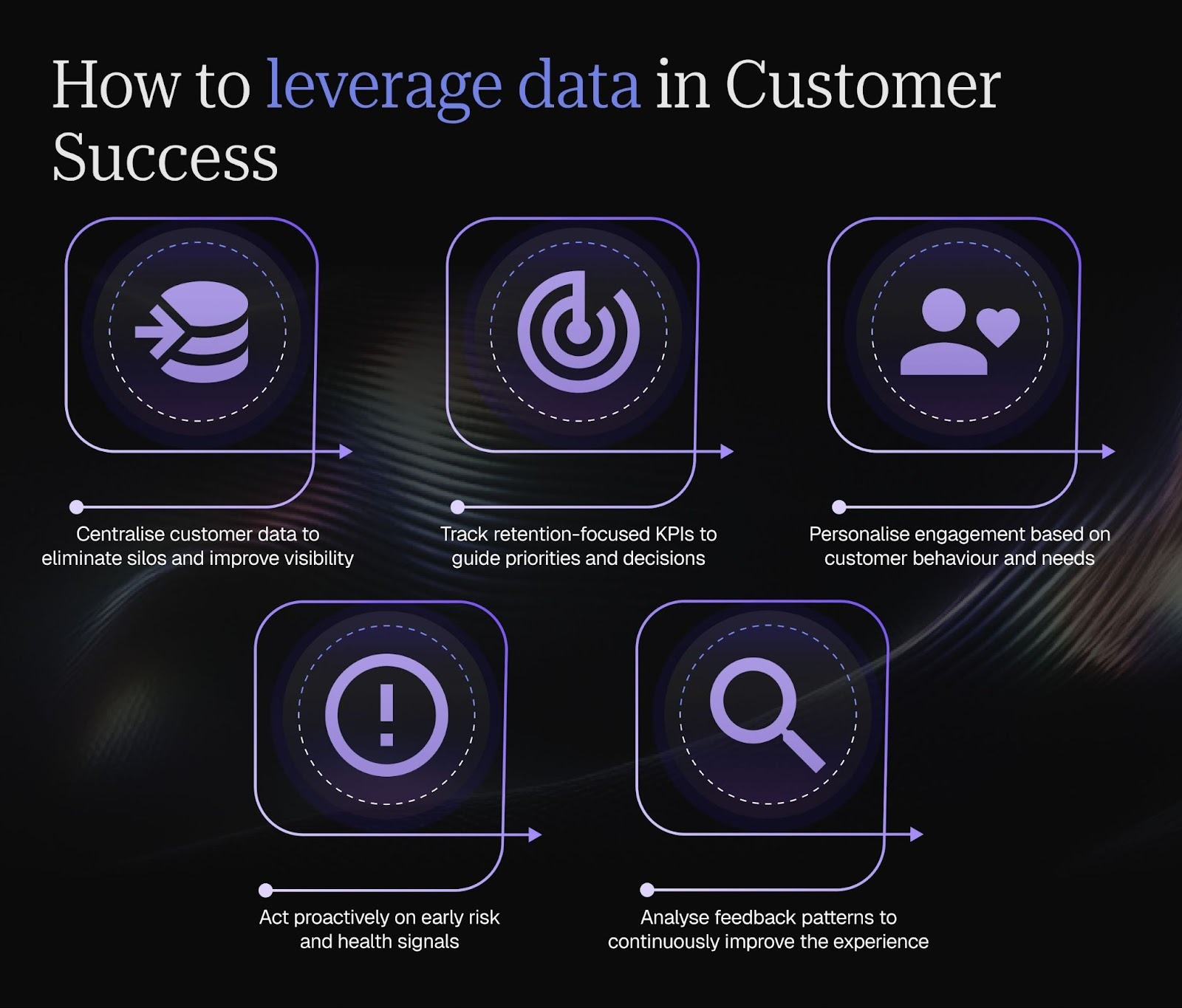
- Data collection and integration
To get started, it's essential to implement systems that gather and unify data from multiple sources. Having all your customer information in one place allows for better analysis and more accurate insights.
You can use platforms like Velaris to unite siloed data for better insights. By integrating with your CRM systems and any other platforms that gather information, Velaris is able to bring all your customer data to one place.
Plus, with its Custom Objects feature, you’ll be able to create and manage custom data points, ensuring you capture the most relevant information for your needs.
- Setting and tracking KPIs
Identifying and tracking key performance indicators (KPIs) that align with your business goals is crucial. These metrics provide a clear picture of your progress and highlight areas for improvement.
For example, a KPI could be the Net Promoter Score (NPS), which measures customer satisfaction and loyalty. To get more ideas on what KPIs to track, check out our blog about customer success statistics.
You can monitor these key metrics with Velaris and use its customer health dashboard to keep a close eye on your performance and make data-driven decisions.
- Personalized customer engagement
Use customer data to tailor interactions and provide personalized experiences. By understanding individual customer needs and preferences, you can engage with them in a more meaningful way, improving satisfaction and loyalty.
Personalized engagement can include customized recommendations, tailored support, and proactive communication. There’s no one way to engage with your customers, so you can pick an engagement model that aligns with your objectives.
- Proactive customer management
Use data to anticipate customer needs and address potential issues before they escalate. Proactive management involves regular check-ins, monitoring customer health, and identifying early warning signs of dissatisfaction or churn. This approach helps in maintaining strong relationships and ensuring long-term customer success.
- Leveraging customer feedback
Collect and analyze customer feedback to gain insights into their experiences and identify areas for improvement. Feedback can be gathered through surveys, direct interactions, and customer reviews. Using this data to make informed changes can enhance customer satisfaction and loyalty.
Instead of using tools like SurveyMonkey and Google Forms, you can use Velaris to streamline the collection and analysis of customer feedback. This way, you can keep all your Customer Success data in the same place.
Now that we've explored key strategies for leveraging data in customer success, it's clear that a data-driven approach can significantly enhance your team's effectiveness.
However, implementing these strategies isn't always straightforward. Many Customer Success Managers face common challenges that can hinder their ability to fully utilize data. In the next section, we'll discuss these challenges and provide practical solutions to overcome them, helping you to make the most out of your customer data.
Overcoming common challenges
Navigating the world of data-driven customer success can be complex, but understanding and addressing common challenges can make a significant difference. Here are some practical solutions to help you overcome these obstacles and fully leverage your customer data:
- Dealing with data silos
One of the biggest hurdles is dealing with data silos, where customer information is scattered across different systems and teams. This fragmentation makes it difficult to get a comprehensive view of customer interactions and hampers effective decision-making.
To break down data silos, implement integrated systems that allow for seamless data sharing and communication across your organization. Encourage collaboration between teams to ensure that valuable insights are not lost in isolated departments.
- Ensuring data accuracy
Accurate data is crucial for making informed decisions. However, maintaining data integrity can be challenging, especially with large volumes of information and frequent updates.
To fix this, implement strict data entry protocols and regular audits to ensure the accuracy and consistency of your data. Train your team on the importance of data integrity and provide tools to help them input and manage data correctly.
While overcoming these challenges is essential, it's also important to look ahead and stay updated on the latest trends. In the next section, we'll explore future trends in data-driven customer success and how they can shape your strategy moving forward.
Future trends in data-driven customer success
As the customer success landscape continues to evolve, staying ahead of emerging trends is crucial for maintaining a competitive edge. Here are some future trends in data-driven customer success that every CSM should be aware of.
Role of AI and machine learning
The latest AI customer success tools are revolutionizing how customer success teams operate, analyzing vast amounts of data to identify patterns, predict customer behavior, and provide actionable insights. AI-driven tools can automate routine tasks, such as sending follow-up emails or scheduling check-ins, allowing CSMs to focus on more strategic activities.
Velaris is at the forefront of integrating AI and machine learning into its platform. By leveraging these technologies, Velaris enhances data analysis, provides predictive insights, and automates customer success processes – making it easier for CSMs to deliver exceptional service.
Changing the role of CSMs with data-driven tools
The role of CSMs is transforming as data-driven tools become more sophisticated. CSMs are increasingly expected to be strategic advisors who can interpret data and provide insights that drive customer value. This shift requires CSMs to be proficient in using data analytics tools and to continuously adapt to new technologies.
With Velaris, CSMs can easily access and interpret customer data, collaborate with their teams, and automate routine tasks, allowing them to focus on building strong, long-term customer relationships.
Embracing these trends and integrating advanced technologies into your customer success strategy can significantly improve your team's efficiency and effectiveness. By staying ahead of the curve, you can ensure that your customer success efforts are always aligned with the latest industry standards and best practices.
Conclusion
Being data-led in customer success is no longer optional; it's essential. By embracing data-driven strategies, CSMs can gain deeper insights into customer behaviors and needs, anticipate and address issues proactively, and deliver personalized experiences that foster long-term loyalty.
These approaches not only enhance customer satisfaction but also significantly increase Customer Lifetime Value, leading to sustainable growth and success for both customers and the company.
By leveraging advanced customer success management software like Velaris, a well-reviewed software on G2, you can unify data, automate routine tasks, and monitor key metrics effortlessly, empowering your team to focus on building stronger customer relationships.
If you’d like to learn more about how Velaris works, request a demo today.
Frequently Asked Questions
How do you calculate customer lifetime value in a SaaS business?
Customer lifetime value is typically calculated using average revenue per account, gross margin, and average customer lifespan. Many SaaS teams refine this further by segment, plan type, or use case to understand which customers generate long-term value versus short-term revenue.
What’s the difference between being data-rich and being data-led?
Being data-rich means you collect a lot of customer data. Being data-led means you consistently use that data to guide decisions, prioritisation, and customer engagement. The difference shows up in how quickly teams act on signals and how consistently they deliver outcomes.
Which customer success metrics matter most for improving CLV?
Metrics tied to retention and expansion tend to have the biggest impact, including product adoption, engagement trends, renewal rates, expansion revenue, and customer health indicators. The key is choosing metrics that reflect long-term value, not just short-term activity.
How do you avoid analysis paralysis when working with customer data?
The most effective teams focus on a small set of actionable signals and clear ownership. Data should trigger decisions or follow-ups, not just reporting. Prioritising trends and changes over raw volume helps teams stay focused.

The Velaris Team
A (our) team with years of experience in Customer Success have come together to redefine CS with Velaris. One platform, limitless Success.




Velaris is an AI-native Customer Success Platform built for mid-market and enterprise B2B SaaS teams. From customer health scoring and churn prediction to onboarding automation, renewals, and expansion workflows, Velaris helps recurring revenue teams understand account health, reduce churn, and scale customer success with greater visibility and control.