We look forward to showing you Velaris, but first we'd like to know a little bit about you.


Voice of the Customer (VoC): A Complete Guide for Customer Success Teams
Learn everything you need to know about creating the Voice of the Customer – from key strategies for gathering data to the best ways to use it.
The Velaris Team
May 8, 2026
Voice of the Customer (VoC) is the process of capturing, analyzing, and acting on customer feedback to improve retention, guide product decisions, and enhance the overall customer experience. In Customer Success, it provides a clear understanding of what customers need, expect, and struggle with.
When done right, VoC helps teams move from reacting to issues after they happen to proactively identifying risks, improving outcomes, and delivering a more consistent, customer-centric experience at scale.
Key takeaways
- Voice of the Customer (VoC) is a system for capturing, analyzing, and acting on customer feedback to improve outcomes
- Strong VoC programs help improve retention, guide product decisions, and enable proactive Customer Success
- Capturing VoC requires multiple sources, including surveys, interviews, support data, and product usage
- AI enables faster and more accurate VoC analysis by surfacing patterns, predicting trends, and reducing manual effort
- Teams that embed VoC into their culture and decision-making consistently deliver better customer experiences and long-term growth
What is Voice of the Customer (VoC)?
Voice of the Customer (VoC) is the process of collecting and understanding what customers think, feel, and experience when using your product or service. It goes beyond individual feedback points and brings together multiple signals to form a complete view of customer needs, expectations, and satisfaction.
Definition of VoC
At its core, VoC represents the collective voice of your customers. It includes their feedback, preferences, pain points, and overall sentiment across every interaction with your business. The goal is not just to listen, but to use these insights to improve the customer experience and drive better outcomes.
What counts as VoC data
VoC data comes from both direct and indirect sources.
Direct feedback includes:
- Surveys such as NPS, CSAT, and CES
- Customer interviews and calls
- Reviews and support conversations
Indirect signals include:
- Product usage and engagement patterns
- Feature adoption trends
- Behavioral data across the customer journey
Sentiment is another critical layer. It reflects how customers feel, often captured through conversations, support interactions, and written feedback.
Simple example in a SaaS context
Imagine a SaaS company notices that customers frequently mention difficulty with a specific feature in support tickets and surveys.
At the same time, product data shows low adoption of that feature.
By combining these VoC signals, the team identifies a usability issue. They then improve the feature, update onboarding materials, and add in-app guidance.
As a result, adoption increases, support tickets decrease, and customer satisfaction improves.
Why Voice of the Customer matters for Customer Success
Voice of the Customer (VoC) plays a critical role in helping Customer Success teams understand what customers actually need, not just what teams assume they need. When used effectively, it becomes a foundation for improving retention, guiding product decisions, and enabling more proactive engagement.
Improves retention and satisfaction
VoC helps teams identify gaps in the customer experience before they turn into churn. By consistently listening to feedback and acting on it, businesses can address pain points early, improve satisfaction, and build stronger relationships.
When customers feel heard and see their feedback reflected in improvements, they are more likely to stay and continue engaging with the product. And this leads to direct increases in revenue, with companies using VoC strategies possibly showing up to up to 10x year-over-year revenue growth.
Drives better product decisions
Customer feedback provides direct insight into what is working and what is not.
VoC helps teams:
- Prioritize features based on real customer needs
- Identify usability issues and friction points
- Align product roadmaps with customer expectations
This ensures that product decisions are grounded in real-world usage rather than assumptions.
Enables proactive Customer Success
Without VoC, teams often react to issues after they escalate.
With VoC, teams can:
- Identify dissatisfaction signals early
- Detect trends across customer segments
- Anticipate needs before customers raise them
This shift from reactive to proactive Customer Success leads to better outcomes, as teams can intervene earlier, guide customers more effectively, and prevent problems before they impact retention.
How to capture the Voice of the Customer
Capturing the Voice of the Customer (VoC) requires a mix of structured feedback and real-world signals. The goal is to gather both quantitative data and qualitative insights to build a complete understanding of customer needs and experiences.
Surveys (NPS, CSAT, CES)
Surveys are one of the most direct ways to collect customer feedback.
- NPS (Net Promoter Score) helps measure loyalty and long-term satisfaction
- CSAT (Customer Satisfaction Score) captures satisfaction after specific interactions
- CES (Customer Effort Score) evaluates how easy it is for customers to complete tasks
Each survey serves a different purpose, so timing matters. NPS works well at key lifecycle moments, CSAT after support interactions, and CES during onboarding or feature usage.
Customer interviews and focus groups
Surveys provide scale, but interviews provide depth.
One-on-one conversations and focus groups allow teams to:
- Ask open-ended questions
- Understand context behind feedback
- Identify underlying needs and motivations
These sessions often uncover insights that structured surveys miss.
Feedback channels
Customers share feedback across multiple touchpoints, not just through formal surveys.
Key channels include:
- Support tickets
- Product reviews
- Social media
Monitoring these channels helps capture real-time sentiment and identify recurring issues or themes.
Community and forums
Community spaces offer unfiltered customer perspectives.
In forums or user groups, customers tend to:
- Share honest experiences
- Discuss challenges openly
- Suggest improvements
Engaging in these spaces not only provides valuable insights but also demonstrates that your team is actively listening.
How to act on Voice of the Customer insights
Collecting and analyzing feedback is only valuable if it leads to action. The goal of Voice of the Customer (VoC) is not just to understand customers, but to improve their experience in a meaningful and measurable way.
Prioritize actions based on impact
Not all feedback should be treated equally. Teams need to focus on changes that will have the greatest effect on retention, satisfaction, and growth.
This means:
- Addressing issues that affect a large number of customers
- Prioritizing feedback from high-value or at-risk accounts
- Focusing on problems that directly impact product value
Prioritization ensures that effort is directed toward improvements that matter most.
Close the feedback loop
Customers want to know that their feedback leads to change.
Closing the loop involves:
- Acting on the feedback
- Communicating updates or improvements back to customers
- Acknowledging their input
This builds trust and reinforces the relationship, showing customers that their voice has real impact.
Align teams around insights
VoC should not be limited to Customer Success. It needs to inform decisions across the organization.
- Product teams use feedback to guide feature development and improvements
- Customer Success teams use it to improve engagement and retention strategies
- Support teams identify recurring issues and reduce friction
- Sales teams refine messaging and set better expectations
When there is cross-functional alignment around customer insights, the organization can respond more effectively and consistently.
Platforms like Velaris, a well-received software on G2, help turn VoC insights into execution by connecting feedback directly to workflows and action plans. With structured Success Plans and task workflows, teams can track initiatives, assign ownership, and ensure that feedback-driven improvements are actually implemented.
How to build a Voice of the Customer program
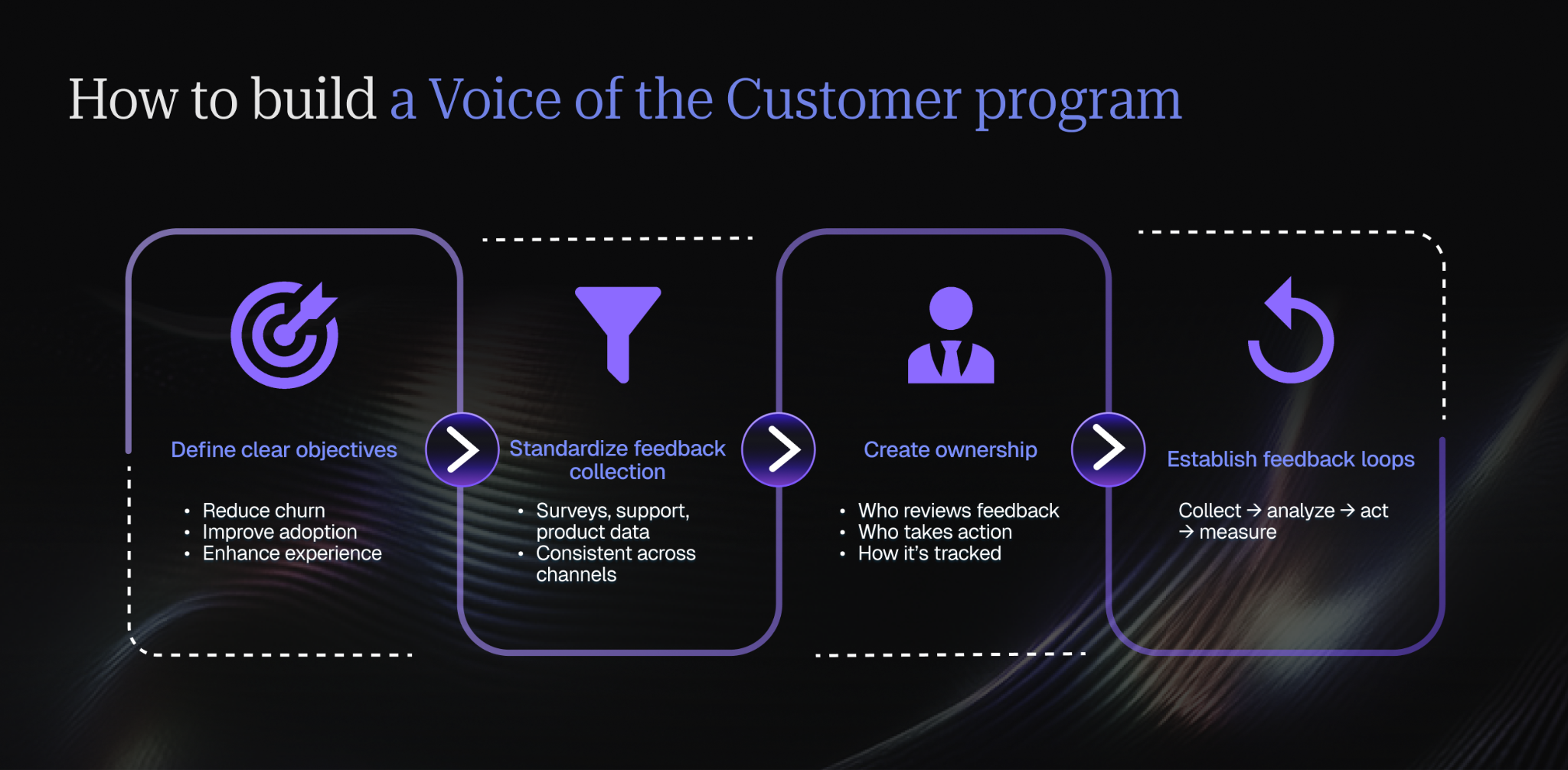
Define clear objectives
Building an effective Voice of the Customer (VoC) program starts with clarity. Teams need to define what they are trying to improve, whether that is reducing churn, increasing product adoption, or enhancing the overall customer experience.
Without clear objectives, feedback can become scattered and difficult to act on, limiting its impact.
Standardize feedback collection
Consistency in how feedback is collected is equally important. Standardizing feedback collection across channels such as surveys, support interactions, and product usage ensures that data is reliable and comparable over time.
When feedback is captured in a structured way, it becomes much easier to identify trends and make informed decisions.
Create ownership and accountability
A successful VoC program also depends on clear ownership and accountability. Teams need to define who is responsible for reviewing feedback, who takes action on specific insights, and how those actions are tracked.
This clarity is necessary so that feedback can not only be acknowledged, but also acted upon.
Establish feedback loops
Establishing continuous feedback loops ensures that the program drives ongoing improvement. This involves collecting feedback, analyzing it, taking action, and then measuring the impact of those actions.
Over time, this cycle helps refine both the product and the customer experience, turning VoC into a system that continuously improves outcomes rather than a one-time initiative.
How to operationalize VoC at scale
Centralize customer data
Operationalizing Voice of the Customer at scale starts with bringing all customer data into one place. Feedback, usage data, support interactions, and communication history should be unified to create a complete view of each customer.
Without this centralized context, insights remain fragmented and difficult to act on consistently across teams.
Automate feedback collection
Manually collecting feedback does not scale. Automating feedback collection ensures that insights are gathered continuously at key moments in the customer journey, such as onboarding, feature usage, and renewal.
This creates a steady stream of data without relying on ad hoc efforts, making VoC more reliable and comprehensive.
Trigger workflows based on signals
VoC becomes powerful when it drives action automatically. Instead of reviewing feedback manually, teams can set up workflows that trigger based on specific signals, such as negative sentiment, low satisfaction scores, or repeated issues. This allows teams to respond faster and ensures that important signals are not overlooked.
Monitor impact continuously
To make VoC effective at scale, teams need to track the outcomes of their actions. This means monitoring changes in customer satisfaction, retention, and product adoption over time.
Continuous monitoring helps teams understand what is working, refine their approach, and ensure that feedback is translating into measurable improvements.
Platforms like Velaris support this by unifying customer data across systems, enabling automated workflows through Scenarios, and providing dashboards that track the impact of VoC-driven actions. This makes it easier to move from collecting feedback to executing and improving at scale.
How to build a customer-centric culture
According to Forrester, customer-obsessed companies achieve 51% better customer retention than peers. That’s your sign to make the customer the focus of your work, which is easy to do with a strong grasp of the Voice of the Customer.
Make Voice of the Customer a shared source of truth
A customer-centric culture starts with making Voice of the Customer the foundation for decision-making across the organization. This means centralizing feedback from surveys, support interactions, product usage, and conversations into a single, accessible view.
When all teams work from the same set of customer insights, decisions become more aligned and grounded in reality. VoC should not just be used to validate ideas after the fact, but to actively guide what teams prioritize and build.
Embed VoC into cross-functional decision making
Customer-centricity only works when it extends beyond Customer Success. Product teams should prioritize features based on real customer feedback, ensuring the roadmap reflects actual needs. Sales teams should align expectations with what customers truly value, reducing misalignment early in the journey.
Support and Customer Success teams should collaborate closely to identify recurring issues and resolve them at the root. When VoC informs decisions across functions, the entire organization moves in the same direction.
Close the loop on customer feedback
Collecting feedback is not enough. Teams need to act on it and communicate those actions back to customers. Closing the loop involves implementing changes based on feedback, sharing updates with customers, and showing how their input directly influenced improvements. This builds trust and reinforces the idea that customer voices are not just heard, but valued.
Check out this article to learn more about building a customer centric culture with feedback loops.
Measure and reinforce customer-centric outcomes
To sustain a customer-centric culture, teams need to measure what matters. Metrics like retention, Net Promoter Score (NPS), and product adoption provide visibility into how well the organization is serving its customers.
Aligning KPIs across teams to these outcomes ensures that everyone is working toward the same goals. Reinforcing and rewarding actions that improve the customer experience helps embed customer-centric thinking into everyday decision-making. It's the same shift happening on the brand side too. Tools like CMO Huddles' RepuTracker now give CMOs a monthly, AI-scored view of reputation instead of a gut check.
Common challenges in Voice of the Customer
Survey fatigue
One of the most common challenges in VoC programs is over-surveying customers. When feedback requests are too frequent or poorly timed, customers are less likely to respond, and the quality of responses declines. The focus should be on asking fewer, more meaningful questions at the right moments in the customer journey, rather than collecting large volumes of low-quality feedback.
Fragmented data
VoC data often lives across multiple tools, including surveys, support platforms, product analytics, and communication systems. When insights are spread out, it becomes difficult to form a complete picture of the customer experience. This fragmentation leads to missed patterns and slows down decision-making.
Lack of action
Many teams successfully collect and analyze feedback but struggle to act on it. Insights remain in reports or dashboards without translating into meaningful changes. Without clear ownership and processes, even valuable feedback fails to drive impact.
Data quality issues
VoC is only as reliable as the data behind it. Inaccurate, outdated, or incomplete data can lead to misleading conclusions. Poor data quality often results from inconsistent collection methods or lack of validation, making it harder to trust and act on insights.
How to overcome VoC challenges
Keep feedback concise and timely
Improving response rates and quality starts with better timing and relevance. Feedback should be collected at key moments, such as after onboarding or support interactions, and questions should be clear and focused. This ensures that customers provide more thoughtful and useful input.
Unify data sources
Bringing VoC data into a single system helps eliminate fragmentation and provides a complete view of the customer. When feedback, usage, and communication data are combined, teams can identify patterns more easily and act with greater confidence.
Focus on actionable insights
Not all feedback requires immediate action. Teams should prioritize insights that have a clear impact on retention, satisfaction, or product experience. This ensures that effort is directed toward meaningful improvements rather than low-impact changes.
Continuously validate data
VoC programs should include regular checks to ensure data accuracy and relevance. This involves updating collection methods, validating assumptions, and refining analysis as customer behavior evolves. Continuous validation helps maintain trust in the data and improves decision-making over time.
Velaris supports this by creating a unified customer context, reducing data fragmentation and manual effort while making it easier to turn insights into action.
How AI is transforming Voice of the Customer
Automated sentiment analysis
AI makes it possible to understand how customers feel at scale. Instead of manually reading through surveys, support tickets, and conversations, AI can analyze tone and language to detect sentiment automatically. This helps teams identify dissatisfaction, frustration, or positive experiences much earlier, even when customers don’t explicitly state it.
Real-time insight generation
Traditional VoC analysis often relies on periodic reporting. AI changes this by generating insights in real time. As new feedback and behavioral data come in, patterns and issues can be surfaced immediately. This allows teams to respond faster and address problems before they impact a larger portion of the customer base.
Predictive feedback trends
AI doesn’t just analyze current feedback, it can also predict future trends. By identifying patterns across historical and real-time data, teams can anticipate emerging issues, shifting customer needs, or potential risks. This enables a more proactive approach to Customer Success, where teams can act before customers raise concerns.
Reduced manual analysis
One of the biggest challenges with VoC is the volume of data. AI reduces the need for manual effort by automatically organizing feedback, clustering similar themes, and highlighting what matters most. This allows teams to focus less on analysis and more on execution.
Platforms like Velaris support an AI-native approach to VoC by using features like Headlines, CallSense, and AI Topics to surface key insights across conversations and feedback. This makes it easier to detect patterns, understand customer sentiment, and turn insights into action without relying on manual processes.
Tools for Voice of the Customer
Capturing and acting on the Voice of the Customer requires a combination of tools that help collect feedback, analyze it, and turn it into action. Each layer plays a different role in building a complete VoC system.
Check out the best feedback tools available right now in this listicle.
Survey tools
Survey tools are the most direct way to gather customer feedback. They allow teams to capture structured input through methods like NPS, CSAT, and CES. These tools are useful for measuring satisfaction at specific moments, such as after onboarding or support interactions, and provide a consistent way to track sentiment over time.
Analytics platforms
Analytics platforms help teams make sense of both feedback and behavioral data. They enable trend analysis, segmentation, and pattern recognition across large datasets. By combining survey results with product usage and engagement data, teams can better understand not just what customers are saying, but how they are behaving.
Customer Success platforms
Customer Success platforms connect insights to execution. They bring together data from multiple sources, provide visibility into customer health, and enable teams to act on VoC signals through workflows and engagement strategies. Instead of treating feedback as isolated data points, these platforms help embed VoC into daily operations.
How Velaris helps with Voice of the Customer
A key challenge in VoC is fragmented data. Velaris addresses this by unifying customer data across systems, creating a single source of truth that combines behavioral signals with direct feedback. This allows teams to understand not just what customers are saying, but how they are actually engaging with the product.
AI plays a central role in making this data actionable. Velaris analyzes conversations, support tickets, and feedback to generate insights that would otherwise require manual effort. Features like Headlines and CallSense surface important moments and signals, while Trending Topics automatically clusters recurring themes across accounts.
This helps teams quickly identify patterns such as common feature requests, emerging issues, or widespread dissatisfaction, without having to sift through individual data points.
What sets Velaris apart is its ability to turn insights into action. Velaris Copilot further supports this by recommending next best actions based on real-time context, helping teams move quickly from insight to execution.
Conclusion
Voice of the Customer is the foundation of customer-centric growth. It gives teams a clear understanding of what customers need, where they are struggling, and how their experience can be improved. When used effectively, it helps align teams, guide decisions, and strengthen relationships.
However, insights alone are not enough. The real impact comes from consistently acting on those insights. Teams that translate feedback into workflows, product improvements, and proactive engagement are the ones that see meaningful gains in retention and customer satisfaction.
AI is what makes this scalable. It enables teams to analyze large volumes of feedback, detect patterns in real time, and respond faster without relying on manual effort. This allows VoC to move from a periodic exercise to a continuous system of improvement.
Platforms like Velaris, a highly rated software on G2, help bring this together by combining unified customer data, AI-driven insights, and automated workflows, making it easier to capture, understand, and act on the Voice of the Customer at scale.
Request a demo to see how Velaris helps you capture and act on the Voice of the Customer
Frequently Asked Questions
Voice of the Customer vs customer feedback: what’s the difference?
Customer feedback refers to individual inputs such as survey responses, reviews, or support interactions. Voice of the Customer (VoC) is the broader system that collects, analyzes, and connects all of that feedback with behavioral and sentiment data to generate actionable insights. In simple terms, feedback is the input, while VoC is the strategy that turns it into decisions and improvements.
What tools are used for VoC?
VoC typically requires a combination of tools, including survey platforms for collecting feedback, analytics tools for identifying patterns, and Customer Success platforms for connecting insights to action.
Platforms like Velaris bring these elements together by unifying customer data, analyzing feedback with AI, and enabling teams to act on insights through workflows and recommendations.
How often should you collect customer feedback?
Customer feedback should be collected continuously rather than at fixed intervals. The most effective approach is to gather feedback at key moments in the customer lifecycle, such as onboarding, feature adoption, and renewal. This ensures that insights reflect real-time experiences rather than delayed or outdated opinions.
Why is VoC important for retention?
VoC helps teams identify dissatisfaction and friction before it leads to churn. By understanding customer needs, expectations, and sentiment, teams can proactively address issues, improve the product experience, and deliver more value. This leads to stronger relationships, higher satisfaction, and ultimately better retention.

The Velaris Team
A (our) team with years of experience in Customer Success have come together to redefine CS with Velaris. One platform, limitless Success.




Velaris is an AI-native Customer Success Platform built for mid-market and enterprise B2B SaaS teams. From customer health scoring and churn prediction to onboarding automation, renewals, and expansion workflows, Velaris helps recurring revenue teams understand account health, reduce churn, and scale customer success with greater visibility and control.