We look forward to showing you Velaris, but first we'd like to know a little bit about you.


Customer Lifecycle Management: The Complete Guide
Master client lifecycle management with practical steps to streamline workflows, enhance collaboration and boost customer satisfaction.
The Velaris Team
June 4, 2026
Client Lifecycle Management (CLM) is a structured, end-to-end approach to managing customer relationships from acquisition through renewal, expansion, and advocacy, designed to turn customer interactions into predictable, long-term value.
This guide is for Customer Success Managers, CS leaders, and cross-functional teams in B2B, B2C, and hybrid organizations who are responsible for driving retention, expansion, and customer outcomes.
Use CLM when you need to move beyond reactive support and fragmented handoffs, scale customer success consistently, reduce churn, improve net revenue retention, and align teams around delivering measurable value at every stage of the customer journey.
Key Takeaways
- Most churn isn't caused by product failure. It's caused by customers who were never told what success was supposed to look like.
- The difference between reactive and proactive CS isn't attitude. It's whether your team has the data to see problems forming 60–90 days before the customer does.
- Each lifecycle stage has a different job. Treating them as a single continuous "journey" is how teams miss the transitions that matter most.
- Health scores only work if they combine what customers do (usage data) with what they feel (sentiment signals). One without the other produces false confidence or unnecessary panic.
- Outcome-based success plans don't start with your product's features. They start with the specific win the customer described on the sales call.
- CLM fails most often not because of missing technology, but because different departments are optimizing for different things.
What is client lifecycle management?
Client Lifecycle Management (CLM) is a structured, end-to-end approach to managing customer relationships from acquisition through renewal, expansion, and advocacy, designed to turn customer interactions into predictable, long-term value.
CLM connects three critical business elements: strategic vision, tactical execution, and sustainable growth, and transforms how organizations think about customers,shifting from transactional moments to continuous value creation across the entire relationship arc. This structured approach helps teams anticipate needs, prevent churn, and systematically identify expansion opportunities. It aligns teams around shared customer goals, eliminates silos that fragment the customer experience, and creates the foundation for data-driven decision making that drives retention and revenue growth.
What is a client lifecycle?
The client/customer lifecycle represents the complete journey customers take with your business, from initial discovery to becoming vocal advocates. This framework helps teams understand where customers are in their relationship with your company and what they need at each stage.
Core lifecycle stages
The typical customer lifecycle flows through five interconnected stages.
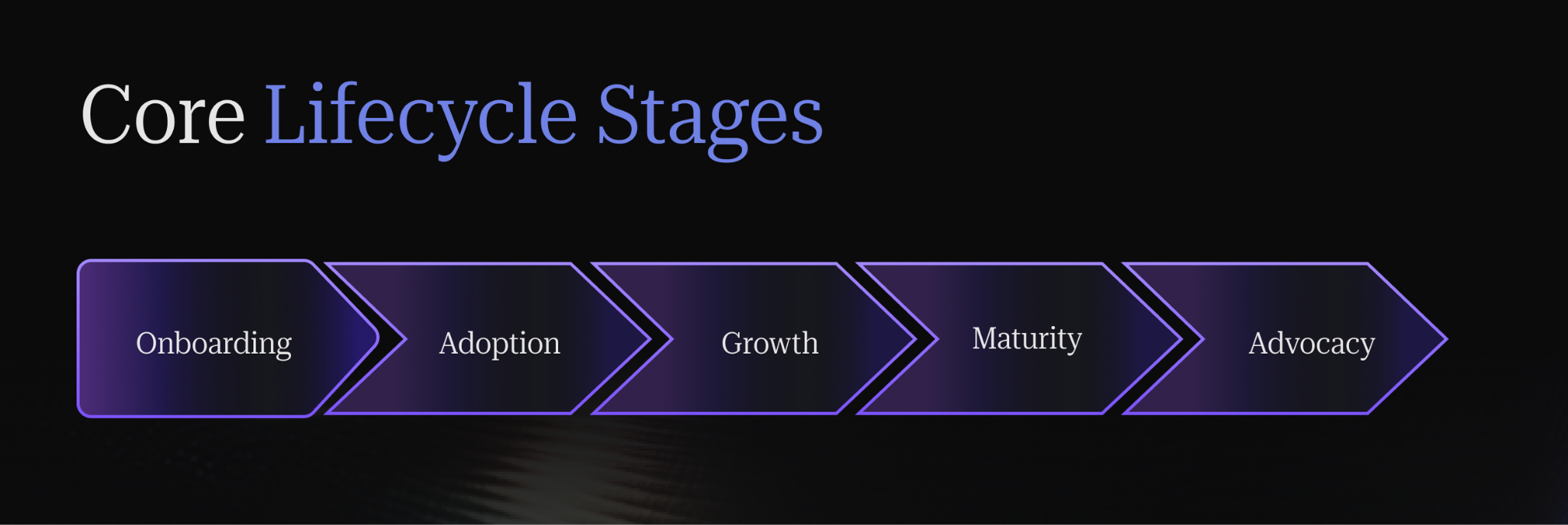
- Onboarding is where the relationship either gets traction or quietly starts to fail. Customers are translating a purchase decision into actual usage, and the gap between what was promised and what they experience is widest here. Get the customer to their first concrete win before doubt sets in.
- Adoption is when customers stop following your onboarding guidance and start making the product their own, and, if things are going well, reaching out less (not more). Don’t confuse light feature usage for adoption. You’re looking for deep, habitual usage.
- Growth is the signal that value realization has happened. Customers in this stage are expanding their usage, adding seats, or exploring adjacent use cases. The CSM's job here shifts from enablement to strategic guidance: helping them grow without overextending.
- Maturity is the steadiest and most undermanaged stage. Customers are embedded, outcomes are documented, and the relationship can start to feel routine. But because of the lower oversight, this is exactly when invisible churn risk accumulates.
- Advocacy is covered in its own section below, because loyalty and advocacy are different things. A customer who renews isn't automatically a customer who refers.
The advocacy stage: turning successful customers into growth assets
An advocate is a loyal customer that goes out and refers, defends, co-creates, and shows up on your behalf in rooms you're not in.
In B2B SaaS, the mechanics that actually move the needle are reference calls, peer advisory boards, and G2/Capterra reviews. Not generic testimonials. Most lifecycle frameworks treat loyal customers and advocates as the same thing, which is why most advocacy programmes are just renewal celebrations with a case study request attached.
But advocacy-ready customers share a specific profile: high NPS, multi-year tenure, at least one expansion, and an executive who has personally staked something on the relationship. Wait for all four before treating a customer as an advocate.
How lifecycle thinking differs from traditional customer management
Traditional customer management often treats interactions as isolated transactions like sales closing deals, support fixing problems, and success teams checking in periodically. This fragmented approach can create gaps in the overall customer experience if teams end up uninformed on the customer’s overall experience. .
Lifecycle thinking takes a fundamentally different approach. It views customer relationships as continuous journeys requiring coordinated effort across all stages. Every touchpoint connects to the next, creating momentum towards long-term value.
This perspective shifts teams from asking "how do we close this deal?" to "how do we ensure this customer achieves their goals?" It replaces reactive problem-solving with proactive relationship-building. Teams are always thinking ahead of the customer’s problems before they bring it up themselves. .
Client Lifecycle Management as a strategic business function
Client Lifecycle Management has evolved far beyond operational tactics. It now drives fundamental business outcomes that leadership cares about most. Understanding CLM's strategic impact helps Customer Success teams secure resources and demonstrate their value to the organization.
Top-quartile B2B SaaS companies achieve 113% median NRR compared to 98% for bottom performers, while organizations with mature proactive customer success operations regularly reach 120-140% NRR by systematically converting customer success into revenue growth. Proactive engagement strategies drive 20-40% expansion revenue by identifying usage limits and growth signals early, with approximately 40% of SaaS revenue now coming from renewals and expansions through data-driven lifecycle strategies.
CLM supports revenue growth, retention, and expansion
CLM creates predictable revenue patterns by systematically guiding customers toward successful outcomes. When customers achieve value consistently, they stay longer, and have the potential to recommend your solution to others..
Growth happens through three mechanisms:
- First, reduced churn preserves existing revenue that would otherwise disappear.
- Second, systematic expansion identification uncovers opportunities to grow account values through upsells and cross-sells.
- Third, successful customers become advocates who accelerate new customer acquisition through referrals and case studies.
Retention improves because CLM helps teams spot risks early. By monitoring customer health across lifecycle stages, teams can intervene before small issues escalate into cancellations. This proactive approach prevents surprises at renewal time.
Expansion becomes more systematic as CLM frameworks help teams identify signals indicating readiness for additional products or increased usage. Rather than hoping for expansion, teams can create conditions that naturally lead customers toward growth.
The data confirms that this proactive approach works: customer success strategies leveraging usage data and feedback reduce churn by 2.3% or more by addressing issues before they escalate. Leading indicators like declining usage and engagement typically signal churn risks 60-90 days early, giving teams meaningful time to intervene through predictive models and prevent cancellations.
The role of CLM in Net Revenue Retention (NRR) and Customer Lifetime Value (CLV)
Net Revenue Retention measures how much revenue you retain and grow from existing customers over time. Strong CLM directly impacts NRR by improving both retention rates and expansion revenue from your customer base.
Customer Lifetime Value quantifies the total revenue a customer generates throughout their entire relationship with your company. Effective lifecycle management extends customer tenure and increases revenue per customer, directly boosting CLV.
Lifecycle marketing strategies demonstrate measurable impact on customer value, delivering a 35% reduction in time-to-first-value, 22% higher repeat purchase rates, and 18% expansion ARR growth through systematic retention optimization across the customer journey.
How to align client lifecycle strategy with company-wide goals
CLM works best when integrated into a broader business strategy. This means connecting lifecycle initiatives to company objectives like revenue targets, market expansion goals, or product development priorities.
For example:
- Sales teams benefit from understanding what happens after the deal closes, helping them set accurate expectations and identify ideal customer profiles.
- Marketing gains insights into which messages resonate at different lifecycle stages, improving campaign effectiveness.
- Product teams learn which features drive adoption and value, informing their roadmap decisions.
Who owns CLM across Customer Success, Sales, Marketing, and Support?
Client lifecycle management (CLM) is best led by the Customer Success (CS) team in collaboration with Revenue Operations (RevOps). And it is ideal to have a dedicated lifecycle manager or CS leader overseeing each process in order to prevent fragmented customer experiences.
This is because the lifecycle spans multiple departments: Sales owns acquisition and sets the stage for what follows. Onboarding teams guide initial implementation. Support resolves issues that could derail progress. Product teams enable adoption through great features and experiences.
Success requires clear ownership of each stage while maintaining seamless handoffs between teams. When departments operate from shared lifecycle definitions and coordinate around customer milestones, customers experience consistency rather than disconnected interactions managed by siloed teams.
Lifecycle Models and Frameworks
Different businesses require different approaches to lifecycle management. Understanding various frameworks helps teams design systems that match their specific customer base and business model.
Common lifecycle models used by Customer Success teams
The linear progression model follows customers through sequential stages from awareness through advocacy. This straightforward framework works well for businesses with predictable customer journeys and clear milestone progressions.
The cyclical model recognizes that customers don't follow straight paths. They may loop back to earlier stages, such as needing re-onboarding after personnel changes or returning to adoption phases when expanding to new use cases. This model acknowledges the reality that customer needs evolve and change over time.
The value-based model organizes stages around outcomes rather than activities. Instead of tracking whether onboarding tasks were completed, this framework focuses on whether customers achieved their first meaningful result. It emphasizes customer success rather than internal process completion.
Differences between B2B, B2C, and hybrid lifecycle frameworks
B2B lifecycles typically involve longer timeframes, multiple stakeholders, and complex decision-making processes. Enterprise customers might spend months in onboarding alone, with adoption happening gradually across different departments. Relationships tend to be high-touch with significant human interaction at every stage.
B2C lifecycles move faster with shorter timeframes between stages. Individual consumers make quick decisions, start using products rapidly, and expect immediate value. These relationships often scale through digital channels rather than personal touchpoints.
Hybrid models blend elements of both approaches. Product-led growth companies might start with self-service B2C-style acquisition and adoption, then introduce high-touch B2B elements as customers grow and require more sophisticated support.
High-touch vs low-touch lifecycle models
High-touch models provide personalized, human-driven experiences throughout the lifecycle. Dedicated Customer Success Managers maintain ongoing relationships, conduct regular business reviews, and provide strategic guidance. This approach works well for enterprise customers with high contract values justifying significant service investment.
Low-touch models leverage automation, self-service resources, and digital engagement to scale customer support efficiently. Customers access help through knowledge bases, automated onboarding sequences, and community forums. Human intervention happens selectively for specific triggers or high-value opportunities.
Many companies use tiered models, providing high-touch service to strategic accounts while supporting smaller customers through scaled approaches. This segmentation optimizes resource allocation based on customer value and needs.
Effective segmentation requires structured frameworks. Explore different approaches in our customer segmentation guide.
Key Pillars of Effective Client Lifecycle Management
Successful lifecycle management rests on four foundational pillars. Master these areas and you create the conditions for consistent customer success across your entire portfolio.
Clear and Consistent Onboarding
Onboarding represents your first major opportunity to deliver value after the sale. Get it right and you build momentum that carries through the entire relationship. Get it wrong and you fight an uphill battle trying to recover customer confidence.
How to design onboarding for faster time-to-value
Customers don't buy your product, they buy the outcomes your product enables. The faster they experience those outcomes, the more confident they become in their purchase decision. Time-to-value measures how quickly customers achieve their first meaningful result.
Reducing time-to-value requires understanding what "value" means for each customer segment. For some, value might mean connecting their first integration. For others, it's completing their first workflow or seeing initial data insights. This means you need to focus on a few things:
- Designing your onboarding to drive toward these specific milestones rather than generic product tours.
- Breaking implementation into clear phases with obvious progress markers with checklists, progress bars etc. to create a sense of movement. Customers should always know where they are in the journey and what comes next.
- Removing friction wherever possible. Every extra step, confusing instruction, or technical hurdle risks derailing progress.
The retention impact of effective onboarding is substantial: mastering customer onboarding can reduce churn by up to 45% through faster value delivery and structured processes. Faster time-to-value boosts retention as customers perceive quick ROI, leading to loyalty and recommendations, with customers completing onboarding within 30 days showing significantly higher engagement rates.
How to align onboarding milestones with lifecycle outcomes
Research confirms that seamless onboarding with dedicated support and feedback reduces early churn risks by accelerating activation and building customer confidence during the critical first weeks of the relationship.
If healthy customers typically activate five specific features within 60 days, structure your onboarding to guide them toward those features systematically.
In order to align milestones with lifecycle outcomes, think beyond product education and also focus on relationship building. As you follow a customer through their journey, track which onboarding paths lead to the best long-term outcomes. Customers who complete certain sequences might show higher retention or faster expansion. Use this data to refine your approach continuously.
For detailed strategies on optimizing your onboarding process, see our comprehensive guide to customer onboarding strategies.
Proactive Engagement and Collaboration
Reactive Customer Success teams respond to problems after they surface. Proactive teams anticipate needs and engage customers before issues arise. This shift from reactive to proactive fundamentally changes relationship dynamics.
How to anticipate customer needs across lifecycle stages
Different lifecycle stages create predictable patterns in customer needs. Newly onboarded customers need encouragement and basic implementation support. Mid-lifecycle customers benefit from advanced features and optimization guidance. And renewal-stage customers want to discuss ROI and strategic planning.
Map these patterns to create engagement cadences matched to lifecycle stages. Don't wait for customers to reach out with problems. Establish regular touchpoints that provide value and surface potential issues early.
Building long-term partnerships vs reactive support
Support solves immediate problems. Partnerships help customers achieve strategic goals.
It’s better to position yourself as a strategic advisor rather than just a product expert. This involves understanding your customers' business challenges, industry trends, and competitive pressures. In that same vein, frame your guidance in terms of their success rather than just your product’s capabilities, and invest time building relationships with multiple stakeholders within customer organizations.
The more people who see you as a valuable partner, the stickier your solution becomes. Gartner found that when a buying team isn’t in conflict, they are 2.5 times more likely to report that their deal was high-quality. Champions come and go; but distributed relationships stay stable.
Monitoring Customer Health and Satisfaction
You can't manage what you don't measure. Customer health monitoring provides the visibility needed to make informed decisions about where to invest your time and energy.
What does "customer health" really mean?
Customer health synthesizes multiple signals into an overall assessment of relationship strength and risk level. Healthy customers are the ones that engage regularly, achieve their goals, express satisfaction, and show signs of long-term commitment. At-risk customers will display warning signs like declining usage, unresolved complaints, or disengagement.
When it comes to creating health scores, everyone does it differently. SaaS companies might weigh product usage heavily. Service businesses might emphasize relationship quality. Professional services firms might focus on project success and expansion pipeline. This is why it’s important for you to define health in terms specific to your business model and customer base.
Usage metrics provide hard data but miss important context. Sentiment analysis and relationship quality assessments fill gaps that numbers alone can't capture. Ultimately, you need to be creating objective scoring methodologies that combine quantitative and qualitative inputs.
When implemented effectively, predictive health scoring using usage, engagement, and financial metrics achieves 72-91% accuracy in B2B churn prediction through machine learning models. This precision enables Customer Success teams to prioritize interventions strategically and allocate resources where they'll have the greatest impact on retention outcomes.
How to balance qualitative and quantitative health signals
Numbers only tell part of the story. A customer might show strong usage metrics while privately harboring frustrations that could lead to churn. Conversely, lower usage doesn't always indicate problems. It might simply reflect normal seasonal patterns.
Qualitative signals including tone in communications, feedback during business reviews, responsiveness to outreach, and stakeholder engagement levels can fill in the information that quantitative data simply can’t track. Pay attention to subtle shifts like shorter email responses, canceled meetings, or reduced enthusiasm during calls.
Combining both signal types into comprehensive health assessments is the best solution. Train your team to notice qualitative warning signs and document them systematically so patterns emerge over time. Use AI tools to analyze communication sentiment at scale, surfacing concerns that might otherwise go unnoticed.
You can learn more about building effective health scoring systems in our guide to customer health scores.
Managing success plans and measuring outcomes
Success plans align your team and your customers around shared definitions of success. They transform vague goals into specific, measurable milestones that guide your work together.
How to align success plans with lifecycle stages
Early-stage success plans focus on implementation and initial value realization. Questions center on "what needs to happen for this customer to be successful in their first 90 days?"
Mid-lifecycle plans shift toward optimization and expansion. The conversation becomes "how do we help this customer maximize value from their current investment and potentially expand into new use cases?"
Renewal-stage plans emphasize business outcomes and strategic value. You're discussing "what results has this customer achieved and how do we build on that foundation going forward?"
Create templated success plan frameworks for each lifecycle stage while allowing flexibility to customize based on individual customer needs.
Building self-service resources that scale lifecycle outcomes
The instinct behind most self-service investments is cost reduction, like fewer tickets, less CSM time, and leaner support headcount. But that framing produces the wrong resources, because teams end up building content that deflects complaints rather than knowledge bases that accelerate outcomes.
What to build depends on where the customer is in the lifecycle:
- New customers need onboarding checklists and quickstart guides that are short, specific, and sequenced around their first concrete win rather than a full product tour.
- Customers in the adoption stage need feature deep-dives and best practice libraries that help them go beyond basic usage without requiring a CSM to walk them through it.
- At renewal, the resources that matter are ROI calculators and executive summary templates: tools that help champions build the internal case for continuation without relying on you to do it for them.
Finally, self-service engagement data should feed directly into health scores. A customer visiting your knowledge base three times a week is telling you something. If that activity is invisible to your health scoring model, you're making prioritization decisions with incomplete information.
Using the first 90 days to predict two-year retention
Engagement patterns formed in the first 90 days post-onboarding are among the strongest predictors of two-year retention, which means the resources spent on a mid-lifecycle customer who's already embedded are worth less than the same resources spent on a customer in their first quarter.
- Customers who complete their first meaningful workflow within 30 days retain at significantly higher rates than those who don't.
- Feature breadth in the first 90 days predicts expansion, because customers who touch more of the product early are more likely to grow their usage later.
- Response time to CSM outreach in the first month is a relationship signal more than a product signal; slow responses early rarely recover into strong partnerships.
Userflow notes that most SaaS users who churn do so within the first 90 days. What this means practically is that onboarding deserves a disproportionate share of your team's attention and your tooling budget. The customers who need the most investment are the ones who've just signed, not the ones approaching renewal.
It also means your early warning system needs to be calibrated to this window. A customer who hasn't logged a second session by day 14 is a higher priority intervention than a two-year customer whose usage dipped last month.
Front-load the high-touch moments like kickoff calls, milestone check-ins, early business reviews into the first quarter rather than spacing them evenly across the year. And then build your alerting accordingly, and make sure your health scoring model weights first-90-day behaviors more heavily than it weights mid-lifecycle fluctuations.
The uncomfortable truth is that if a customer reaches day 91 without forming strong usage habits, recovery is possible but expensive. The earlier you catch disengagement, the cheaper it is to fix.
Lifecycle management through Mergers and Acquisitions
M&A is the stress test that exposes every weakness in a lifecycle framework. Playbooks built for stable relationships don't account for the specific ways acquisitions destabilize them. Champions disappear overnight, budgets get frozen during integration, and a competing vendor that came in through the acquiring company suddenly has an inside track. The accounts that feel most secure before an announcement are often the ones most vulnerable after it.
The first thing to establish is which side of the transaction is changing. Is it yours or the customer's? Because the response is different.
When your customer is acquired, your immediate priority is stakeholder mapping. The champion who signed your contract may have no authority in the new structure. Find out quickly who owns the budget, who owns the technology decisions, and whether your product has a functional equivalent in the acquirer's existing stack. Don't wait for the customer to bring this up. By the time they do, a consolidation decision may already be in motion.
When your company is acquired, the customer's concern is continuity, whether that’s of the product, the pricing, or the people they work with. Satrix Solutions found that customers are up to three times more likely to switch providers after an M&A announcement in their vendor base. CSMs should be the first to reach out, before corporate communications occur, with a clear and honest account of what is and isn't changing.
In both scenarios, the lifecycle framework needs a specific M&A track. This means accelerating health score reviews for affected accounts, temporarily increasing touch frequency regardless of tier, and documenting relationship history in enough detail that a new stakeholder can be onboarded quickly if the existing champion exits. Undocumented relationships don't survive personnel changes.
Metrics, KPIs, and Measurement Across the Client Lifecycle
What you measure shapes what your team prioritizes. Choose the right metrics and you drive behaviors that create customer success and business results.
What are the lifecycle-specific KPIs and success indicators?
Each lifecycle stage demands different measurement approaches.
What are leading vs lagging indicators of churn and expansion?
Lagging indicators tell you what already happened. This includes metrics like churn rate, expansion revenue and Net Revenue Retention. These are important for understanding results but provide limited ability to influence outcomes.
Leading indicators predict what will happen, giving you time to intervene. Declining product usage, decreased response rates to outreach, and unresolved support tickets are examples of lagging indicators and all signal increased churn risk before customers actually cancel.
Build monitoring systems into your CLM strategy to surface leading indicators automatically, alerting your team to emerging opportunities and risks while there's still time to act.
For a comprehensive overview of essential metrics, check out these customer success metrics every CSM should know.
How to measure time-to-value and product adoption
Time-to-value quantifies how long customers take to achieve their first meaningful outcome. Shorter time-to-value correlates strongly with higher retention rates because customers who see value quickly become confident in their purchase decision.
To track time-to-value, follow which approaches deliver value fastest and where customers typically get stuck. Use these insights to continuously optimize your onboarding process.
Adoption metrics should go beyond simple login counts to measure meaningful engagement. A customer who logs in daily but only uses basic features without engaging with everything that’s useful to them hasn’t truly adopted your solution. To measure adoption, create definitions tied to the features and workflows that deliver the most value.
Executive-level reporting for lifecycle performance
Executives care about outcomes that impact the business like revenue growth, customer retention, expansion pipeline, and overall customer health. In order to communicate with them, you need to translate your lifecycle metrics into the language leadership understands and cares about.
- Report on how lifecycle initiatives drive key business results.
- Show how improved onboarding reduces early churn.
- Demonstrate how proactive engagement increases expansion revenue.
- Connect the dots between tactical work and strategic outcomes.
- Use visualization to make trends immediately obvious.
How to connect lifecycle metrics to business outcomes
The ultimate test of lifecycle management effectiveness is business impact. Does better lifecycle management actually drive higher NRR? Does it increase customer lifetime value? Does it enable your business to grow more efficiently?
In order to be certain,build analytical models connecting lifecycle behaviors to financial outcomes: Which early indicators most strongly predict long-term retention? How does time-to-value impact expansion revenue? What health score thresholds separate customers who churn from those who renew?
You can use these insights to optimize resource allocation. Focus effort on the activities and interventions that drive the biggest impact on outcomes leadership cares about.
Technology, Tools, and Integrations for Lifecycle Management
The right tech stack transforms lifecycle management from manual coordination into systematic orchestration. Choose tools that enable your strategy rather than letting tools dictate your approach. Here are some popular tools that are used in CLM:
We already discussed how CLM spans multiple departments and needs to be handled seamlessly. The reason is because customers don't care about your internal systems. They expect consistent experiences regardless of which team member they interact with or which system stores relevant information.
The most effective tech stacks integrate all of these systems, allowing data to flow seamlessly so teams work from a complete picture rather than fragmented views scattered across disconnected tools.
When a support ticket resolves, that information should update the customer's health score. When usage drops, it triggers a check-in workflow.
API-based integrations offer flexibility but require technical resources to build and maintain. Pre-built integrations through middleware platforms provide faster implementation but might not cover all your specific needs. Native integrations between tools can offer the best experience but limit your technology choices.
Modern platforms like Velaris, a highly rated tool on G2, are built as AI-native systems where intelligent automation handles repetitive tasks like summarizing calls, flagging churn risks and drafting follow-ups, so CS teams can focus on strategy and relationships. Velaris also offers both plug-and-play integrations across 70+ tools as well as custom integrations for your unique lifecycle requirements to ensure data flows seamlessly across your entire tech stack.
Best Practices for Client Lifecycle Management
Technical systems and frameworks provide foundation, but execution determines results. These practices separate good lifecycle management from great.
How to break down internal silos
- Create regular communication forums bringing together teams that touch customers at different lifecycle stages. These might be weekly alignment meetings, shared Slack channels, or structured handoff processes.
- Define clear ownership for each lifecycle stage while establishing explicit handoff procedures between teams. Customers should never be forgotten during transitions from sales to onboarding or from onboarding to ongoing success management.
- Share customer insights broadly across teams. When success teams discover that customers struggle with a specific feature, product teams need to know. When sales learns about emerging customer needs, success teams should hear about it so they can guide existing customers appropriately.
- Implement shared metrics that incentivize collaboration rather than departmental optimization. If success teams get measured solely on retention while sales focuses only on new bookings, conflicting priorities emerge. Shared accountability for customer lifetime value aligns everyone around long-term customer outcomes.
How to leverage automation for efficiency
Manual processes can create bottlenecks that prevent scaling. Strategic automation, done carefully, has the ability to multiply your team's impact without sacrificing quality.
How to automate lifecycle touchpoints
First, identify the touchpoints that happen repeatedly following predictable patterns, like onboarding emails, milestone check-ins, renewal reminders, and satisfaction surveys. These are prime automation candidates.
Next, build workflows related to the above touchpoints that get triggered by customer behaviors or lifecycle transitions. Some examples are automatically scheduling a business review when a customer completes onboarding, or sending out an outreach message when their usage drops below certain thresholds.
Templates and sequence automation become key here in maintaining consistent communication without having to manually craft each message. Enabling personalization within frameworks allows you to keep messages feeling relevant while benefiting from systematic delivery.
How to scale personalization responsibly
Use data to personalize automated communications. Reference specific customer behaviors, milestones achieved, or relevant context in templated messages. Customers should feel like you know them, not like they're receiving generic broadcasts. Though you are engaging with multiple customers, they’re always in a one-to-one relationship with you.
Determine which touchpoints benefit most from human attention versus which can be automated without sacrificing relationship quality. Save personal outreach for strategic moments such as business reviews, renewal discussions, expansion conversations, while automating routine updates and administrative communications.
Make sure you’re monitoring customer sentiment and engagement with these automated touchpoints. If response rates drop or satisfaction declines, adjust your approach. Automation should enhance experiences, not degrade them.
Discover more automation strategies in our article on streamlining customer success with automation.
How to use data-driven insights to guide strategy
Intuition has limits. Data reveals patterns invisible to even experienced practitioners and enables optimization impossible through gut feel alone.
- Collect data systematically across all lifecycle touchpoints: product usage, support interactions, success activities, customer feedback, and business outcomes. This comprehensive view reveals relationships between activities and results.
- Analyze which behaviors predict positive outcomes. Do customers who complete onboarding faster retain better? Does higher feature adoption correlate with expansion? Which health signals most reliably indicate churn risk? Use these insights to prioritize interventions.
- Create segments based on customer characteristics and behaviors, then tailor lifecycle approaches to each segment. High-growth startups might need different engagement than stable enterprises. Technical users might adopt differently than business users.
- Share insights broadly to inform strategy across teams. When data reveals that customers who engage specific features expand at higher rates, product teams can emphasize those capabilities and marketing can highlight them in campaigns.
Minimum viable lifecycle management for early-stage CS teams
Most lifecycle frameworks are written for teams that already have a dedicated CS program. If that's not you, here's how to start from scratch:
Compress the lifecycle to three stages: onboarding, active, and at-risk. You don't have the infrastructure to manage five stages with distinct playbooks yet, and pretending otherwise produces a framework nobody follows.
- Onboarding ends when the customer has achieved their first concrete win.
- Active means they're using the product and haven't raised concerns.
- At-risk means something has changed: usage has dropped, a stakeholder has gone quiet, or a support issue hasn't been resolved.
Track two metrics: time-to-first-value and churn rate by cohort. Time-to-first-value tells you whether your onboarding is working. Cohort churn tells you whether customers who onboarded similarly are retaining similarly, which is the earliest signal that a process problem exists, not just an account problem.
Run one weekly review. Not a full health audit, but a 30-minute check of which customers moved into at-risk since last week and what the next action is for each. The goal is to make sure nothing falls through the gap between "we should probably check in" and "they've already decided to leave."
The instinct when building from scratch is to instrument everything before acting on anything. Resist it. A simple system you actually use will outperform a sophisticated one that lives in a spreadsheet nobody opens.
Common Challenges and How to Overcome Them
Even well-designed lifecycle management programs encounter obstacles. Anticipating common challenges helps you navigate them successfully.
Difficulty Scaling Processes
What works perfectly with 50 customers becomes impossible with 500. Scaling requires fundamentally different approaches, not just working harder.
Standardization enables scaling by creating repeatable processes that work consistently without requiring constant customization. Playbooks, templates, and automated workflows allow teams to manage more customers effectively.
However, excessive standardization feels impersonal and may not address unique customer needs.
You can balance standardization with flexibility through tiered approaches. Create standard frameworks that work for most customers while allowing customization for high-value accounts. Build flexibility into templates so they can be adapted quickly when needed.
Identify which aspects of your process truly require customization versus which benefit from consistency. Onboarding might need personalization around implementation details while following a standard sequence. Business reviews might use standard agendas while discussing customer-specific goals.
Structured playbooks help teams scale consistently. Learn how to build them in our guide to customer success playbooks.
Limited Visibility into Customer Sentiment and Health
You can't solve problems you don't know exist. Lack of visibility means reacting to churn after it's too late rather than preventing it proactively. And Customer Success Managers can take multiple measures to ensure they’re staying on top of customer health.
- Centralizing customer information so nothing hides in individual inboxes or scattered notes. When all interactions, feedback, and observations live in shared systems, patterns emerge that would otherwise stay invisible.
- Implementing systematic data collection at key lifecycle moments. Don't rely on team members to remember to log important information. Build data capture into workflows so it happens automatically.
- Using technology to surface signals that might otherwise go unnoticed. AI sentiment analysis can detect subtle tone shifts in customer communications. Product analytics can identify concerning usage patterns before they become obvious.
- Creating reporting and alerting systems that bring important information to decision-makers' attention proactively rather than requiring them to dig through data manually.
Platforms like Velaris provide AI-powered account intelligence that delivers instant historical overviews of everything happening in an account, automatically surfacing key themes from emails, notes, tickets, and calls without requiring team members to dig through scattered information.
Inefficient Internal Communication
When information doesn't flow smoothly between teams, customers suffer through repeated questions and conflicting guidance.
To counter this:
- Define clear ownership for each lifecycle stage and explicit handoff procedures between stages. Document what information must be transferred, how handoffs should occur, and how receiving teams confirm they're ready to engage.
- Create visibility into what's happening across the customer lifecycle. Shared dashboards or regular syncs help teams understand where customers are and what's coming next without requiring constant status updates.
- Implement shared systems that create single sources of truth rather than requiring information to be passed manually between teams. When everyone works from the same customer record, communication becomes simpler and more reliable.
- Establish escalation paths for situations requiring cross-functional coordination. When customers need help across multiple teams, clear processes prevent confusion about who's responsible for driving resolution.
How to rescue accounts that have gone quiet
Dormant doesn't mean lost, but it does mean the window is closing. For practical purposes, an account is dormant when there's been no CSM contact in 30 or more days, login frequency is declining, and two or more outreach attempts have gone unanswered.
The re-engagement triggers that consistently work in B2B SaaS are ones that are immediately actionable to your clients. Things like product release announcements tied directly to the customer's use case, benchmark reports that make peers' usage visible, and upcoming renewals used as a forcing function for an honest conversation.
You also need to know when to stop. Some Tier 3 accounts will never re-engage regardless of what you try. Establish clear criteria for transitioning them to a tech-touch model rather than continuing to invest human effort in accounts that have effectively made their decision. Accepting dormancy on a small account isn't failure. Continuing to chase it at the expense of accounts that can still be saved is.
Advanced and Future-Focused Topics in Client Lifecycle Management
Lifecycle management continues evolving as technology advances and customer expectations shift. These emerging areas represent the future of the discipline.
Predictive lifecycle management and churn forecasting
Historical health scoring tells you where customers stand today. Predictive models forecast where they're heading, enabling earlier intervention before situations deteriorate.
Machine learning algorithms can identify subtle patterns in customer behavior that precede churn, often months before traditional indicators surface. These models might detect that customers who reduce usage of specific features by certain amounts typically churn within 90 days, even if overall usage remains healthy.
Predictive approaches enable more strategic resource allocation. Focus intensive attention on customers showing early warning signs while allowing healthy customers to progress with lighter-touch engagement. This optimization lets teams manage larger portfolios without sacrificing outcomes.
What is the role of AI in customer health scoring and engagement?
Artificial intelligence enhances health scoring by analyzing more signals than humans could process manually. AI can evaluate product usage patterns, communication sentiment, support ticket trends, and dozens of other factors simultaneously, creating more accurate health assessments.
AI also enables personalization at scale. Machine learning can determine optimal engagement timing, preferred communication channels, and relevant content for individual customers based on patterns across similar customer segments.
Generative AI assists CSMs with routine communications, summarizes customer interactions, and suggests next-best actions based on current customer state. This augmentation lets humans focus on strategic relationship building while AI handles routine cognitive work.
AI-native platforms provide real-time health scores and automated sentiment analysis based on call transcripts and customer communications, turning conversations into actionable intelligence that predicts churn and expansion opportunities.
Learn how to implement AI-driven health scoring effectively in our dedicated guide for CSMs.
Lifecycle management in product-led growth (PLG) models
Product-led growth flips traditional lifecycle sequencing. Instead of sales-led acquisition followed by onboarding, PLG lets customers adopt products first, often through self-service trials, with sales engagement happening later for successful users.
This model requires different lifecycle frameworks. The early journey is entirely digital, with success depending on product experience and automated onboarding. Human engagement enters selectively, such as when usage indicates expansion potential, when customers hit limits requiring paid upgrades, or when complexity requires implementation assistance.
PLG success demands tight integration between product analytics and customer success. Product signals must trigger lifecycle workflows since traditional engagement points don't exist. Success teams focus on high-value users showing expansion signals rather than managing all customers from day one.
Continuous lifecycle management beyond renewal
Traditional lifecycle thinking often treats renewal as an endpoint, a moment to celebrate before the cycle resets. Modern approaches view lifecycle as truly continuous, with no artificial breaks at contract anniversaries.
This perspective emphasizes ongoing value delivery rather than episodic renewals. Instead of annual check-ins to discuss continuation, teams maintain regular engagement focused on helping customers achieve evolving goals.
Expansion becomes a natural extension of success rather than periodic sales events. As customers grow and their needs expand, new opportunities emerge organically from the relationship rather than requiring separate sales motions.
The future of personalization at scale
The holy grail of lifecycle management is delivering enterprise-grade personalization to every customer regardless of segment or contract size. Advances in AI and automation increasingly make this possible. Future systems will dynamically adjust engagement based on real-time customer signals. Instead of predefined playbooks, lifecycle workflows will adapt continuously based on how customers respond, what they need, and what's happening in their business.
Hyper-personalization will extend beyond communications to product experience itself. Products will adapt interfaces, suggest features, and configure workflows based on individual user patterns and goals, making adoption faster and more intuitive.
Conclusion
Client Lifecycle Management has evolved from tactical customer support into a strategic business function driving retention, expansion, and competitive advantage. The frameworks, practices, and technologies covered in this guide provide a roadmap, but successful implementation requires adaptation to your specific context. Start with fundamentals like clear ownership, standardized processes, and systematic measurement. Build from there as your team's capabilities and customer needs evolve.
Velaris combines complete customer visibility, AI-powered predictive intelligence, and automated workflows in one system, helping CS teams prevent churn, identify expansion opportunities, and scale personalized engagement across their entire customer base.
See how Velaris can help your team master client lifecycle management. Book a demo to explore the platform.
Frequently Asked Questions
What's the difference between Customer Success and Client Lifecycle Management?
Customer Success is typically a team or function focused on helping customers achieve their goals, while Client Lifecycle Management (CLM) is the broader strategic framework that structures how your entire organization manages customers across their complete journey.
CLM encompasses activities across multiple departments (Sales, Marketing, Support, Product, and Customer Success), defining how these teams coordinate to deliver consistent value at every stage. Think of Customer Success as one of the key players executing your CLM strategy.
How do I know which lifecycle model is right for my business?
Your ideal lifecycle model depends on your customer segment, deal size, and sales motion. B2B companies with enterprise contracts typically need high-touch models with dedicated CSMs, longer onboarding periods, and personalized engagement. B2C and SMB businesses usually benefit from low-touch, digitally-scaled models with automation handling most touchpoints. Product-led growth companies often start with self-service models and layer in high-touch support as customers grow. Many companies use tiered segmentation, providing high-touch service to strategic accounts while supporting smaller customers through scaled, automated approaches.
What metrics should I track if I'm just starting with CLM?
Begin with fundamental metrics across each lifecycle stage: time-to-value and onboarding completion rate for new customers, product adoption rate and feature usage for the adoption phase, customer health scores combining usage and sentiment signals, Net Revenue Retention (NRR) to measure overall retention and expansion, and churn rate by customer segment. Focus on leading indicators like declining usage or engagement that predict problems 60-90 days early, rather than only lagging indicators like churn that tell you what already happened. As you mature, add more sophisticated metrics like Customer Lifetime Value (CLV) and predictive churn scores.
How can I implement CLM without a big budget for new technology?
Start by optimizing what you already have. Most teams underutilize their existing CRM, product analytics, and communication tools. Define clear lifecycle stages, create simple health scoring using available data, establish standardized handoff processes between teams, and build basic automation using email sequences and triggered workflows in your current platforms. Focus first on process improvements and cross-functional alignment rather than new software. As you demonstrate ROI through improved retention and expansion, you'll have stronger justification for investing in dedicated Customer Success platforms that consolidate and enhance these capabilities.
What's the biggest mistake companies make when implementing CLM?
The most common mistake is treating CLM as purely a Customer Success initiative rather than a cross-functional business strategy. When Sales, Marketing, Support, and Product operate in silos with different definitions of success, customers experience disconnected, frustrating journeys regardless of how sophisticated your CS processes are. Successful CLM requires aligned ownership across lifecycle stages, shared metrics that incentivize collaboration, systematic handoffs between teams, and leadership commitment to customer-centric operations. Without this organizational alignment, even the best frameworks and technology will fail to deliver results.
How do I balance automation with the personal touch customers expect?
Strategic automation should enhance personalization, not replace it. Automate repetitive, routine touchpoints like onboarding emails, milestone notifications, renewal reminders, and usage alerts so your team can focus human attention on high-value interactions like business reviews, strategic planning sessions, and complex problem-solving. Use customer data to personalize automated messages with relevant context, behaviors, and milestones. Reserve human engagement for moments requiring empathy, judgment, and relationship-building. Monitor how customers respond to automation and adjust when engagement drops. The goal is scaling efficiently while maintaining relationship quality, not maximizing automation for its own sake.

The Velaris Team
A (our) team with years of experience in Customer Success have come together to redefine CS with Velaris. One platform, limitless Success.




Velaris is an AI-native Customer Success Platform built for mid-market and enterprise B2B SaaS teams. From customer health scoring and churn prediction to onboarding automation, renewals, and expansion workflows, Velaris helps recurring revenue teams understand account health, reduce churn, and scale customer success with greater visibility and control.