We look forward to showing you Velaris, but first we'd like to know a little bit about you.


Key Customer Onboarding Strategies To Improve Retention and Advocacy
Discover top-notch strategies for successful B2B SaaS customer onboarding! From personalized welcomes to community-building, navigate challenges and harness tech innovations for a seamless experience. Learn more about tailoring to diverse needs, managing complex integrations, and leveraging automation to foster long-term loyalty and satisfaction. Dive into the future of onboarding with AI-driven personalization and virtual experiences.
The Velaris Team
March 24, 2026
This article outlines a practical, end-to-end framework for B2B SaaS customer onboarding that drives faster time-to-value, higher retention, and long-term advocacy. It’s designed for Customer Success leaders, onboarding managers, CS Ops teams, and SaaS executives responsible for scaling implementation without losing personalization. Use this guidance when onboarding completion is stalling, time-to-value is slipping, or early churn risk is rising, especially during periods of growth, complex integrations, or multi-stakeholder rollouts.
Key Takeaways
- Strong onboarding is the foundation of retention and customer advocacy, setting expectations and value perception from day one.
- Personalized, context-aware onboarding helps customers reach value faster, increasing long-term loyalty and product stickiness.
- Clear communication and milestone-driven guidance reduce onboarding drop-off, improving completion rates and customer confidence.
- Interactive, multi-format training accelerates user adoption across teams, driving broader and deeper product usage.
- Proactively managing integrations and technical complexity shortens time-to-value, lowering early churn risk.
- Measuring onboarding success with the right KPIs enables continuous improvement, turning successful onboarding into a repeatable growth engine.
Common challenges in customer onboarding
The numbers tell a compelling story. Research from Bain and Company shows that improving retention by just 5% can boost profitability by 25-95%. When you consider that 86% of customers say effective onboarding makes them more likely to stay with a product, the business case becomes clear: getting onboarding right directly impacts your bottom line.
But the reality is sobering, with average onboarding completion rates hovering around 62% across B2B SaaS, meaning nearly four in ten customers never fully complete implementation.
But before diving into solutions, let's address the realities CS teams face when onboarding customers. These challenges are common across the industry, and understanding them helps you build more effective strategies.
How to tailor to diverse business requirements
Every customer operates differently. What works for a fintech startup won't necessarily work for a healthcare enterprise. Your customers bring unique workflows, compliance needs, and organizational structures to the table.
The challenge is in creating customized onboarding experiences that address each customer's specific context while maintaining quality and consistency across your entire customer base. This requires deep industry knowledge and the flexibility to adapt your approach without reinventing the wheel every time.
The impact of getting this wrong shows up quickly. Customers who don't feel understood during onboarding disengage early, extend implementation timelines, and create additional work for your CS team. Those who receive tailored onboarding that aligns with their business context achieve value faster and become stronger long-term partners.
How to cater to varied learning methods
Your users aren't all the same. Some prefer hands-on exploration, others want detailed documentation, and many need visual walkthroughs to grasp complex concepts.
Building an onboarding program that serves visual learners, readers, and kinesthetic learners simultaneously means creating multiple resource types. Video tutorials, written guides, interactive demos, and live training sessions all play a role. The investment is significant, but inclusive learning resources drive higher adoption rates across diverse user groups.
When you accommodate different learning styles effectively, you see measurable improvements in feature adoption and customer confidence. Users who can learn in their preferred format move through onboarding faster and retain information better, leading to fewer support tickets and stronger product utilization.
For teams looking to scale their training efforts, explore our guides on customer training best practices and choosing the best LMS for effective customer training.
How to manage complex system integrations
B2B customers rarely operate in isolation. Your product needs to connect with their existing tech stack, whether that's CRM systems, marketing automation platforms, data warehouses, or legacy software.
These integrations range from straightforward to incredibly complex. Legacy systems in particular can create technical hurdles that slow down implementation. Your onboarding process needs to account for these integration challenges and provide the technical support necessary to navigate them successfully.
Failed or delayed integrations are one of the most common reasons onboarding timelines extend beyond expectations. Each week of delay pushes back time-to-value and increases the risk of buyer's remorse. Successful integration management during onboarding directly correlates with faster ROI realization and stronger customer confidence.
Technical complexity during onboarding often requires dedicated expertise. Learn more about the role of technical account managers in managing these critical integration challenges.
How to facilitate user adoption across varied team
In B2B settings, you're not onboarding one person. You're onboarding entire organizations. Different departments, roles, and technical skill levels all need to understand and use your product effectively.
Creating an onboarding experience that works for C-suite executives, department managers, and end-users requires careful planning. Each group needs relevant information presented at the appropriate technical level. When any segment fails to adopt, it creates friction that can derail the entire implementation.
The ripple effects of incomplete adoption are significant. If executives don't understand the value, they won't champion the tool. If end-users struggle, they'll revert to old systems. Successful multi-stakeholder onboarding creates alignment across the organization and drives the widespread usage that makes renewals and expansions natural outcomes.
Multi-stakeholder adoption requires strategic coordination. Our guide on mastering multithreading explains how to balance competing priorities across different organizational levels.
How to balance standardization with customization
Standardized processes drive efficiency. They ensure consistency, reduce errors, and make it easier to scale your onboarding operations. But too much standardization feels impersonal and fails to address unique customer needs.
The equilibrium you're looking for sits somewhere between complete customization and rigid playbooks. You need repeatable frameworks that can change when necessary, giving customers the personalized attention they value while keeping your team productive.
Balancing efficiency with personalization is easier with the right technology. Learn about SaaS onboarding software and what to include on a customer onboarding dashboard to support both scaled and personalized approaches.
How to measure onboarding effectiveness
How do you know if your onboarding is actually working? Defining the right metrics and tracking them consistently is harder than it sounds.
Time-to-value, feature adoption rates, customer satisfaction scores, and early engagement indicators all matter, but which ones predict long-term success? Building a measurement framework that gives you actionable insights requires ongoing refinement.
Time-to-value, feature adoption rates, customer satisfaction scores, and early engagement indicators all matter, but which ones predict long-term success? Building a measurement framework that gives you actionable insights requires ongoing refinement.
Dedicated customer success software tools can help by centralizing this data and surfacing patterns across your customer base.
Strategies for successful customer onboarding
Now that we've covered the challenges, let's explore proven strategies that help CS teams deliver onboarding experiences that drive retention and advocacy.
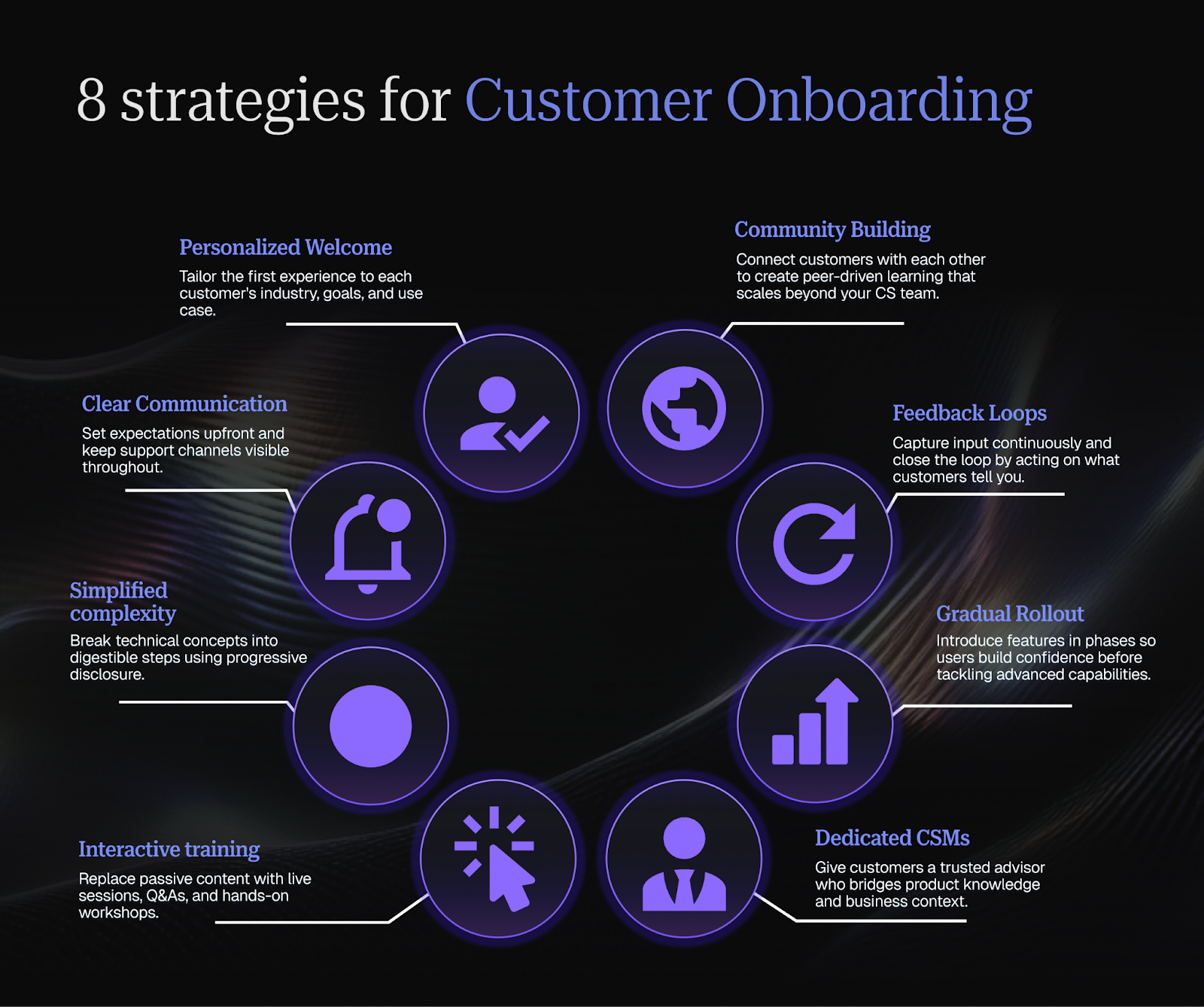
Personalize welcome and product orientation
First impressions matter. Start each customer relationship with a welcome experience that acknowledges their specific business context, goals, and challenges.
This means more than using their company name in an email template. Customize your product orientation to highlight features relevant to their industry and use cases. When customers feel understood from day one, they're more likely to engage deeply with your onboarding process and trust your team's guidance.
The business impact of personalization in onboarding is measurable. Customers who receive tailored welcome experiences report higher satisfaction scores, complete onboarding milestones faster, and demonstrate stronger early engagement with your product. This early momentum creates positive patterns that persist throughout the customer lifecycle, with effective onboarding content making customers 86% more likely to remain loyal to your product long-term.
The business impact of personalization in onboarding is measurable. Customers who receive tailored welcome experiences report higher satisfaction scores, complete onboarding milestones faster, and demonstrate stronger early engagement with your product. This early momentum creates positive patterns that persist throughout the customer lifecycle.
Maintain clear communication and support
Ambiguity kills momentum in onboarding. Set clear expectations about timelines, milestones, and what success looks like at each stage.
Make your support channels obvious and easy to access. Regular check-ins show you're invested in their success and create opportunities to address concerns before they become blockers. Build in structured feedback loops so you can course-correct quickly when things aren't working.
Simplify technical complexity
SaaS products are inherently complex, but your onboarding shouldn't feel overwhelming. Break down technical concepts into digestible pieces that non-technical users can grasp.
Step-by-step guides, visual tutorials, and access to live technical support can make your product more approachable. The goal is progressive disclosure: introduce complexity gradually as users build confidence and competence with core features.
Make your training sessions interactive
Passive learning has its limits. Interactive training sessions like webinars, live Q&A calls, and hands-on workshops create engagement that recorded content can't match.
These sessions give customers a chance to ask questions specific to their situation and learn from peers facing similar challenges. The real-time interaction builds relationships between your team and your customers while accelerating understanding.
Utilize Customer Success Managers
Dedicated CSMs transform onboarding from a transactional process into a consultative partnership. These team members serve as trusted advisors who understand both your product and your customer's business.
CSMs provide personalized guidance throughout onboarding, help navigate obstacles, and serve as the primary point of contact. This human connection makes customers feel supported and increases their likelihood of reaching value quickly.
Understanding what a CSM does, the key skills required for success, and how to be a successful customer onboarding manager helps you build an onboarding team that combines technical expertise with relationship-building capabilities.
Roll features out gradually
Don't dump your entire feature set on new customers at once. Introduce capabilities in phases, starting with core functionality that delivers immediate value.
This phased approach prevents overwhelm and helps users build competence incrementally. As they master basics, they're ready to explore advanced features. The progression creates a sense of achievement and keeps customers engaged over time.
Gradual rollouts require tracking which features customers actually adopt. Our guides on feature adoption for CSMs and understanding the product adoption lifecycle help you identify which capabilities drive value and which get ignored.
Measure and act on feedback
Collecting feedback is easy. Acting on it is what separates good onboarding programs from great ones.
Build systems that capture customer input throughout onboarding, analyze patterns in that feedback, and make data-driven improvements to your process. When customers see their suggestions implemented, it reinforces that you're genuinely invested in their success.
Learn more about collecting and implementing customer insights and best practices for gathering customer feedback to create feedback loops that continuously improve your onboarding experience.
Establish a community
Your customers can learn as much from each other as they can from your team. Build spaces where users can connect, share experiences, and solve problems together.
Forums, user groups, and customer conferences create networks of support that scale beyond what your CS team can provide alone. These communities also generate valuable peer-to-peer learning and can turn satisfied customers into active advocates. Building a strong customer advocacy program alongside your onboarding efforts creates a flywheel where successful customers help onboard new ones.
Onboarding metrics and measurements in Customer Success
What gets measured gets managed. To improve your onboarding process, you need clear visibility into what's working and what isn't.
Key Performance Indicators for onboarding success
Start by defining metrics that actually matter for your business. Common onboarding KPIs include time-to-first-value, feature adoption rates, onboarding completion percentages, and customer health scores during the implementation phase.
Don't track metrics just because you can. Choose KPIs that connect directly to business outcomes like retention, expansion, and customer satisfaction. Quality metrics beat quantity every time. When you track the right KPIs and act on them, you create a feedback loop that continuously improves your onboarding program and drives better business results.
For a deeper understanding of which metrics matter most, explore our guide on customer success metrics every CSM should know and essential KPIs for tracking success.
How to track time-to-value and customer engagement
How quickly do customers achieve meaningful value from your product? Time-to-value (TTV) is one of the most important onboarding metrics because it directly correlates with retention.
Track when customers complete key activation milestones, achieve their first win, and start using your product regularly. Engagement patterns during onboarding often predict long-term success. Customers who engage deeply early tend to stay longer and expand more.
Measuring these patterns gives you predictive power. When you know which early behaviors correlate with long-term retention, you can coach customers toward those behaviors during onboarding and intervene when engagement falls below healthy thresholds. Research consistently shows that shortening time-to-value is one of the most effective levers for improving retention and increasing customer lifetime value.
How to calculate ROI on onboarding investments
Your onboarding program requires resources like people, tools, content creation, and time. Understanding the return on that investment helps justify continued investment and identify optimization opportunities.
Calculate the cost per onboarded customer and compare it against the lifetime value of those customers. Look at how onboarding quality impacts net revenue retention. Strong onboarding programs pay for themselves many times over through improved retention and expansion.
This financial visibility helps CS leaders make the case for continued investment in onboarding resources, tools, and team development. When executives see clear ROI from onboarding improvements, funding decisions become easier. High-quality onboarding programs multiply revenue through retention and expansion at rates that dramatically outweigh implementation costs, making them one of the highest-return investments in the customer lifecycle.
This financial visibility helps CS leaders make the case for continued investment in onboarding resources, tools, and team development. When executives see clear ROI from onboarding improvements, funding decisions become easier.
Early Indicators of churn risk
Not all onboarding challenges lead to churn, but certain patterns should raise red flags. Customers who miss onboarding milestones, show low engagement, or express frustration early often have higher churn risk.
Build early warning systems that flag at-risk customers during onboarding. The earlier you identify problems, the more time you have to intervene and get the customer back on track. Prevention is always easier than recovery.
The cost difference between saving an at-risk onboarding and recovering a churned customer is dramatic. Early intervention during onboarding typically succeeds at much higher rates than win-back campaigns after churn.
Managing Handoffs and Cross-Functional Collaboration
Onboarding doesn't happen in isolation. Success requires seamless coordination between multiple teams throughout the customer lifecycle.
Sales-to-onboarding transition best practices
The handoff from sales to onboarding is one of the most critical moments in the customer journey. Poor transitions create confusion, duplicate effort, and erode customer confidence.
Establish clear handoff protocols that define what information sales must transfer and when. Include notes on customer expectations, promised deliverables, technical requirements, and key stakeholders. Make the introduction to the onboarding team warm and personal, not a cold email forward.
Organizations that nail this transition see measurably shorter time-to-value. When onboarding teams start with complete context, they avoid the delays and frustration that come from rediscovering information that sales already gathered.
For teams looking to optimize this critical handoff, our guide on streamlining the sales to customer success handoff provides tactical frameworks and best practices.
Coordinating between product, support, and success teams
Effective onboarding requires input from product, support, engineering, and customer success. Product teams provide feature expertise, support resolves technical issues, and CS orchestrates the overall experience.
Create communication channels that keep all teams aligned on customer status. Regular syncs between teams prevent customers from falling through cracks. When everyone has visibility into the onboarding journey, collaboration becomes natural rather than forced.
This alignment particularly matters when problems arise. If a customer hits a technical blocker, you want support and engineering looped in immediately rather than days later. Cross-functional visibility enables faster problem resolution and better customer experiences.
Information transfer and documentation requirements
Nothing frustrates onboarding teams more than missing critical customer information. What were the customer's specific pain points? What customizations did sales promise? Who are the decision-makers and end users?
Build documentation standards that capture this context systematically. Use shared systems that all teams can access and update. The goal is creating a single source of truth about each customer that follows them throughout their lifecycle.
How to transition from onboarding to ongoing customer success
Onboarding has a finish line, but the customer relationship doesn't. The transition from onboarding specialist to ongoing CSM needs to be intentional and smooth.
Define clear criteria for when onboarding is complete, which is typically when customers have achieved specific adoption milestones and realized initial value. Introduce the ongoing CSM before onboarding ends in order to overlap that ensures continuity. Make sure all context transfers so customers don't have to repeat themselves.
Poor transitions create a perception that your organization doesn't communicate internally, eroding customer confidence. Smooth handoffs reinforce that you're a unified team focused on their success, strengthening the relationship for the long term.
Successfully managing lifecycle transitions requires clear processes. Explore our guide on mastering client lifecycle management for strategic frameworks that ensure continuity throughout the customer journey.
How to use Velaris for your customer onboarding process
Modern onboarding requires both strategic thinking and operational excellence. Velaris serves as the operating system for CS teams managing complex B2B onboarding at scale, bringing together visibility, automation, and AI-powered insights in one platform.
Complete visibility across every onboarding stage
Velaris gives you real-time visibility into where every customer sits in their onboarding journey. Instead of hunting through spreadsheets, email threads, and scattered project management tools, you see the complete picture in one place.
Track onboarding milestones, monitor progress against timelines, and identify bottlenecks before they delay implementations. When customers get stuck at specific stages, Velaris surfaces these patterns so you can proactively address common obstacles and continuously improve your onboarding playbooks.
AI-Powered context for every customer interaction
Walking into an onboarding call without full context wastes everyone's time. Velaris AI features like Headlines and CallSense ensure you're always prepared.
Headlines automatically summarizes everything happening in an account by reading through notes, emails, call transcripts, and support tickets. CallSense transforms customer calls into structured intelligence.
Centralized onboarding plans that keep everyone aligned
As your customer base grows, scattered onboarding documentation creates confusion and delays. Velaris Canvas gives each customer a dedicated onboarding workspace where plans, progress, and context live in one shared document.
Create onboarding Canvas pages that combine your implementation roadmap, key stakeholder information, critical milestones, and action items. Your entire team can reference the same living document throughout the journey. When timelines shift or new requirements emerge, update the Canvas once and everyone stays in sync without endless email threads or status meetings.
Metrics that connect onboarding to business outcomes
Velaris helps you measure what actually matters in onboarding. Track time-to-value, monitor feature adoption rates, and see how onboarding quality impacts retention and expansion.
Customer health scores update automatically based on engagement signals, product usage data, and AI-detected sentiment shifts. Early warning systems flag at-risk implementations so you can intervene before customers disengage. The platform surfaces patterns across your entire customer base, showing which onboarding strategies drive the best outcomes and where inefficiencies exist.
Built for cross-functional collaboration
Effective onboarding requires coordination between sales, CS, support, product, and operations. Velaris creates a single source of truth that all teams can access and contribute to.
Sales handoffs include complete context about what was promised and why the customer bought. Support teams see onboarding status and can prioritize tickets accordingly. Product teams get direct visibility into where customers struggle during implementation, informing roadmap decisions. Everyone works from the same data, eliminating the miscommunication and dropped balls that plague siloed tools.
For CS leaders, this means replacing gut feelings with data-driven decisions about resource allocation, process improvements, and team performance. You can prove the ROI of onboarding investments by connecting implementation quality directly to revenue metrics.
Conclusion
Customer onboarding is an investment in the foundation of every customer relationship. The strategies and approaches covered here give you a framework for building onboarding experiences that drive real business results.
The best CS teams continuously refine their onboarding based on data and feedback. What works today might need adjustment tomorrow as your product evolves and customer expectations shift. Stay curious, keep measuring, and always be willing to experiment.
Ready to transform your onboarding process? See how Velaris helps CS teams deliver faster time-to-value, reduce churn risk, and scale onboarding without losing the personal touch.
Book a demo to explore how AI-powered visibility and automation can elevate your customer onboarding experience.
Frequently Asked Questions
How long should a typical B2B SaaS onboarding process take?
The ideal onboarding timeline varies based on product complexity and customer segment, but most B2B SaaS companies aim for 30-90 days. Enterprise customers with complex integrations might need 120+ days, while SMB customers using simpler configurations could complete onboarding in 2-3 weeks. The key is setting realistic expectations upfront and defining clear milestones that demonstrate progress.
Should we charge for onboarding services or include them in the subscription price?
This depends on your market positioning, customer segment, and product complexity. Many SaaS companies include basic onboarding in their subscription to reduce friction and accelerate adoption, while charging for premium services like custom integrations, dedicated onboarding specialists, or accelerated timelines.
Consider offering tiered onboarding packages: a self-service option for cost-conscious customers, a standard guided onboarding included in annual contracts, and premium white-glove service for enterprise deals.
What's the optimal ratio of onboarding specialists to new customers?
Industry benchmarks suggest one onboarding specialist can handle 8-15 concurrent implementations for mid-market customers, though this varies widely based on product complexity and touch model. Enterprise customers typically require 1:3 to 1:5 ratios due to customization needs, while tech-touch or low-touch segments might see one specialist managing 20-30 concurrent onboardings with heavy automation support.
How do we handle customers who go dark or become unresponsive during onboarding?
Customer ghosting during onboarding is a major red flag that requires immediate intervention. Start with a multi-channel approach. If email isn't working, try phone calls, LinkedIn messages, or reaching out to different stakeholders in their organization. Often, silence indicates internal blockers like budget freezes, competing priorities, or champion turnover rather than dissatisfaction with your product.
What role should product teams play in the onboarding process?
Product teams should be deeply involved in onboarding strategy, even if they're not directly interacting with every customer. They need visibility into where customers struggle during implementation because these friction points often indicate product gaps, confusing UX, or missing features that would accelerate adoption. Regular feedback loops between onboarding teams and product help prioritize improvements that reduce manual support burden.
How do we scale onboarding when we're growing quickly but can't hire fast enough?
Rapid growth without proportional hiring requires aggressive automation and self-service investments. Start by documenting your highest-performing onboarding playbooks and identifying which steps can be automated or templatized. Build comprehensive self-service resources (video libraries, interactive demos, knowledge bases) and create cohort-based group onboarding sessions that let one specialist serve multiple customers simultaneously.

The Velaris Team
A (our) team with years of experience in Customer Success have come together to redefine CS with Velaris. One platform, limitless Success.




Velaris is an AI-native Customer Success Platform built for mid-market and enterprise B2B SaaS teams. From customer health scoring and churn prediction to onboarding automation, renewals, and expansion workflows, Velaris helps recurring revenue teams understand account health, reduce churn, and scale customer success with greater visibility and control.