We look forward to showing you Velaris, but first we'd like to know a little bit about you.


Benefits of a Customer Success software
How customer success software stops SaaS churn and drives growth.
The Velaris Team
June 15, 2026
For SaaS and subscription-based businesses, managing customer relationships at scale is one of the hardest things to get right, largely because churn often goes unnoticed until it's too late. That's exactly the problem customer success software is built to solve.
By pulling together data from CRMs, support tools, billing systems, and product analytics into one place, customer success software gives customer success teams a clear picture of every account. This means teams have the visibility to manage relationships proactively rather than reactively. That level of control translates directly into a customer base that grows with the business rather than churning in the background.
Key takeaways
- Customer success software helps businesses catch early signs of churn and triggers the right automated retention workflow before an account is lost.
- The right platform brings all customer data such as CRM, support, billing, and product usage into one place. Ensuring that CS teams run at maximum efficiency.
- A customer health score gives CS teams an overview of each account, making it easy to identify which customers are thriving and which ones need attention.
- The most overlooked growth lever for most SaaS businesses isn't the new pipeline; it's the existing customer base. Customer success software surfaces the accounts that are getting consistent value and may be ready for an upgrade.
- The hours CSMs spend on onboarding follow-ups, risk alerts, renewal reminders, and re-engagement campaigns are hours pulled away from the relationships that actually drive growth.
- Product adoption insights collected through platform data give product teams direct insight into how to improve the product or service to match real customer needs.
In this blog, we will be discussing the benefits of customer success software and why businesses that are trying to scale need it to ensure long-term growth.
Let's look at why investing in customer success software can take your business to the next level.
What is customer success software?
Customer success software is a platform that helps businesses proactively manage relationships with existing customers to ensure they achieve their desired outcomes with a product or service.
It basically answers three questions:
- Are my customers healthy?
- Which customers need attention?
- What should my team do next?
If you want a deeper understanding of what customer success actually involves, this guide on Customer Success 101 covers everything you need to know.
Core benefits of customer success software
Reduces churn
Most customers don't announce they're leaving. They quietly stop logging in, skip renewals, and disappear. By the time a cancellation hits, it's usually too late to save the relationship.
Customer success software solves this by detecting the warning signs early, monitoring usage signals like login frequency, session duration, and feature adoption to catch disengagement before it becomes a decision.
Beyond product usage, it tracks broader activity signals like declining email engagement, skipped check-in calls, and silence on NPS surveys, building a complete picture of where a customer stands across every touchpoint.
All of these signals are translated into a Customer Health Score, an indicator that tells a CSM whether an account needs attention. Based on the severity of the health score, CS teams can take appropriate courses of action to avoid churn.
According to Saber, churn prediction models typically identify at-risk customers 30-90 days in advance with 70-85% accuracy, and companies using predictive churn models reduce involuntary churn by 15-25% as a result.
To get the most out of this, businesses need a well-structured dashboard that surfaces the right metrics, something covered in depth in this guide on how to build an effective customer health dashboard.
Centralizes customer data
Most CS teams are working with an incomplete picture. CRM data lives in one tool, support tickets in another, billing somewhere else, and product usage across a separate set of dashboards. By the time a CSM pulls it all together before a call, something is already out of date.
Customer success software brings every data source into one place. The practical effect is straightforward: CSMs spend less time hunting for information and more time acting on it.
It also closes the gaps between teams. When everyone is working from the same data, the usual miscommunications around account health, renewal status, and open issues stop happening. Sales, support, finance, and CS are no longer operating on different versions of the same customer.
Customized reporting tools
One of the most valuable capabilities of customer success software is the ability to build reporting and dashboards around the metrics that actually matter to your business, not just the arbitrary ones that come pre-loaded out of the box.
Every CS team tracks success differently. Some prioritize churn rate and renewal forecasting. Others focus on feature adoption, onboarding completion rates, or time-to-value. Customized dashboards let teams surface the KPIs most relevant to their goals, so CSMs and team leads aren't sifting through irrelevant data to find what they need.
Real-time reporting is another critical advantage. Instead of waiting for end-of-month reviews to spot a problem, CS teams can see account health shifts as it happens and respond immediately.
When a cluster of accounts starts showing declining engagement at the same time, the dashboard surfaces it, giving teams the context to act before it becomes a pattern.
Automates retention workflows
An automated retention workflow is a set of predefined triggers built into the customer success platform that activate automatically when a customer shows signs of risk.
When an account shows signs of risk such as declining usage, missed milestones, or a dropping health score, the platform responds automatically. Renewal reminders go out ahead of schedule, follow-up tasks get assigned to the right CSM, and personalized outreach campaigns launch based on the specific signals detected.
High-risk accounts are automatically escalated to CSMs, ensuring no customer slips through the cracks. The result is a retention process that runs quietly in the background.
Today, many of these capabilities are being enhanced further by AI, with tools designed specifically to automate workflows. You can explore how in this guide on the Top 10 Best AI Customer Success Tools for 2026.
Improves customer onboarding
Customer success software guides new customers through a structured onboarding path, ensuring they can find their footing with the product without being overwhelmed from the moment they sign up.
This support looks like training resources, automated in-app messages, and step-by-step walkthroughs, ensuring customers know exactly what to do next.
What makes this especially powerful is the visibility it gives CS teams on the backend. Customer success software tracks exactly where each customer is in their onboarding journey. When a customer falls behind, it flags it immediately. Teams don't have to guess who needs help, they can step in before it’s too late.
All of this feeds into one of the most important metrics in customer success: time-to-value. The faster a customer reaches their first meaningful outcome, the moment they genuinely feel the product working for them. This is when they are more likely to stick around.
For teams looking to build this kind of structure from the ground up, this SaaS onboarding checklist covers the key steps to ensuring a smooth and consistent customer journey.
According to ProductLed's 2025 benchmark report, the median free-to-paid conversion rate sits at 9%, while top-quartile companies achieve nearly 24%, a gap that largely comes down to how well teams identify and act on the right signals at the right time.
Increases product adoption
Product adoption is about understanding how customers are actually using the product and using that data to drive improvements.
Customer success managers sit in a unique position; they collect firsthand insight from the software into where customers struggle, which features go unused, and what gaps exist between what the product offers and what customers actually need.
Product teams can use this information to simplify, remove, or improve features in the product. Similarly, recurring customer needs highlight exactly where new functions should be built.
Velaris, a highly rated Customer Success platform on G2, introduced its AI copilot after recognizing through customer data that users were finding dashboard management overly complex, turning a common pain point into a product improvement.
Increases expansion revenue
The most efficient revenue a business can generate is the revenue that comes from customers it already has. Acquiring a new customer costs significantly more than growing an existing one, yet many businesses leave that opportunity on the table simply because they don't have the visibility to act on it at the right time.
Customer success software changes that by turning the existing customer base into a structured, trackable source of growth.
It starts with surfacing the right opportunities. By using the metrics set by the CS team, the platform identifies customers who are consistently getting value and may be ready for more. Not every customer reaches this point at the same time.
When a CSM reaches out about an upgrade, and they can point to exactly how the customer is using the product and where they're hitting the limits of their current plan, it doesn't feel like a sales call. It feels like the next step the customer probably already sensed was coming.
On the renewal side, customer success software ensures no account reaches its renewal date unnoticed. Automated workflows trigger renewal conversations at the right time, so the outreach always happens.
Together, expansions and renewals create a compounding revenue motion, where the existing customer base isn't just maintained, but grows with your business.
Reduces team burnout
As a company grows, the customer base grows with it, but headcount rarely keeps pace. That gap lands squarely on CSMs, who end up stretched across too many accounts, buried in admin work, and left with little time for the relationships that actually drive retention. It's a slow burn that leads to burnout, and burnout leads to turnover, which only makes the problem worse.
Customer success software doesn't solve the headcount problem, but it changes what the existing team spends its time on. When re-engagement emails, risk alerts, and renewal reminders run automatically, CSMs get back the hours that were going to admin, and put them toward the accounts that need real attention.
The business effect compounds over time. A smaller team can manage a significantly higher volume of accounts without the quality of those relationships dropping. That means less pressure to hire reactively, lower onboarding costs for new CSMs, and a team that isn't perpetually running on empty.
Improves customer relationships
Customer success software removes the dependency on a singular CSM by ensuring every customer interaction is backed by the full context of the account. This includes anything from communication logs to support tickets. This ensures the quality of the relationship doesn't change based on who owns the account.
When a CSM leaves or an account gets reassigned, the incoming team member has everything they need to pick up the relationship without missing a beat. There are no awkward restarts, no gaps in communication, and no customer having to re-explain their situation from scratch.
No CSM can hold the full history of every account in their head; it's simply the reality of managing relationships at scale. The problem arises when that gap becomes visible to the customer: a missed follow-up, a repeated question, a conversation that starts from scratch instead of picking up where it left off.
Customer success software fixes this gap. Every time a CSM opens an account, they're walking in fully briefed, not piecing together context from memory or buried email threads, but starting exactly where the last conversation ended.
The result on the customer side is a relationship that feels remarkably consistent. The CSM they're talking to, whether it's the same one they've had for two years or someone new who just took over the account, already knows them. That continuity is what builds long-term relationships.
How to choose the right customer success software
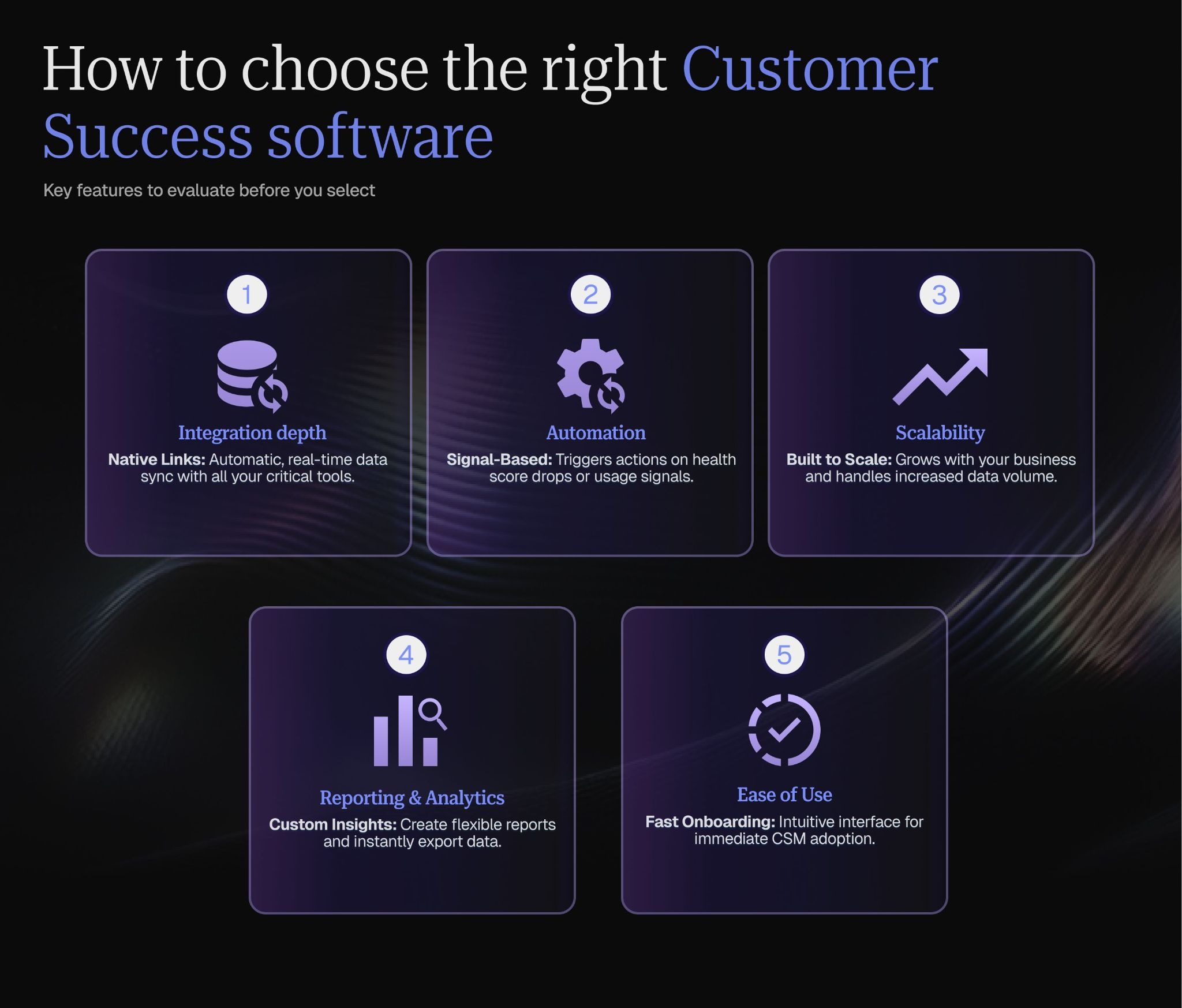
Choosing the right customer success software is one of the most important decisions a growing business can make. Before selecting a platform, businesses should evaluate the following key features:
Integration depth
A platform is only as useful as the data feeding into it. Look for native connections to your CRM, support tool, billing system, and product analytics. If pulling data in requires manual exports or custom engineering work, the health scores it produces will always be slightly out of date.
Automation
The core question isn't whether a platform has automation; most do. It's whether workflows are triggered by real signals like health score drops, usage changes, and renewal windows, or just scheduled sends. Predictive churn and upsell identification are worth evaluating too, but only if the underlying data model is sound.
Scalability
A platform that works for fifty accounts needs to work for five hundred without requiring a rebuild. Check whether pricing scales proportionally with your customer base and whether the infrastructure holds up as data volume increases.
Reporting and analytics
Pre-built dashboards are a starting point, not a solution. The platform should let your team build reporting around the metrics that matter, churn rate, time-to-value, feature adoption, and export that data for finance, product, and leadership without friction.
Ease of use
A powerful platform that takes six months to embed isn't delivering value in month two. Onboarding speed for new CSMs and the intuitiveness of the day-to-day interface matter more than feature depth that nobody ends up using.
With a wide range of platforms available, choosing the right customer success software comes down to understanding your team's specific needs. For a closer look at today's leading tools, this guide to the top 10 customer success software tools breaks down the key options to help you make a more informed decision.
Conclusion
The businesses that grow their customer base and the ones that quietly lose it are often running the same playbook; the difference is whether their CS team can see what's coming before it happens.
That's what customer success software actually does. Not just centralise data or automate emails, but give teams the visibility to act early, consistently, across every account, without needing to grow headcount every time the customer base does.
The effects build on each other. Customers who onboard well adopt the product faster. Customers who adopt the product deeply are easier to retain. Customers who are retained long enough become expansion opportunities. None of that happens reliably without a system underneath it.
Customer success software is that system. For businesses serious about scaling, it's not a tool that makes the CS team's life easier, though it does that too. It's what makes the whole retention and growth motion repeatable.
Book a demo to see how Velaris, a highly rated Customer Success platform on G2, can help your team get there.
Frequently Asked Questions
How is customer success software different from a CRM?
A CRM is primarily built for managing the sales pipeline and tracking pre-sale interactions. Customer success software picks up where the CRM leaves off, focusing on what happens after the sale. It monitors ongoing product usage, tracks account health, automates retention workflows, and helps teams manage the post-sale relationship in a way that a CRM was never designed to do.
Does customer success software replace the need for CSMs?
No. It makes CSMs more effective. The platform handles the monitoring, alerting, and routine workflows so CSMs can spend less time on admin and more time on the high-value conversations and relationships that actually drive retention and growth. The human element remains essential; the software just removes the noise around it.
Can customer success software predict churn before it happens?
Yes, to a significant degree. By analyzing behavioral signals and feeding them into a customer health score, the platform can identify accounts that are at risk weeks or even months before a cancellation occurs. According to Saber, churn prediction models typically identify at-risk customers 30 to 90 days in advance with 70 to 85% accuracy when properly implemented.
How does customer success software help smaller CS teams manage large customer bases?
It does this through automation. Rather than requiring a CSM to manually monitor every account, the platform watches for risk signals and triggers the appropriate response according to the predefined set of actions configured by the cs team. This means a small team can manage a significantly larger customer base without every account requiring hands-on attention.

The Velaris Team
A (our) team with years of experience in Customer Success have come together to redefine CS with Velaris. One platform, limitless Success.




Velaris is an AI-native Customer Success Platform built for mid-market and enterprise B2B SaaS teams. From customer health scoring and churn prediction to onboarding automation, renewals, and expansion workflows, Velaris helps recurring revenue teams understand account health, reduce churn, and scale customer success with greater visibility and control.