We look forward to showing you Velaris, but first we'd like to know a little bit about you.


Customer Success 101: Everything You Need to Know
Explore Customer Success basics, top strategies, essential tools, and tips.
The Velaris Team
June 19, 2026
Customer Success is a proactive approach focused on helping customers achieve their desired outcomes, or “success”. In SaaS, where revenue depends on renewals and expansion, this shifts from reactive support to proactive engagement.
By combining clear strategy, customer data, and the right tools, Customer Success teams can identify risks early, and create consistent value at every stage of the customer journey. The result is higher retention, increased expansion revenue, and a more predictable, scalable growth engine.
Key takeaways
- By the time churn shows up in your retention data, it's already too late. Customer Success works precisely because it intervenes before that point
- CSMs, onboarding specialists, and CS Ops serve different parts of the lifecycle; when one is missing, the others compensate in ways that don't scale
- Early onboarding determines long-term retention more than any later intervention
- Health scores only work if leading indicators are weighted by what actually correlates with renewal in your customer base, not what's easiest to track
- AI doesn't replace CSM judgment, it surfaces the signals that would otherwise get missed across a large book of business
- Scaling Customer Success without standardized processes doesn't produce more coverage; it produces inconsistent coverage at higher volume
What is Customer Success?
Definition of Customer Success in SaaS
As we mentioned above, Customer Success is the proactive function responsible for ensuring customers achieve their desired outcomes while using your product. When it comes to SaaS, this means helping customers realize value continuously, and not just at the point of purchase.
Unlike traditional models where success is measured by closed deals, Customer Success focuses on what happens after the sale.
The goal is to guide customers toward meaningful outcomes, whether that is saving their time, constantly providing them with access to educational material on your product, or solving specific problems they may encounter as they engage with you. When customers achieve the outcomes they desire, they are more likely to renew, expand, and stay long term.
How it differs from support and account management
Customer Success is often confused with support or account management, but each serves a different purpose.
Support is reactive. It responds to issues when customers raise them, focusing on resolving problems quickly and efficiently.
Account management is more commercial. It focuses on maintaining relationships and driving revenue through renewals and upsells.
Customer Success sits in between but with a different mindset. Instead of waiting for problems or focusing only on revenue, it works to prevent issues ahead of time, guide adoption, and ensure customers consistently see value.
Simple example of Customer Success in action
Imagine a SaaS company that provides project management software.
A support team would help when a customer encounters an issue with a feature. An account manager might step in during renewal to discuss pricing or upgrades.
A Customer Success Manager, however, would take a more proactive approach. They would monitor how the customer is using the product, identify that key features are underutilized, and reach out with tailored recommendations or training. They might also set milestones during onboarding to ensure the customer reaches value quickly.
As a result, the customer becomes more engaged, achieves their goals faster, and is far more likely to renew and expand.
Why is Customer Success important?
Drives retention and reduces churn
Customer Success directly impacts whether customers stay or leave. By proactively guiding customers toward value, teams can identify risks early and address issues before they turn into churn. Instead of reacting to cancellations, Customer Success focuses on preventing them by ensuring customers continuously see the benefit of the product.
Expands revenue through upsell and cross-sell
Growth in SaaS doesn’t just come from acquiring new customers. It also comes from expanding existing accounts through upselling and cross-selling. When customers are successful, they are more likely to increase usage, upgrade plans, or adopt additional features. Customer Success plays a key role in identifying these opportunities and aligning them with customer goals, making expansion feel natural rather than forced.
Builds customer loyalty and advocacy
Customers who consistently achieve their desired outcomes are more likely to trust your product and your team. This leads to stronger relationships, higher satisfaction, and increased loyalty. Over time, these customers can become advocates, referring others and contributing to long-term brand credibility.
Supports long-term business growth
Customer Success creates a foundation for predictable and sustainable growth. By improving retention and expanding existing accounts, businesses can reduce reliance on constant new acquisition. This leads to more stable revenue, better forecasting, and a stronger overall business model.
When does a company need Customer Success?
Deciding when to make your first customer success hire is a balancing act between capacity, product complexity, and the need for proactive value delivery.
Many early-stage companies make the mistake of hiring a dedicated CS person too early, before they have a repeatable onboarding process or even a clear definition of what “success” looks like for their customers. When this happens, the new hire often gets pulled into reactive support tickets, losing the time needed for the strategic, proactive work that prevents churn.
Conversely, hiring too late can lead to founder burnout and reactive fire-fighting. You should consider your first CS hire when:
- Capacity is strained: When founders or sales leaders are spending more time solving product usage issues or managing account relationships than they are on sales or product development.
- Product complexity demands guidance: If your product requires significant setup, training, or ongoing adoption to deliver value, waiting for the customer to figure it out leads to early-stage churn.
- Retention is a business priority: When revenue growth is heavily dependent on renewals and expansion rather than just new acquisition, a dedicated role is needed to protect and grow that revenue base.
The right time to hire is when you have enough volume to justify a role, but enough process in place to allow that person to focus on proactive strategy rather than just reactive support.
Key roles in Customer Success
Customer Success is not a single role, but a coordinated function made up of multiple roles that work together to drive customer outcomes. Each role focuses on a different part of the customer journey, from onboarding to scaling operations.
Customer Success Manager (CSM)
The Customer Success Manager is the primary owner of the customer relationship after the sale. Their core responsibility is to ensure that customers achieve their desired outcomes and continue to see value from the product over time.
CSMs typically:
- Guide customers through onboarding and adoption
- Build relationships with key stakeholders
- Monitor account health and identify risks early
- Drive renewals and expansion opportunities
A strong CSM does more than just regular check-ins. They also act as a strategic partner, helping customers align product usage with their business goals. This often involves proactive outreach, tailored recommendations, and ongoing value reinforcement.
Onboarding specialist
The onboarding specialist focuses on the early stages of the customer journey, where first impressions are formed and long-term success is often determined.
Their role includes:
- Setting up accounts and ensuring a smooth implementation
- Guiding customers through initial product usage
- Reducing time to value with structured onboarding plans
- Identifying early blockers and resolving them quickly
Effective onboarding specialists ensure that customers reach their first meaningful outcome as quickly as possible. Since early engagement strongly influences retention, this role plays a critical part in reducing early-stage churn.
Customer Success Operations (CS Ops)
Customer Success Operations supports the entire CS function by building the systems, processes, and data infrastructure needed to scale.
Their responsibilities include:
- Defining and maintaining customer health scoring models
- Managing tools and integrations across the CS tech stack
- Creating workflows, playbooks, and automation
- Analyzing performance metrics and reporting insights
CS Ops ensures that Customer Success is not dependent on individual effort alone. By standardizing processes and enabling data-driven decision-making, they make it possible for teams to scale efficiently while maintaining consistency.
Key components of Customer Success
Customer onboarding
Customer onboarding is one of the most critical components of Customer Success because it sets the foundation for the entire relationship. The goal of onboarding is to help customers reach their first meaningful outcome as quickly as possible, often referred to as time-to-value. The faster a customer experiences value, the more likely they are to stay engaged and continue using the product.
To achieve this, onboarding needs to be structured and consistent. Without a clear process, customers can feel lost or overwhelmed, leading to early disengagement. Standardizing onboarding through defined milestones, guided steps, and clear success criteria ensures that every customer has a reliable path to value.
Platforms like Velaris, a highly rated software on G2, support this by enabling teams to create repeatable onboarding playbooks and workflows. Automation can be used to trigger the right actions at the right time, reducing manual effort while ensuring that no critical step is missed.
Customer health monitoring
Once customers are onboarded, ongoing visibility into their health becomes essential. Customer health monitoring involves tracking key signals such as product usage, engagement levels, and satisfaction metrics to understand how well a customer is doing.
By combining these signals, teams can identify risks early. For example, a drop in usage or a spike in support tickets may indicate that a customer is struggling. Early detection allows teams to intervene before issues escalate into churn.
With tools like Velaris, a highly-rated CS software on G2, teams can build custom health scores tailored to different lifecycle stages. This makes it easier to prioritize accounts, track changes over time, and focus attention where it is needed most.
Customer engagement
Customer engagement is what sustains the relationship over time. It involves ongoing communication, relationship building, and ensuring that customers continue to see value as their needs evolve.
Effective engagement requires frequency as well as relevance. Teams need to tailor interactions based on customer goals, usage patterns, and lifecycle stage. This includes sharing best practices, providing guidance, and reinforcing the value of the product through meaningful conversations.
Engagement also plays a key role in capturing feedback and understanding customer sentiment. By staying closely connected to customers, teams can continuously adapt their approach and ensure that the experience remains aligned with customer expectations.
Core Customer Success strategies
Customer Success strategies are what turn the concept of “helping customers succeed” into a structured, repeatable system. The most effective teams combine multiple strategies to ensure customers consistently achieve value across the entire lifecycle.
Proactive engagement
Customer Success is fundamentally proactive. Instead of waiting for customers to raise issues, teams monitor usage and behavior to identify risks and opportunities early.
Personalized support
Customers expect experiences tailored to their needs, and not generic interactions. In fact, 80% of consumers are more likely to purchase when brands offer personalized experiences, and being treated like an individual is a key driver of loyalty.
In Customer Success, this means adapting communication, recommendations, and engagement based on who each customer is.
Feedback loops
Strong Customer Success teams continuously collect and act on feedback like surveys, past conversations, and behavioral signals. Feedback loops allow teams to identify issues early, improve the product experience, and adapt their approach over time. Without feedback loops, teams risk making decisions based on assumptions rather than real customer needs.
Data-driven decision making
Customer Success relies heavily on data to guide actions. Usage metrics, engagement signals, and health scores help teams prioritize accounts correctly. Data-driven approaches make Customer Success scalable and consistent, especially as customer bases grow.
Customer advocacy programs
Satisfied customers can become powerful advocates. Advocacy programs focus on turning successful customers into content that can be used to boost confidence in prospective customers who are still on the fence about buying in. This not only strengthens retention but also reduces acquisition costs by leveraging word-of-mouth and social proof.
Cross-functional collaboration
Customer Success does not operate in isolation. It requires close alignment with product, sales, and support teams. For example, product teams rely on customer feedback to prioritize features, while sales teams need to align expectations with actual product capabilities. Strong collaboration ensures a consistent customer experience across all touchpoints.
Value realization
The ultimate goal of Customer Success is to ensure customers achieve meaningful outcomes. This means consistently tying product usage back to business value. When customers clearly see the impact of the product, they are more likely to renew and expand.
Customer journey mapping
Understanding the full customer journey is essential for identifying gaps and improving the experience. Mapping each stage, from onboarding to renewal, helps teams understand customer goals, challenges, and emotions at every step. This structured view makes it easier to design better engagement strategies.
Scalable processes
As companies grow, Customer Success needs to scale without losing quality. This requires standardized processes and automation. Without scalability, teams will end up becoming reactive and inconsistent, especially with larger customer bases.
Retention and renewal strategies
Retention is the core outcome of Customer Success. Strong retention strategies focus on early risk detection and continuous value delivery. Customer retention is directly tied to business performance, as retaining customers has a significant impact on long-term profitability and growth
Quarterly Business Reviews
The Quarterly Business Review (QBR) is a strategic touchpoint between a Customer Success team and key customer stakeholders. Unlike a standard check-in, the QBR is designed to discuss long-term business value.
By reviewing performance metrics and aligning product usage with the customer's specific goals, these reviews strengthen the partnership and validate ROI. There’s also a chance to identify opportunities for future expansion.
How to build a Customer Success strategy step-by-step
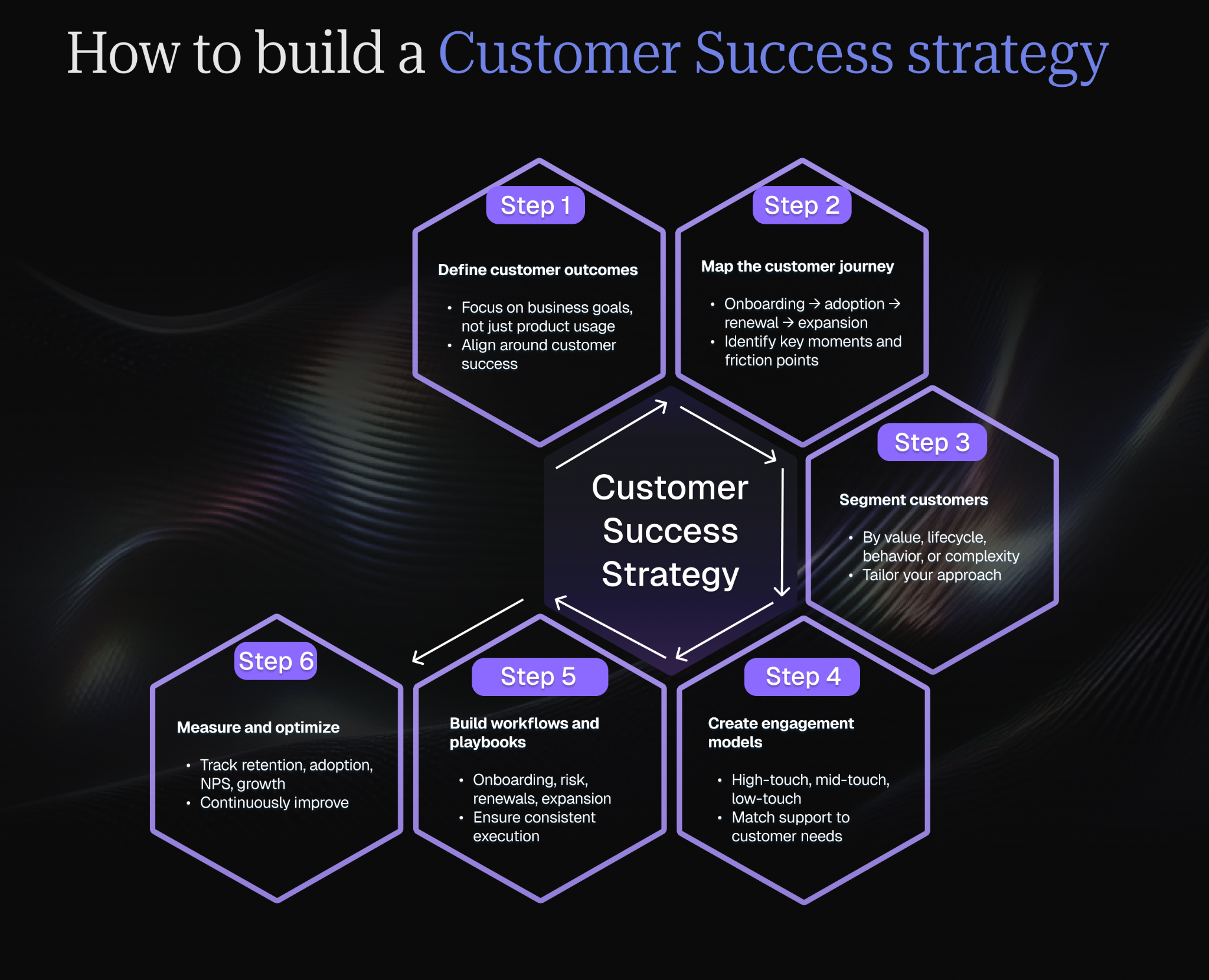
Step 1: Define customer outcomes
Start by identifying what success actually means for your customers. This should go beyond product usage and focus on the business outcomes they want to achieve, such as saving time, increasing revenue, improving efficiency, or reducing risk. Clear outcomes give your team a shared target to work toward.
Step 2: Map the customer journey
Next, map the key stages customers move through, from onboarding to adoption, renewal, and expansion. This helps you understand where customers need guidance, where they may face friction, and which moments are most important for delivering value.
Step 3: Segment customers
Not every customer needs the same level of support. Segment customers based on factors like company size, revenue potential, product complexity, lifecycle stage, or health. This allows your team to tailor engagement instead of applying the same approach to every account.
Step 4: Create engagement models
Once customers are segmented, define how your team will engage with each group. High-value or complex accounts may need high-touch support, while lower-touch segments can be supported through automation, self-service, and scalable communication.
Step 5: Build workflows and playbooks
Turn your strategy into repeatable processes. Build playbooks for onboarding, risk management, renewals, expansion, and customer check-ins. These workflows help teams act consistently and ensure important steps are not missed.
Step 6: Measure and optimize
Finally, track whether your Customer Success strategy is working. Monitor metrics like retention rate, product adoption, customer health, NPS, and expansion revenue. Use these insights to refine your journey, segments, and playbooks over time so your strategy improves as your customers and business evolve.
How to operationalize Customer Success at scale
Standardize processes
Scaling Customer Success starts with consistency. Standardizing processes ensures that every customer receives a reliable experience, regardless of who manages the account. This includes defining clear onboarding steps, engagement cadences, renewal workflows, and success criteria. Without standardization, outcomes vary widely, making it difficult to scale effectively or measure performance.
Automate repetitive tasks
As the customer base grows, manual work quickly becomes a bottleneck. Automating repetitive tasks such as onboarding emails, follow-ups, health alerts, and lifecycle-based outreach allows teams to maintain quality while increasing capacity. Automation also reduces the risk of human error and ensures that key actions happen at the right time without relying on manual intervention.
Align teams across functions
Customer Success does not operate in isolation. Scaling effectively requires alignment across product, sales, and support teams. This means sharing customer insights, defining clear ownership of actions, and aligning on common goals such as retention, adoption, and expansion. When teams work from the same understanding of the customer, the experience becomes more cohesive and effective.
Monitor customer health continuously
At scale, it is not possible to manually track every account. Continuous health monitoring allows teams to identify which customers are thriving, which are at risk, and where opportunities exist. By combining usage data, engagement signals, and feedback, teams can prioritize their efforts and focus on the accounts that need attention most.
Platforms like Velaris enable this by combining automation through Scenarios, structured Success Plans, and workflow execution into a single system. This allows teams to standardize processes, automate engagement, and act on customer signals in real time, making Customer Success both scalable and consistent.
Common challenges in Customer Success
High customer expectations
Customers expect fast responses, personalized experiences, and continuous value from the product. As competition increases, expectations continue to rise, making it harder for teams to consistently meet them. When expectations are not met, even strong products can struggle to retain customers.
Customer churn
Churn remains one of the biggest challenges in Customer Success. Customers may leave due to poor onboarding, low product adoption, or misaligned expectations. Since churn directly impacts revenue, reducing it is a core priority for every Customer Success team.
Fragmented data and systems
Customer data is often spread across multiple tools such as CRM systems, support platforms, and product analytics tools. This fragmentation makes it difficult to get a complete view of the customer, slowing down decision-making and making it harder to identify risks or opportunities early.
How to overcome Customer Success challenges
Proactive engagement strategies
Instead of waiting for customers to raise issues, teams need to engage proactively based on usage patterns, lifecycle stages, and potential risks. This helps prevent problems before they escalate and ensures customers consistently see value.
Early churn detection
Identifying churn risk early is critical. By monitoring signals such as declining usage, reduced engagement, or negative feedback, teams can intervene before customers decide to leave. Early action significantly increases the chances of retention.
Adapting when customers are under budget pressure
A customer may still value the product, but internal cuts or hiring freezes can force them to reduce spend.
In these situations, CS teams should proactively review whether the contract still fits the customer’s current needs. That might mean reducing unused seats, removing add-ons, shifting them to a better-fit plan, or helping them focus on the features that deliver the clearest ROI.
This can feel difficult because it may reduce short-term revenue. But right-sizing a contract early can protect the relationship and prevent full churn later.
Centralizing customer data
Bringing all customer data into a single system allows teams to understand the full customer context. When data from product usage, support interactions, and communication is unified, it becomes much easier to identify patterns, prioritize accounts, and take action quickly.
Platforms like Velaris address these challenges by creating a unified customer context and layering AI-driven insights on top. This enables teams to detect risks earlier, understand customer behavior more clearly, and respond with the right actions at the right time.
When CS can't fix it: recognising product-driven churn and escalating it
When a product lacks clear ROI or has persistent adoption friction, CS teams are set up to fail, because they are essentially building human relationships to compensate for a structural gap in the product itself. Recognizing this distinction is critical, as it shifts the focus from "fixing the customer" to "fixing the product."
How to diagnose the root cause
Before escalating, determine if the friction is behavioral or structural:
- Is it a CS problem? If the customer is struggling because they haven't been onboarded correctly, do not understand how to use features, or have expectations misaligned with what the product offers, this is a CS problem. The solution lies in training, documentation, or better expectation setting.
- Is it a Product problem? If the customer is fully trained, uses the product consistently, but still cannot achieve their desired business outcomes, this is a product problem. Signs include low feature adoption despite proactive outreach, recurring support tickets regarding the same usability hurdles, or customers explicitly stating the product doesn't solve their workflow needs.
How to escalate effectively
When you identify a product-driven churn risk, escalating it requires more than a complaint—it requires data.
- Bring the "Why": Product teams are driven by data. Present usage metrics, support ticket volumes, and, most importantly, qualitative feedback that explains the business impact of the product gap.
- Quantify the cost: Clearly link the product gap to retention and expansion revenue. Explain that this isn't just one disgruntled customer, but a pattern that puts renewal revenue at risk.
- Collaborate, don't blame: Frame the feedback as a partnership. Instead of saying, "The product is failing our customers," say, "We’re seeing a pattern where customers are hitting this friction point, and fixing it would significantly improve our renewal rate for this segment."
By proactively identifying these gaps, CS teams can move from being firefighters to being strategic partners, ensuring that product development is directly fueled by real-world customer outcomes.
How AI is transforming Customer Success
Predictive insights
AI is shifting Customer Success from reactive to predictive. Instead of relying on historical reports, teams can use AI to analyze patterns across usage, engagement, and customer behavior to anticipate what will happen next. This makes it possible to identify at-risk accounts before they churn and uncover expansion opportunities earlier, allowing teams to prioritize their efforts more effectively.
Automated workflows
As Customer Success scales, manual execution becomes a limitation. AI enables workflows to be triggered automatically based on customer signals such as declining engagement, lifecycle changes, or sentiment shifts. This ensures that the right actions happen at the right time without relying on constant human intervention, improving both efficiency and consistency across the team.
Real-time customer intelligence
One of the biggest advantages of AI is the ability to process and interpret large volumes of data in real time. Customer interactions, support conversations, and product usage can all be analyzed continuously to surface insights as they happen. This gives teams immediate visibility into customer health, emerging risks, and changing needs, allowing them to respond faster and more accurately.
Platforms like Velaris bring these capabilities together by combining AI Topics, Headlines, and CallSense to surface key signals across accounts, while Copilot recommends next best actions based on real-time context. This allows teams to move from understanding customer data to acting on it with speed and precision, making Customer Success more proactive and scalable.
What metrics should Customer Success teams track?
Leading vs Lagging Indicators
Lagging indicators like churn rate, NRR, CLV, and expansion revenue tell you what happened; while leading indicators tell you what's about to.
The most predictive signals are adoption depth (how many features a customer uses and whether that's expanding or contracting), feature breadth, login frequency, support ticket sentiment, and engagement with CSM communications.
No single signal is conclusive. There needs to be a combination of these signals into a health score that weights each input by how strongly it correlates with renewal in your customer base. A declining score should trigger intervention while there's still time to change the outcome.
Retention rate
Retention rate measures the percentage of customers who continue using your product over a given period. It is one of the most important indicators of Customer Success performance because it reflects whether customers are consistently finding value. A high retention rate suggests strong onboarding, engagement, and ongoing support, while a declining rate often signals underlying issues that need attention.
Net revenue retention (NRR)
Net Revenue Retention (NRR) goes a step further by measuring how much revenue is retained from existing customers, including expansions, downgrades, and churn. It provides a more complete view of account health and growth. SaaS companies often aim for NRR above 100%, meaning expansion revenue outweighs any losses, making it a key metric for sustainable growth.
Customer lifetime value (CLV)
Customer Lifetime Value (CLV) estimates the total revenue a business can expect from a customer over the duration of their relationship. It helps teams understand the long-term impact of retention and expansion efforts. Improving retention and increasing product adoption directly contributes to higher CLV, making it a critical metric for strategic decision-making.
Product adoption
Product adoption measures how effectively customers are using your product, including feature usage, engagement frequency, and depth of interaction. It is one of the strongest leading indicators of retention. Customers who actively use key features and integrate the product into their workflows are far more likely to renew and expand, while low adoption often signals future churn risk.
Building a customer-centric culture
Creating a customer-centric culture means making customer outcomes the priority across the entire organization, not just within Customer Success. This requires alignment between teams, shared visibility into customer insights, and a consistent focus on delivering value.
Align teams around customer outcomes
Customer-centric organizations define success based on customer results, not just internal metrics. This means aligning teams around outcomes like retention, product adoption, and expansion. When everyone is working toward the same goals, decisions become more consistent and focused on long-term value rather than short-term wins.
Share insights across departments
Customer insights should not be limited to a single team. Product, sales, support, and Customer Success all need access to the same information to make better decisions. Sharing insights across departments ensures that feedback is acted on holistically, whether that means improving the product, refining messaging, or resolving recurring issues.
Embed customer feedback into decisions
A true customer-centric culture uses feedback as a foundation for decision-making. Instead of relying on assumptions, teams use real customer input to guide priorities, strategies, and improvements. This creates a continuous loop where feedback informs action, and action improves the customer experience.
Platforms like Velaris support this by providing centralized dashboards and AI-driven insights that make customer data accessible and actionable across the organization. This helps teams stay aligned, respond faster, and consistently deliver better outcomes.
Conclusion
Customer Success is more than a support function. It is a proactive growth strategy that ensures customers continuously achieve value, leading to stronger retention, expansion, and long-term revenue stability.
However, strategy alone is not enough. The teams that succeed are the ones that execute consistently. Turning plans into workflows, insights into actions, and engagement into measurable outcomes is what separates high-performing Customer Success teams from reactive ones.
AI and automation are what make this scalable. They enable teams to detect risks earlier, personalize engagement at scale, and act on customer signals in real time without being limited by manual processes.
Platforms like Velaris, a tool that is well-rated on G2, help bring this together by combining unified customer data, AI-driven insights, and automated workflows. This allows teams to operate more proactively, stay aligned, and deliver consistent value across the customer lifecycle.
Book a demo to see how Velaris helps you scale Customer Success.
Frequently Asked Questions
What does a Customer Success Manager do?
A Customer Success Manager (CSM) is responsible for ensuring that customers achieve their desired outcomes using the product. This includes guiding onboarding, driving product adoption, monitoring account health, identifying risks early, and supporting renewals and expansion. The role is proactive and focused on long-term value, rather than just resolving issues.
What is the difference between Customer Success and Customer Experience?
Customer Success focuses on helping customers achieve specific outcomes with a product, particularly in SaaS environments. Customer Experience is broader and covers every interaction a customer has with a company, including marketing, sales, support, and product. Customer Success is a key part of the overall Customer Experience, but with a stronger emphasis on retention and growth.
How do you measure Customer Success?
Customer Success is measured using a combination of metrics that reflect retention, engagement, and growth. Common metrics include retention rate, Net Revenue Retention (NRR), customer lifetime value (CLV), product adoption, and customer satisfaction scores such as NPS. These metrics together provide a clear view of how well customers are achieving value.
How does Customer Success impact revenue growth?
Customer Success drives revenue growth by improving retention and enabling expansion within existing accounts. When customers consistently achieve value, they are more likely to renew, upgrade, and adopt additional features. This creates a more predictable revenue stream and reduces the need for constant new customer acquisition.
How is Customer Success different from support?
Support is reactive and focuses on resolving customer issues when they arise. Customer Success is proactive and focuses on preventing issues, driving adoption, and ensuring customers achieve their goals. While support handles immediate problems, Customer Success works to create long-term value and reduce the likelihood of those problems occurring in the first place.

The Velaris Team
A (our) team with years of experience in Customer Success have come together to redefine CS with Velaris. One platform, limitless Success.




Velaris is an AI-native Customer Success Platform built for mid-market and enterprise B2B SaaS teams. From customer health scoring and churn prediction to onboarding automation, renewals, and expansion workflows, Velaris helps recurring revenue teams understand account health, reduce churn, and scale customer success with greater visibility and control.