We look forward to showing you Velaris, but first we'd like to know a little bit about you.


Account Growth Strategy: How to Grow Existing Customer Accounts
A practical guide to growing existing customer accounts. Learn how to prioritize accounts by potential and readiness, map whitespace and stakeholders, spot growth signals, and turn them into a clear plan, with an example, key metrics, and common mistakes to avoid.
The Velaris Team
October 27, 2026
Companies often put enormous structure around acquiring new customers, but far less around what happens after the deal closes.
As a result, existing accounts can renew year after year at roughly the same size, even when there are untapped teams, use cases, products, or regions that could create more value for the customer and more revenue for the business.
Having a repeatable way to identify which accounts can grow and to turn the right signals into a clear plan can be challenging.
An account growth strategy gives teams a structured way to identify where existing customers could grow and coordinate the actions required to expand the relationship over time.
Key takeaways
- Prioritize accounts based on both growth potential and readiness.
- Look for whitespace across products, teams, use cases, users, and geographies.
- Strong stakeholder coverage makes growth easier and reduces relationship risk.
- Turn every growth opportunity into clear actions, owners, timing, and success measures.
- Account growth strategies should change as customer usage, goals, relationships, and business conditions change.
What is an account growth strategy?
An account growth strategy is a structured approach for increasing the value and scope of existing customer relationships over time.
Growth can take several forms. It might mean increasing product adoption, adding more users, introducing new products or use cases, expanding into other departments or geographies, or building stronger relationships with senior stakeholders. Over time, these changes can lead to higher expansion revenue and greater customer lifetime value.
The opportunity can be substantial. ChartMogul found that expansion now contributes up to 40% of growth for SaaS companies with $15M-$30M+ ARR, highlighting how important existing customers become as companies scale.
At its core, account growth is about understanding the gap between a customer’s current footprint and their potential footprint, then creating a plan to close that gap in a way that aligns with the customer’s goals.
That means looking beyond what the customer buys today and asking where else your product could create meaningful value.
How to build an account growth strategy
A strong account growth strategy starts by deciding where to focus, understanding the customer's current position, and identifying realistic paths for growth. From there, teams need a way to validate opportunities, prioritize them, and turn them into clear actions.
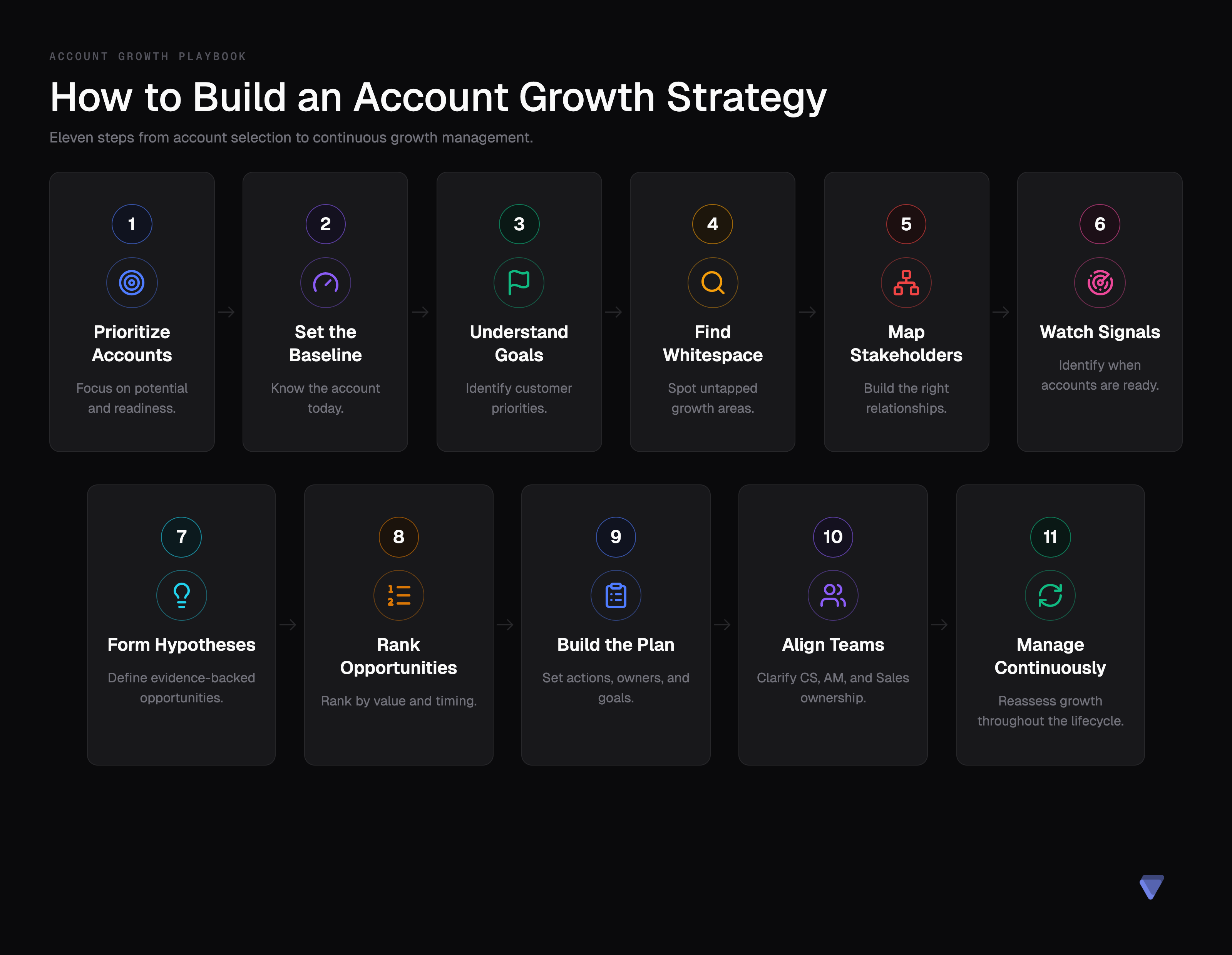
1. Decide which accounts are worth investing in
Not every customer needs the same level of growth planning. Start by identifying the accounts where additional investment is most likely to create value.
Consider factors such as current and potential account value, strategic fit, product adoption, health, customer outcomes, relationship strength, business growth, and likelihood of expansion.
The key distinction is between growth potential and growth readiness. A large enterprise account may have significant theoretical potential but weak adoption and limited stakeholder relationships. A smaller customer may have less total whitespace but be much better positioned to grow today.
This is increasingly a strategic priority for revenue teams. Gartner says 70% of CSOs consider delivering higher returns from key accounts a priority. It also reports that 79% of sales organizations have rebuilt their key-account programs at least once in the past seven years because of underperformance.
A simple growth matrix can help:
Accounts with high potential and high readiness should receive the most immediate attention. High-potential accounts with low readiness may need stronger adoption, value realization, or stakeholder relationships before a growth conversation makes sense.
2. Establish the baseline and understand customer goals
Start by building a clear picture of where the account stands today. That should include the customer’s current contract, products, users, adoption, use cases, health, stakeholder relationships, renewal timing, and any open risks or blockers.
Then look beyond the current state and understand where the customer is trying to go. What outcomes are they focused on this year? What has changed since they first purchased? Which problems are still unsolved? Where is the product already delivering measurable value, and where are there gaps?
This helps separate genuine growth opportunities from simple whitespace. The strongest opportunities sit at the intersection of what the customer needs next and where your product can credibly create more value.
3. Map whitespace and stakeholder coverage
Whitespace is the gap between the customer's current footprint and the areas where your company could potentially create additional value. It might exist across products, users, use cases, departments, regions, or business units.
For example:
Then map the relationships needed to pursue those opportunities. An opportunity to expand into another department is far less actionable if you have no relationship with the people who would evaluate or buy the product there.
There is good evidence for building broader account relationships. Gong’s analysis of millions of sales interactions found that closed-won deals involved 67% more contacts than closed-lost deals.
Whitespace shows where growth could happen, while stakeholder coverage shows whether you have the relationships needed to make it happen.
4. Identify the signals that an account is ready to grow
Account growth should be driven by evidence rather than assumptions.
Product signals might include increasing usage, growing active-user counts, adoption approaching plan limits, or repeated interest in capabilities available in another package.
Customer signals can include strong sentiment, demonstrated ROI, goals being achieved, requests for new use cases, or introductions to other teams. Business changes such as new funding, headcount growth, acquisitions, geographic expansion, or new strategic initiatives can also create opportunities.
Relationship signals matter too. Increased executive engagement, a champion gaining influence, or new senior stakeholders appearing can all improve the likelihood that an opportunity progresses.
Just as important are the signals that suggest you should wait. Poor adoption, unresolved support issues, negative sentiment, renewal uncertainty, executive turnover, or an inability to demonstrate existing value usually need attention before pursuing further growth.
5. Turn opportunities into a prioritized growth plan
Once you identify a potential opportunity, turn it into something that can be tested.
A simple format is:
Because [customer evidence], we believe [customer or team] could achieve [outcome] by [new use case, product, or expansion].
For example:
Because the Operations team has reduced reporting time by 35% and the US division currently runs the same process manually, we believe extending the platform to the US team could help them achieve a similar efficiency improvement.
For each hypothesis, record the evidence, customer problem, proposed opportunity, expected outcome, commercial potential, stakeholders required, risks, and the next step needed to validate it.
Then rank opportunities based on factors such as customer value, evidence, readiness, revenue potential, stakeholder access, timing, and effort.
A simple way to think about prioritization is:
Growth opportunity score = potential × readiness × timing
For the highest-priority opportunities, define the objective, expected customer outcome, stakeholders, actions, owners, timeline, risks, and success measures. This turns broad whitespace into an actionable account growth plan.
6. Align Customer Success, Account Management, and Sales
Account growth frequently crosses team boundaries, so ownership needs to be clear.
Define who is responsible for detecting growth signals, validating the customer need, building the business case, handling commercial conversations, pricing, procurement, forecasting, closing, and supporting the customer after expansion.
Different companies may use different models. Customer Success might own straightforward seat expansion, an Account Manager may own all commercial growth, or CS may identify and develop opportunities before handing complex deals to Sales.
The exact structure matters less than making sure opportunities do not stall because everyone assumes someone else owns the next step.
7. Execute account growth throughout the customer lifecycle
Account growth should be an ongoing process rather than an activity that begins a few weeks before renewal.
During onboarding, focus first on delivering the value the customer originally purchased, while capturing clues about potential future use cases.
During adoption, look for deeper usage, measurable outcomes, adjacent teams, and new problems the product could solve.
During QBRs and strategic reviews, use the conversation to revisit customer goals, demonstrate value, explore changing priorities, and validate potential whitespace.
Before renewal, assess expansion separately from retention risk. A customer approaching renewal is not automatically ready to grow.
And after an expansion, treat the additional investment as a new value commitment. Track adoption and outcomes just as carefully as you did after the original sale.
This turns account growth into a continuous discipline built around how the customer relationship develops over time.
Account growth strategy example
A practical example makes it easier to see how account growth strategy works in practice.
Example: Northstar Analytics
Northstar Analytics is a B2B SaaS customer on a $120,000 ARR enterprise plan. Today, the product is used primarily by the UK Operations team, with around 50 active users.
The customer’s main objective is to reduce manual reporting across its regional operations teams. The UK team already has strong adoption and has significantly reduced the time spent on reporting, giving the account team clear evidence that the product is delivering value.
However, there is still substantial whitespace. The US and APAC Operations teams continue to rely on manual processes, even though they have similar reporting needs.
The main constraint is relationship coverage. The account team has a strong champion in the UK, but no direct relationships with the Operations leaders in the US or APAC.
Based on that context, the team could form the following growth hypothesis:
Because the UK Operations team has already achieved measurable efficiency gains, expanding the same workflow to the US team could help them reduce manual reporting in a similar way.
The account growth strategy would then be:
- Quantify the value already delivered to the UK team.
- Ask the existing champion for an introduction to the US Operations leader.
- Validate whether the US team faces the same reporting problem.
- Build a business case based on the proven UK results.
- Run an initial rollout with 25 US users.
- Expand further if adoption and outcomes meet the agreed targets.
Success could then be measured through additional ARR, active users, time saved, and the number of regions adopting the product.
This approach turns a broad idea like “expand into more regions” into a specific, evidence-backed growth plan with clear assumptions, actions, and measures of success.
Account growth metrics to track
A strong account growth strategy should measure more than expansion revenue alone. Teams need to understand whether customers are receiving more value, whether individual accounts are actually growing, and whether the wider growth program is working consistently.
Customer value metrics
These show whether the customer is getting enough value from the relationship to support future growth.
Useful metrics include:
- Goal attainment: Progress against the outcomes the customer wants to achieve.
- Product adoption: How broadly and deeply the customer is using the product.
- Active users: Whether usage is growing across the account.
- ROI or value delivered: The measurable business impact the customer is receiving.
- Time-to-value: How quickly customers reach meaningful outcomes.
- Stakeholder engagement: The strength and breadth of relationships across the account.
Commercial growth metrics
These measure whether account growth is translating into additional revenue and a larger customer footprint.
Track metrics such as:
- Expansion ARR or MRR
- Account revenue growth
- Average contract value
- Products per customer
- Seats or users per account
- Expansion pipeline
- Expansion win rate
- Net Revenue Retention (NRR)
NRR is particularly useful for understanding whether your existing customer base is growing overall after expansion, contraction, and churn. However, it does not explain why an individual account did or did not grow, so it should be used alongside account-level metrics.
Growth-program health metrics
These show whether your account growth process is being executed consistently across the portfolio.
Useful measures include:
- Percentage of strategic accounts with an active growth plan
- Percentage of accounts with identified whitespace
- Stakeholder coverage across priority accounts
- Growth opportunities created from existing customers
- Time from growth signal to action
- Forecasted versus realized expansion revenue
Tracking all three groups together gives teams a fuller picture. Customer-value metrics show whether the conditions for growth exist, commercial metrics show the resulting revenue impact, and program metrics reveal whether the organization has a repeatable process for turning opportunities into results.
Common account growth strategy mistakes
Even a well-designed growth strategy can fail if teams pursue the wrong accounts, act at the wrong time, or rely on assumptions instead of evidence.
Treating every healthy account as expansion-ready
A healthy customer is not automatically ready to grow. They may be satisfied and renewing, but have no immediate budget, business need, or internal appetite for expansion.
Health should be treated as one input alongside readiness, timing, stakeholder access, and evidence of additional customer need.
Starting with what you want to sell
Growth strategies become less effective when they start with a product, module, or revenue target and work backward.
Start with the customer’s goals, unresolved problems, and changing priorities. The strongest opportunities are the ones where additional products, users, or use cases clearly support an outcome the customer already cares about.
Measuring potential without readiness
Large whitespace can look attractive, but theoretical potential does not mean an opportunity is actionable.
If adoption is weak, value is unclear, or the right stakeholders are missing, the account may need more development before expansion makes sense. Prioritize where potential and readiness are both strong.
Relying on one champion
A single strong relationship can help an account succeed, but it can also become a constraint on growth.
If all communication runs through one champion, your team may struggle to reach additional departments, senior decision-makers, or new buying centers. Broader stakeholder coverage makes it easier to validate and progress new opportunities.
Waiting until the renewal
Growth opportunities do not only appear during renewal discussions.
They can emerge when usage increases, new teams become involved, customer priorities change, or the business expands. Monitoring accounts throughout the lifecycle gives teams more time to identify and develop those opportunities.
Creating account plans that never change
Account growth strategies quickly become outdated if they are only reviewed once or twice a year.
Usage changes, stakeholders move, goals evolve, and new risks or opportunities appear. Growth plans should be treated as living documents that are updated as the customer relationship changes.
How AI changes account growth strategy
Traditional account growth planning often depends on a CSM or Account Manager manually piecing together information from product data, CRM records, calls, emails, support tickets, health scores, account plans, and commercial systems.
AI can analyze those signals continuously and surface changes that may affect an account’s growth potential.
This could include rising usage in a new department, a customer repeatedly discussing an additional use case, a new executive stakeholder becoming involved, or sentiment improving after a previously unresolved issue.
That allows teams to use AI for tasks such as:
- identifying emerging growth signals
- detecting changes in customer priorities
- surfacing new stakeholders and use cases
- summarizing account history and recent activity
- finding opportunities across an entire portfolio
- prioritizing accounts based on current conditions
- recommending next actions
- keeping account plans up to date
The biggest change is the move toward continuous account growth planning. Instead of reviewing growth opportunities only during a QBR or annual planning exercise, teams can monitor how each account is changing throughout the customer lifecycle.
For example, AI might detect that adoption is increasing quickly within one department and surface another team showing similar usage patterns.
It could then flag that as a potential growth opportunity, update the account context, and recommend that the CSM investigate further.
AI adoption in Customer Success is already widespread, but most teams have not reached this continuous model yet. Velaris surveyed 394 CS professionals and found that 94.8% use AI in some form, while around 76% still primarily use it for manual prompting tasks such as drafting and summarization.
Platforms such as Velaris apply this approach by continuously bringing together customer signals and using AI to surface changes in risk, adoption, relationships, and potential opportunities.
This helps account strategies evolve alongside the customer rather than relying on plans that may already be outdated by the next quarterly review.
How Velaris supports account growth
Velaris is a highly rated platform on G2 that helps Customer Success teams turn account growth into a more continuous, data-driven process by bringing customer context, AI analysis, and action into the same platform.
See the complete customer context
Velaris brings together product usage, CRM data, support activity, calls, emails, health, commercial information, and other customer signals. This gives teams a fuller view of what is happening in an account before deciding where growth potential may exist.
Identify which accounts deserve attention
Teams can use portfolio data, health, engagement, usage, risk, and other account signals to prioritize where to spend time. This helps separate accounts with genuine growth potential from those that may need stronger adoption or relationship development first.
Detect growth opportunities
Velaris Copilot and AI agents can analyze customer activity for signs that an account may be ready to grow, such as increasing adoption, new use cases, changing stakeholder activity, or positive shifts in sentiment and engagement.
Keep account plans current
Account plans can stay connected to the latest customer context in Velaris Canvas rather than relying on information gathered manually during quarterly reviews. As customer goals, usage, risks, and stakeholders change, teams can update the growth strategy accordingly.
Turn signals into action
Workflows and AI agents can help teams act on growth signals by creating tasks, sending alerts, preparing account research, or triggering other follow-up steps when relevant conditions appear.
Monitor the portfolio continuously
Instead of relying on individual CSMs to remember every possible opportunity, Velaris can help teams monitor a much larger customer portfolio for changes that may create new growth opportunities.
This makes account growth less dependent on periodic account reviews and gives teams a way to continuously identify, validate, and act on opportunities as customer conditions change.
Conclusion
Growing existing accounts consistently requires more than spotting the occasional upsell.
A strong account growth strategy helps teams understand which customers have room to grow, what that growth could look like, whether the timing is right, which relationships need to be developed, and what actions will move the opportunity forward.
The most effective strategies combine customer value, account intelligence, prioritization, stakeholder development, and disciplined execution. They also evolve as the customer changes, rather than relying on a static plan that is reviewed only a few times a year.
Velaris, a well-rated platform on G2, helps Customer Success teams make account growth more continuous by bringing customer context together, using AI to surface changing risks and opportunities, and connecting those insights to account plans and actions.
Book a demo with Velaris to see how your team can identify growth opportunities earlier and turn customer signals into action.
Frequently Asked Questions
What is an account growth strategy?
An account growth strategy is a structured approach for increasing the value and scope of an existing customer relationship over time.
It helps teams identify where growth potential exists, assess whether the account is ready, and create a plan for expanding the relationship in a way that supports the customer’s goals.
How do you grow an existing customer account?
Start by understanding the customer’s current footprint, goals, adoption, relationships, and business priorities.
Then identify whitespace across products, users, teams, use cases, or regions, validate which opportunities are realistic, and prioritize the ones with the strongest combination of potential, readiness, and timing.
What should an account growth strategy include?
A strong account growth strategy should include the customer’s goals, current account footprint, growth potential, whitespace, stakeholder map, evidence supporting each opportunity, growth hypotheses, priorities, next actions, owners, timelines, risks, and success measures.
What is the difference between account growth and customer expansion?
Account growth is the broader strategy for increasing the value and depth of a customer relationship over time. Customer expansion is one outcome of that strategy and usually refers more specifically to additional revenue through more users, products, modules, consumption, or use cases.
What is the difference between an account growth strategy and an account plan?
An account growth strategy defines how and where an existing customer could grow. An account plan is the document or framework used to organize the goals, stakeholders, risks, opportunities, and actions for a specific account.
In practice, the account growth strategy informs what should go into the account plan.
How do you identify account growth opportunities?
Look for a combination of whitespace and evidence. This can include rising product usage, strong adoption, new use cases, increasing active users, positive sentiment, new business initiatives, additional departments with similar needs, or changing stakeholder involvement.
A possible growth path becomes much more credible when there is clear customer value and strong readiness to act.
What is whitespace analysis in account management?
Whitespace analysis identifies the gap between what a customer uses today and what they could potentially use in the future.
Whitespace can exist across products, seats, departments, use cases, business units, or geographies. It helps teams see where additional value may be possible, but it should not be treated as a qualified opportunity until there is evidence of customer need and readiness.
What are the best metrics for measuring account growth?
Useful account growth metrics include expansion ARR or MRR, account revenue growth, average contract value, products per customer, users or seats per account, expansion pipeline, expansion win rate, and Net Revenue Retention.
Teams should also track customer-value metrics such as adoption, ROI, and goal attainment, along with program metrics such as stakeholder coverage, identified whitespace, and time from growth signal to action.
Who is responsible for growing existing accounts?
Ownership depends on the company’s operating model. Customer Success may own straightforward growth such as seat or usage expansion, Account Managers may own commercial growth, or Customer Success may identify opportunities before handing them to Sales.
The important part is having clear ownership for detecting signals, validating customer need, building the business case, handling commercial conversations, and managing the customer after expansion.
How can AI help grow customer accounts?
AI can continuously analyze product usage, CRM data, calls, emails, support activity, health, sentiment, and commercial information to identify changes that may indicate growth potential.
It can help teams surface new use cases, detect changes in customer priorities, identify stakeholders, summarize account history, prioritize opportunities, recommend next actions, and keep account plans updated as the customer changes.

The Velaris Team
A (our) team with years of experience in Customer Success have come together to redefine CS with Velaris. One platform, limitless Success.





Velaris is an AI-native Customer Success Platform built for mid-market and enterprise B2B SaaS teams. From customer health scoring and churn prediction to onboarding automation, renewals, and expansion workflows, Velaris helps recurring revenue teams understand account health, reduce churn, and scale customer success with greater visibility and control.