We look forward to showing you Velaris, but first we'd like to know a little bit about you.


Decoding Customer Behavior: Psychographic vs. Behavioral Segmentation
Discover how psychographic and behavioral segmentation help Customer Success teams personalize strategies and reduce churn.
The Velaris Team
February 27, 2026
Psychographic segmentation explains why customers think and decide the way they do, while behavioral segmentation reveals how they act and engage with your product. Relying on only one lens creates blind spots.
Engagement strategies built purely on usage data can feel impersonal, while strategies based only on perceived motivations lack measurable signals. To drive retention, predict churn, and deliver relevant experiences, Customer Success teams need both types of signals working together.
In this article, we explore how psychographic and behavioral segmentation differ, where each approach excels, and how combining them enables Customer Success teams to personalize engagement with greater precision and impact.
Key takeaways
- Psychographic segmentation explains motivations, values, and decision drivers
- Behavioral segmentation reveals measurable engagement patterns and risk signals
- Behavioral data is scalable but lacks context; psychographic data is rich but harder to collect
- Combining both creates more accurate personalization and lifecycle strategies
- AI and CS platforms help operationalize segmentation at scale
What is behavioral segmentation?
Behavioral segmentation groups customers based on observable, measurable actions rather than assumptions about who they are or what they believe. Instead of focusing on demographics or attitudes, this approach analyzes how customers interact with a product, service, or brand over time.
Common behavioral data signals
Product usage frequency
Tracking how often customers log in or interact with the product helps identify active users, declining engagement, or dormant accounts that may require outreach.
Feature adoption
Understanding which features customers use (and which they ignore) reveals value realization gaps and opportunities to guide adoption through targeted enablement.
Support interactions
Support tickets, help center usage, and escalation patterns can signal friction points, onboarding gaps, or customers needing additional guidance.
Engagement milestones
Monitoring progress toward key lifecycle events such as onboarding completion, first value achieved, or integration setup provides insight into customer maturity and momentum.
Benefits for Customer Success
Objective and trackable insights
Behavioral data is grounded in measurable activity, making it reliable for analysis and easier to benchmark across customer segments.
Early churn detection
Changes in behavior, such as reduced login frequency or feature abandonment, often act as leading indicators of churn risk, enabling proactive intervention.
Targeted expansion opportunities
Customers who consistently use advanced features or reach usage limits can be identified as strong candidates for upgrades or additional capabilities.
Scalable segmentation
Because behavioral data can be collected automatically, teams can segment large customer bases efficiently without relying on manual research or subjective judgment.
Limitations
Lack of intent context
Behavioral signals reveal what customers do but not why they do it. A drop in usage may indicate dissatisfaction, shifting priorities, or external constraints.
Data interpretation complexity
Large volumes of behavioral data require strong analytics capabilities to transform raw activity into meaningful insights and actionable decisions.
Similar behaviors masking different motivations
Two customers may display identical usage patterns but have entirely different goals, expectations, or levels of satisfaction, making behavior alone an incomplete picture of customer reality.
What is psychographic segmentation?
Psychographic segmentation categorizes customers based on psychological and emotional characteristics rather than observable actions. It focuses on attitudes, beliefs, motivations, and lifestyle preferences that influence how customers perceive value and make decisions.
Core psychographic attributes
Values and beliefs
Customers often make decisions based on what matters most to them, such as innovation, reliability, sustainability, or cost efficiency. Understanding these priorities helps shape positioning and engagement strategies.
Personality traits
Some customers are analytical and detail-oriented, while others prefer experimentation and speed. Personality traits influence how customers adopt products, respond to change, and engage with guidance.
Lifestyle orientation
Customers may prioritize convenience, productivity, experience, or control in their workflows. Recognizing these orientations helps teams design experiences that feel intuitive and relevant.
Goals and motivations
Customers adopt products to achieve specific outcomes, such as scaling operations, improving efficiency, or gaining visibility. Psychographic segmentation surfaces these underlying objectives.
Benefits for Customer Success
Stronger personalization
Understanding motivations and preferences enables Customer Success teams to deliver experiences that feel tailored. Communication that reflects customer priorities and language increases engagement and strengthens trust.
Better long-term retention strategy
Psychographic insights help teams design success strategies that align with evolving customer goals, supporting sustained value realization.
Insight into decision drivers
Knowing what influences customer decisions allows teams to anticipate reactions to product changes, pricing adjustments, or expansion opportunities.
Limitations
Subjective measurement
Unlike behavioral data, psychographic insights often rely on interpretation, making them less precise and harder to standardize.
Requires direct input
Surveys, interviews, and qualitative feedback are typically needed to capture psychographic attributes, which can require additional effort and participation.
Dynamic and evolving traits
Customer priorities, motivations, and preferences can shift over time, meaning psychographic segmentation must be revisited and updated regularly.
Bias risk
Self-reported data and internal assumptions can introduce bias, potentially leading to inaccurate segmentation if insights are not validated through multiple sources.
H2: Behavioral vs psychographic segmentation: key differences
Behavioral segmentation focuses on observable actions, while psychographic segmentation focuses on underlying motivations.
When to use behavioral segmentation in Customer Success
Behavioral segmentation is most effective when Customer Success teams need to act on observable customer signals. Because it is grounded in measurable actions, it enables timely interventions, scalable workflows, and data-driven decision-making across the customer lifecycle.
Adoption optimization
Behavioral data helps identify how customers interact with core features and where adoption gaps exist. By analyzing usage frequency, feature engagement, and onboarding completion patterns, Customer Success teams can pinpoint friction points and introduce targeted enablement.
For example, if customers consistently abandon a setup step or underutilize a key feature, teams can trigger walkthroughs, educational content, or proactive outreach to improve adoption outcomes.
Churn risk detection
One of the most valuable applications of behavioral segmentation is early churn detection. Declining login frequency, reduced feature usage, or decreased engagement with support and communication channels often signal emerging risk.
Tracking these signals allows Customer Success teams to intervene before dissatisfaction escalates, enabling timely check-ins, support offers, or value reinforcement strategies that improve retention.
Expansion targeting
Behavioral segmentation also highlights customers who may be ready for growth conversations. Increased usage intensity, repeated interactions with advanced features, or approaching plan limits can indicate unmet needs.
These signals enable Customer Success teams to recommend upgrades, add-ons, or expanded use cases that align with demonstrated customer behavior.
Lifecycle milestone tracking
Customers progress through identifiable lifecycle stages such as onboarding completion, first value realization, feature maturity, and renewal readiness.
Behavioral segmentation helps track movement across these milestones by monitoring engagement patterns and outcome signals. This visibility allows teams to orchestrate lifecycle-based playbooks, ensuring customers receive the right guidance, support, and opportunities at each stage of their journey.
When to use psychographic segmentation in Customer Success
Psychographic segmentation becomes especially valuable when Customer Success teams need to understand customer mindset, motivations, and decision-making style.
Messaging personalization
Different customers respond to different value narratives. Some prioritize efficiency and ROI, while others care more about innovation, ease of use, or risk reduction.
Psychographic segmentation helps Customer Success teams tailor messaging to align with these underlying motivations.
By adapting language, examples, and framing to what customers value most, teams can create communication that feels more relevant and persuasive, improving engagement and responsiveness.
Change management and adoption resistance
Adoption challenges are not always driven by product complexity. Often, resistance stems from mindset, risk tolerance, or organizational culture. Psychographic segmentation can identify customers who may be cautious, skeptical, or overwhelmed by change.
With this understanding, Customer Success teams can adjust their approach, offering reassurance, incremental rollout strategies, or additional enablement to support smoother adoption and reduce friction.
Executive stakeholder engagement
Executive stakeholders typically evaluate products through strategic lenses such as business outcomes, competitive positioning, and long-term value.
Use psychographic segmentation to understand what matters most to decision-makers and tailor conversations accordingly.
Whether emphasizing innovation leadership, operational efficiency, or revenue impact, aligning communication with executive priorities strengthens credibility and partnership depth.
Long-term relationship strategy
Sustainable customer relationships are built on shared goals, trust, and alignment beyond immediate product usage. Psychographic segmentation provides insight into customer ambitions, success definitions, and organizational priorities.
This enables Customer Success teams to shape long-term engagement strategies that resonate with customer vision, supporting stronger partnerships, advocacy, and retention over time.
Why the best CS strategies combine both approaches
Combining behavioral and psychographic segmentation allows Customer Success teams to move beyond surface-level observations and build a deeper understanding of customers.
Closing the “what vs why” gap
Behavioral segmentation highlights patterns such as declining usage, feature engagement, or increased support activity.
However, these signals alone rarely explain intent. Psychographic segmentation fills this gap by providing context around customer mindset, priorities, and preferences.
By combining both, Customer Success teams can interpret signals more accurately and avoid assumptions, leading to interventions that address root causes rather than symptoms.
Improving onboarding effectiveness
Onboarding success depends on both guiding customers through key steps and understanding how they prefer to learn and adopt new tools.
Behavioral data can identify where customers stall or drop off in onboarding journeys, while psychographic insights inform how onboarding content should be delivered.
This combination enables Customer Success teams to create onboarding experiences that are not only structured but also aligned with customer learning styles, increasing early adoption and confidence.
Increasing feature adoption
Customers may interact with similar features but for different reasons. Behavioral segmentation identifies which features are used and when engagement changes, while psychographic segmentation explains what customers value and what outcomes they seek.
Together, these insights help Customer Success teams position features in ways that resonate with customer goals, improving relevance and increasing the likelihood of sustained adoption.
Strengthening churn prevention
Churn rarely results from a single behavioral signal. A drop in usage may indicate dissatisfaction, shifting priorities, or external constraints.
Behavioral segmentation surfaces early warning signs, while psychographic segmentation helps Customer Success teams understand emotional drivers, expectations, and perceived value gaps.
This dual perspective enables more empathetic and effective outreach, allowing teams to address both functional challenges and underlying concerns before churn risk escalates.
Practical use cases combining behavioral and psychographic segmentation
While behavioral and psychographic segmentation each provide valuable insights independently, their real impact emerges when they are applied together in day-to-day Customer Success workflows. Combining observable actions with motivational context enables teams to move from reactive responses to intentional, experience-driven strategies.
Below are practical scenarios where this combined approach drives stronger outcomes.
Onboarding personalization
A personalized onboarding experience requires more than tracking progress through setup steps.
Behavioral signals help teams:
- Identify where customers drop off or hesitate
- Detect which onboarding resources are used most
- Monitor time-to-first-value milestones
Psychographic insights help teams:
- Adapt onboarding format (self-serve vs guided)
- Align messaging with customer goals and expectations
- Adjust pacing based on confidence or change readiness
Result: onboarding journeys that are structurally guided but psychologically aligned, improving early confidence and activation.
Feature adoption acceleration
Driving adoption is not just about encouraging usage. It requires understanding why customers may or may not engage.
Behavioral data surfaces:
- Underutilized features
- Power user patterns
- Adoption plateau points
Psychographic context explains:
- Perceived relevance of features
- Customer priorities and workflows
- Hesitations tied to complexity or change resistance
Result: targeted adoption strategies that position features as solutions to meaningful problems rather than additional functionality.
Upsell targeting
Effective upsells occur when capability gaps and customer ambition intersect.
Behavioral indicators include:
- Reaching usage thresholds
- Frequent use of advanced workflows
- Expansion-adjacent feature activity
Psychographic indicators include:
- Growth mindset and innovation orientation
- Desire for efficiency or competitive advantage
- Strategic priorities communicated in conversations
Result: upsell conversations framed around progress and outcomes, not pricing tiers.
Retention intervention strategies
Retention efforts are strongest when they address both symptoms and root causes.
Behavioral warning signs:
- Declining login frequency
- Reduced feature engagement
- Increased support activity or unresolved issues
Psychographic warning signs:
- Frustration signals in communication
- Shifting priorities or perceived value gaps
- Stakeholder sentiment changes
Result: interventions that combine timely outreach with empathetic context, increasing recovery likelihood and strengthening trust.
Together, these use cases demonstrate how combining behavioral and psychographic segmentation transforms Customer Success from signal monitoring into insight-driven relationship management.
How to operationalize segmentation in your CS strategy
Understanding segmentation concepts is only the first step. The real value comes from operationalization, which involves embedding segmentation into daily Customer Success workflows so it consistently informs decisions, outreach, and strategy.
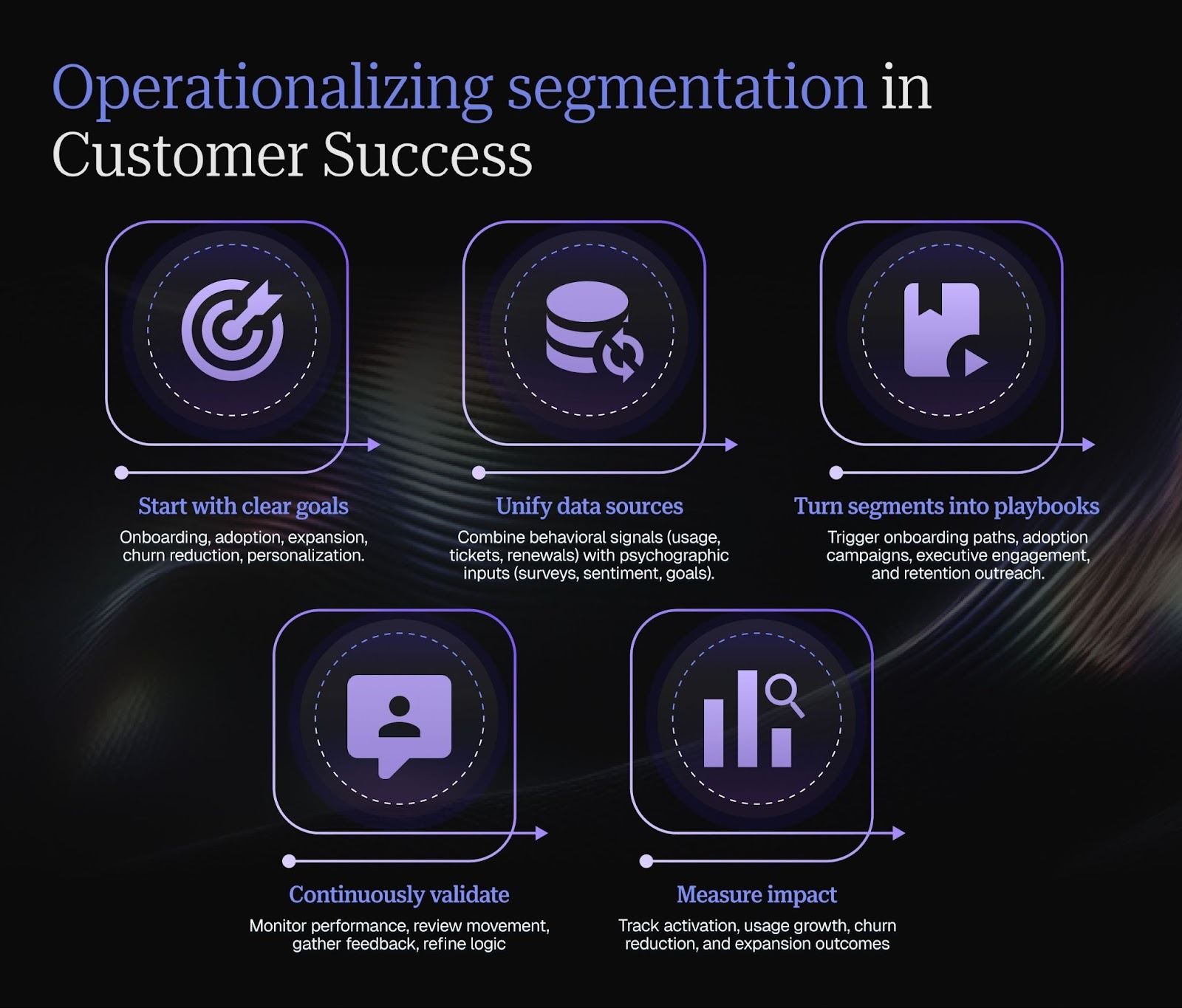
Define segmentation goals
Before creating segments, clarify what decisions segmentation should support.
For Customer Success teams, segmentation typically aims to:
- Improve onboarding effectiveness
- Increase feature adoption
- Identify expansion opportunities
- Reduce churn risk
- Personalize engagement at scale
Defining these goals helps avoid over-segmentation and ensures segments remain actionable rather than purely analytical.
Establish data sources
Operational segmentation requires both behavioral and psychographic inputs.
Common behavioral sources:
- Product usage and feature adoption data
- Support tickets and interaction history
- Renewal and purchase patterns
- Engagement metrics across lifecycle stages
Common psychographic sources:
- Surveys and feedback responses
- Conversation sentiment and themes
- Customer goals captured during onboarding
- Stakeholder priorities and strategic initiatives
Customer Success platforms like Velaris, which is highly rated on G2, help unify these signals by combining product data, communication insights, and sentiment analysis into a single workspace. This consolidation reduces fragmentation and enables segmentation that reflects the full customer context.
Segmentation using AI is also incredibly useful for data analysis, but is being underutilized. Research from Acxiom shows that 54% of organizations are aware of AI-powered customer segmentation, but only 17% are currently deploying it. Velaris’s AI capabilities can make segmentation much more efficient with identifying patterns across large data sets from different sources.
For a closer look at what's available, our roundup of the top AI customer success tools covers platforms that bring these segmentation and analysis capabilities to CS teams.
Build lifecycle playbooks
Segmentation becomes impactful when it directly drives action.
Lifecycle playbooks translate segments into workflows such as:
- Proactive onboarding paths for different customer personas
- Adoption campaigns triggered by behavioral gaps
- Executive engagement cadences for strategic stakeholders
- Retention outreach sequences for emerging risk segments
By mapping playbooks to segments, teams ensure segmentation consistently informs engagement rather than remaining static classification.
Continuously validate segments
Customer behavior and motivations evolve over time, meaning segmentation cannot remain static.
Effective validation includes:
- Monitoring segment performance against expected outcomes
- Reviewing segment movement across lifecycle stages
- Gathering qualitative feedback from CSM conversations
- Updating segmentation logic as product or market dynamics change
Regular validation prevents outdated assumptions from shaping engagement strategies.
Align segmentation with outcomes
Ultimately, segmentation should be measured by impact, not complexity.
Key outcome alignment questions include:
- Do segmented onboarding experiences improve activation rates?
- Are targeted adoption campaigns increasing feature usage?
- Do retention segments correlate with churn reduction?
- Are expansion segments producing higher conversion rates?
Operationalized effectively, segmentation becomes the connective layer between customer understanding and Customer Success execution, enabling teams to deliver experiences that are both scalable and meaningfully personalized.
Common segmentation mistakes to avoid
Segmentation can significantly improve Customer Success strategy, but only when applied thoughtfully. Many teams invest time building segments that ultimately fail to influence engagement, decision-making, or outcomes. Avoiding the following pitfalls helps ensure segmentation remains practical and impactful.
Over-segmenting customers
Creating too many segments can dilute focus and make execution difficult.
When teams attempt to capture every nuance in customer behavior or personality, segments quickly become:
- Difficult to maintain
- Hard to activate in workflows
- Confusing for CSMs to interpret
A smaller set of clearly defined, action-oriented segments is typically more valuable than an overly complex taxonomy.
Treating segments as static
Customer needs, behaviors, and motivations change over time. Segments that are defined once and never revisited quickly lose relevance.
Static segmentation can lead to:
- Misaligned engagement strategies
- Missed lifecycle transitions
- Outdated assumptions about customer priorities
Segments should evolve alongside customer journeys, product maturity, and market conditions.
Ignoring qualitative insights
Behavioral data is powerful, but relying on it alone creates blind spots. Without qualitative inputs such as conversations, feedback, and sentiment, teams may misinterpret customer actions.
For example, reduced product usage might signal churn risk, but it could also reflect seasonality or a completed use case. Qualitative context helps clarify intent behind behavior.
Using segmentation without workflows
Segmentation that does not trigger action provides limited value.
A common mistake is building detailed segments but failing to connect them to:
- Playbooks
- Automation triggers
- Messaging strategies
- Success planning motions
Segments should directly influence what teams do differently, not just how they categorize customers.
Measuring segmentation without outcome linkage
Segmentation effectiveness is often evaluated based on analytical completeness rather than business impact.
Instead, teams should assess whether segmentation contributes to measurable outcomes such as:
- Faster onboarding completion
- Increased feature adoption
- Improved retention rates
- Higher expansion conversion
When segmentation is tied to outcomes, it becomes a strategic driver of Customer Success performance rather than a reporting exercise.
Conclusion
Understanding customers requires more than observing what they do or assuming why they act. Behavioral segmentation reveals engagement patterns, usage signals, and lifecycle movement, while psychographic segmentation uncovers motivations, preferences, and decision drivers. Together, they create a complete picture of the customer.
Platforms like Velaris, which is highly rated on G2, enable this shift by unifying behavioral signals with AI-driven sentiment and topic analysis, allowing teams to operationalize segmentation across the customer lifecycle.
If you’re looking to move beyond static segmentation and build a more intelligent, actionable Customer Success strategy, book a demo to see how Velaris can help.
Frequently Asked Questions
Which segmentation type is better?
Neither behavioral nor psychographic segmentation is inherently better. Behavioral segmentation excels at identifying measurable engagement patterns, while psychographic segmentation explains motivations and preferences. The most effective Customer Success strategies combine both to capture a complete customer view.
Can behavioral and psychographic segmentation be combined?
Yes. Combining the two allows teams to understand both what customers are doing and why they are doing it. This enables more accurate personalization, stronger churn prediction, and more relevant lifecycle engagement strategies.
How do Customer Success teams collect psychographic data?
Psychographic data is typically gathered through surveys, customer interviews, feedback forms, call transcripts, and sentiment analysis of communications. Social signals, success plan discussions, and stakeholder conversations also provide valuable context.
How does AI improve customer segmentation?
AI enhances segmentation by analyzing large volumes of behavioral and unstructured data simultaneously. It can detect emerging patterns, cluster customers dynamically, surface sentiment trends, and update segments in real time, reducing manual effort while improving accuracy.
What tools help with behavioral segmentation?
Behavioral segmentation is commonly supported by product analytics platforms, Customer Success platforms, CRM systems, and engagement tools that track usage, feature adoption, support interactions, and lifecycle events. These tools enable teams to monitor customer activity and trigger proactive engagement based on behavior patterns.

The Velaris Team
A (our) team with years of experience in Customer Success have come together to redefine CS with Velaris. One platform, limitless Success.





Velaris is an AI-native Customer Success Platform built for mid-market and enterprise B2B SaaS teams. From customer health scoring and churn prediction to onboarding automation, renewals, and expansion workflows, Velaris helps recurring revenue teams understand account health, reduce churn, and scale customer success with greater visibility and control.