We look forward to showing you Velaris, but first we'd like to know a little bit about you.


Mastering Omnichannel Customer Engagement
Discover how omnichannel customer engagement helps Customer Success Managers unify touchpoints, improve customer journeys, and strengthen loyalty.
The Velaris Team
March 12, 2025
Omnichannel customer engagement seamless experiences across every touchpoint by connecting every interaction—email, chat, support tickets, in-app messages, and calls—into a single, continuous experience.
For Customer Success Managers and CS leaders, this means better visibility, stronger relationships, and measurably higher retention.
This guide breaks down what omnichannel engagement means in practice, the obstacles that make it difficult, and proven strategies to implement it successfully.
Key Takeaways
- Omnichannel customer engagement connects every customer interaction into one seamless experience across email, chat, support, calls, and in-app messaging.
- Unlike multichannel strategies, omnichannel engagement unifies customer data and conversation history across platforms for continuous interactions.
- The biggest barriers to omnichannel success include data silos, integration complexity, limited resources, and inconsistent customer experiences.
- A strong omnichannel tech stack combines customer success platforms, CRMs, communication tools, support systems, and product analytics.
- Effective omnichannel strategies rely on centralized data, personalized outreach, standardized processes, and cross-channel communication.
- AI strengthens omnichannel engagement by automating personalization, surfacing customer risks, and recommending proactive next steps at scale.
What is omnichannel customer engagement?
Omnichannel customer engagement creates a unified experience across every channel your customers use. Unlike multichannel approaches where each platform operates independently, omnichannel connects every touchpoint so conversations flow naturally, regardless of whether they start in email, continue in chat, or end with a phone call.
The core principle: customers shouldn't have to repeat themselves or provide context multiple times. When a customer reaches out via Slack after submitting a support ticket, your CSM should see both interactions instantly. When they follow up over email, that context carries forward.
What is the difference between omnichannel and multichannel engagement?
Multichannel engagement means you're present on multiple platforms—email, chat, phone, social media. Each channel works, but they don't talk to each other. A customer who emails you and then messages on Slack has to explain their issue twice. Your team has to manually piece together context from different tools.
Omnichannel engagement connects these channels into a unified system. Customer data, conversation history, and context flow automatically between touchpoints. When your customer switches channels, your team doesn't lose the thread. The experience feels continuous, not fragmented.
What is the difference between omnichannel and cross-channel engagement?
Cross-channel engagement focuses on coordinating campaigns or messages across different platforms. You might send an email, follow up with an in-app notification, and post on social media, all pointing to the same offer or announcement. The channels are coordinated but still operate separately.
Omnichannel goes further by integrating customer data and interaction history across all channels. It's not just about sending coordinated messages; it's about creating a single customer view that informs every interaction, regardless of the channel.
How does omnichannel customer engagement differ from omnichannel retail?
Omnichannel retail focuses on the buying journey, allowing customers to browse online, buy in-store, or return via app seamlessly. The goal is frictionless commerce.
Omnichannel customer engagement in SaaS and B2B focuses on the post-sale relationship. It's about onboarding, support, adoption, expansion, and retention. Instead of optimizing transactions, you're optimizing ongoing relationships and ensuring every touchpoint, from QBRs to support tickets, contributes to customer success.
What are the challenges in implementing omnichannel strategies?
Most Customer Success teams recognize the value of omnichannel engagement but struggle with execution. The obstacles exist at technical, organizational, and operational levels and are often resource-driven. Understanding these challenges helps you address them directly.
Data silos and how they impact omnichannel engagement
Customer data lives everywhere: sales uses one CRM, marketing has its automation platform, support runs a separate ticketing system, and product tracks usage in analytics tools. None of these systems share information automatically.
For CSMs, this creates blind spots. You're managing a renewal conversation without seeing recent support escalations, or running a QBR without knowing the customer complained on social media last week. Critical context disappears between channels, leading to repetitive questions and disconnected experiences.
Data silos make it nearly impossible to understand customer health accurately or intervene at the right moments.
Integration complexities in omnichannel success
Even when CS leaders want to connect their tools, technical reality gets in the way. Different platforms have different APIs, data structures, and update frequencies. Building integrations requires engineering resources, ongoing maintenance, and constant troubleshooting.
Many teams rely on IT or engineering to build and maintain these connections, which creates bottlenecks. When priorities shift or resources get pulled to other projects, integrations break or go stale. CS teams lose access to critical data just when they need it most.
The complexity multiplies as you add more tools. Each new platform requires integration with every existing system, creating an exponentially more complicated tech stack.
Resource constraints in omnichannel implementation
Small to mid-sized CS teams face a straightforward problem: building omnichannel capabilities takes time, budget, and people they don't have. Implementing new systems, training teams, and managing integrations requires resources that are already stretched thin.
CSMs are already managing onboarding, renewals, expansions, and escalations. Adding complex system overhauls to their workload without additional support leads to incomplete implementations, rushed rollouts, and eventual abandonment of the initiative.
Budget constraints compound the issue. Leadership wants results but may not fund the tools, training, or headcount needed to execute an omnichannel strategy effectively.
Difficulty in achieving consistent customer experience across channels
Different teams handle different touchpoints, and without clear standards, the customer experience varies wildly. Support might deliver fast, helpful responses while onboarding feels slow and disorganized. Email communications are polished, but in-app messages are generic.
Customers expect brand consistency everywhere. Omnichannel engagement research shows that roughly 90% of consumers expect consistent interactions, whether they're engaging online or offline, and companies that fail to deliver see measurably lower retention as a result.
When tone, quality, or responsiveness changes across channels, it creates confusion and erodes trust. They question whether your company actually has its act together.
Ensuring consistency requires more than just good intentions. It requires documented processes, shared playbooks, and tools that enforce standards automatically.
What tools and technology do you need for omnichannel customer engagement?
Technology enables omnichannel engagement, but choosing the right stack requires understanding what each tool does and how they work together. The goal here is to build a connected system that gives CSMs complete visibility without adding complexity.
What does a typical omnichannel tech stack look like for a CS team?
A functional omnichannel tech stack for Customer Success typically includes:
- Customer Success platform: Centralizes customer data, health scores, touchpoints, and workflows. Acts as the single source of truth for CSMs.
- CRM system: Tracks sales interactions, account details, and revenue data. Should sync bidirectionally with your CS platform.
- Communication tools: Email, Slack, in-app messaging, and video platforms that log conversations automatically.
- Support ticketing system: Captures issues, resolutions, and customer sentiment. Needs to feed into health scoring and CS workflows.
- Product analytics: Shows usage patterns, feature adoption, and engagement trends. Critical for identifying at-risk accounts.
The key is to ensure that they connect seamlessly so CSMs don't waste time switching between platforms or manually updating records.
Our guide on building a winning customer success tech stack covers integration priorities, evaluation criteria, and how to avoid common pitfalls when selecting tools.
How do you evaluate and choose omnichannel tools for a CS team?
Start by identifying gaps in your current workflow. Where do CSMs lose context? Which channels don't connect? What data never makes it into customer health scores?
Evaluate tools based on:
- Integration capabilities: Does it connect with your existing CRM, support system, and analytics tools out of the box? How difficult are custom integrations?
- Data unification: Can it pull customer information from multiple sources and present it in one view?
- Automation potential: Does it reduce manual work by automating workflows, alerts, and routine tasks?
- User adoption: Will your CSMs actually use it daily, or is it too complex and clunky?
- Scalability: Can it handle your growth plans without requiring a complete overhaul in two years?
How do you migrate from siloed tools to a unified platform without disrupting customers?
Migration risks are real. Issues like data loss, broken workflows, and customer-facing errors can damage trust.
The key is phased implementation, not a big-bang cutover. Migration strategy research consistently shows that phased rollouts allow teams to catch data integrity issues and workflow gaps before they surface in live customer interactions, reducing the blast radius of any single failure point.
Start by running the new platform in parallel with existing tools. This lets your team validate data accuracy and workflow functionality without risking customer interactions.
Migrate customer segments gradually. Start with lower-risk accounts, learn from the process, and refine before moving high-value or complex customers. Communicate changes internally before they affect customers, and give CSMs time to learn the new system.
Monitor customer sentiment throughout the migration. If CSAT or support tickets spike, pause and address issues before continuing.
What are the strategies for effective omnichannel customer engagement?
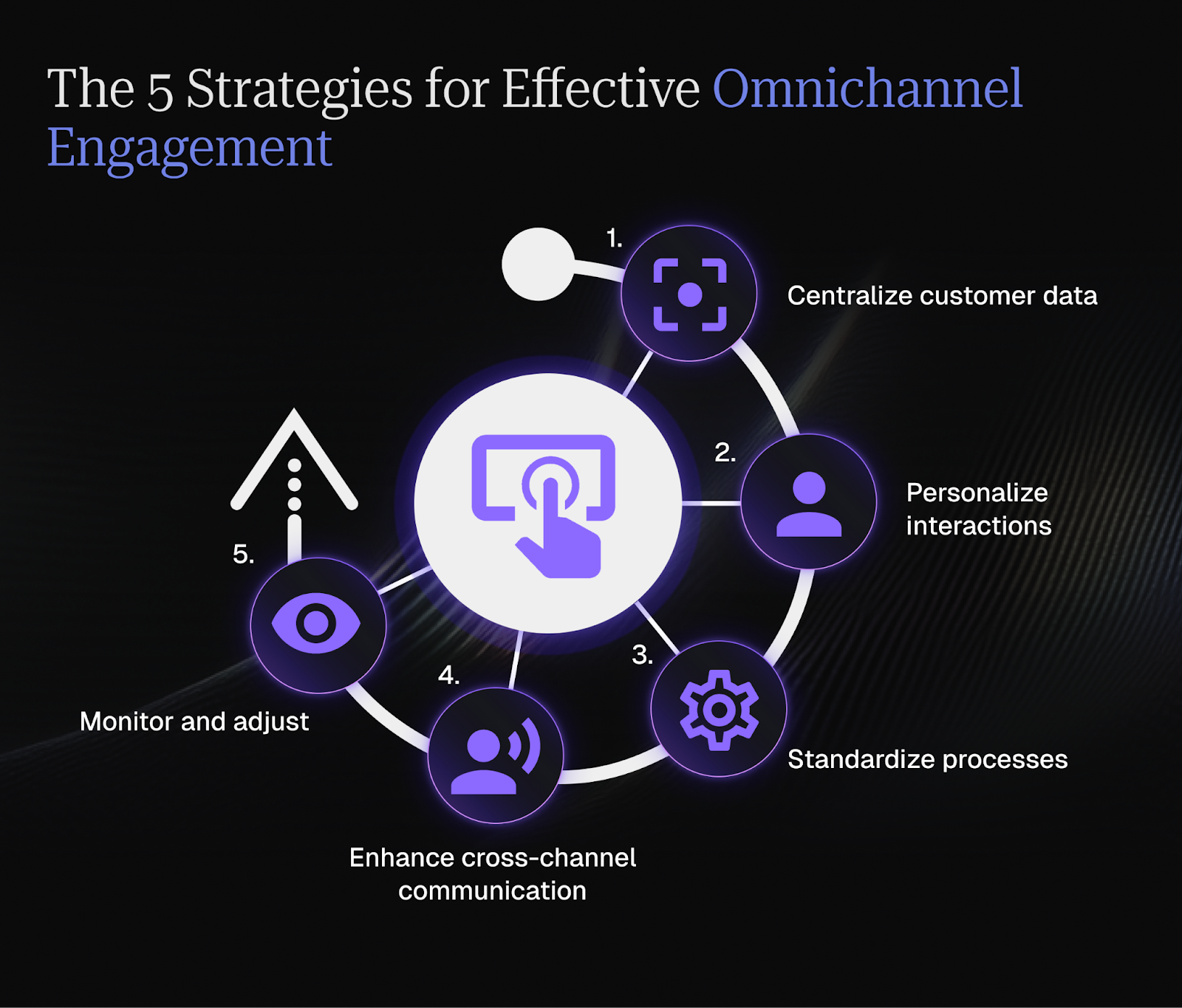
Building an effective omnichannel strategy requires more than good technology. It requires deliberate process design, clear standards, and continuous optimization. These strategies address the challenges outlined earlier and create sustainable, scalable customer engagement.
Centralize customer data for omnichannel engagement
Customer data centralization eliminates blind spots by creating a single source of truth. When every interaction—from sales calls to support tickets, product usage, and emails—flows into one platform, CSMs gain a 360-degree view of each account.
Centralized data enables accurate health scoring, early risk detection, and personalized engagement at scale. According to predictive analytics research, models that integrate CRM data, product usage metrics, support interactions, and payment history consistently outperform those drawing from a single source.
Platforms like Velaris, a highly-rated software on G2, integrate automatically with sales, marketing, support, and product tools, ensuring data updates in real time without manual entry. This reduces administrative work and ensures everyone operates from the same information.
Personalize customer interactions across channels
Generic outreach doesn't cut it. Customers expect CSMs to understand their usage patterns, challenges, and goals, and to tailor interactions accordingly.
With centralized data, personalization becomes scalable. AI-powered platforms analyze customer behavior and recommend next-best actions. If a customer's usage drops, the system flags it and suggests proactive outreach. If feature adoption lags, it recommends relevant resources.
Personalization doesn’t stop at using someone's name in an email. You need to demonstrate that you understand their business and offer solutions that actually help.
Standardize processes for a consistent omnichannel experience
Consistency requires standardization. Create documented playbooks for common scenarios: onboarding sequences, renewal processes, escalation protocols, and expansion plays. These playbooks ensure every customer receives the same quality of service regardless of which CSM handles their account or which channel they use.
This consistency compounds over time. Analysis of omnichannel customer engagement shows that companies with strong, standardized engagement practices retain 89% of customers annually, compared to just 33% for those without. Automation enforces these standards.
Build workflows that trigger automatically based on customer actions or milestones. When a customer reaches a certain usage threshold, the system launches an upsell sequence. When support tickets increase, it alerts the CSM to intervene.
If you're building these from scratch, our guide to customer success playbooks walks through templates and best practices for every stage of the customer journey.
Enhance cross-channel communication
Customers don't think in channels. They just want problems solved. When they switch from email to chat to phone, they expect the conversation to continue seamlessly.
Centralizing communication in one platform makes this possible. Every email, chat message, call note, and in-app interaction appears in the customer's timeline. Any team member can pick up where the last conversation ended, regardless of channel.
This also improves internal collaboration. CSMs can loop in support, sales, or product teams without leaving their primary workspace, leading to faster resolutions and better customer experiences.
Monitor and adjust your omnichannel strategy over time
Omnichannel engagement isn't a set-it-and-forget-it initiative. Customer expectations evolve, new channels emerge, and what worked six months ago may not work today.
Track key metrics continuously: Net Promoter Score (NPS), Customer Satisfaction Score (CSAT), Customer Effort Score (CES), retention rates, and channel-specific engagement. These metrics reveal which touchpoints drive value and which create friction.
Customizable dashboards let CS leaders monitor performance in real time. If a specific channel underperforms, you can investigate immediately and adjust. If customer health scores decline, you can intervene before churn happens.
Not sure which metrics matter most? Our breakdown of customer success metrics every CSM should know helps you prioritize the KPIs that actually make a difference on retention and expansion.
How does AI fit into an omnichannel customer engagement strategy?
AI transforms omnichannel engagement from a manual, reactive process into a proactive, scalable system. The right AI capabilities make it possible to deliver personalized experiences at scale without overwhelming your CS team.
How does AI improve personalization at scale in omnichannel CS?
AI analyzes customer behavior patterns across all channels and identifies opportunities humans might miss. It detects when usage drops, when engagement changes, or when customer sentiment shifts—and recommends specific actions.
Research comparing AI and manual monitoring found that AI systems can identify trends and sentiment shifts across large account volumes in timeframes that would take human teams weeks, while manual review struggles with consistency as portfolio size grows.
Instead of CSMs manually reviewing hundreds of accounts, AI surfaces the customers who need attention most and suggests the next best step: send a check-in email, schedule a call, share a specific resource, or escalate to leadership.
AI-powered platforms like Velaris take this further by automatically summarizing customer calls, flagging churn risks, and recommending next steps, handling 80% of routine post-sales activities while CSMs focus on the 20% that requires human judgment and relationship-building.
Customer data platforms (CDPs) in omnichannel engagement
Customer Data Platforms collect, unify, and activate customer information from every source. Unlike CRMs that focus on sales and contact management, CDPs create comprehensive customer profiles by combining behavioral data, transactional data, and interaction history.
For CS teams, CDPs enable real-time personalization at scale. When a customer interacts on any channel, the CDP updates their profile instantly, making that context available to every subsequent touchpoint.
The value lies in how you time the data activation. Real-time customer data research demonstrates that acting on behavioral signals within minutes of an event, rather than waiting for overnight batch processing, significantly increases the likelihood of a relevant response reaching the customer while their intent is still active.
How do you handle data privacy and compliance across multiple channels?
More channels mean more data, which creates more compliance risk. GDPR, CCPA, and other regulations require careful management of customer information across every touchpoint.
Your CS platform should handle compliance by design: data encryption, audit trails, consent management, and the ability to delete or export customer data on request. When evaluating tools, verify they meet regulatory requirements for your markets.
Document what data you collect, where it's stored, who can access it, and how long you retain it. Regular compliance audits ensure your omnichannel strategy doesn't create legal exposure.
Transparency builds trust. Let customers know how you use their data and give them control over their preferences across all channels.
How does omnichannel engagement change at different stages of the customer lifecycle?
Customer needs vary dramatically across the lifecycle, and your omnichannel approach should adapt accordingly.
During onboarding, new customers need structured guidance across multiple touchpoints: automated email sequences, in-app tutorials, scheduled check-in calls, and quick-response support channels. The goal is rapid time-to-value through coordinated, high-touch engagement.
In the adoption phase, customers benefit from targeted content and proactive outreach based on usage patterns. If they're not using a key feature, an in-app message or email series can drive adoption. If they're power users, upsell conversations become relevant.
During renewal periods, omnichannel engagement shifts to value demonstration and risk mitigation. CSMs combine usage analytics, satisfaction surveys, and direct conversations to ensure customers see ROI and address concerns before contracts end.
At expansion opportunities, coordinated outreach across email, calls, and in-product prompts drives upsells and cross-sells by meeting customers where they already engage.
Conclusion
Omnichannel customer engagement isn't optional anymore. Customers expect seamless experiences across every touchpoint, and CS organizations that deliver them retain more customers, expand more accounts, and operate more efficiently.
If you're ready to move from fragmented, channel-by-channel engagement to a truly connected customer experience, book a demo with Velaris, highly-rated software on G2, and see how omnichannel Customer Success works in practice.
Frequently Asked Questions
What channels should a CS team prioritize for omnichannel engagement?
Prioritize the channels your customers already use. Email and support tickets are universal, but if your customers prefer Slack or in-app messaging, invest there. Track engagement rates by channel and double down on what works.
How long does it take to implement an omnichannel strategy?
Timeline depends on your current tech stack and team size. Basic implementation like connecting key tools and centralizing data can happen in weeks. Full optimization with automated workflows and AI-powered insights typically takes 3-6 months.
Can small CS teams implement omnichannel engagement?
Yes. Small teams actually benefit most because omnichannel platforms automate repetitive tasks and surface high-priority accounts automatically. The key is choosing tools designed for efficiency, not complexity.
How do you measure omnichannel engagement success?
Track retention rates, Net Promoter Score (NPS), Customer Satisfaction Score (CSAT), Customer Effort Score (CES), time-to-resolution, and expansion revenue. Also measure internal metrics like CSM productivity and time spent on manual data entry.
What's the biggest mistake CS teams make with omnichannel engagement?
Trying to be everywhere at once without connecting the experience. More channels don't help if they don't talk to each other. Start by unifying data and processes before expanding to additional touchpoints.

The Velaris Team
A (our) team with years of experience in Customer Success have come together to redefine CS with Velaris. One platform, limitless Success.




Velaris is an AI-native Customer Success Platform built for mid-market and enterprise B2B SaaS teams. From customer health scoring and churn prediction to onboarding automation, renewals, and expansion workflows, Velaris helps recurring revenue teams understand account health, reduce churn, and scale customer success with greater visibility and control.