We look forward to showing you Velaris, but first we'd like to know a little bit about you.


Customer 360 View Dashboard for Smarter Success
Centralize data and source insights to help CSMs manage account relationships more effectively with a comprehensive customer dashboard.
The Velaris Team
February 23, 2026
Businesses often struggle with fragmented customer data spread across CRMs, support tools, marketing platforms, and product usage logs. This siloed information makes it hard for customer success teams to see the full picture, leading to missed opportunities, delayed responses, and higher churn.
A Customer 360 View Dashboard solves these pain points by unifying data into a single, actionable view that empowers teams to deliver smarter, personalized success strategies.
In this article, you’ll learn what a Customer 360 dashboard is, why it matters, the key components to include, how to design one step‑by‑step, and how platforms like Velaris make building and scaling these dashboards easier.
Key takeaways
- A customer 360 dashboard unifies data from CRM, marketing, product usage, support, and finance into one complete customer profile.
- It helps success teams deliver personalization, resolve issues quickly, and strengthen retention through proactive engagement.
- Designing the dashboard involves clear objectives, stakeholder input, the right tools, mapped data sources, and a user-friendly layout.
- Effective dashboards include profiles, interaction history, usage metrics, health scores, financial overviews, and predictive insights.
- Maintaining success requires best practices like simplicity, accurate data, role-based views, continuous updates, and alignment with business goals.
What is a customer 360 view dashboard
A customer 360 view dashboard is essentially a single, unified profile that brings together all the data a business has about its customers into one place. Instead of having information scattered across CRMs, support systems, marketing tools, and product usage logs, the dashboard consolidates everything into a centralized view.
For customer success teams, this dashboard becomes a strategic tool: it helps them track engagement, identify churn risks, and strengthen retention efforts. By aligning sales, support, and product teams around the same customer insights, the 360 view dashboard ensures that every interaction is informed, consistent, and geared toward building long‑term loyalty.
Why a customer 360 view dashboard matters for customer success
A customer 360 view dashboard matters for customer success because it gives teams the complete context they need to deliver personalized experiences, resolve issues faster, build stronger customer relationships, and make smarter, data-driven decisions. By unifying information across systems, it becomes a powerful tool for improving satisfaction, retention, and long-term loyalty.
Improved customer experience through personalization
When success teams have access to a unified customer profile, they can tailor communication, offers, and support to each individual’s needs. This level of personalization makes customers feel valued and understood, which directly enhances their overall experience.
Faster issue resolution with complete context
Having all customer interactions, product usage data, and support history in one place allows teams to quickly identify problems and provide solutions without asking customers to repeat themselves. This reduces frustration and speeds up resolution times.
Stronger relationships and loyalty
By consistently engaging with customers based on accurate insights, businesses can build trust and long-term loyalty. A 360 view ensures every interaction is informed, consistent, and aligned with the customer’s journey, strengthening relationships over time.
Data-driven decision making for success teams
Dashboards provide actionable insights into customer health, engagement, and risk. Success teams can use this data to prioritize accounts, identify upsell opportunities, and proactively address churn risks. Decisions are no longer based on guesswork but on reliable, real-time information.
Key data sources for building a 360 view dashboard
Building a customer 360 view dashboard requires pulling data from multiple sources to create a complete and unified customer profile. Each source contributes unique insights, from customer interactions and marketing engagement to product usage and financial history.
New Epsilon research indicates that 80% of consumers prefer personalized experiences. By integrating these systems, businesses can eliminate silos and empower customer success teams with the context they need to deliver personalized, proactive, and data-driven support.
CRM systems
CRM platforms provide the foundation of customer data, including profiles, contact details, and records of past interactions. They capture sales activities, account notes, and communication history, making them essential for understanding customer relationships.
Marketing automation tools
Marketing systems track how customers engage with campaigns, emails, and digital touchpoints. They also provide lead scoring and segmentation data, helping success teams understand customer interests and engagement levels.
Product usage data
Usage data reveals how customers interact with a product which features they use, how often they log in, and adoption trends. This information is critical for identifying power users, spotting underutilization, and predicting churn risks.
Customer support platforms
Support systems record customer issues, tickets, and conversations. These insights show pain points, recurring problems, and satisfaction levels, enabling teams to improve service quality and proactively address concerns.
Financial systems
Financial data provides visibility into customer value, billing history, and renewal cycles. It helps success teams track revenue impact, identify upsell opportunities, and manage retention strategies tied to account health.
Essential components of a customer 360 dashboard
A customer 360 dashboard is effective only when it includes the right components that give a complete, actionable view of each customer. These elements range from basic profile information to advanced predictive insights, ensuring success teams can personalize engagement, monitor health, and make data-driven decisions. Together, they form the foundation for smarter customer success strategies.
Customer profile
The customer profile provides the core details about each account, including demographic and firmographic data, preferences, and key identifiers. This forms the baseline for understanding who the customer is and how they fit into your business ecosystem.
Interaction history
Tracking all past interactions ensures teams have full context when engaging with customers. By consolidating emails, calls, meetings, and support tickets, the dashboard eliminates blind spots and helps deliver consistent communication.
Product usage metrics
Usage data reveals how customers interact with the product. Metrics such as login frequency, feature adoption, and usage trends highlight engagement levels and help identify both power users and accounts at risk of churn.
Customer health score
A customer health dashboard combines multiple signals like engagement, satisfaction surveys, and churn risk indicators into a single metric (a health score) that helps success teams quickly assess account status and prioritize actions. This helps success teams quickly assess account status and prioritize actions.
Financial overview
Financial data shows the monetary impact of each customer, including lifetime value, recurring revenue, and renewal cycles. This enables teams to align success strategies with revenue goals and identify upsell opportunities.
Predictive insights
Advanced analytics and AI models provide predictive insights into customer behavior. These forecasts help success teams anticipate churn, identify upsell potential, and take proactive measures to secure long-term growth.
Steps to design a customer 360 dashboard
Designing a customer 360 dashboard requires a structured approach that ensures the right objectives, stakeholders, tools, and integrations are in place. By following clear steps, businesses can build dashboards that are user-friendly, accurate, and capable of delivering real-time insights for customer success teams.
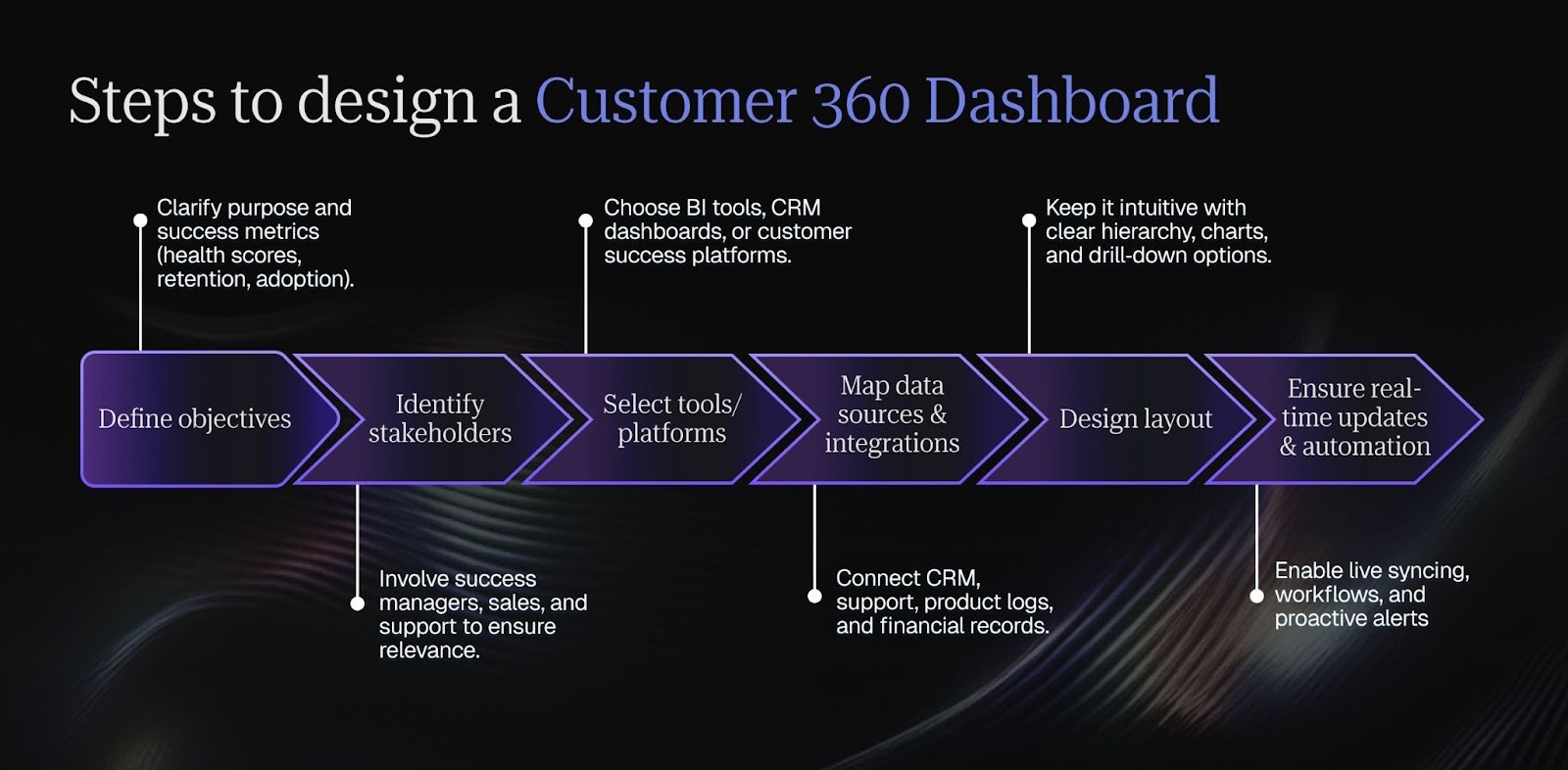
Define objectives
The first step is to clarify the purpose of the dashboard. Decide which success metrics matter most such as customer health scores, retention rates, or product adoption so the dashboard is aligned with business goals.
Identify stakeholders
Determine who will use the dashboard and what their needs are. Customer success managers, sales teams, and support staff may each require different views, so stakeholder input ensures relevance and usability.
Select tools/platforms
Choose the right technology stack to build and host the dashboard. Options include business intelligence tools, CRM dashboards, or specialized customer success software tools, depending on the complexity and scale of your data.
Map data sources and integrations
Identify where customer data resides CRM, support systems, product usage logs, financial records and plan integrations to bring them together. This step eliminates silos and ensures a unified view.
Design layout
Create a dashboard layout that is intuitive and easy to navigate. Use clear visual hierarchy, charts, and drill-down options so users can quickly access both high-level insights and detailed data.
Ensure real-time updates and automation
Enable real-time data syncing and automation to keep dashboards current. Automated workflows and alerts help teams act proactively, ensuring the dashboard remains a living tool rather than a static report.
Customer 360 dashboards in Velaris
Velaris, which is highly rated on G2, provides powerful customer 360 dashboards that unify data across systems and deliver actionable insights for success teams. By combining CRM records, product usage, support history, and financial data into one view, Velaris enables businesses to personalize engagement, detect churn risks early, and make smarter, real-time decisions.
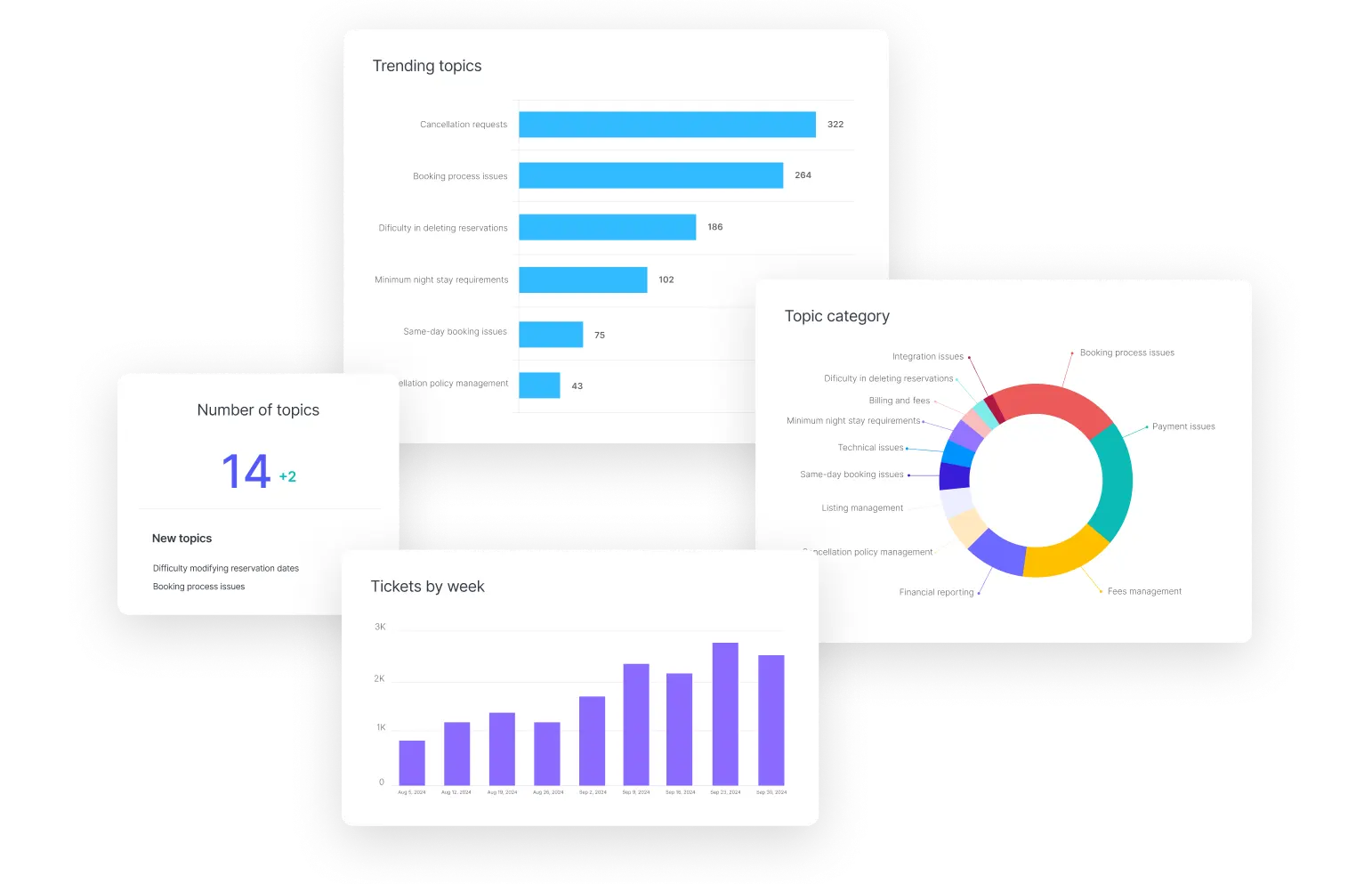
Unified customer view
Velaris consolidates data from multiple sources into a single profile, eliminating silos and giving teams a complete picture of each customer’s journey.
AI-powered analytics
With built-in AI, Velaris analyzes customer behavior to surface trends, predict churn, and highlight opportunities for growth.
Customizable health scores
Success teams can configure health scores to reflect engagement, satisfaction, and risk factors, ensuring account prioritization is tailored to business goals.
Real-time dashboards
Velaris dashboards update continuously, providing live reporting and analytics so teams can act quickly and proactively.
Best practices for building and maintaining the dashboard
Building and maintaining a customer 360 dashboard demands thoughtful design, ongoing refinement, and alignment with business goals. By following best practices, businesses can ensure their dashboards remain intuitive, accurate, and actionable, empowering customer success teams to deliver consistent value.
Keep it simple and intuitive
Dashboards should be easy to navigate, with a clear visual hierarchy that highlights the most important metrics. Avoid clutter and unnecessary details so users can focus on insights that matter.
Use visualizations
Visual elements such as charts, graphs, and heatmaps make complex data easier to understand. They help teams quickly spot trends, patterns, and anomalies without digging through raw numbers.
Ensure data accuracy and consistency
Reliable dashboards depend on accurate and consistent data. Regular validation and synchronization across systems prevent errors and ensure teams are working with trustworthy information.
Provide role-based access
Different teams need different perspectives. Role-based access ensures customer success managers, sales reps, and executives each see the metrics most relevant to their responsibilities.
Continuously update and refine metrics
Customer needs and business priorities evolve over time. Regularly reviewing and refining dashboard metrics keeps them aligned with current goals and ensures ongoing relevance.
Align dashboard KPIs with business goals
Dashboards should directly support organizational objectives. By aligning KPIs with business goals, success teams can measure impact effectively and demonstrate value to leadership.
For practical inspiration, these Customer Success dashboard examples show how high-performing teams structure their reporting.
Common challenges and how to overcome them
Building a customer 360 dashboard is not without its challenges. Businesses often face issues like data silos, poor data quality, resistance to adoption, overly complex designs, and scalability limitations. Overcoming these obstacles requires the right mix of technology, governance, and change management to ensure the dashboard remains effective and sustainable.
Data silos across departments
Customer information is often scattered across sales, marketing, support, and finance systems. Integration tools and APIs help unify these sources, breaking down silos and creating a single source of truth.
Poor data quality
Inaccurate or inconsistent data undermines dashboard reliability. Establishing strong data governance practices including validation, cleansing, and standardization ensures the information feeding the dashboard is trustworthy.
Resistance to adoption
Teams may hesitate to use new dashboards if they feel overwhelmed or unprepared. Offering training sessions, clear documentation, and change management initiatives helps drive adoption and build confidence.
Overcomplicated dashboards
Dashboards overloaded with metrics can confuse users. Focusing on essential KPIs and designing a clean, intuitive layout ensures the dashboard remains actionable and easy to use.
Scalability issues
As customer data grows, dashboards must scale without performance issues. Cloud-based platforms with flexible architecture provide the scalability needed to handle increasing datasets and evolving business needs.
Conclusion
A customer 360 view dashboard unifies data from CRM, marketing, product usage, support, and finance into a single source of truth. This empowers success teams to personalize engagement, resolve issues faster, and make smarter, data-driven decisions. While challenges like data silos and adoption resistance exist, best practices such as simplicity, accuracy, and alignment with business goals ensure dashboards remain effective.
Platforms like Velaris, which is highly rated on G2, make this process seamless by offering unified profiles, AI-powered analytics, customizable health scores, and real-time dashboards. To see how Velaris can transform your customer success strategy, request a demo today and experience smarter success in action.
Frequently Asked Questions
How is a customer 360 dashboard different from a traditional CRM?
A CRM mainly tracks sales and contact information, while a customer 360 dashboard integrates data from multiple systems including product usage, support, and finance to provide a complete view of the customer journey.
Can small businesses benefit from a customer 360 dashboard, or is it only for enterprises?
Even small businesses gain value because it helps them centralize data, personalize engagement, and scale customer success processes without needing large teams.
How do customer 360 dashboards support cross-functional collaboration?
By giving sales, support, product, and success teams access to the same unified data, dashboards eliminate silos and ensure all departments work toward shared customer goals.
How often should a customer 360 dashboard be updated?
Ideally, dashboards should refresh in real time or at least daily, ensuring teams always work with the most current customer data.

The Velaris Team
A (our) team with years of experience in Customer Success have come together to redefine CS with Velaris. One platform, limitless Success.





Velaris is an AI-native Customer Success Platform built for mid-market and enterprise B2B SaaS teams. From customer health scoring and churn prediction to onboarding automation, renewals, and expansion workflows, Velaris helps recurring revenue teams understand account health, reduce churn, and scale customer success with greater visibility and control.