We look forward to showing you Velaris, but first we'd like to know a little bit about you.


What is Customer Success Software and How Organizations Can Benefit from Them
The Velaris Team
July 30, 2026
Customer success managers (CSMs) often struggle with managing their time; searching for information, updating reports, and reacting to customer issues are all things that drain their bandwidth. This directly endangers revenue, as important warning signs get buried across emails and support tickets, making it harder to retain customers, or expand when appropriate.
This is why customer success software was created, as it helps orgs manage customer relationships and monitor account health. Designed for customer success teams at recurring-revenue businesses, customer success software is valuable when growing customer volumes make manual processes difficult to manage.
In this article, you will learn about customer success software, including its key features, impact on revenue, and how to choose the best platform for your organization.
Key takeaways
- Customer success software provides a set of tools for companies to monitor and manage post sale customer relationships.
- They help companies reduce churn, boost retention and increase customer lifetime value.
- Core features include onboarding automation, churn prediction, customer health scoring, customer lifecycle management, customer analytics and reporting
- Other than core features CS leaders need to consider integrating with existing systems, implementation timeline, Cost-Benefit Analysis and usefulness of AI features.
What is customer success software?
Customer success software provides a suite of tools for businesses to proactively manage post sales customer relationships, track health scores, identify at risk accounts, discover upsell and crosssell opportunities.
The primary objective is to help customers achieve their business goals as efficiently as possible which leads to reduced churn, longer retention, higher customer lifetime value and product champions.
Customer success platforms (CSPs) act as a central hub for customer data connecting CRMs, product analytics, customer support tickets, billing to provide you a comprehensive view of your customer, which solves the main problem faced by many CS teams.
Core Features of Customer Success Software
While various CSPs offer specialized features the core features include the following:
The Evolution of CS Tools
Customer success software has evolved alongside the growth of subscription business models and changing customer expectations. Recently, advances in automation and artificial intelligence have caused significant technological leaps.
Retention becomes a business priority (2015-2020)
During this time period, the subscription economy expanded rapidly, prompting more organizations to recognize the importance of customer retention. However, limited tooling and challenging unit economics meant that dedicated customer success platforms were primarily suited to enterprises and companies selling high-value products.
Remote work accelerates demand for digital experiences (2020 to 2022)
Here there was a shift towards remote work, which accelerated demand for digital products. McKinsey found that the average share of customer interactions taking place through digital channels increased from 36% in December 2019 to 58% by July 2020. Globally, this represented approximately three years of digital adoption compressed into seven months.
At the same time, lower barriers to switching providers gave customers more choice, making retention and customer experience increasingly important business priorities.
Customer success shifts from support to revenue (2022 and 2024)
At this stage, a growing number of dedicated customer success platforms entered the market. During this period, customer success also began to be viewed less as a support function and more as a revenue function responsible for protecting renewals, reducing churn, and identifying expansion opportunities.
The growth of recurring-revenue models has continued beyond this period. Zuora’s 2025 Subscription Economy Index, based on data from more than 600 companies, found that subscription businesses recorded an 11% faster revenue growth rate than the wider economy over the previous two years.
AI creates a new generation of customer success platforms (2024-now)
Since 2024, the rise of AI has shifted the market towards automation, predictive analytics, and proactive customer management. This has led to a new generation of AI-native customer success platforms that can analyze customer signals, identify risks, summarize account activity, and automate routine work for CSMs.
Benefits of customer success software for businesses
Prevents churn
Customer success software brings together signals such as product usage, support activity, engagement, sentiment, and health scores to help teams spot risk earlier. Instead of waiting for a customer to raise a complaint or announce their intention to leave, teams can identify warning signs such as declining usage, unresolved tickets, missed meetings, or a change in stakeholder engagement.
These insights give CSMs time to investigate the problem, follow a defined risk playbook, and take corrective action before the account reaches the renewal stage.
Unlocks revenue growth
By monitoring customer health, adoption, goals, and product usage, teams can identify accounts that may be ready for an upgrade, additional seats, or another product. Expansion opportunities can be based on evidence, such as a customer approaching a usage limit, adopting advanced features, or achieving the outcomes they originally purchased the product for.
This helps teams approach customers at a relevant point in their journey rather than relying on generic upsell campaigns. It also supports more predictable expansion revenue from the existing customer base.
Strengthens customer relationships
Customer success software gives CSMs a clearer view of each customer’s history, goals, challenges, previous conversations, and outstanding actions. This allows them to communicate with greater context instead of repeatedly asking customers for information they have already shared.
Automated reminders and alerts also help teams follow up at the right time, respond to important changes, and keep commitments from being missed. Over time, this creates a more reliable and personalized experience that can strengthen trust and advocacy.
Aligns teams around the customer
Sales, support, product, and success teams often store customer information in separate systems. Customer success software creates a shared view of the account by bringing together data such as sales notes, support tickets, usage activity, renewal dates, health scores, and customer goals.
This reduces the need for manual handovers and internal status requests. It also gives each team the context needed to make better decisions, helping customers receive a more consistent experience across departments.
Automates repetitive tasks
Customer success software can automate routine processes such as onboarding tasks, check-in reminders, risk alerts, email follow-ups, meeting preparation, account summaries, and renewal workflows. Automations can be triggered by dates, lifecycle stages, customer behavior, or changes in account health.
This reduces administrative work and makes important processes more consistent. CSMs can spend less time maintaining spreadsheets and updating systems, and more time working directly with customers or developing account strategy.
Enables data-driven decisions
Customer success software provides reporting on metrics such as retention, churn, product adoption, onboarding progress, customer health, expansion, and team activity. Leaders can use this information to understand which customer segments are performing well, where accounts are becoming stuck, and which activities are associated with stronger outcomes.
It also makes it easier to evaluate team capacity, compare performance across portfolios, and improve customer success processes. Decisions can be based on patterns across the customer base rather than individual opinions or incomplete data.
Customer success software vs. CRM: what's the difference?
Customer success software and CRM software are often confused because both store customer information. But they are built for different jobs. A CRM is mainly designed to manage the commercial relationship before and around the sale. Customer success software is designed to manage what happens after the sale, when the goal becomes adoption, retention, expansion, and long-term value.
What a CRM is built to do
A CRM is usually the system of record for sales activity. It tracks leads, contacts, opportunities, deal stages, pipeline value, contract dates, and account ownership. Sales teams use it to manage prospects, forecast revenue, and understand where each deal sits in the buying process.
That data is still useful after the sale. CSMs need to know contract value, renewal dates, stakeholders, deal history, and commitments made during the sales process. But CRM data alone rarely shows whether a customer is successful with the product.
What customer success software is built to do
Customer success software focuses on the post-sale relationship. It brings together signals such as product usage, onboarding progress, support tickets, customer sentiment, health scores, renewal risk, success plans, and expansion opportunities.
This gives CSMs a more complete view of whether customers are adopting the product, achieving outcomes, and likely to renew. Instead of only showing who the customer is and what they bought, customer success software shows what is happening inside the relationship after the contract is signed.
Why CRM data alone is not enough
CRM data can tell you when a renewal is coming up, but it may not explain whether the customer is likely to renew. Churn prediction and health scoring need more than account fields. They need behavioural and relationship signals. A 2024 study using 3,959 subscriptions from a European software provider found that usage data is valuable for B2B customer churn prediction, supporting the case for combining CRM, product, support, and engagement signals.
For example, a customer may have a high contract value and a renewal date six months away, but usage could be dropping, support tickets could be increasing, and the main champion may have stopped responding. Those signals usually live outside the CRM, across product analytics, support tools, emails, calls, and survey responses.
Without that context, teams end up relying on manual CSM updates or gut feel. That makes health scoring inconsistent and makes churn risk harder to catch early.
Where CRM and customer success software should integrate
The two systems should work together rather than compete. The CRM should remain the source of truth for commercial data, such as contract value, renewal date, opportunity stage, and account ownership. The customer success platform should own post-sale health, adoption, sentiment, risks, playbooks, and success plans.
The best setup is a two-way integration. CRM data flows into the customer success platform so CSMs have commercial context. Customer success data flows back into the CRM so Sales, RevOps, and leadership can see health, risk, and expansion signals without switching systems.
Signs you have outgrown “just using the CRM”
A team usually outgrows CRM-only customer success when CSMs start maintaining separate spreadsheets, health scores depend on manual updates, renewal risks are spotted too late, or leadership cannot get a reliable view of customer health.
Other signs include inconsistent onboarding, unclear handoffs, duplicated customer outreach, and CSMs spending too much time searching across tools for account context. At that point, the CRM may still be useful, but it is no longer enough to manage customer success at scale.
Customer success software does not replace the CRM. It fills the post-sale gap the CRM was not built to solve.
How to choose customer success software wisely
The best way to choose customer success software is to match the platform to your business goals, confirm it integrates with your existing systems, and assess whether it can support your team as your customer base grows.
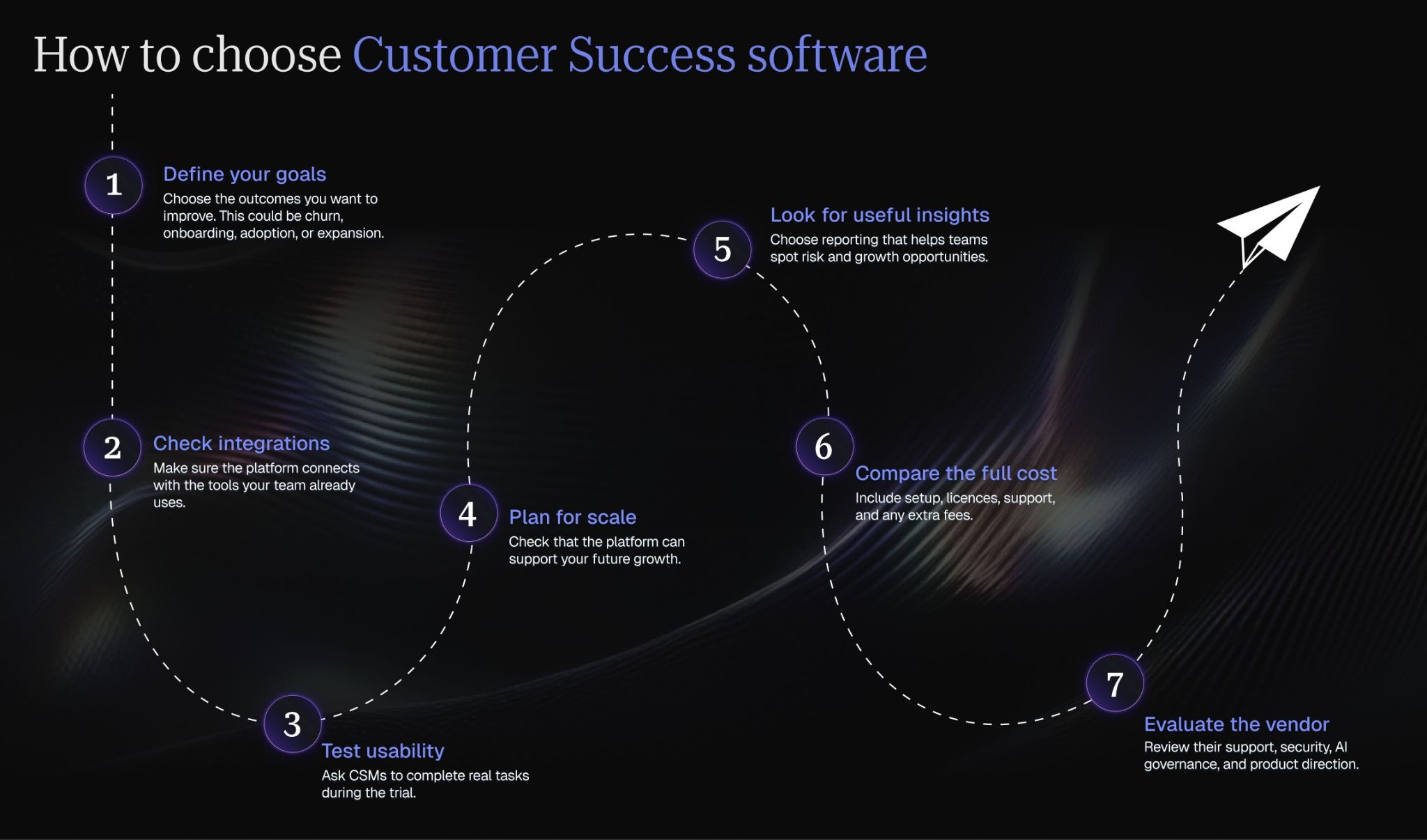
Most poor software decisions happen when organizations rush the process, focus too heavily on feature lists, or fail to involve the people who will use the platform every day. A structured evaluation helps you avoid paying for capabilities you do not need or choosing a tool that creates more work than it removes.
Define your goals first
Start by identifying the specific outcomes you want the platform to support. These might include reducing churn, improving onboarding, increasing product adoption, identifying expansion opportunities, standardizing team processes, or improving renewal forecasting.
Turn these goals into measurable requirements wherever possible. For example, you might want to reduce onboarding time, improve the percentage of customers reaching a key adoption milestone, or give CSMs earlier warning of renewal risk.
Clear goals give you a practical filter for comparing platforms. Without them, it is easy to become distracted by impressive features that do not solve your most important problems.
Prioritize integrations over novelty
Customer success software is only as useful as the data available within it. MuleSoft research found that 89% of IT leaders say data silos slow down digital transformation. For customer success software, that is exactly the problem integrations need to solve.
The platform should connect reliably with the systems your teams already use, including your CRM, support platform, product analytics tools, communication channels, billing system, and data warehouse.
Strong integrations allow the platform to create a more complete view of the customer. They also reduce the need for manual data entry and help ensure health scores, alerts, and reports are based on current information.
During the evaluation, look beyond whether an integration simply exists. Check which data it can import, whether information syncs in both directions, how often it updates, and whether additional development work or fees are required.
Evaluate usability and involve the people who will use it
A tool can offer extensive functionality and still fail if CSMs find it difficult to use. Complicated navigation, cluttered dashboards, and rigid workflows can reduce adoption and push teams back towards spreadsheets or separate tools.
Assess how easily users can complete common tasks, such as checking account health, reviewing recent activity, updating a success plan, preparing for a meeting, or creating a report. The best platform should fit naturally into the team’s daily work rather than adding another administrative layer.
Include CSMs, customer success leaders, operations teams, and other relevant users in product demonstrations and trials. Their feedback can reveal practical limitations that may not be obvious to senior decision-makers or procurement teams.
Think long term about scalability
The platform should support the size and complexity of the customer base you expect to manage in the future, not only what you manage today. As the business grows, you may need to handle more accounts, additional products, new customer segments, larger data volumes, and more complex team structures.
Consider whether the software can support different service models, such as high-touch, low-touch, and digital customer success. It should also allow you to adjust health scores, workflows, permissions, reporting, and segmentation without rebuilding the system from scratch.
Choosing a scalable platform reduces the risk of an expensive migration later and gives the team more flexibility as its strategy develops.
Calculate ROI before you commit
Customer success software should be evaluated against the revenue it can protect and expand, not just the subscription price. Before committing, build a simple ROI case that compares the cost of the platform with the expected impact on churn reduction, expansion revenue, and CSM efficiency.
Start with your current baseline. Capture gross churn, net revenue retention, expansion revenue, number of at-risk accounts, average contract value, and how many accounts each CSM manages today. Then model a realistic improvement. For example, if the platform helps reduce churn by even a small percentage across high-value accounts, the retained revenue may outweigh the cost of the software.
Include total cost of ownership, not just licence fees. Implementation, data migration, integrations, training, paid modules, AI usage, and future seat growth can all affect the real cost. A tool that looks cheaper upfront may become more expensive if it requires heavy admin work or extra systems to fill gaps.
For a skeptical CFO, keep the business case simple. Show the current cost of churn, the target reduction, the value of retained ARR, expected expansion upside, and the payback period. The strongest case does not claim the software will magically fix retention. It shows how better visibility, earlier risk detection, and more consistent workflows can help the team protect revenue that is already at risk.
Choosing CS software when you don’t have dedicated RevOps or CS Ops functions
Many mid-market CS teams do not have a dedicated RevOps or CS Ops resource to configure systems, clean data, build workflows, and maintain reporting. That should change how you evaluate customer success software.
In a lean team, prioritise ease of setup and day-to-day usability. The platform should not require weeks of admin work before CSMs can see account health, track renewals, manage onboarding, or act on risk. Look for clear implementation support, simple configuration, prebuilt templates, and integrations that do not require heavy technical ownership.
You should also ask how much ongoing maintenance the platform needs. Some tools look powerful in a demo but depend on constant manual work. Without an ops owner, that work usually falls to a CS leader or senior CSM, which can quickly reduce adoption.
Ask vendors to show exactly how a non-technical CS leader would update a workflow, adjust a health score, or build a report.
Spotting AI-washing in vendor pitches
Nearly every customer success platform now claims to have AI. The harder question is whether the AI actually improves how the CS team works, or whether it is just a chatbot added on top of a legacy system.
Start by asking what the AI can access. A genuinely useful AI-native platform should understand account history, product usage, support tickets, customer sentiment, health trends, lifecycle stage, renewal context, and playbook activity.
Next, ask what the AI can do with that context. Can it explain why an account is at risk? Can it recommend the next best action? Can it help prepare a QBR, draft a renewal summary, identify expansion signals, or trigger a workflow? Or does it simply generate generic text inside the platform?
A practical checklist helps during demos:
- Does the AI use live customer data, or only static knowledge?
- Can it analyse structured and unstructured data together?
- Does it explain the evidence behind recommendations?
- Can it support real CS workflows, not just answer questions?
- Can CSMs review, edit, and override AI outputs?
- Are AI actions governed by permissions, audit trails, and admin controls?
- Does the vendor show customer success use cases, or only generic productivity examples?
Demand actionable analytics, not vanity metrics
Basic measures such as login frequency and email opens provide limited insight when viewed alone. The platform should help your team understand what those signals mean and what action to take next.
Look for analytics that connect adoption, engagement, support activity, sentiment, customer outcomes, and commercial data. Useful reporting should help teams identify risk, prioritize accounts, understand the causes of churn, track onboarding progress, and spot expansion opportunities.
Leaders should also be able to measure the impact of customer success through metrics such as gross revenue retention, net revenue retention, renewal rates, time-to-value, product adoption, and portfolio performance.
Assess pricing honestly
Customer success software pricing can be based on users, customer accounts, managed revenue, features, integrations, data volume, or a combination of these factors. A low starting price may become significantly more expensive as your team or customer base grows.
Compare the total expected cost rather than the advertised entry price. Ask about implementation fees, premium integrations, additional user licences, AI usage limits, data storage, training, and support packages.
It is also useful to model how the cost could change over the next two or three years. This helps you determine whether the platform remains affordable as adoption increases and prevents unexpected costs after implementation.
Vet the vendor, not just the product
The quality of the vendor can have a major impact on implementation, adoption, and long-term value. Even capable software can underperform if the vendor provides limited onboarding, slow support, or little guidance on how to configure the platform effectively.
Ask what implementation support is included, how data migration is handled, and whether the vendor provides training for administrators and end users. You should also understand how quickly support requests are handled and whether you will have access to a dedicated customer success contact.
Review the vendor’s product roadmap, security standards, customer references, and experience with organizations similar to yours. A reliable partner should be able to support both the initial rollout and the continued development of your customer success strategy.
AI governance should form part of the vendor evaluation. Nearly one-quarter of customer success teams surveyed by Velaris had no clear guidelines for using AI, while another 30% relied on informal or loosely defined rules. In addition, 40% of respondents were unsure who would be accountable if an AI-generated output contributed to a negative outcome.
Ask prospective vendors how their systems handle permissions, data security, output review, auditability, and human approval. Organizations should also define internally who owns AI-assisted decisions before allowing automation to influence customer communications, health assessments, or renewal strategies.
Top customer success tools to consider
With many customer success platforms offering similar features, the right choice depends on your organization’s size, service model, existing technology, and level of operational complexity. A smaller team may prioritize usability and quick implementation, while a larger organization may need advanced data management, permissions, automation, and support for complex customer structures.
The following platforms take different approaches to customer success. When comparing them, look beyond the feature checklist and consider how well each platform fits your data, workflows, customer segments, and long-term strategy.
If you want a more in-depth look into these tools and more, check out our blog on the top customer success software tools.
Velaris
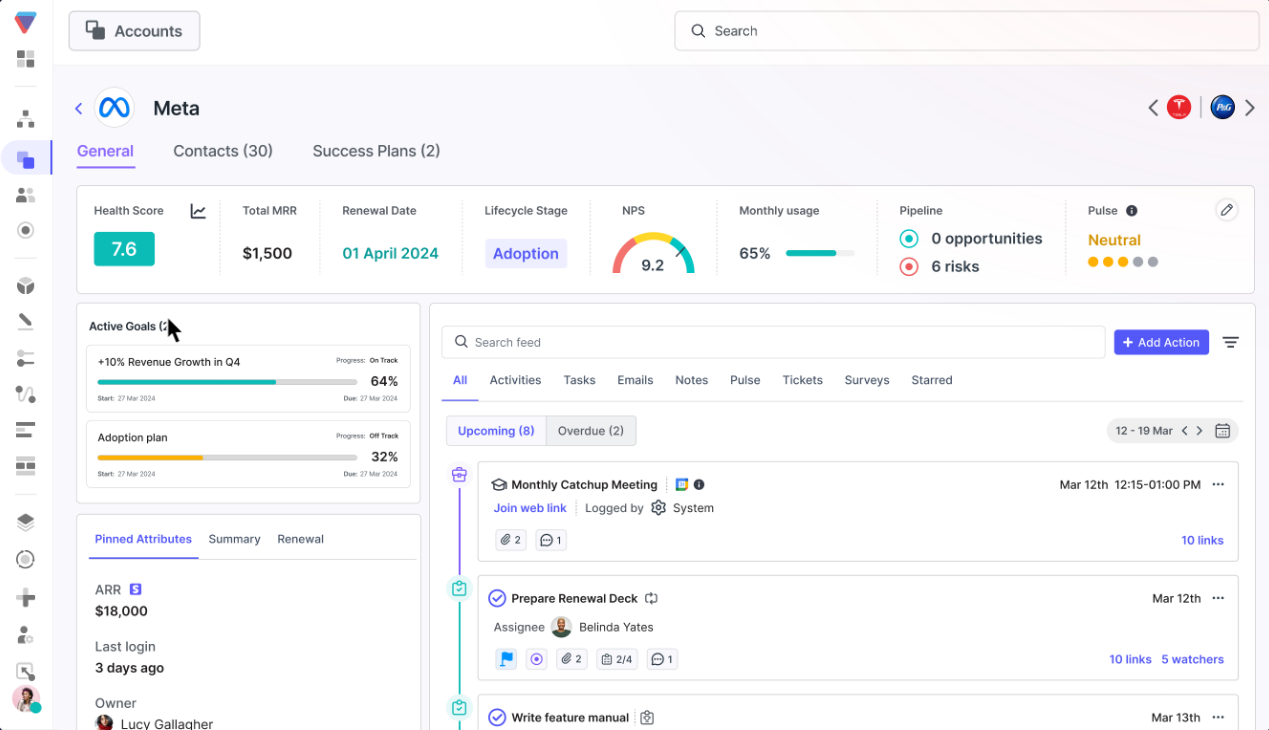
Velaris is an AI-native customer success and post-sales platform designed for mid-market and enterprise B2B companies. It brings customer data, conversations, activities, health scores, renewals, and workflows into one system, giving teams a more complete view of each account.
Its AI analyzes both structured information, such as product usage and CRM fields, and unstructured information from calls, emails, tickets, and notes. This helps teams identify emerging risks, understand customer sentiment, uncover expansion signals, and receive recommended actions without manually reviewing every interaction.
Velaris also includes a Copilot for asking questions about customer data, generating reports and dashboards, preparing QBRs, and taking actions within the platform. Teams can create AI agents that monitor customer activity, update account information, and alert CSMs when important changes occur.
It is particularly relevant for organizations that want to move beyond static dashboards and use AI to automate analysis, reporting, risk detection, and repetitive post-sales work.
Gainsight
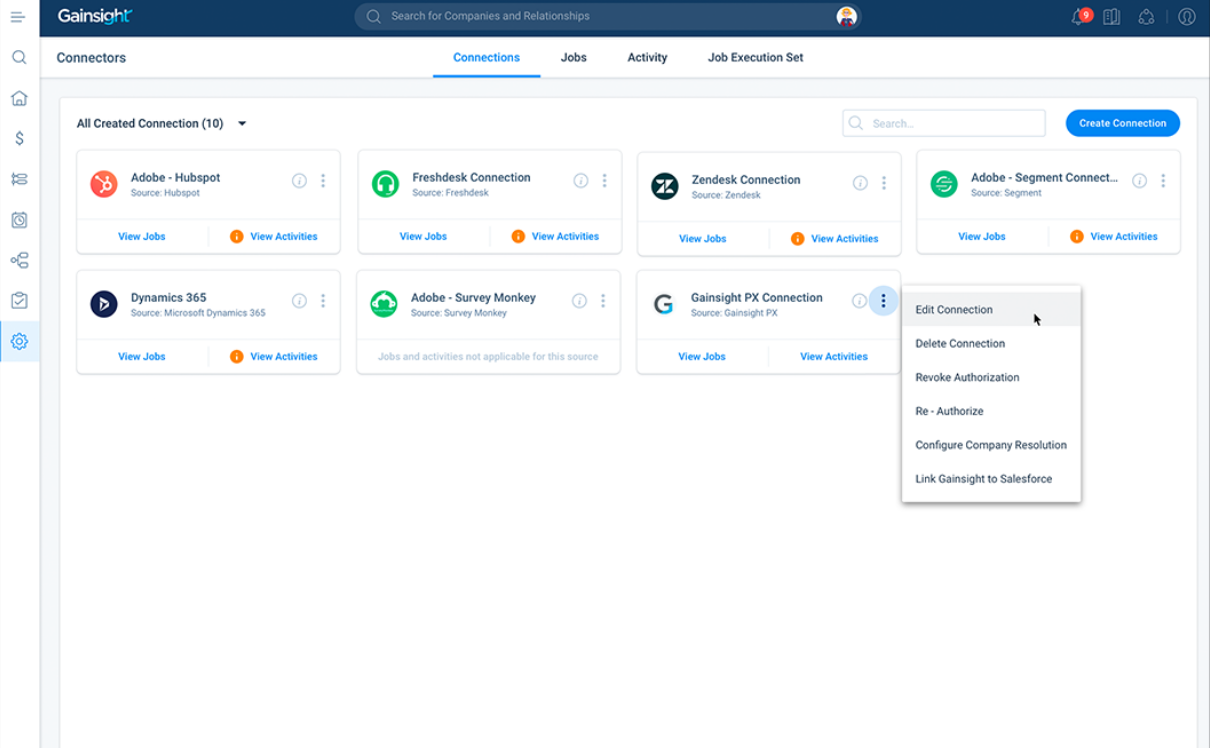
Gainsight is an established customer success platform with extensive capabilities for health scoring, success planning, journey orchestration, digital engagement, and reporting. It is commonly considered by larger organizations that need to manage complex customer portfolios, processes, and team structures.
Teams can combine product usage, support activity, survey responses, lifecycle stages, and other customer data to create health scores and trigger actions. Gainsight’s playbooks and calls to action help standardize how CSMs respond to common situations such as onboarding delays, adoption issues, renewal risks, and expansion opportunities.
Its Journey Orchestrator supports automated and personalized communication based on customer attributes and behavior. The platform also offers AI-supported workflows and insights, alongside its more traditional customer success management capabilities.
Because of its breadth and configurability, Gainsight may be best suited to organizations with dedicated customer success operations resources that can manage implementation, administration, and ongoing optimization.
Totango
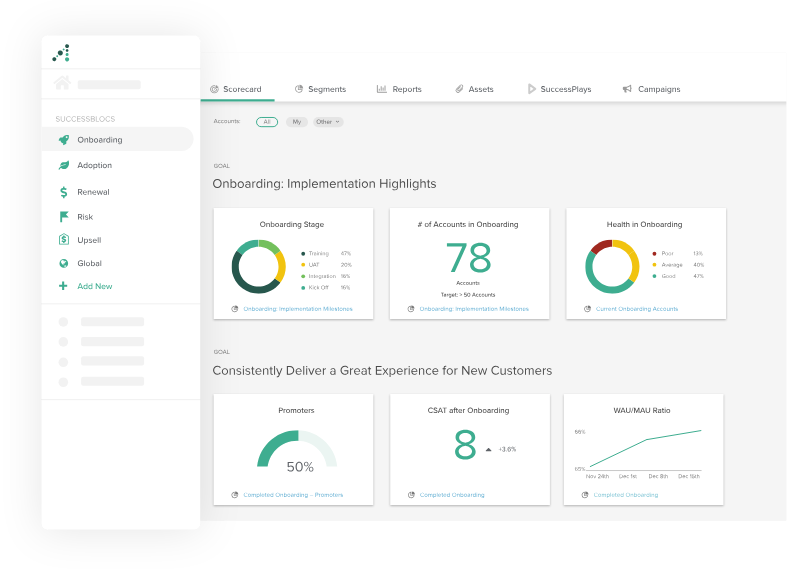
Totango takes a modular approach to customer success, allowing organizations to begin with a specific use case and expand their processes over time. Its pre-built SuccessBLOCs provide frameworks for common stages and objectives, including onboarding, adoption, renewals, risk management, expansion, and advocacy.
Each SuccessBLOC can include customer segments, health indicators, workflows, campaigns, reports, and recommended processes. This gives teams a starting point instead of requiring them to design every customer journey from scratch.
Totango also supports automated digital programs alongside high-touch engagement. This can help organizations apply different service models to different customer segments, such as assigning strategic accounts to CSMs while using automated journeys for lower-touch customers.
It may be a useful option for teams that want structured customer success processes but prefer to implement them gradually rather than launching a large transformation at once.
ChurnZero
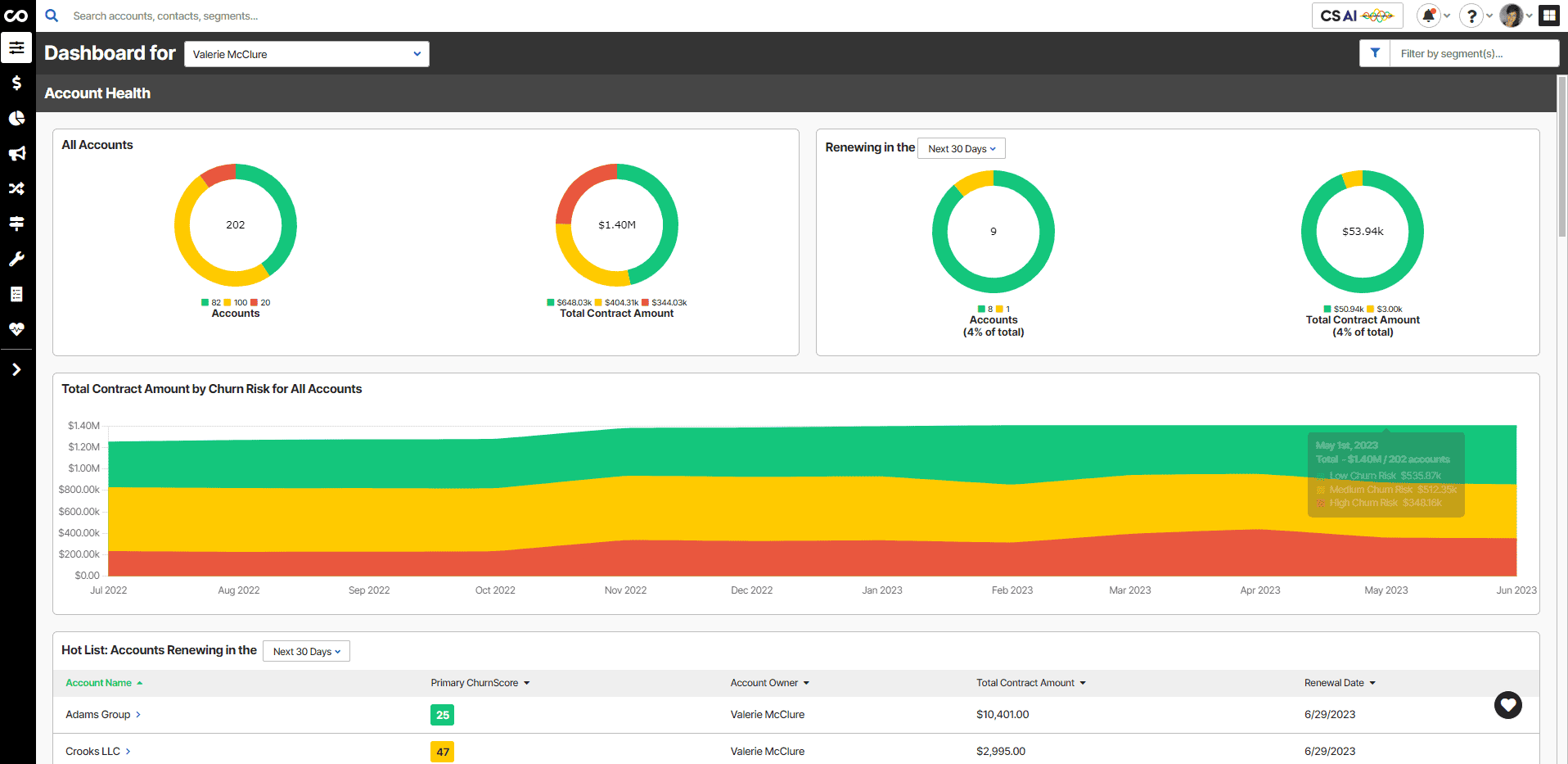
ChurnZero focuses heavily on customer visibility, real-time alerts, digital engagement, and proactive account management. It brings together customer data and behavior so teams can identify meaningful changes without repeatedly checking individual dashboards.
Alerts can notify teams when product usage falls, engagement changes, sentiment shifts, or a customer reaches an important milestone. These notifications can be delivered through the platform, email, Slack, or Microsoft Teams, helping CSMs respond while there is still time to influence the outcome.
ChurnZero also provides journeys, playbooks, customer segmentation, health scoring, and automated communications. These capabilities can be used to standardize onboarding, improve adoption, manage renewals, and deliver personalized outreach across larger customer portfolios.
It is likely to appeal to subscription businesses that want to combine real-time product usage insights with structured customer engagement and digital customer success programs.
ClientSuccess
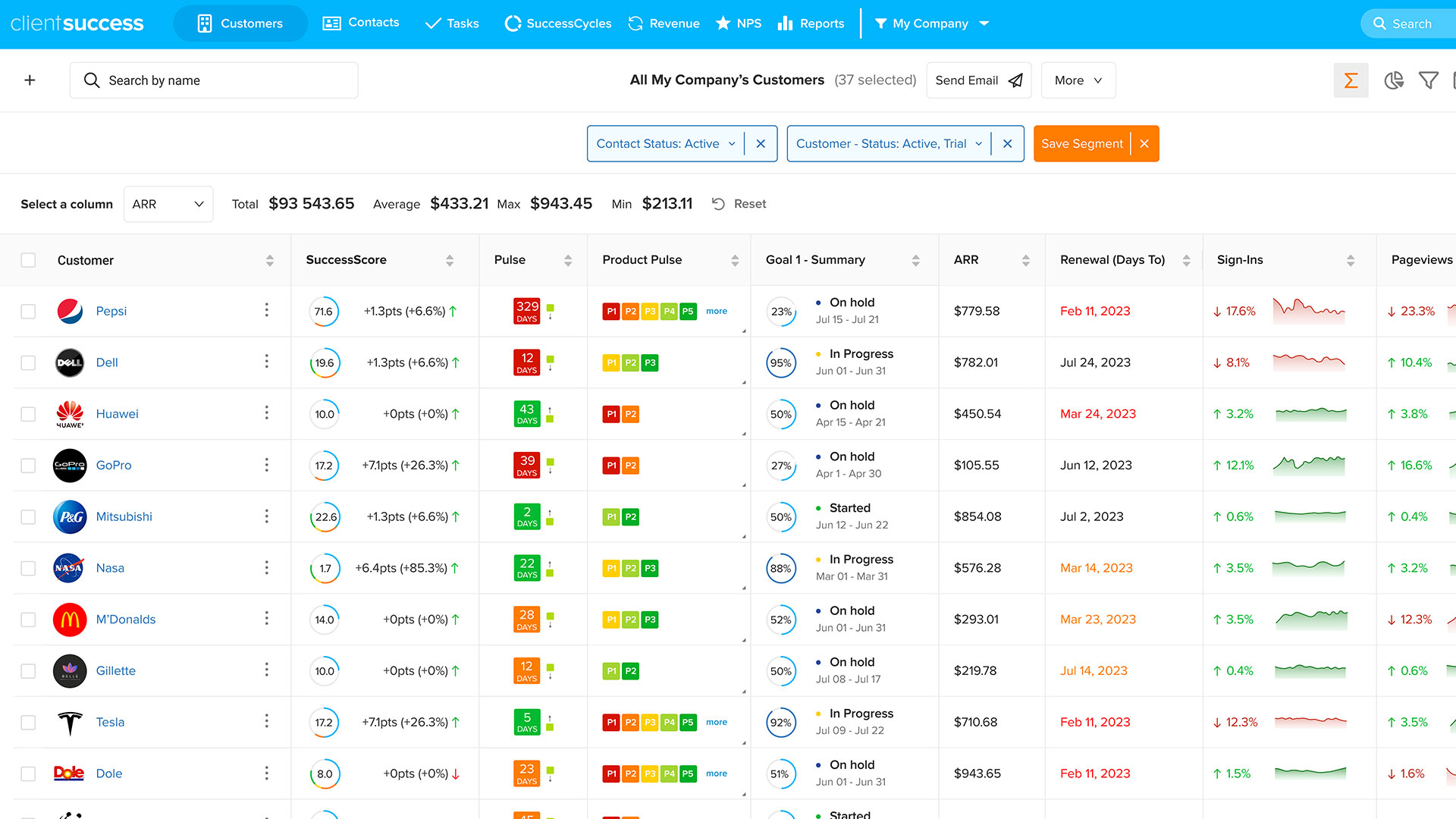
ClientSuccess is a customer success platform designed primarily for B2B SaaS companies. It centralizes customer information such as CRM data, product usage, support activity, survey responses, billing signals, health scores, and renewal information.
The platform includes health scoring, journey management, renewal forecasting, goals, playbook automation, onboarding portals, and reporting. Its customer views are designed to give CSMs a clear picture of account status and the actions that require attention without requiring them to navigate several separate systems.
ClientSuccess also offers AI-supported summaries and insights that highlight positive developments and potential areas of concern within an account. This can help CSMs prepare for customer conversations and prioritize follow-up activity.
Its emphasis on usability and guided implementation may make it suitable for growing SaaS teams that want broader customer success functionality without the administrative demands of a highly complex enterprise platform.
No platform should be selected from its website description alone. Create a shortlist based on your requirements, test each option using realistic customer data and workflows, and involve the CSMs and operations teams who will use the system every day.
How to implement customer success software
Buying customer success software is only the first step. The real value comes from how well you roll it out, connect it to your data, and get the team using it consistently.
Run a proof of concept before full rollout
Start with a focused proof of concept instead of launching every workflow at once. Choose a small group of CSMs, a defined customer segment, and a few high-impact use cases, such as health scoring, renewal risk alerts, onboarding tracking, or account reporting.
The goal is to test whether the platform works with real customer data and real CS workflows. During the proof of concept, check whether CSMs can find account context faster, whether alerts are useful, whether health scores make sense, and whether the system reduces manual work.
Sequence data migration and setup carefully
Data migration should happen in stages. Start with the core account and contact records from your CRM, then add renewal dates, ownership, ARR, lifecycle stage, and key commercial fields. Once the basics are clean, connect product usage, support tickets, surveys, communications, and other customer signals.
Avoid building automations or health scores before the data is reliable. If lifecycle stages are inconsistent or renewal dates are missing, the platform may trigger the wrong workflows and reduce trust before the rollout has even started.
Train the team on workflows, not just features
CSM adoption depends on whether the software fits into daily work. Training should focus on practical scenarios: preparing for a customer call, reviewing at-risk accounts, updating success plans, responding to alerts, managing onboarding milestones, and preparing renewal reviews.
It also helps to create clear rules for what should live in the customer success platform versus the CRM or other tools. If CSMs are unsure where to update health, log risks, or track next steps, they may fall back into spreadsheets and old habits.
Set realistic time-to-value expectations
Some value should appear quickly. Teams may see better account visibility, cleaner dashboards, and reduced manual reporting within the first few weeks. More strategic value, such as improved renewal forecasting, stronger health scoring, and better churn prevention, usually takes longer because the system needs consistent data and team adoption.
A practical rollout might take 30 days to configure the basics, 60 days to validate workflows, and 90 days to measure early impact. By that point, leaders should be able to see whether the platform is improving CSM productivity, account coverage, risk visibility, and customer follow-through.
Implementation should not be treated as a one-time setup project. Review usage, data quality, workflow performance, and CSM feedback regularly so the platform keeps improving as your customer success motion evolves.
The second-platform problem: migrating off an incumbent CS tool
Implementing customer success software is more complicated when your team is already using another CS platform. This is not a clean first rollout. You have live account data, active playbooks, existing dashboards, historical health scores, and CSM habits that all need to move without disrupting customer work.
Start by auditing what must be migrated and what should be retired. Not every field, workflow, report, or automation from the old platform deserves to come across. Some may be outdated, duplicated, or built around processes the team no longer follows. Migration is a chance to simplify the operating model, not copy old complexity into a new system.
Pay special attention to in-flight work. Active onboarding plans, renewal playbooks, risks, tasks, customer notes, and success plans should be mapped before the switch. Decide which system remains the source of truth during the transition, and avoid letting CSMs update the same account in two places for too long.
CSM muscle memory is another risk. Teams may know the old platform well, even if it is inefficient. Training should focus on the workflows they perform every day: reviewing account health, preparing for customer calls, managing tasks, updating risks, and tracking renewals. Show how those actions work in the new platform rather than only explaining new features.
A good migration plan should include parallel testing, data validation, workflow QA, and a clear cutover date. The goal is not just to move data. It is to make sure the team can keep managing customers confidently from day one.
How customer success software evolves with your business
Customer success software should evolve alongside your customer base, team structure, and revenue model. A business may initially use it to centralize account information and track basic health indicators, but its role becomes more strategic as the organization adds customers, products, segments, and customer success processes.
Over time, the platform can support more advanced analytics, automate a larger share of routine work, and give leadership a clearer view of retention and expansion. This allows the customer success function to scale without requiring headcount to increase at the same rate as the customer base.
Start with basic health tracking
In the early stages, customer success software helps teams replace scattered spreadsheets and manual account tracking with a shared view of each customer. CSMs can monitor basic indicators such as product usage, engagement, support activity, onboarding progress, satisfaction scores, and upcoming renewal dates.
These signals make it easier to identify customers who may need attention. For example, a decline in usage, an incomplete onboarding task, or a series of unresolved support tickets could indicate that an account is falling behind.
At this stage, the primary value is visibility and consistency. Teams can begin to define what a healthy customer looks like, create a repeatable account review process, and reduce their reliance on individual CSM knowledge.
Expand into segmentation and standardized workflows
As the customer base grows, it becomes difficult to manage every account in the same way. Customer success software can help teams segment customers according to factors such as revenue, lifecycle stage, product usage, industry, growth potential, or level of support required.
These segments can then be matched with different engagement models. Strategic accounts may receive frequent CSM interaction, while smaller customers follow automated onboarding, adoption, and renewal journeys.
Teams can also introduce playbooks for common situations, such as low adoption, stakeholder changes, onboarding delays, or upcoming renewals. This creates a more consistent customer experience and reduces the amount of manual decision-making required from each CSM.
Add predictive analytics
Once the platform has access to enough reliable customer data, organizations can move beyond reporting what has already happened and begin predicting what may happen next.
Predictive models can analyze patterns across product usage, engagement, support activity, sentiment, health scores, and commercial information. These models may help identify customers with a higher likelihood of churning, renewing, expanding, or failing to achieve an important milestone.
The predictions should not replace human judgement. Instead, they help teams focus their attention by highlighting accounts that warrant further investigation. They can also improve renewal forecasting and give leaders a clearer understanding of risk across the entire customer base.
Integrate AI for proactive engagement
AI can help customer success teams interpret larger volumes of structured and unstructured customer data. This includes information from calls, emails, support tickets, meeting notes, surveys, and product activity.
Rather than asking CSMs to review every source manually, AI can summarize recent account activity, identify potential risks, detect sentiment changes, recommend next steps, and draft personalized follow-up messages. It can also trigger alerts or workflows when a meaningful change occurs.
This allows teams to respond more quickly while reducing the administrative work involved in preparing for meetings, updating account records, and monitoring customer activity. It also becomes easier to provide proactive engagement across accounts that would otherwise receive limited attention.
Connect customer success with the wider business
As customer success operations mature, the platform can become a shared source of customer intelligence for sales, support, product, finance, and leadership.
Sales teams can use customer data to identify expansion opportunities. Product teams can analyze recurring feedback and adoption barriers. Finance teams can improve renewal forecasting, while support teams can see the wider account context behind an individual ticket.
Connecting these departments reduces information silos and gives the organization a more consistent understanding of customer needs, risks, and outcomes.
Become a strategic growth driver over time
At its most mature stage, customer success software supports decisions that affect retention, expansion, resource allocation, and product strategy. Leaders can compare performance across customer segments, understand the drivers of churn, evaluate team capacity, and identify which customer success activities produce the strongest commercial outcomes.
The platform can also help the organization test and refine its service model. For example, teams can determine which customers require high-touch support, which workflows can be automated, and where additional human intervention has the greatest impact.
At this point, customer success software is no longer simply a system for tracking accounts. It becomes part of the organization’s revenue infrastructure, helping protect recurring revenue, increase customer lifetime value, and scale customer relationships more efficiently.
Conclusion
Customer success software has become an essential driver of retention, growth, and customer loyalty. From preventing churn and unlocking upsell opportunities to scaling personalized engagement and aligning teams, these platforms transform how businesses build relationships with their customers.
The right tool evolves with your business starting with health tracking, expanding into predictive analytics, and eventually becoming a strategic growth engine.
Among the options, Velaris, which is highly rated on G2, stands out with its AI‑powered approach that helps teams move from reactive support to proactive success. If you’re ready to see how Velaris can transform your customer success strategy, book a demo today.
Frequently Asked Questions
Who should be involved in selecting customer success software?
Beyond the customer success team, it’s smart to involve sales, product, and support leaders. This ensures the tool aligns with cross‑functional goals and avoids siloed decision‑making.
Can small businesses benefit from customer success software, or is it only for enterprises?
Even small teams gain value by centralizing customer data, automating workflows, and tracking health scores. The difference is in scale, not relevance.
How does customer success software differ from a CRM?
CRMs focus on managing sales pipelines and contacts, while customer success software is designed to monitor ongoing customer health, retention, and expansion after the sale.
What metrics should be tracked with customer success software?
Key metrics include churn rate, customer health scores, product adoption, net revenue retention (NRR), and customer lifetime value (CLV)
What role does automation play in customer success software?
Automation reduces repetitive tasks like sending reminders, tracking usage, or flagging risks, freeing teams to focus on high‑value customer interactions.

The Velaris Team
A (our) team with years of experience in Customer Success have come together to redefine CS with Velaris. One platform, limitless Success.




Velaris is an AI-native Customer Success Platform built for mid-market and enterprise B2B SaaS teams. From customer health scoring and churn prediction to onboarding automation, renewals, and expansion workflows, Velaris helps recurring revenue teams understand account health, reduce churn, and scale customer success with greater visibility and control.