We look forward to showing you Velaris, but first we'd like to know a little bit about you.


How Luminary Built a More Proactive Customer Success Operation With Velaris

AI Estate Planning Software
11-50 employees
Hybrid
The challenge
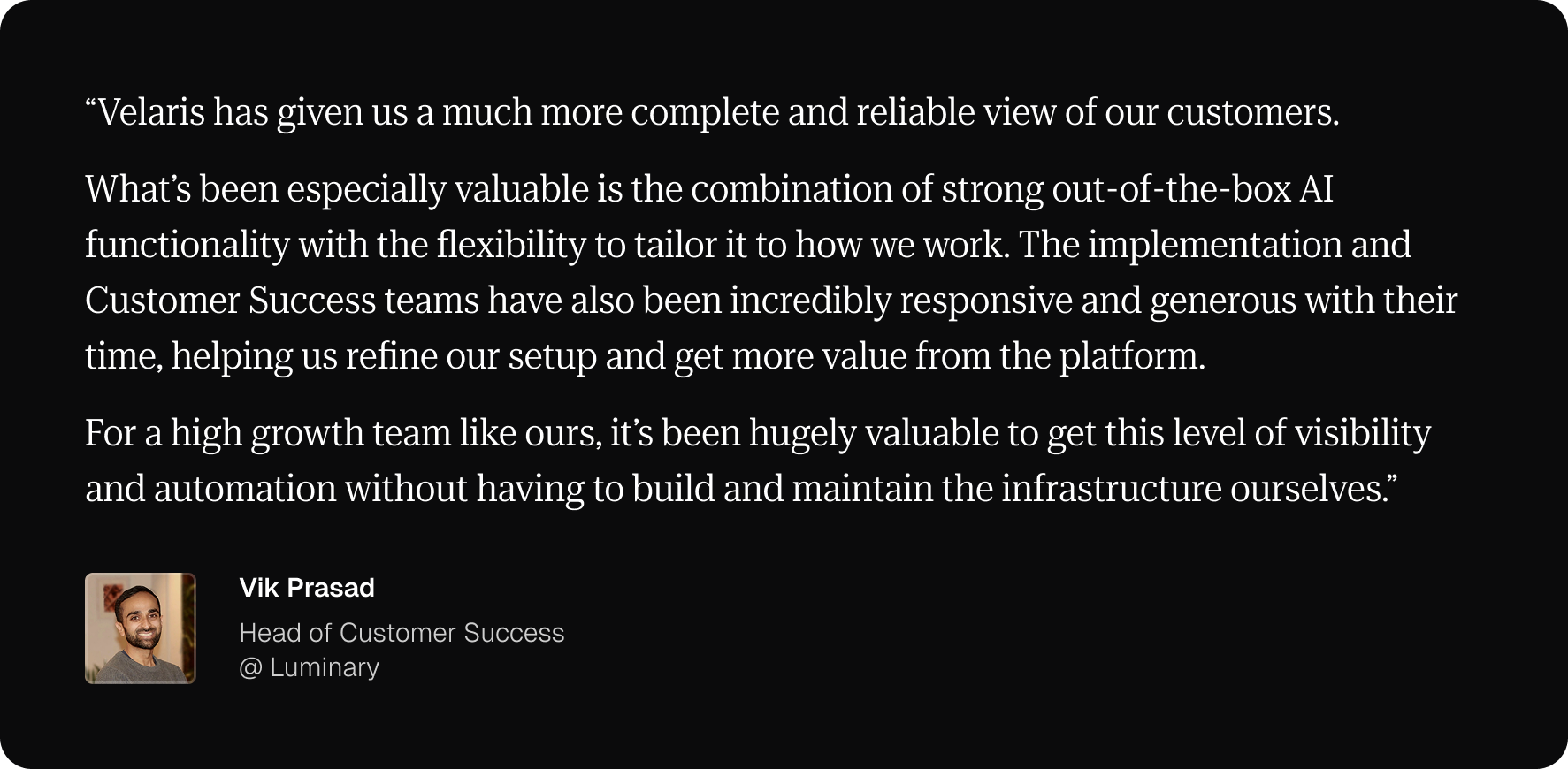
As Luminary’s customer base grew, its Customer Success team needed a more proactive way to understand which customers were thriving, which were at risk, and where expansion opportunities were emerging.
Before Velaris, Luminary’s customer data was spread across several different systems. Product usage lived in PostHog, customer information and automations in HubSpot, and reps were creating one-off outputs using standard LLM tools to generate customer briefs. The challenge was connecting those signals into a single, reliable view of each customer. Without that shared context, it was difficult to efficiently and proactively understand customer health, risk, and opportunity across the rapidly expanding customer base.
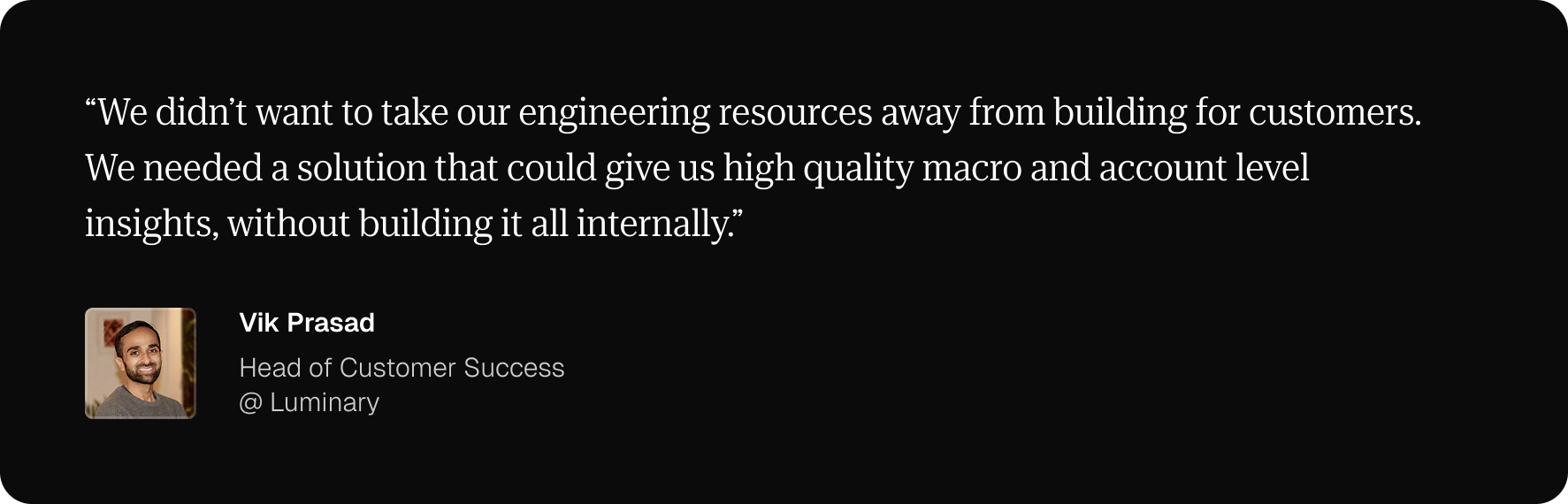
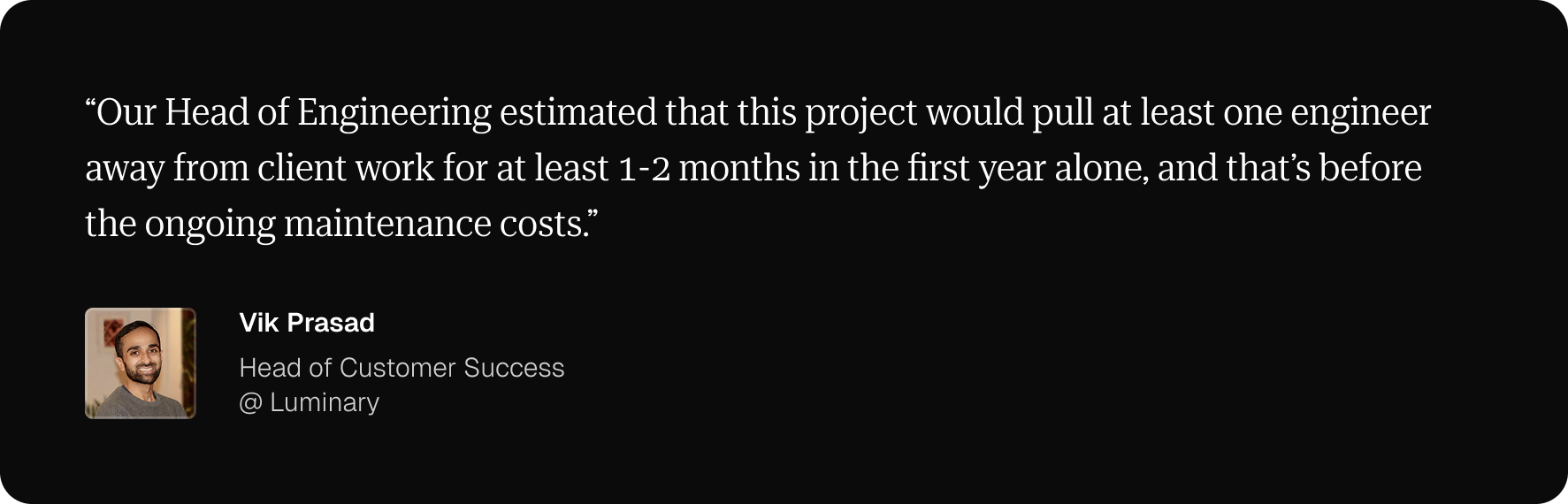
Vik, the Head of Customer Success at Luminary, considered building a cohesive system internally, but quickly realized there was a high level of complexity that comes with integrating all of Luminary’s frequently evolving data sources. After scoping the project, it became clear that building the infrastructure internally would require a substantial investment of development time and resources in the first year, with ongoing maintenance adding further overhead that would pull the team’s focus away from their core product roadmap.
Why Velaris
Luminary evaluated several options, including Vitally, ChurnZero, and building its own system. Velaris stood out for three major reasons.
1. A more complete view of customer health
Health scoring was Luminary’s original reason for buying Velaris.
The team wanted to combine usage data, support activity, CRM information, and customer engagement into one health model rather than assessing each signal separately.
With Velaris, usage could finally be interpreted in context.
A spike in activity could be considered alongside recent customer conversations or CS initiatives. A decline in adoption could be surfaced alongside engagement data and other account signals.
That gave Luminary a much clearer picture of what was actually happening across the customer relationship.
2. Avoiding high internal build and maintenance costs
Luminary had already explored recreating the system itself using PostHog, HubSpot, Claude, and its internal tooling.
It was possible, but the engineering cost quickly became difficult to justify.
For a fast growing company, the biggest cost was opportunity.
Any time its development team spent building internal CS infrastructure was time it couldn’t spend building Luminary’s product.
3. An AI strategy built into the product
Vik was also looking closely at where Customer Success technology was heading.
The team knew it could continue building individual AI workflows with standard LLM tools, but it wanted AI to operate from a connected understanding of the customer rather than forcing individual reps to repeatedly assemble that context themselves.
Velaris’ Customer Context Graph continuously organizes customer data into a connected understanding of each account, linking context like usage, conversations, support activity, commercial information, health, risks, and historical events. Creating purpose-built, context driven, made Velaris’ product direction stand out.
Luminary started with features like CallSense, which automatically turns call transcripts into pre-drafted follow-up actions and tasks. The team has since started building custom AI skills and agents around its own workflows, all powered by the Velaris Context Graph.
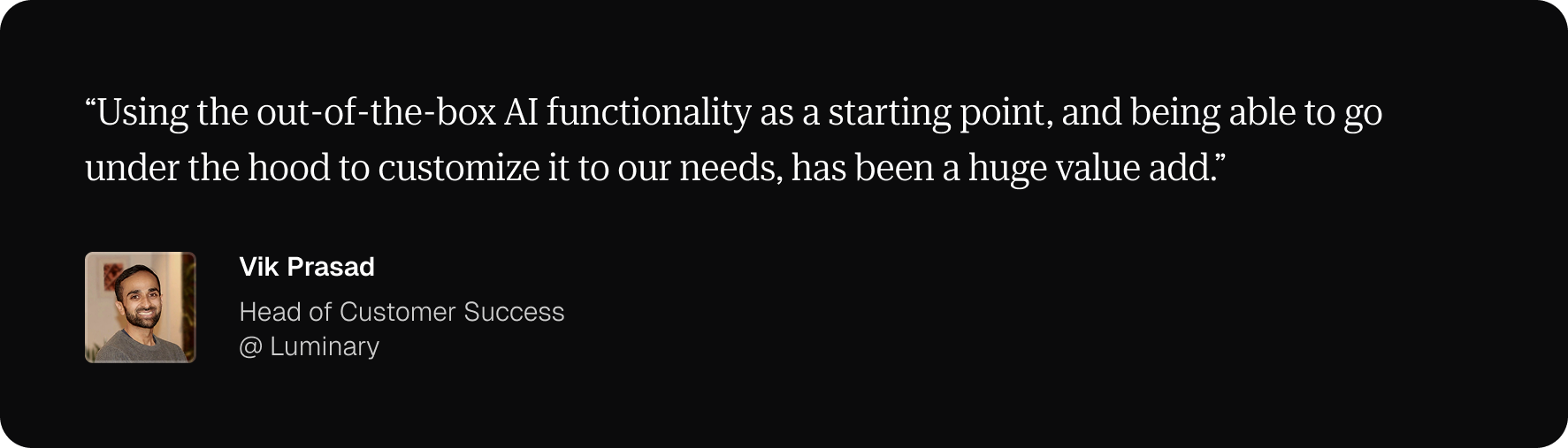
For Vik, the combination of ready-made functionality and the ability to customize it has been particularly valuable.
The results
Since implementing Velaris, Luminary has started building a much more proactive Customer Success operation.
1. Customer health became a single, comprehensive measurement
By connecting usage, CRM, support, and customer engagement data in Velaris, Luminary has a more concrete way to understand the health of its customer base.
Leadership can now see how regularly customers are engaging with the platform, how often the team is connecting with them, and how accounts are performing against Luminary’s health model.
This gives the team visibility into customers that may have dips in usage or interaction with the CS team, reducing the time it takes to address important changes in adoption.
2. Luminary can identify risk and expansion opportunities earlier
Velaris gives the Luminary team a way to monitor both expansion opportunity and churn risk without relying on a CSM to manually spot the change. The team is now able to intervene early and often to address risk and drive expansion deals.
That means Luminary can start expansion conversations while customer momentum is high and address declining engagement before it’s too late.
3. Account reviews and planning became more data-driven
Velaris is now part of Luminary’s regular deal and book reviews.
CSMs use account-level dashboards to see what is coming up, what requires action, and which automated triggers have already fired.
Leadership can also use dashboards and Velaris Copilot to answer questions across the customer base without manually pulling information together.
During renewal planning, for example, Vik can identify the accounts where action today could have the biggest impact on the forecast and give each rep a focused list of customers to prioritize.
4. The use case expanded far beyond health scores
Luminary originally bought Velaris to solve customer health monitoring, but the team is now using or building workflows around a much broader set of CS activities.
One of those is product feedback. Instead of relying on individual reps to manually collect and report what they hear from customers, Luminary is building an agent to help turn customer conversations into a more consistent stream of feedback for the product team.
The team is also exploring agents that can proactively identify:
- Expansion opportunities
- Emerging customer risks
- Documenting their growing Customer Advocacy Network
As the customer base and CS team grow, the goal is to make these processes repeatable without creating more administrative work for CSMs.
5. Luminary avoided building a costly internal CS infrastructure
Perhaps most importantly, Luminary was able to build this operating model without taking on a costly internal engineering project. Replicating the same infrastructure in-house would have required significant engineering investment upfront, as well as ongoing resources to maintain it.
With Velaris handling the bulk of the implementation, Luminary’s development team could stay focused on building its own product.
What’s next
Luminary is expanding its use of Velaris, with its roadmap being centered around using AI agents to proactively manage more of the work happening across its customer base.
As Luminary looks to scale this model across its customer base, the value of having customer context centralized within Velaris becomes even more important. The standard LLM tools could help an individual CSM analyze information, but doing that consistently across every customer would still require Luminary to build and maintain the infrastructure connecting all of its data. Now, thanks to Velaris, they don’t have to.
Moving forward, the team wants agents continuously scouting for expansion opportunities and emerging risks, consolidating product feedback, and identifying customers who could become references or advocates.
Instead of spending time compiling information from various sources and manually discovering signals, CSMs at Luminary can spend time doing what matters most: connecting with customers.
With Velaris, Luminary can achieve their long-term goal of building a Customer Success function where every account is monitored proactively, and the team has the capacity and context to act at the right moment.

The Velaris Team





Velaris is an AI-native Customer Success Platform built for mid-market and enterprise B2B SaaS teams. From customer health scoring and churn prediction to onboarding automation, renewals, and expansion workflows, Velaris helps recurring revenue teams understand account health, reduce churn, and scale customer success with greater visibility and control.