We look forward to showing you Velaris, but first we'd like to know a little bit about you.


Top 10 AI Churn Prevention Software for 2026
Churn prevention software helps teams spot warning signs earlier and act before revenue is lost. We compare 10 of the best tools for 2026, from Customer Success Platforms that detect account and renewal risk to tools that prevent cancellations and recover failed payments, covering features, limitations, and pricing.
The Velaris Team
October 3, 2026
Churn rarely starts when a customer clicks cancel. The warning signs usually appear much earlier. But the problem is that these signals are often spread across different systems, making them easy to miss until the customer is already close to leaving.
Churn prevention software helps teams spot those signals earlier and take action before revenue is lost. Unlike churn prediction software, which focuses on identifying who is likely to leave, churn prevention tools also help teams respond to risk.
In this guide, we compare 10 of the best churn prevention software tools for 2026, covering platforms built for account and renewal risk, voluntary cancellations, and involuntary churn from failed payments.
Key takeaways
- Velaris, ChurnZero, Hook, and Gainsight connect churn signals directly to Customer Success action.
- Churnkey and Paddle Retain focus more heavily on cancellations and failed-payment recovery.
- Pendo is strongest where declining product engagement is an important churn signal.
- Planhat and Odie/Unison emphasize customer health and early risk detection.
- The right tool depends on the type of churn you need to prevent, and not entirely on which platform has the most features.
1. ChurnZero
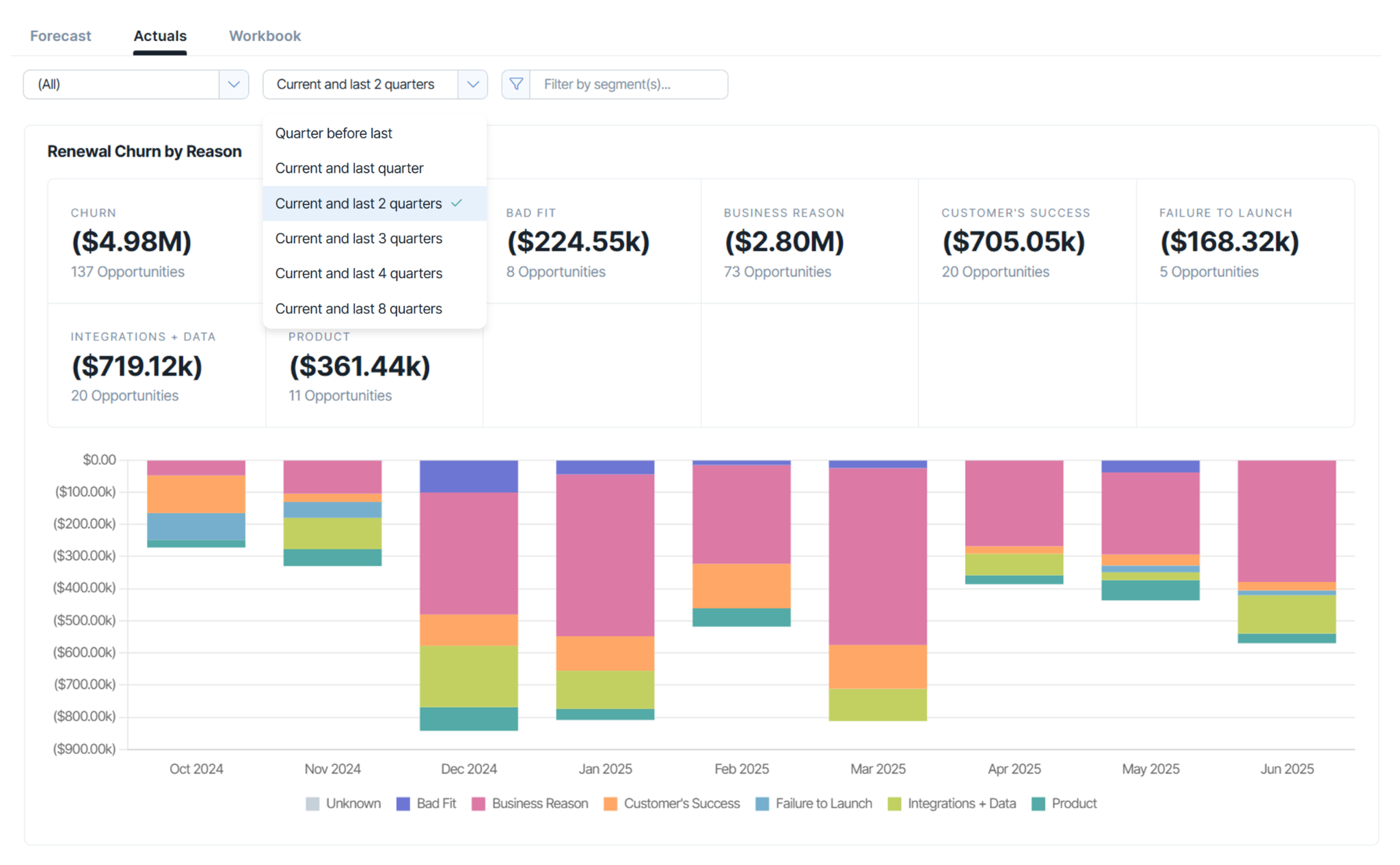
ChurnZero is a Customer Success Platform built around customer retention, with health scoring, lifecycle automation, renewal management, and AI agents designed to identify and act on churn risk.
Its Harbinger agent focuses specifically on early relationship risk. It analyzes engagement patterns, sentiment shifts, behavioral signals, account context, and previous signals, then produces a risk signal that explains what is happening, how urgent it is, why it matters, and what the CSM should do next.
Best for
Mid-market B2B SaaS companies that want churn prevention embedded directly into their Customer Success workflows.
What it does well
- Risk detection and prioritization: Harbinger combines engagement, sentiment, behavior, and account context with health scoring and segmentation to identify which customers are becoming risky and which need attention first.
- Automated retention workflows: Risk signals can trigger Plays, tasks, outreach, and other actions, helping teams move from detection to intervention without relying on manual follow-up.
- AI agents for retention: ChurnZero includes 20 purpose-built agents that can support workflows such as risk detection, customer engagement, renewal management, and data enrichment.
- Retrospective churn analysis: The Retrospective agent reviews churned accounts to identify root causes, categorize losses, and help teams improve future prevention strategies.
- Business-aware AI: Customer Intelligence Profile and Knowledge Sources give agents context about the company's customers, processes, renewal strategy, and internal knowledge so recommendations are more relevant.
Limitations and considerations
ChurnZero's churn prevention capabilities are strongest when customer data, health scores, lifecycle stages, and workflows are already centralized inside the platform. Teams adopting it purely as a point solution for churn prevention may therefore be taking on more Customer Success infrastructure than they need.
Its agent model also leans heavily on predefined agents built for specific CS jobs. That can make adoption faster, but teams that want to design highly bespoke autonomous agents from scratch may prefer a more open-ended agent builder.
Pricing
ChurnZero does not publish standard pricing for its Customer Success Platform, so companies need to request a custom quote.
Its Agentic Essentials package is sold as a separate annual subscription with a flat fee and a shared pool of AI credits. It is available with ChurnZero Professional and Enterprise, and agents such as Harbinger and Retrospective are included within that package.
2. Velaris
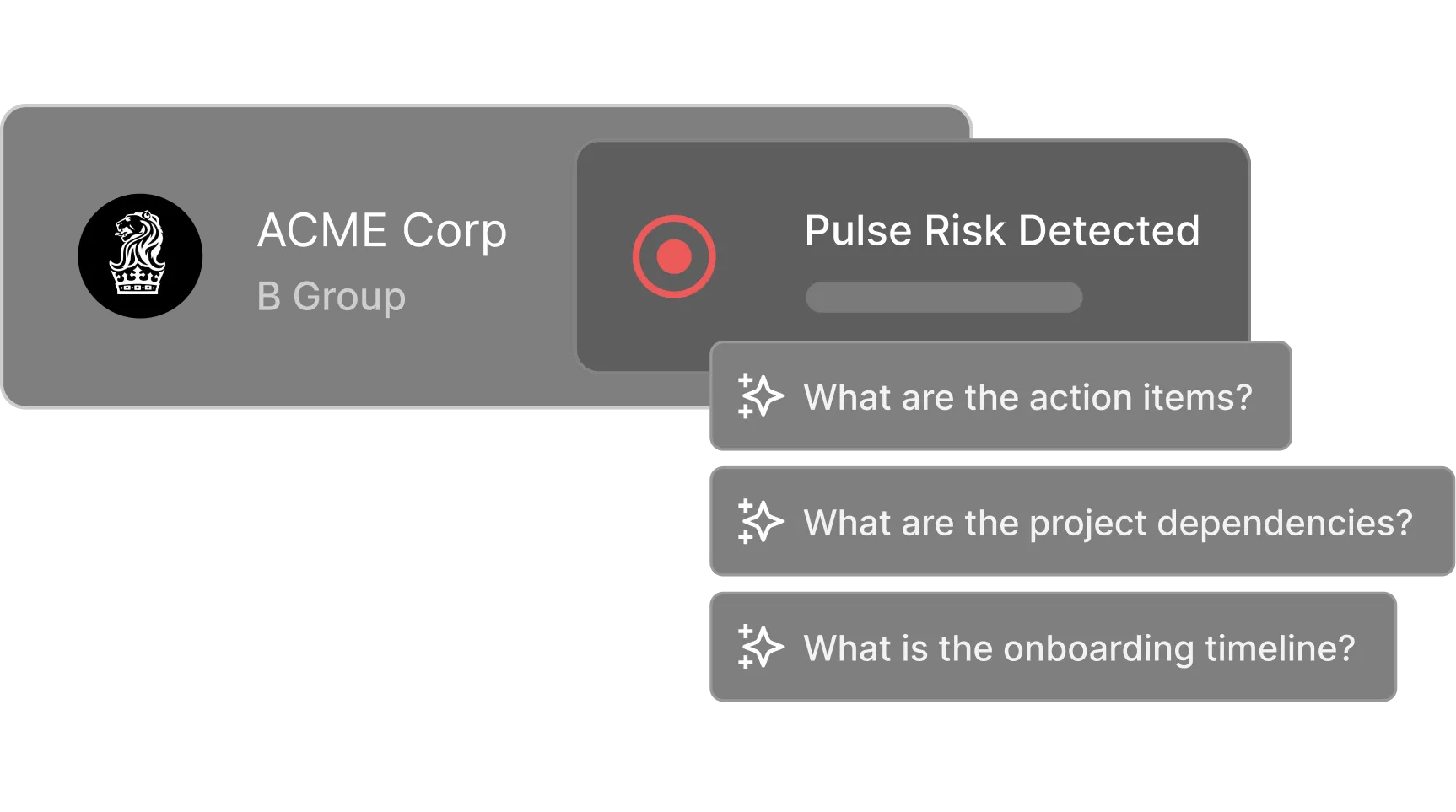
Velaris is an AI-native Customer Success Platform that combines customer health, lifecycle management, workflows, reporting, and AI agents in one system.
For churn prevention, Velaris focuses on identifying risk early and then helping teams act on it. Its Context Engine brings together product usage, CRM data, support activity, calls, emails, Slack conversations, notes, commercial information, and other customer signals so that risk can be assessed using the full customer relationship rather than a handful of isolated metrics.
Its AI agents can then monitor that context continuously, investigate changes in customer behavior, and trigger the appropriate response when risk emerges.
Best for
Mid-market and enterprise B2B SaaS companies that want churn prevention embedded into their wider Customer Success operation, particularly teams managing large portfolios where CSMs cannot manually monitor every account.
What it does well
- Continuous risk monitoring: Velaris AI agents monitor usage, sentiment, engagement, support activity, health, and other customer signals in the background to identify emerging churn risk.
- Customer Context Engine: Brings structured and unstructured customer data together in one continuously updated context layer, helping both CSMs and AI understand why an account may be deteriorating.
- Custom AI agents: Teams can create agents around their own churn-prevention processes, define the steps they should follow, and trigger them automatically when events such as a health-score drop occur.
- AI-enriched health and conversation signals: AI Pulse, lifecycle-specific health scores, and CallSense combine quantitative and qualitative signals to surface risks that might be missed by traditional health scoring alone.
- Portfolio and renewal intelligence: Copilot and AI agents help teams investigate why accounts are at risk, prioritize upcoming renewals, and monitor lower-touch customers that may otherwise receive little attention.
The key difference is that Velaris is designed to move beyond simply predicting churn. A declining health score, negative call, fall in usage, or unresolved customer issue can become the trigger for an agent or workflow that investigates what happened and starts the appropriate intervention.
Limitations and considerations
Velaris is a broader Customer Success Platform rather than a specialist cancellation or payment-recovery product. Companies primarily trying to reduce failed-payment churn or optimize self-service cancellation flows may be better served by a dedicated tool such as Churnkey or Paddle Retain.
Its churn-prevention capabilities also become more powerful as more customer context is connected, so teams should consider which CRM, usage, support, conversation, and commercial data sources they want available to the platform.
Pricing
Velaris uses custom annual pricing based on factors such as the number of customer accounts, users, integrations, data requirements, and the capabilities included.
The core platform includes AI functionality, while additional AI usage, MCP access, Custom Agents, integrations, and other advanced capabilities can be added depending on the team's requirements.
3. Hook
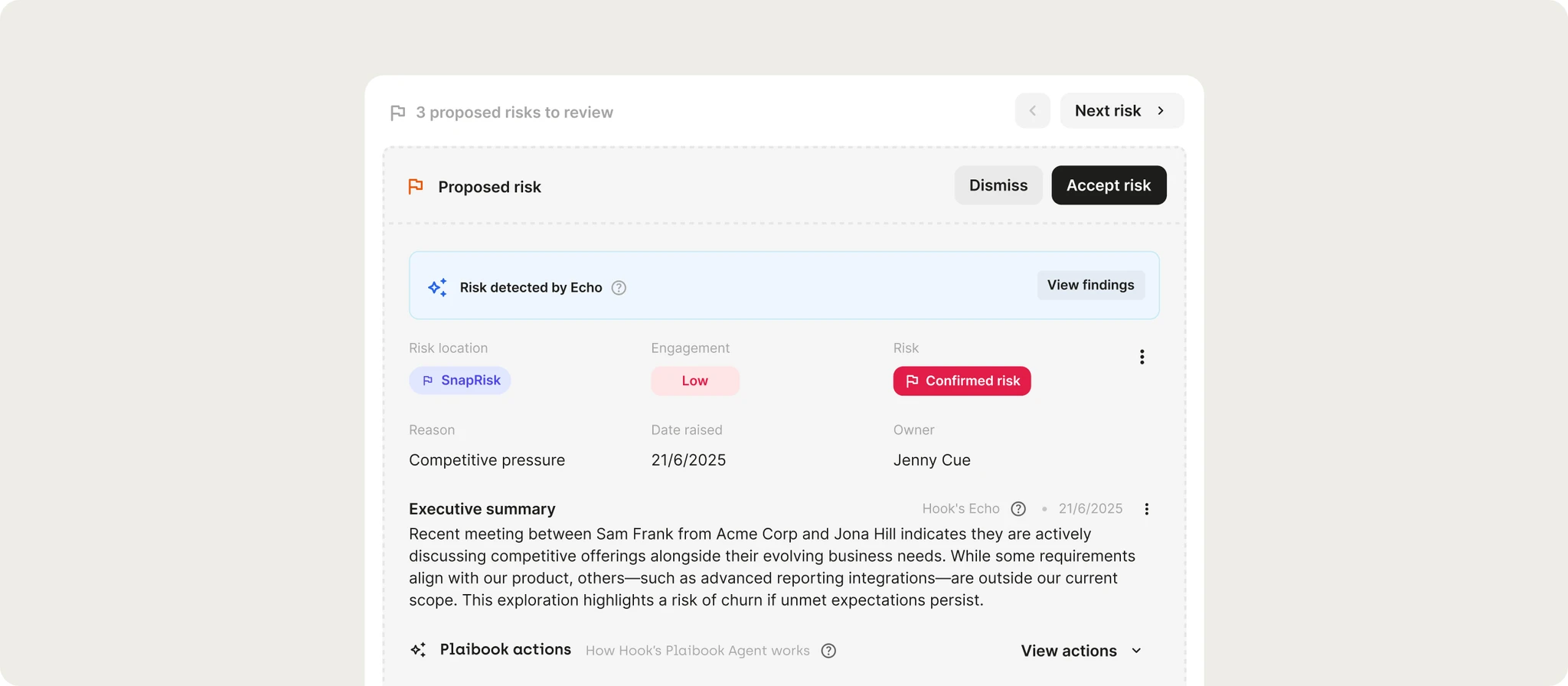
Hook is a Customer Success Platform focused heavily on churn prevention, customer health, and renewal risk. Rather than simply flagging accounts as healthy or unhealthy, it uses machine learning and customer signals to identify why an account may be at risk and what the team should do next.
Its Echo agent analyzes product usage, customer conversations, meetings, support activity, and other account signals to detect churn risk and expansion opportunities. Hook says Echo can identify risk up to 180 days before renewal, and that 90% of churn is identified as a risk before the renewal date.
Best for
B2B SaaS Customer Success teams that want predictive churn detection connected directly to playbooks and recommended or automated intervention.
What it does well
- Echo and early churn detection: Echo continuously monitors customer activity, conversations, product usage, and other signals to identify churn risk well before renewal.
- Predictive customer health: Hook’s Engagement Level uses behavioral and engagement data to estimate renewal likelihood and prioritize accounts that need attention.
- Conversation and usage intelligence: Analyzes meetings, customer interactions, adoption, and engagement for signals such as dissatisfaction, competitive mentions, unresolved issues, or declining usage.
- Tailored recovery playbooks: When risk is detected, Hook can build account-specific playbooks and recommend or automatically execute the next best actions.
- Renewal prioritization and investigation: Helps CSMs understand which renewals need attention and use Hey Hook to investigate the signals, stakeholders, and blockers behind the risk.
- Hey Hook: Gives CSMs a conversational interface for asking questions about customers, stakeholders, blockers, product usage, and renewal risk.
Hook's strength is the connection between prediction and intervention. It does not stop at telling a CSM that an account looks risky. Echo can explain the signals behind that risk, recommend a response, and create a tailored playbook designed to address it.
Limitations and considerations
Hook is particularly focused on customer intelligence, churn prevention, onboarding, renewals, and expansion. Teams looking for a broader Customer Success operating system with extensive success planning, customer portals, highly configurable reporting, or more complex lifecycle management should compare its wider platform capabilities with full-suite CSPs.
Its predictive models also depend on having enough reliable customer data available. Teams will get more value when product usage, CRM information, customer conversations, support activity, and renewal data are consistently connected.
Pricing
Hook does not publish standard pricing for its Customer Success Platform or AI agents. Companies need to request a custom quote based on their size, data requirements, and the capabilities they want to use.
Pricing for Echo, Activator, predictive health scoring, and other AI functionality is also not publicly listed, so buyers should confirm which capabilities are included in their proposed package.
4. Gainsight
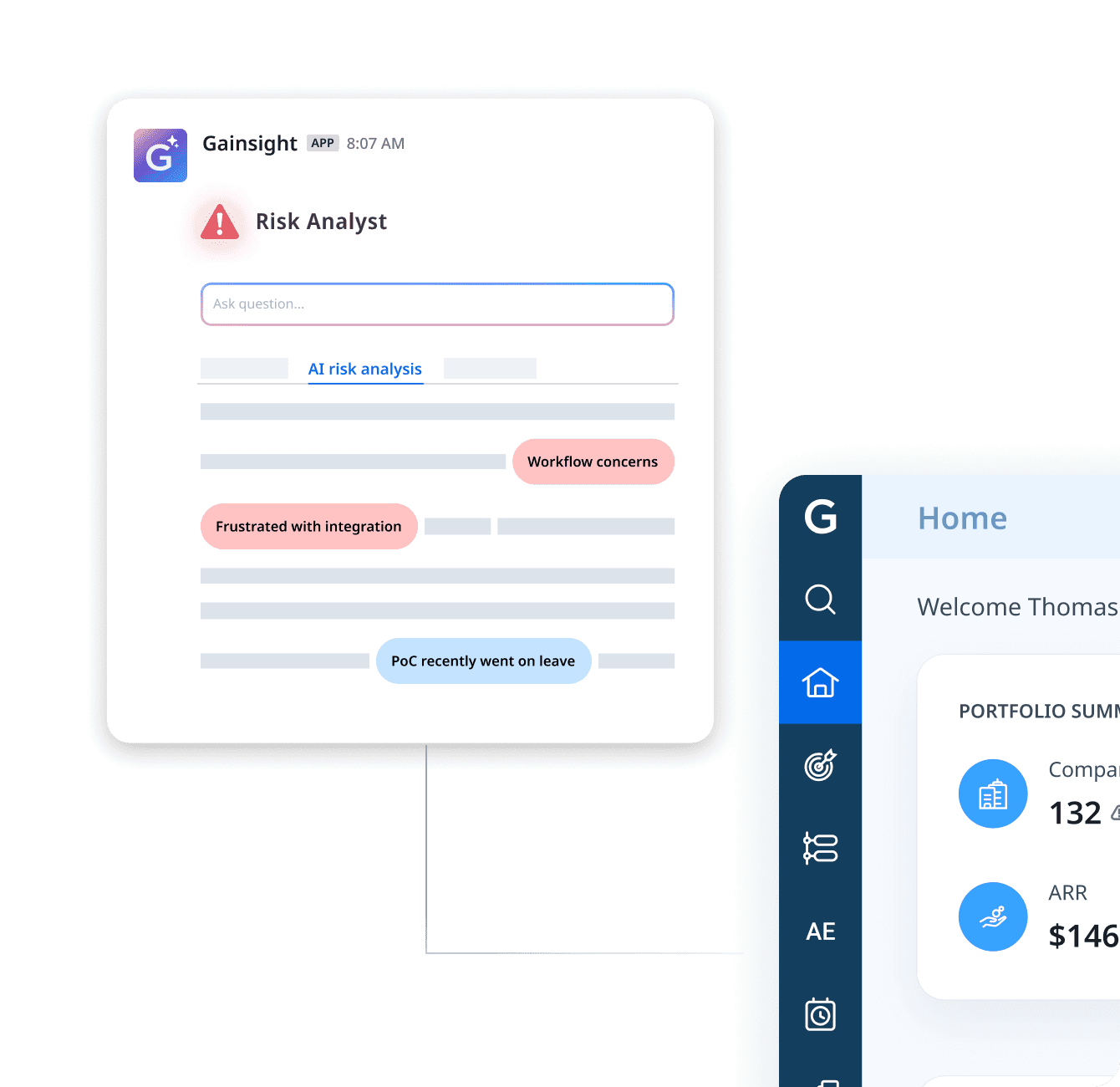
Gainsight is an enterprise Customer Success Platform with mature infrastructure for customer health, renewals, digital engagement, and revenue retention.
Its newer Atlas AI Agents extend that foundation by monitoring customer signals and taking action across retention workflows.
Rather than relying entirely on CSMs to identify risk and initiate outreach, Atlas agents can personalize communications, follow up with customers, manage parts of the renewal process, and escalate accounts when human involvement is needed.
Best for
Large enterprises with complex Customer Success organizations, significant renewable revenue, and established processes for health scoring, renewals, and digital customer engagement.
What it does well
- Atlas AI Agents: Purpose-built agents monitor customers, identify risk, communicate with accounts, and automate parts of retention and renewal workflows.
- Relationship and health intelligence: Staircase AI and configurable health scores combine customer signals to surface deteriorating accounts.
- Renewal and revenue prioritization: Renewal forecasting and at-risk ARR visibility help teams focus on the accounts where churn would have the greatest commercial impact.
- Digital and long-tail retention: Automated customer journeys and AI agents extend proactive outreach and renewal coverage to lower-touch accounts that may not have dedicated CSM attention.
- Automated intervention workflows: Changes in health or other risk signals can trigger playbooks and escalations to help teams move from detection to action faster.
Gainsight's biggest strength for churn prevention is the combination of enterprise-scale customer intelligence and execution. Risk can be connected directly to renewable revenue, then routed into digital journeys, CSM playbooks, or Atlas agents depending on the type of account and intervention required.
Limitations and considerations
Gainsight is designed for sophisticated Customer Success organizations, so implementation, configuration, and ongoing administration can be more demanding than with lighter churn prevention tools.
Its strongest retention capabilities also depend on having customer data, health methodologies, renewal processes, and workflows properly configured inside Gainsight. Smaller teams primarily looking for a quick way to identify churn risk may find the platform more extensive than they need.
Pricing
Gainsight does not publish fixed prices for its Customer Success Platform. Its Essentials package includes 10 full users and up to 100 customers per user, while Enterprise includes 20 full users and up to 200 customers per user. Both are priced on request and include unlimited viewer licenses.
Pricing for Atlas AI Agents is also quote-based. Companies need to speak with Gainsight to determine the cost of adding AI agents or its AI-native renewal services to their existing package.
5. Planhat
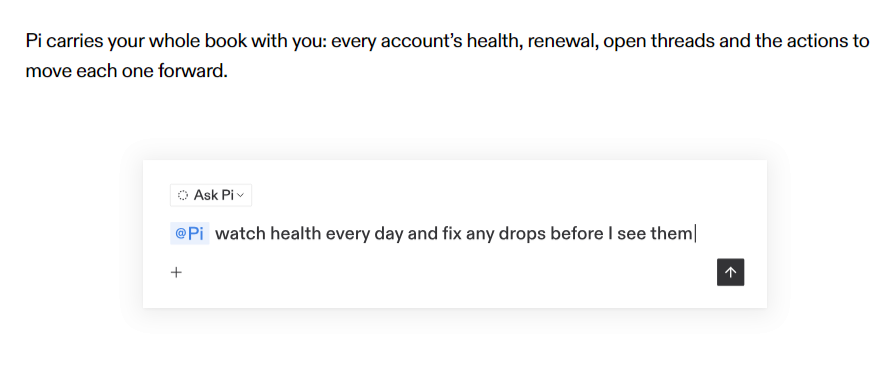
Planhat is a Customer Success Platform that combines configurable health scoring, customer intelligence, and AI-powered workflows to help teams identify churn risk and intervene earlier.
Its churn prevention approach centers on bringing signals such as product usage, support activity, sentiment, NPS, relationship engagement, and renewal data into a unified health model. Planhat can then use AI to explain changes in customer health, identify retention risks, and route accounts into targeted recovery workflows.
Best for
Mid-market and enterprise organizations that want highly configurable, health-based churn prevention across different customer segments and lifecycle stages.
What it does well
- Health modeling and Churn Signals: Health Lab, AI-powered health scoring, and Churn Signals help teams identify deteriorating accounts and understand the signals driving the change.
- Usage, relationship, and sentiment intelligence: Combines product adoption with qualitative relationship and sentiment data to build a more complete picture of churn risk.
- Segment-specific health: Teams can use different scoring models for different customer segments, lifecycle stages, or engagement models rather than applying one health methodology to every account.
- Pi for risk investigation: Planhat’s AI agent can analyze customer context and help CSMs understand why an account is becoming risky without manually reviewing every data source.
- Automated recovery workflows: Health changes and churn signals can trigger targeted playbooks and other interventions, while renewal context helps teams prioritize which accounts need attention first.
Planhat's strength is that it treats churn risk as a combination of signals rather than relying on a single metric. Usage decline, support friction, relationship changes, sentiment, and renewal timing can all contribute to the same health view, giving teams more context before deciding how to intervene.
Limitations and considerations
Planhat is a broad Customer Success Platform rather than a narrowly focused churn prevention tool. Its flexibility makes it suitable for complex CS organizations, but teams may need to spend more time configuring health models, segments, workflows, and customer data before getting the full value from its churn prevention capabilities.
Its newer AI and agentic functionality is also evolving quickly, so teams evaluating Planhat specifically for autonomous intervention should confirm which Pi capabilities and automated actions are available within their package.
Pricing
Planhat does not publish standard package pricing. Its subscriptions typically combine a one-time integration fee, a fixed platform fee, and a variable fee based on the number of customer accounts being managed.
All plans include an allocation of AI usage, including 10,000 AI credits on a rolling 30-day basis for capabilities such as AI automation steps, conversation summaries, sentiment analysis, and classification. Additional AI capacity and more advanced AI capabilities can be purchased separately.
6. Odie / Unison
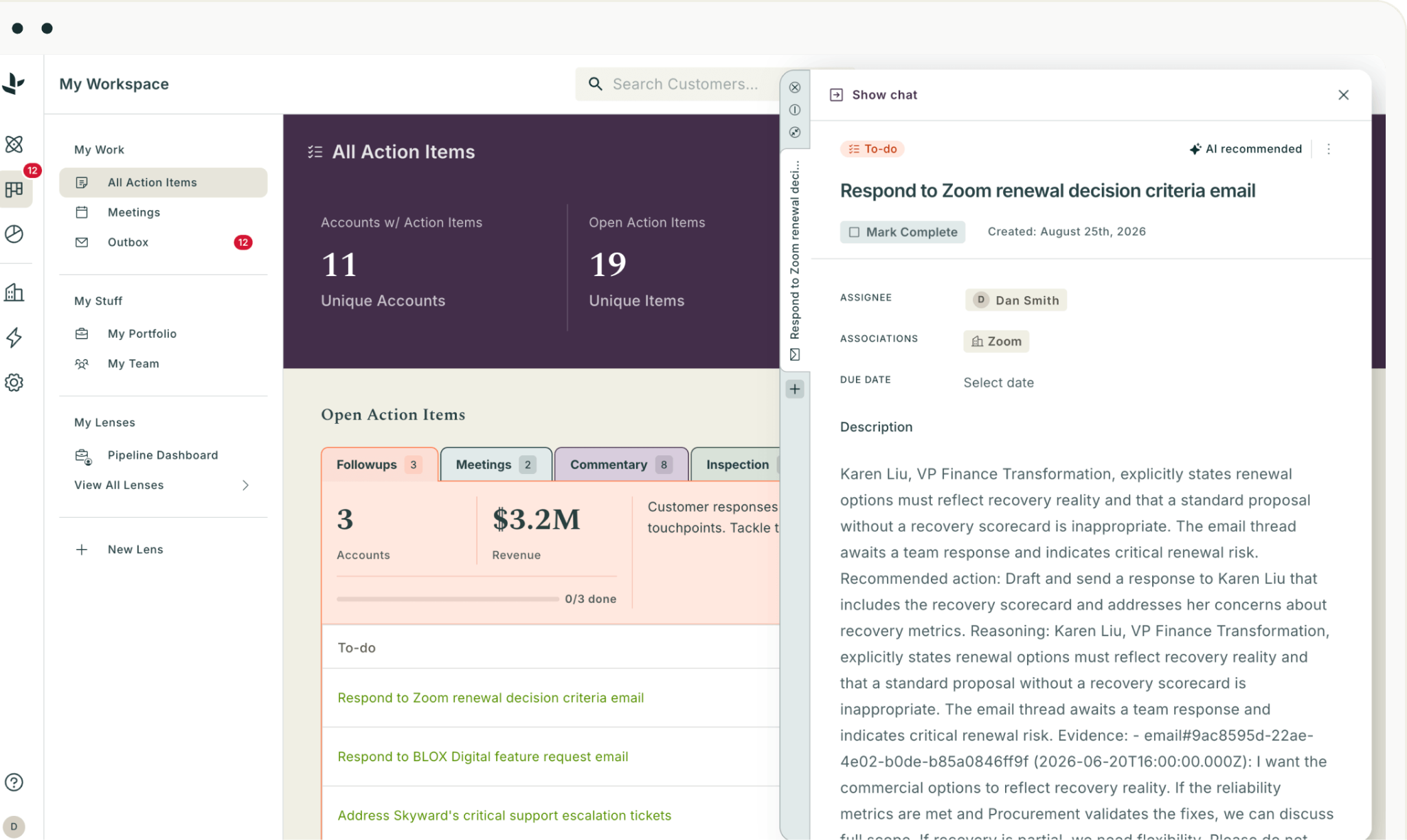
Odie, formerly Totango, is a Customer Success platform with a strong focus on customer intelligence and predictive churn analysis. Its Unison product is an AI-powered intelligence engine designed to identify customers at risk of churn and surface the signals contributing to that risk.
Unison can work alongside Odie's wider Customer Success Platform or connect with another CSP, making it useful for teams that already have established workflows but want to add a more predictive layer to their customer health and retention strategy.
Best for
Customer Success and revenue teams that already have established retention workflows but want stronger AI-driven churn prediction and customer health intelligence.
What it does well
- Predictive churn intelligence: Unison analyzes customer data to identify accounts at risk and can use either prebuilt AI models or custom models trained on the company’s own churn history.
- Sentiment and engagement analysis: Combines emails, meetings, calls, support interactions, and customer feedback to detect deterioration in engagement and sentiment.
- Relationship and Voice of Customer signals: Tracks stakeholder relationships and qualitative customer feedback to surface risks that may not appear in usage data alone.
- Portfolio and revenue risk: AI Health Overview connects customer health with revenue exposure so teams can see how much revenue is at risk and prioritize the most important accounts.
- Early renewal risk detection: Predictive signals help teams identify deteriorating accounts ahead of renewal, giving CSMs more time to investigate the cause and intervene.
Unison's main value for churn prevention is in helping teams understand which accounts are deteriorating and why. Rather than relying on manually weighted health scores alone, its AI models dynamically assess sentiment, engagement, relationships, and customer feedback to identify patterns associated with churn.
Limitations and considerations
Odie and Unison lean more heavily toward prediction and customer intelligence than autonomous intervention.
The platform can help teams identify which customers need attention and what is contributing to the risk, but companies still need a clear Customer Success process for turning those insights into recovery actions.
For teams primarily looking for agents that automatically execute multi-step churn-prevention workflows, more agentic platforms may provide a stronger execution layer.
Pricing
Odie does not publish standard pricing for its Customer Success Platform or Unison. Pricing is provided on a quote basis depending on the products, number of users, customer volume, and other requirements.
Unison is available with Standard AI models for faster deployment or Custom AI models trained on an organization's historical customer data, with pricing for both provided through the sales process.
7. Pendo
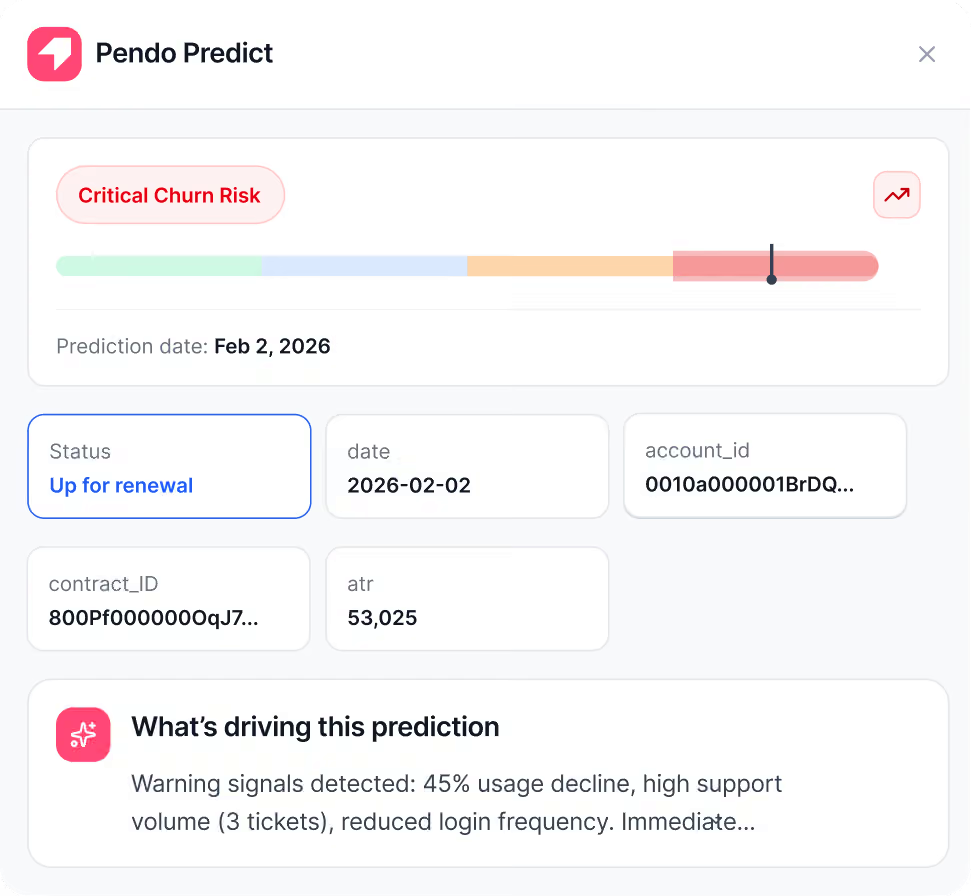
Pendo approaches churn prevention primarily through product behavior. Rather than monitoring the full customer relationship, it focuses on how customers are actually using the product and whether changes in adoption, engagement, or activity suggest they are becoming more likely to disengage.
Its Risk Advisor, currently in beta, uses Pendo Predict to identify accounts at risk of becoming inactive.
For each account, it surfaces a risk score, explains the behavioral signals contributing to that score, and recommends a next step so Customer Success teams can intervene before declining usage turns into churn.
Best for
Product-led SaaS businesses where declining product usage, adoption, and engagement are important leading indicators of churn.
What it does well
- Predictive churn risk: Risk Advisor and Pendo Predict identify accounts trending toward disengagement, assign a risk score, explain the behavioral drivers, and recommend a next step.
- Product usage and adoption intelligence: Tracks frequency, depth of usage, feature adoption, and changes in engagement to spot early signs of customer disengagement.
- Behavioral churn signals: Surfaces patterns such as declining activity, reduced feature usage, frustration, or weaker adoption before a customer becomes fully inactive.
- Risk explanations and recommended actions: Helps teams understand why an account is at risk and suggests actions based on the company’s own playbooks rather than presenting a score alone.
- In-app intervention: Pendo Guides let teams act directly on product-risk signals with targeted education, onboarding, and adoption experiences inside the product.
Pendo is particularly useful when product disengagement happens before churn becomes visible elsewhere. Instead of waiting for a low health score or difficult renewal conversation, teams can use behavioral data to see that an account is gradually using the product less and intervene while there is still time to rebuild adoption.
Limitations and considerations
Pendo's churn prevention capabilities are strongest when product usage is a reliable indicator of customer health. It provides less visibility into relationship risk, stakeholder changes, commercial issues, support friction, and renewal conversations than a dedicated Customer Success Platform.
Risk Advisor and some of Pendo's newer predictive capabilities are also currently in beta, so teams should confirm feature availability and maturity before relying on them as a core part of their churn-prevention process.
Pricing
Pendo offers a Free plan for up to 500 monthly active users, while its paid Base, Core, and Ultimate plans use custom pricing.
Paid pricing is based primarily on the number of monthly active users being tracked and the functionality included in the package. Pendo Predict, which powers churn prediction capabilities, can be added to Pendo plans and is also priced on a custom basis according to prediction volume.
8. Custify
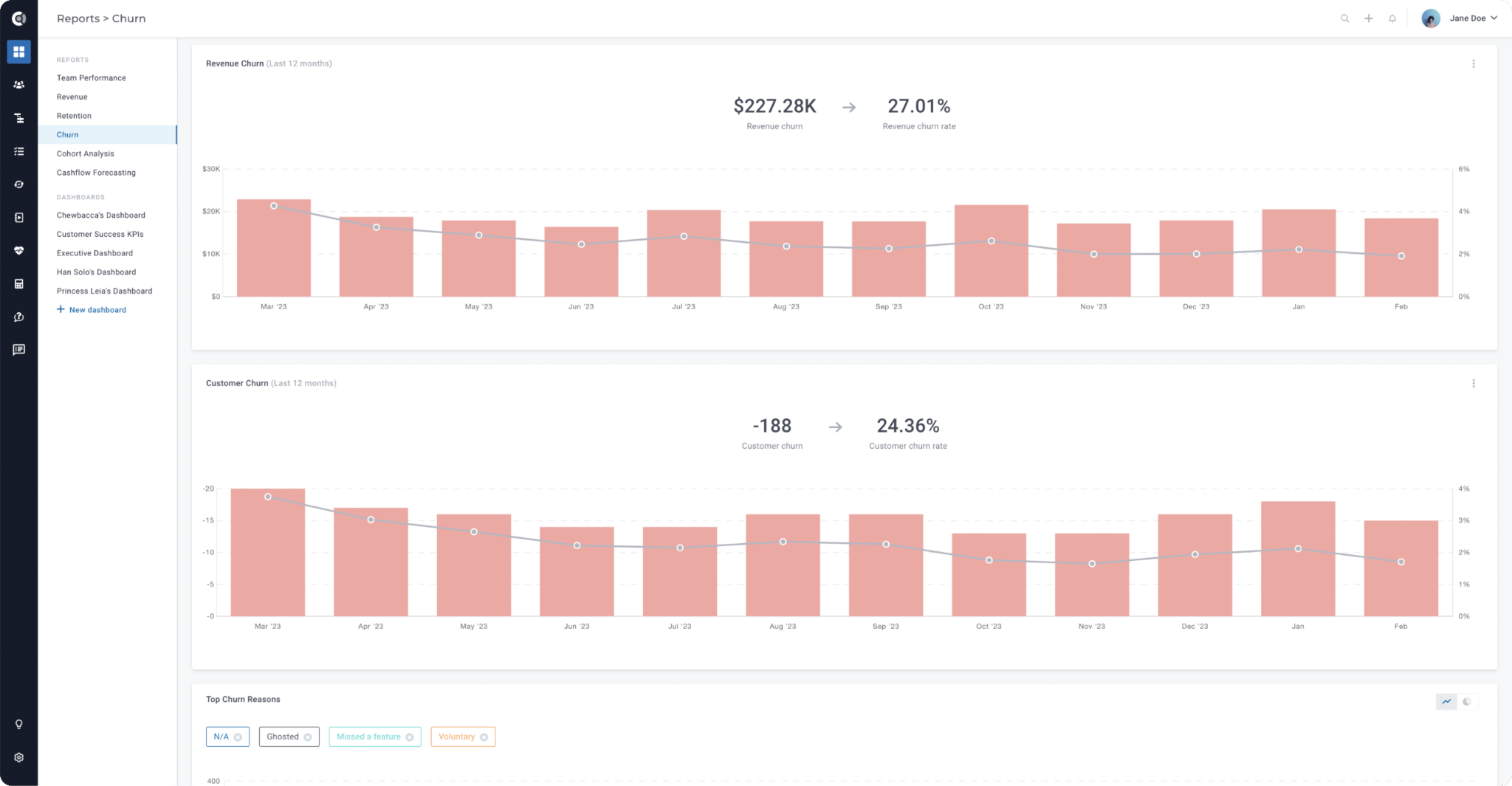
Custify is a Customer Success Platform built for SaaS companies that want customer health, automation, lifecycle management, and AI without the complexity of a heavyweight enterprise CSP.
For churn prevention, Custify combines configurable health scores with AI agents that continuously monitor accounts, analyze customer interactions, detect sentiment changes, and surface emerging churn signals.
Its agents can then recommend or take actions when risk increases rather than relying on CSMs to manually monitor every account.
Best for
Small and mid-market SaaS companies that want proactive churn prevention, health monitoring, and AI automation without a lengthy enterprise implementation.
What it does well
- Health and churn risk monitoring: Combines usage, engagement, customer activity, and AI-generated churn scores to help teams identify which accounts are becoming risky.
- Customer Health Agents: Continuously review account activity, conversations, sentiment, and health changes to surface churn signals and suggest the appropriate response.
- Sentiment, usage, and stakeholder intelligence: Tracks communication sentiment, product adoption, champions, blockers, and engagement gaps to give teams a broader view of relationship risk.
- Automated intervention workflows: Drops in health, sentiment, or usage can trigger alerts, tasks, emails, and AI-assisted playbooks so teams can act before the renewal is at risk.
- Lifecycle and portfolio context: Customer 360, segmentation, lifecycle stages, and Slack-based AI access help teams investigate risk and apply different retention strategies across customer groups.
Custify is particularly useful for teams that want to move from monitoring health to automatically responding to changes in health. For example, a decline in customer sentiment or activity can trigger an alert, start a playbook, create tasks, and prompt the AI to recommend an intervention.
Limitations and considerations
Custify is positioned around relatively accessible implementation and automation, which makes it particularly attractive to smaller and mid-market SaaS companies. Larger enterprises with highly complex account hierarchies, governance requirements, or extensively customized retention processes may want to compare it with more enterprise-oriented platforms.
It is also focused on relationship, adoption, and account churn rather than involuntary churn caused by failed payments, so subscription businesses with significant payment-related churn may still need a specialist recovery tool.
Pricing
Custify does not publish fixed subscription prices. Pricing is customized based on each company's requirements, so teams need to request a quote.
There are no setup fees, and Custify includes guided implementation, onboarding, and ongoing support. The company does not publicly separate pricing for its AI agents and other AI capabilities, so buyers should confirm what AI functionality and usage are included in their proposed package.
9. Churnkey
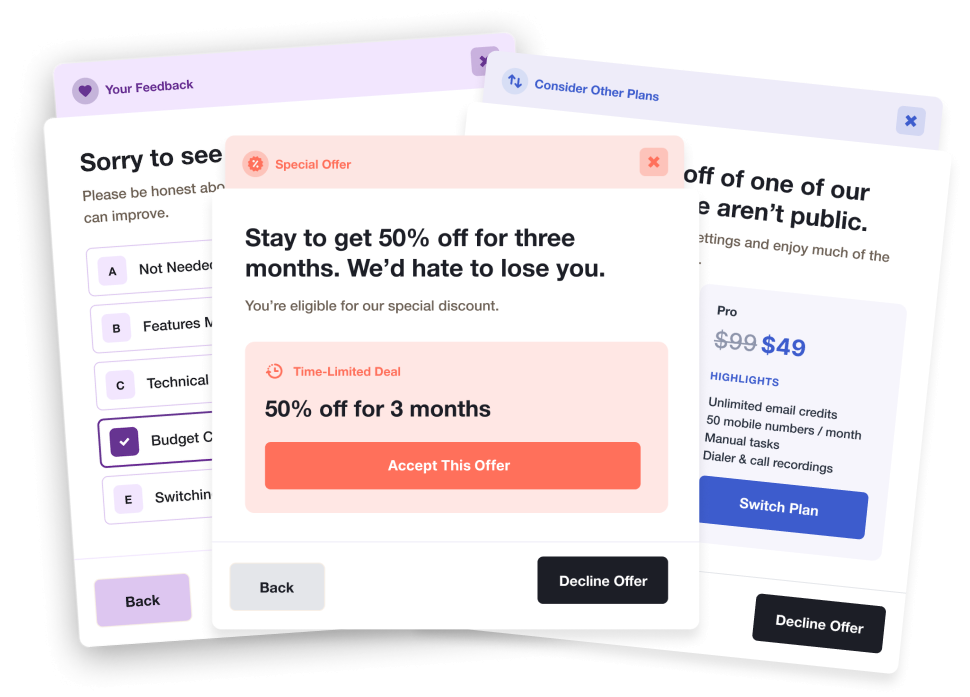
Churnkey is a retention platform focused on subscription churn, particularly customers who actively try to cancel and those lost because of failed payments.
Its Cancel Flows intervene at the point of cancellation with targeted alternatives such as discounts, pauses, plan changes, trial extensions, or other save offers. Its Payment Recovery product tackles involuntary churn by optimizing retries and recovery journeys for failed transactions.
Best for
SaaS and subscription businesses with meaningful self-service cancellation volume or recurring revenue being lost through failed payments.
What it does well
- Cancel Flows and save offers: Replaces a standard cancellation screen with personalized retention flows that can offer discounts, pauses, plan changes, trial extensions, or other alternatives based on the customer and cancellation reason.
- Cancellation insights and optimization: Surveys, segmentation, customer timelines, Feedback AI, and A/B testing help teams understand why customers leave and improve retention flows over time.
- Payment Recovery: Automates failed-payment recovery to reduce involuntary churn, with retry logic that determines when unsuccessful payments should be attempted again.
- Adaptive retention: Higher-tier capabilities such as Adaptive Offers and Account Agent use AI to tailor retention decisions and offers using customer context rather than static rules alone.
- Billing integrations: Connects with platforms including Stripe, Chargebee, Maxio, Paddle, and Braintree so teams can add churn prevention without replacing their billing system.
Churnkey is strongest at the moment churn is about to happen. If a customer has already decided to cancel, the platform can identify their reason and offer a more appropriate alternative before the subscription is actually lost.
Limitations and considerations
Churnkey operates much later in the churn journey than a Customer Success Platform. It is designed to prevent cancellations and recover failed payments, rather than identify deteriorating relationships, declining stakeholder engagement, or renewal risk months in advance.
For B2B companies with high-touch customer relationships, it is therefore more likely to complement a platform such as Velaris, ChurnZero, or Gainsight than replace one.
Pricing
Churnkey's Starter plan currently costs $250 per month when billed annually and is available to companies with less than $5,000 in monthly churn volume. It includes Cancel Flows, Payment Recovery, and retention metrics.
For companies with $10,000 or more in monthly churn, Churnkey offers Core and Intelligence plans.
Core adds A/B testing, unlimited segmentation, customer timelines, and advanced retry logic, while Intelligence adds capabilities such as Adaptive Offers, Account Agent, Feedback AI, and self-improving retries. Enterprise pricing is custom. Churnkey says pricing is primarily based on average monthly churned revenue.
10. Paddle Retain
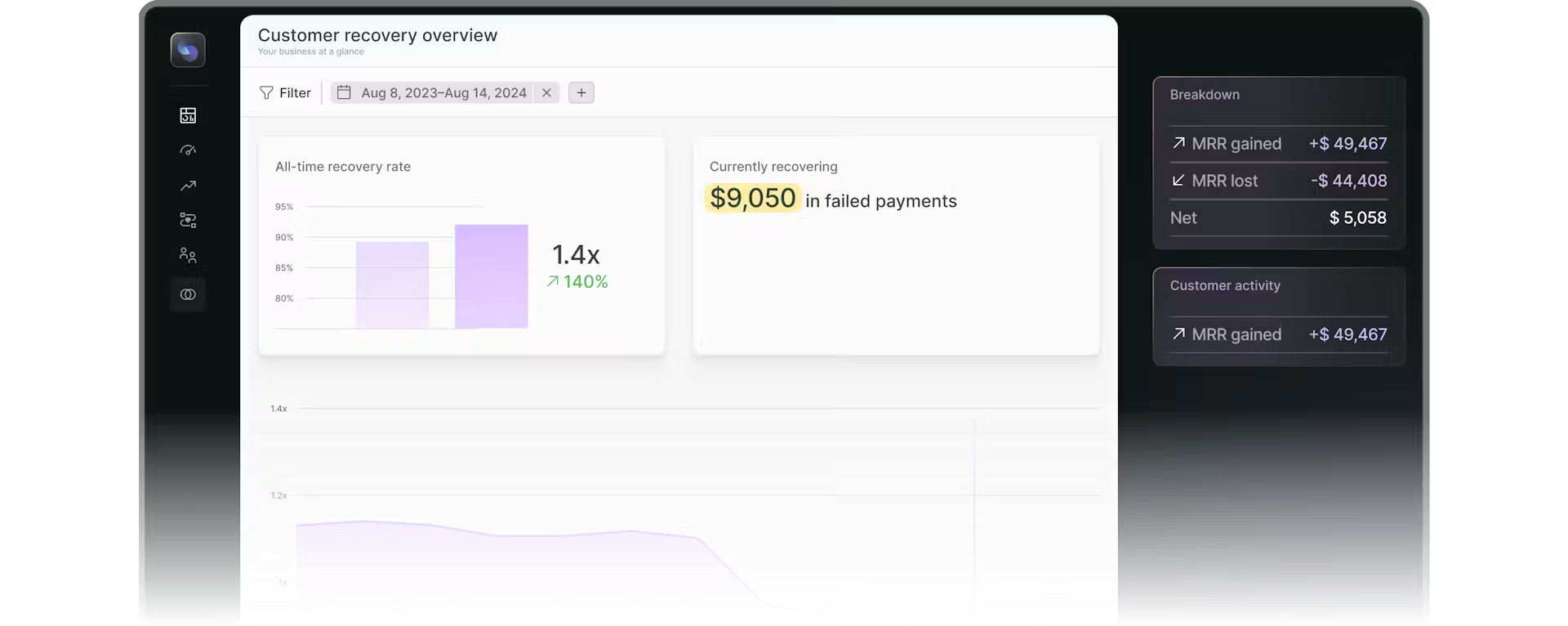
Paddle Retain is a churn reduction platform focused on the subscription lifecycle, particularly failed payments, cancellation attempts, and reactivation.
It combines Payment Recovery, Cancellation Flows, Term Optimization, and reactivation in one system. Retain is built directly into Paddle Billing, but it can also sit on top of third-party billing platforms such as Stripe Billing, Chargebee, Recurly, Zuora, Braintree, and Maxio.
Best for
SaaS and subscription businesses that want to automate failed-payment recovery and reduce voluntary churn at the point of cancellation.
What it does well
- Payment recovery and retries: Automatically intervenes when payments fail, using decline reason, payment method, location, and other signals to optimize retry timing and recover revenue.
- Automated dunning and multichannel recovery: Runs recovery workflows across email, SMS, and in-app messages, with no-login payment update experiences to reduce friction.
- Cancellation prevention: Cancellation Flows collect the reason a customer wants to leave and can present alternatives such as discounts, plan changes, or subscription pauses.
- Retention optimization: Term Optimization and reactivation workflows help move customers to longer commitments or bring previously churned subscribers back.
- Flexible billing integrations: Retain can work with Paddle Billing or third-party billing systems, so companies can add churn prevention without necessarily changing their existing billing stack.
Paddle reports that Retain achieves a 50%+ recovery rate for failed payments and can reduce plan cancellations by around 30%. These are Paddle-reported performance figures rather than guaranteed outcomes.
Limitations and considerations
Paddle Retain is designed primarily for subscription and payment-related churn. It is very effective once a customer has encountered a payment problem or actively starts a cancellation flow, but it does not provide the same visibility into wider B2B churn signals such as declining stakeholder engagement, poor onboarding, deteriorating sentiment, support friction, or enterprise renewal risk.
For companies with high-touch Customer Success motions, Retain is therefore more likely to complement a Customer Success Platform than replace one.
Pricing
For companies already using Paddle Billing, Retain's built-in retention toolkit is included at no additional cost for core functionality.
For companies using Retain as a standalone product with another billing platform, Paddle uses flat-fee pricing for smaller businesses starting at $500 per month, while larger companies are typically priced on a performance-based model. Exact commercial terms depend on the billing setup and scale of the business.
Conclusion
The best churn prevention software depends on when and why customers are leaving.
For B2B companies where churn develops gradually through declining engagement, poor adoption, stakeholder changes, or relationship risk, platforms such as Velaris, ChurnZero, Hook, Gainsight, and Planhat help teams detect those signals earlier and intervene before renewal.
For product-led businesses, Pendo is better suited to spotting churn risk through changes in usage and adoption. Churnkey and Paddle Retain operate much later in the journey, helping subscription businesses prevent cancellations and recover revenue lost through failed payments.
For teams looking for a broader B2B churn prevention platform, Velaris, a highly rated software on G2, is a strong option thanks to its Context Engine giving both CSMs and AI agents a fuller picture of why an account may be deteriorating.
If you want to see how Velaris combines customer context, AI-enriched health, risk detection, and AI agents to identify and act on churn before renewal, book a demo with Velaris.
Frequently Asked Questions
What is churn prevention software?
Churn prevention software helps companies identify customers at risk of leaving and take action before revenue is lost. Depending on the product, that can include triggering Customer Success playbooks, alerting CSMs, sending proactive outreach, presenting save offers, or recovering failed payments.
How does churn prevention software work?
Most churn prevention software follows a similar process: it collects customer signals, identifies risk, helps explain what is causing it, prioritizes the accounts that need attention, triggers an intervention, and tracks whether the customer recovers.
The signals used can include product usage, customer conversations, support activity, sentiment, renewal timing, health scores, and billing data.
What is the difference between churn prediction and churn prevention software?
Churn prediction software focuses on identifying customers that are likely to leave. Churn prevention software goes a step further by helping teams act on that risk.
For example, a prediction tool might flag an account with declining usage, while a churn prevention platform could also trigger a playbook, alert the CSM, recommend next steps, or automatically start a recovery workflow.
What are the main causes of customer churn?
Common causes of churn include poor product adoption, failure to realize value, weak customer relationships, unresolved product or support issues, pricing concerns, competitive alternatives, stakeholder changes, and failed payments.
In B2B SaaS, several of these signals often appear together before a customer eventually decides not to renew.
Can AI prevent customer churn?
AI can help reduce churn by identifying patterns across large volumes of customer data and detecting risks that might otherwise be missed.
It can also help explain why an account is deteriorating, prioritize intervention, and automate actions such as outreach, alerts, or playbooks.
Its effectiveness depends heavily on the quality of the customer context available and what the business does after a risk is identified.
How can SaaS companies reduce churn?
SaaS companies can reduce churn by improving onboarding, monitoring customer health, tracking product adoption, analyzing sentiment, engaging customers proactively, acting on declining usage, improving renewal processes, optimizing cancellation flows, and recovering failed payments.
The most effective approach usually combines early risk detection with a clear process for responding when those signals appear.
What data should churn prevention software monitor?
Churn prevention software should monitor data that helps explain both customer behavior and the wider relationship.
This can include product usage, feature adoption, calls, emails, support tickets, sentiment, stakeholder engagement, health scores, renewal dates, contract information, revenue, cancellation reasons, and payment failures.

The Velaris Team
A (our) team with years of experience in Customer Success have come together to redefine CS with Velaris. One platform, limitless Success.




Velaris is an AI-native Customer Success Platform built for mid-market and enterprise B2B SaaS teams. From customer health scoring and churn prediction to onboarding automation, renewals, and expansion workflows, Velaris helps recurring revenue teams understand account health, reduce churn, and scale customer success with greater visibility and control.