We look forward to showing you Velaris, but first we'd like to know a little bit about you.


Top 10 AI Account Planning Software for 2026
We compare 10 AI account planning tools for 2026, from DemandFarm and Altify to Velaris and Salesforce. See how each supports account strategy, relationship mapping, whitespace analysis, and AI-driven planning, plus pricing and who each tool suits.
The Velaris Team
October 27, 2026
Strategic accounts usually contain plenty of useful information, but it is often scattered across various data sources and individual CSM or Account Manager knowledge.
Account planning software helps teams build and execute strategic plans for important customer accounts by centralizing all the data relevant to accounts.
In this guide, we compare 10 of the best AI account planning software tools for 2026, looking at how each approaches account strategy, stakeholder intelligence, growth planning, AI, and execution.
Key takeaways
- DemandFarm, Prolifiq, Altify, and ARPEDIO are purpose-built for strategic account planning and complex enterprise accounts.
- Velaris and Gainsight connect account plans more closely to post-sales customer context, outcomes, health, retention, and expansion.
- Salesforce and Squivr are strongest for teams that want account planning to live directly inside Salesforce.
- AI is increasingly used for account research, stakeholder mapping, whitespace detection, plan updates, and next-best actions.
- The right tool depends on whether you prioritize strategic methodology, CRM-native execution, post-sales planning, relationship intelligence, or AI automation.
| Software | Best for | Account planning approach | AI capabilities | Key strengths | Pricing |
|---|---|---|---|---|---|
| DemandFarm | Enterprise B2B teams with formal strategic account programs | Purpose-built key account planning with relationship maps, whitespace, and growth strategy | Kampanion AI for account research, Q&A, risk analysis, relationship intelligence, and next actions | Whitespace analysis, relationship mapping, automated research, strategic execution | Custom pricing |
| Velaris | Mid-market and enterprise B2B SaaS Customer Success and Account Management teams | Living post-sales account plans built from continuously updated customer context | Copilot creates and updates plans, while AI agents monitor accounts for risks and expansion opportunities | Customer Context Engine, Canvas, Success Plans, Risk Watchdog, Growth Scout | Custom annual pricing |
| Prolifiq CRUSH | Salesforce-centric enterprise revenue teams | Salesforce-native strategic account plans with objectives, whitespace, and stakeholder mapping | AI-generated relationship maps, stakeholder coverage gaps, and recommended next steps | Master account plans, cross-sell analysis, relationship maps, Salesforce integration | Quote-based |
| Altify | Large enterprise Sales teams using Salesforce | Methodology-led account and opportunity planning for complex enterprise sales | MaxAI provides coaching, plan-gap analysis, account insights, and next-best actions | Structured methodology, relationship intelligence, plan-gap analysis, Salesforce-native execution | Custom annual pricing |
| ARPEDIO | Enterprise Salesforce teams with complex stakeholder networks | Relationship-led account planning with SWOT, milestones, whitespace, and stakeholder maps | AI agents build org charts, analyze sentiment, surface expansion signals, and recommend actions | Relationship intelligence, stakeholder coverage, AI agents, Salesforce-native plans | Custom pricing |
| Salesforce Sales Account Plans | Organizations already standardized on Salesforce | Native CRM account planning with objectives, KPIs, actions, and buyer relationship maps | AI-powered Account Research and Agentforce assistance for research, preparation, and recommendations | Native CRM workflow, account research, objectives, KPIs, relationship maps | Depends on Sales Cloud edition and AI licensing |
| Kapta | Customer Success and Account Management teams managing high-value strategic accounts | Post-sales planning centered on customer goals, health, renewals, and expansion | AI analyzes account activity, risks, stakeholder coverage, and recommends next actions | Customer goals, org charts, account health, QBRs, renewal and expansion planning | Custom pricing |
| Gainsight | Large Customer Success organizations focused on customer outcomes | Success Plans tied to goals, objectives, milestones, tasks, and Customer 360 | AI can help generate Success Plans from customer signals and keep plans current | Outcome tracking, customer collaboration, Customer 360, structured execution | Custom pricing |
| Squivr | Salesforce teams wanting modular, lower-cost account planning | Salesforce-native plans with whitespace, SWOT, revenue gaps, and action planning | Rule-based predictions, account and opportunity scoring, and next-best actions | Whitespace analysis, org charts, strategic matrices, action plans | Account Plans Suite from $25/user/month |
| Revegy | Enterprise Sales and Account Management teams managing complex accounts | Visual strategic account planning centered on relationships, customer priorities, and whitespace | AI-powered account research surfaces company strategy, priorities, and market developments | Relationship Maps, Whitespace+, Customer Strategy Maps, playbooks, portfolio analytics | Custom pricing |
1. DemandFarm

Overview
DemandFarm is a purpose-built strategic account planning platform designed for complex B2B accounts and formal key account management programs.
Its platform includes Account Planner, Relationship Maps, Opportunity Planner, whitespace analysis, and Kampanion, an AI assistant for account managers.
Kampanion brings together CRM data, account plans, conversations, emails, and other account context to surface insights, answer account questions, and recommend next actions.
Best for
Enterprise B2B organizations with formal key account management programs and complex strategic accounts.
What it does well
- Kampanion AI: Helps account managers investigate relationships, whitespace, risks, and account context using natural-language questions.
- Automated account research: Brings together internal and external information to reduce the manual research required before planning sessions.
- Whitespace analysis: Maps the customer’s current footprint against potential products, business units, or buying centers that could create future growth.
- Relationship mapping: Visualizes decision-makers, influence, relationship strength, and account hierarchy across complex organizations.
- Growth Strategy Planner: Connects account objectives, growth opportunities, and execution so teams can move from strategy to action.
DemandFarm’s AI-first approach is particularly useful for teams that want account plans to evolve continuously rather than starting from a blank template before each review.
Limitations and considerations
DemandFarm is designed for sophisticated strategic-account programs, so it may be more complex than necessary for teams that only need lightweight account plans or shared customer documents.
It is best suited to organizations that already have a defined key account management motion and want software to support it at scale.
Pricing
DemandFarm uses custom pricing. Packages vary by company size and requirements, and availability of AI capabilities such as Kampanion depends on the selected package.
2. Velaris

Overview
Velaris is a well-rated platform on G2 that takes a post-sales, AI-native approach to account planning, assisted by cutting-edge AI agents.
Its Customer Context Engine brings together a host of customer signals. Velaris Copilot can then use that context to build account plans, update documents, answer questions about an account, generate reports, and prepare CSMs for customer meetings.
Rather than relying on the CSM to notice every development and manually revise the plan, Velaris AI agents can monitor accounts in the background.
Risk Watchdog looks for emerging churn risks, while Growth Scout identifies potential expansion opportunities, giving teams new information that can feed back into the account strategy.
Best for
Mid-market and enterprise B2B SaaS teams that want account planning closely connected to Customer Success, retention, expansion, and continuously changing customer context.
What it does well
- AI-generated account plans: Copilot can create personalized account plans using the customer data and context already available in Velaris.
- Continuous account intelligence: AI agents monitor accounts between formal reviews for risks, expansion signals, and other developments that may require the plan to change.
- Living account plans: Canvas and Success Plans let teams connect account strategy to customer goals, milestones, tasks, owners, and live metrics.
- Connected customer context: Health, product adoption, conversations, support activity, renewal information, and commercial opportunities can all inform the account strategy.
- AI-assisted planning: Copilot can research the account, answer questions, summarize developments, and help teams prepare for meetings or account reviews.
A key advantage of Velaris is that the account plan is built from a living Customer Context Engine. As new customer signals appear, teams and AI agents can use that context to keep the strategy current rather than treating the account plan as a static document.
Limitations and considerations
Velaris is designed primarily for post-sales Customer Success and Account Management teams.
Organizations looking specifically for a sales methodology platform for net-new enterprise selling may prefer a more sales-focused account planning tool.
Pricing
Velaris uses custom annual pricing based on factors such as customer volume, users, integrations, AI usage, and the capabilities required.
3. Prolifiq CRUSH
Overview
Prolifiq CRUSH is a Salesforce-native account planning platform designed to keep strategic account planning inside the CRM where revenue teams already work.
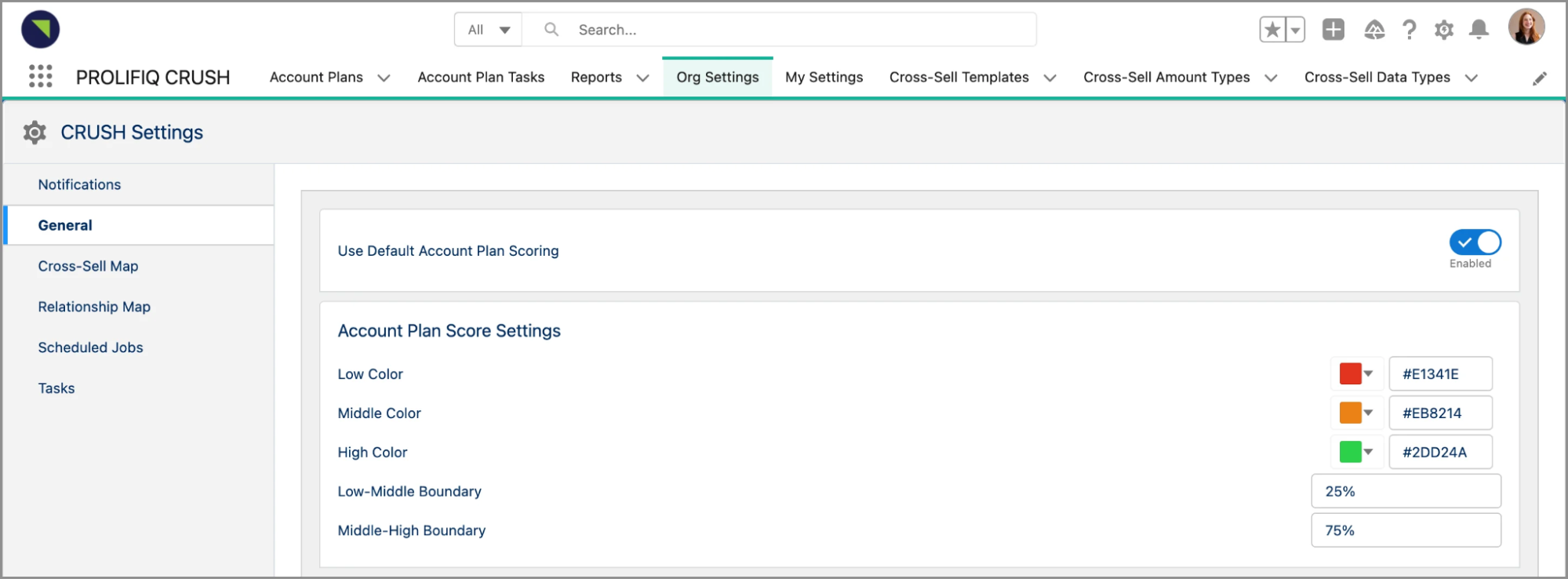
It brings together account hierarchies, SWOT analysis, relationship maps, whitespace and cross-sell analysis, strategic objectives, action plans, and account-plan scoring in one place.
Its AI capabilities can also help generate draft relationship maps from Salesforce data, identify gaps in stakeholder coverage, and recommend next steps.
Best for
Salesforce-centric enterprise revenue teams that want account planning, relationship mapping, and whitespace analysis without introducing a separate system.
What it does well
- Salesforce-native account plans: Keeps planning activity connected to the account, opportunity, and customer data already stored in Salesforce.
- AI-generated relationship maps: Can use existing CRM data to create draft stakeholder maps and help teams visualize account relationships faster.
- Whitespace analysis: Helps teams compare the customer’s current footprint with potential areas for cross-sell and expansion.
- Strategic objectives and actions: Teams can connect account goals to tasks, owners, and next steps so plans stay tied to execution.
- Master account plans: Supports more complex account structures where teams need to manage multiple business units, subsidiaries, or regions under one strategic plan.
Limitations and considerations
Prolifiq’s Salesforce-native architecture is a major advantage for organizations already standardized on Salesforce, but it also makes the platform much less relevant for teams that primarily use another CRM.
Pricing
Prolifiq uses quote-based pricing for CRUSH. Pricing depends on factors such as team size and the scope of the deployment.
4. Altify

Overview
Altify is an enterprise account planning and revenue execution platform built natively inside Salesforce.
It combines structured account planning, relationship mapping, opportunity management, and sales methodology in one system.
Altify’s MaxAI layer adds AI-powered coaching by using live Altify and Salesforce context to identify gaps and help sellers prepare for strategic account reviews.
Best for
Large enterprise Sales teams that use Salesforce and want a structured methodology for managing complex strategic accounts.
What it does well
- MaxAI: Uses live account context to provide AI coaching, recommendations, and next-best actions.
- Structured account strategy: Guides teams through a defined methodology for planning and managing complex enterprise accounts.
- Relationship mapping: Helps teams understand stakeholder influence, power, supporters, blockers, and gaps in account coverage.
- Plan-gap analysis: AI can assess weaknesses, missing information, and vulnerabilities within the account strategy.
- Salesforce-native execution: Keeps account plans connected to the CRM data, opportunities, activities, and relationships teams already manage in Salesforce.
MaxAI can also help generate account details and insight maps, identify missing stakeholders, and prepare sellers for account-plan reviews.
Limitations and considerations
Altify is built around a structured sales methodology, which makes it well suited to sophisticated enterprise selling motions but potentially more complex than teams need for lightweight or flexible account planning.
Its Salesforce-native approach also makes it most relevant to organizations already using Salesforce as their core CRM.
Pricing
Altify uses custom annual pricing based on factors such as the products selected, number of users, MaxAI requirements, and any additional Revenue Services.
5. ARPEDIO

Overview
ARPEDIO is a Salesforce-native account planning platform with a strong focus on relationship intelligence and AI agents.
Its account planning capabilities include structured account plans, SWOT analysis, success criteria, milestones, stakeholder maps, and whitespace analysis.
Its AI agents add a more proactive layer by helping teams build org charts, analyze stakeholder sentiment, maintain relationship intelligence, identify expansion opportunities, and recommend next actions.
Best for
Enterprise Salesforce teams where account growth depends heavily on understanding and navigating complex stakeholder networks.
What it does well
- AI-generated org charts: Helps teams build and maintain account relationship maps without relying entirely on manual updates.
- Stakeholder sentiment analysis: Uses AI to assess relationship signals and give teams more context around key contacts.
- Relationship coverage analysis: Helps identify gaps in stakeholder engagement and areas where the account team may be over-reliant on a small number of contacts.
- Salesforce-native account plans: Keeps strategy, relationships, milestones, and account data connected directly to Salesforce.
- AI next-best actions: Agents can surface expansion signals and recommend actions based on changes across the account.
ARPEDIO is particularly strong for teams that treat stakeholder coverage and relationship quality as a central part of account strategy.
Limitations and considerations
ARPEDIO is highly Salesforce-centric, so teams using another CRM will not get the same benefit from its native architecture.
It also places more emphasis on relationship and revenue intelligence than on collaborative, customer-facing account plans.
Pricing
ARPEDIO uses custom pricing. Teams need to contact the company for a quote based on their requirements and selected capabilities.
6. Salesforce Sales Account Plans

Overview
Salesforce offers native Sales Account Plans, giving Sales teams a dedicated workspace for managing long-term account strategy inside the CRM.
Teams can capture customer needs, define objectives, review KPIs, track actions, assess strengths and weaknesses, and connect account plans to buyer relationship maps.
Its Sales Account Research capability adds generative AI to the process by researching account priorities, competitors, industry trends, KPIs, and other strategic context, then using those insights to help populate the plan.
Best for
Organizations already standardized on Salesforce that want account planning built directly into their existing CRM.
What it does well
- Native account planning: Keeps account strategy, objectives, actions, and customer data in Salesforce rather than in a separate planning tool.
- AI-generated account research: Uses generative AI to research account priorities, KPIs, competitors, and industry context.
- Objectives and KPIs: Lets teams define measurable goals and track progress against the account strategy.
- Buyer Relationship Maps: Helps teams visualize key stakeholders and understand the relationships that influence the account.
- Agentforce assistance: AI can support account research, meeting preparation, plan updates, strategic recommendations, and next-best actions.
Salesforce is particularly useful for teams that want account planning to stay tightly connected to the opportunities, activities, relationships, and customer data already managed in Sales Cloud.
Limitations and considerations
Salesforce’s native account-planning capabilities are broader than they used to be, but specialist platforms such as DemandFarm, Prolifiq, Altify, and ARPEDIO may offer deeper functionality for areas such as whitespace analysis, relationship intelligence, and structured account-planning methodologies.
Some of the more advanced AI capabilities also require Agentforce or additional Salesforce licensing.
Pricing
Sales Account Plans are available in eligible Sales Cloud editions. AI-powered Account Research and related Agentforce capabilities may require additional licensing, so the total cost depends on the Salesforce edition and AI functionality required.
7. Kapta

Overview
Kapta is built specifically for post-sales strategic and key account management, with account planning centered on long-term customer value rather than individual sales opportunities.
Its account plans bring together customer goals, commitments, milestones, relationship maps, account health, action plans, QBRs, renewals, and expansion opportunities.
Kapta’s AI capabilities analyze that wider account story to highlight gaps or risks and recommend what the account team should do next.
Best for
Account Management and Customer Success teams managing a relatively small number of high-value, long-term strategic customers.
What it does well
- Customer-goal-led planning: Keeps the account strategy focused on the customer’s objectives, commitments, and expected outcomes.
- AI coaching and next-best actions: Analyzes account activity, risks, stakeholder coverage, and recent developments to recommend where teams should focus.
- Interactive org charts: Helps teams map key stakeholders, understand relationship coverage, and identify gaps.
- Account health and risk: Brings health signals and risks into the account plan so teams can adjust strategy as conditions change.
- QBR and expansion planning: Connects account goals, deliverables, renewals, and growth opportunities within the same strategic plan.
Kapta is particularly useful for teams that want account plans to reflect the full post-sales relationship, rather than focusing primarily on pipeline or opportunity progression.
Limitations and considerations
Kapta is much more focused on existing customer relationships than on net-new enterprise selling.
That makes it a strong fit for Customer Success and Account Management teams, but less suitable for organizations looking primarily for sales opportunity planning or prospect account strategy.
Pricing
Kapta uses custom pricing based on the mix of functionality and support required. Teams need to contact the company for a tailored quote.
8. Gainsight

Overview
Gainsight approaches account planning primarily through Success Plans, giving Customer Success teams a structured way to manage customer goals and outcomes.
Success Plans can include objectives, tasks, owners, due dates, and progress tracking, while staying connected to the wider Customer 360. They can also be shared with customers, making them useful for collaborative planning around long-term outcomes.
Gainsight is also bringing AI into the process by helping teams generate Success Plans from customer signals and keep them updated as new information appears.
Best for
Large Customer Success organizations that want account planning centered on customer outcomes, retention, expansion, and ongoing value realization.
What it does well
- AI-generated Success Plans: AI can help create plans using existing customer context and signals.
- Customer goals and outcomes: Keeps the plan focused on what the customer is trying to achieve and how progress is being measured.
- Structured objectives and actions: Teams can assign owners, due dates, milestones, and tasks to keep plans moving forward.
- Customer collaboration: Success Plans can be shared externally so customers and internal teams can align around the same objectives.
- Connected Customer 360: Plans sit alongside health, activity, risks, and other customer data already managed in Gainsight.
Gainsight is particularly useful for teams that want account planning to sit inside a broader Customer Success operating model rather than function as a separate sales-planning exercise.
Limitations and considerations
Gainsight is built primarily around Customer Success planning rather than traditional Sales account planning.
It is less focused on capabilities such as whitespace mapping, buying-group analysis, and formal enterprise sales methodology than dedicated account-planning platforms.
Pricing
Gainsight uses custom pricing. Teams need to request a quote based on the products, users, and capabilities required.
9. Squivr

Overview
Squivr provides Salesforce-native tools for account planning, relationship mapping, whitespace analysis, action planning, analytics, and AI.
Its Account Plans Suite includes playbooks, SWOT and competitive analysis, whitespace analysis, revenue-gap tracking, and strategic matrices. Squivr AI adds another layer with rule-based predictions, account and opportunity scoring, and next-best-action recommendations.
Best for
Salesforce teams looking for a modular and relatively affordable way to add account planning and stakeholder intelligence to their CRM.
What it does well
- Salesforce-native account plans: Keeps account strategy and execution connected directly to CRM data.
- Whitespace and revenue-gap analysis: Helps teams identify where additional growth may be available across products, regions, or business units.
- Relationship and org charts: Gives teams a clearer view of stakeholder structure and account coverage.
- AI scoring and predictions: Uses rule-based AI to score accounts and opportunities and surface potential risks or priorities.
- Action plans and next-best actions: Connects strategic insights to concrete follow-up so teams can move from planning to execution.
Squivr is particularly useful for teams that want to add structured account planning to Salesforce without adopting a much broader enterprise platform.
Limitations and considerations
Squivr’s AI approach is primarily rule-based, so it is less generative or agentic than platforms such as DemandFarm, Velaris, Altify, or ARPEDIO.
Its capabilities are also spread across different modules, so buyers should confirm which combination is needed for account planning, relationship mapping, and AI.
Pricing
The Account Plans Suite is listed at $25 per user per month, while the full Enterprise Suite is $65 per user per month. Squivr has a 10-user minimum, with three complimentary users included.
10. Revegy

Overview
Revegy is a strategic account planning and revenue intelligence platform built around visualizing complex accounts and growth opportunities.
Its account planning tools include relationship maps, customer strategy maps, whitespace analysis, account health, action plans, playbooks, and portfolio analytics.
Revegy also offers AI-powered account research, which can automatically gather information about an account and help teams understand strategic priorities and market developments without starting the research process manually.
Best for
Enterprise Sales and Account Management teams that want highly visual strategic account planning, particularly around stakeholder relationships, customer priorities, and whitespace opportunities.
What it does well
- Relationship Maps: Helps teams visualize organizational structure, key stakeholders, influence, relationship strength, and gaps in account coverage.
- Whitespace+: Maps the customer’s existing footprint against potential products, business units, or other areas where additional revenue could be generated.
- Customer Strategy Maps: Connects the customer’s strategic priorities and initiatives to potential solutions and growth opportunities.
- AI-powered account research: Uses AI to gather external account research and surface information about customer strategies and market changes, reducing some of the manual preparation involved in account planning.
- Account execution: Playbooks, goals, action plans, account health, and portfolio analytics help teams move from a visual account strategy to ongoing execution.
Revegy is particularly useful for teams managing complex accounts where understanding who matters, what the customer is trying to achieve, and where additional revenue could come from is central to the planning process.
Limitations and considerations
Revegy’s strongest capabilities are in visual account planning, relationship intelligence, whitespace analysis, and structured execution.
Its AI offering is currently more focused on account research and insight gathering than the broader generative or agentic planning capabilities offered by some newer AI-native platforms.
Its depth may also be more than smaller teams need if they are looking for simple shared account plans rather than a formal strategic account management process.
Pricing
Revegy does not publicly list standard pricing. Teams need to contact the company for a quote based on their deployment and licensing requirements.
Conclusion
For Sales teams running formal strategic-account programs, DemandFarm, Prolifiq, Altify, and ARPEDIO offer deeper capabilities around whitespace, stakeholder relationships, opportunity strategy, and account execution.
Teams that want planning to stay inside Salesforce may prefer Salesforce Account Plans, Squivr, Prolifiq, ARPEDIO, or Altify.
For Customer Success and Account Management teams that want plans to evolve continuously with the customer, Velaris is a strong option that is highly rated on G2. Copilot can build and update plans using customer context, while AI agents can monitor accounts between reviews for developments that should influence the strategy.
Book a demo with Velaris to see how AI can help your team create account plans faster and turn customer context into action.
Frequently Asked Questions
What is the best account planning software?
The best account planning software depends on the type of planning process you need.
Tools such as DemandFarm, Prolifiq, Altify, and ARPEDIO are strong options for formal strategic account planning. Salesforce Account Plans and Squivr suit teams that want planning to stay inside Salesforce.
Velaris, Gainsight, and Kapta are more focused on post-sales planning around customer outcomes, retention, expansion, and long-term value.
What is the difference between an account plan and an opportunity plan?
An account plan covers the broader, long-term strategy for a customer or target account. It may include multiple products, stakeholders, business units, risks, objectives, and growth opportunities.
An opportunity plan is narrower and focuses on progressing or winning one specific deal within that account.
What is whitespace analysis in account planning software?
Whitespace analysis compares the customer’s current footprint with the areas where there may be additional growth potential.
That could include products they do not yet use, business units that have not been reached, geographies with limited adoption, additional users, or buying centers that could benefit from the product. It helps account teams identify where expansion opportunities may exist.
Can Customer Success teams use account planning software?
Yes. Account planning can be especially useful for Customer Success and Account Management teams managing strategic or high-value customers.
Post-sales account planning typically focuses more heavily on customer goals, health, adoption, stakeholder development, retention, value realization, renewals, and expansion.
Platforms such as Velaris are designed around this type of ongoing customer strategy, using live customer context and AI to help teams keep account plans current.

The Velaris Team
A (our) team with years of experience in Customer Success have come together to redefine CS with Velaris. One platform, limitless Success.




Velaris is an AI-native Customer Success Platform built for mid-market and enterprise B2B SaaS teams. From customer health scoring and churn prediction to onboarding automation, renewals, and expansion workflows, Velaris helps recurring revenue teams understand account health, reduce churn, and scale customer success with greater visibility and control.