We look forward to showing you Velaris, but first we'd like to know a little bit about you.


How to collect and implement customer insights
Customer insights: Types, importance, collection, analysis, and strategies.
The Velaris Team
June 30, 2026
Most teams have more customer data than they know what to do with. The problem isn't information; it's that the gap between data and understanding never gets closed.
Customer insights are what bridge that gap. They have a detailed understanding of why customers behave as they do, what they actually need, and where the experience falls short of expectations. Implementing them means transforming that raw data into something your team can actually act on.
This guide is for teams who want to move beyond surface-level metrics. We'll walk through how to build a system that collects customer insights and puts them to work.
Key takeaways
- Customer insights are the context behind the data, not the data itself. Data tells you what happened; insights tell you why it happened and what to do about it.
- There are four types of customer insights: behavioral, attitudinal, transactional, and operational. Each one fills a gap that the others leave, and the most complete picture of any account comes from reading all four together.
- Conflicting signals, like high NPS paired with declining product usage, are often the most important insight rather than something to dismiss. The gap between two misaligned signals usually points to what's actually going on.
- Insights age at different rates, so acting on outdated data is one of the quietest ways insight programs lose accuracy. A survey score from three months ago and a comment from yesterday don't carry the same weight.
- Insights only drive change when they reach the team that can act on them, which means routing them with the right urgency and format matters as much as collecting them in the first place.
- Without clear ownership and a defined next step, even the most valuable insight tends to sit unresolved in a dashboard no one revisits.
What counts as a customer insight
Customer insights are what you get when raw customer data meets context. Data tells you what happened. An insight tells you why, and what to do about it. Below
Behavioral insights
Behavioral insights are patterns in how customers actually interact with your product or service, what they do, how often they do it, and where they stop.
Unlike attitudinal insights, which capture what customers say, behavioral insights capture what customers do. And the two don't always match. A customer might say they're happy with your product, but barely use it. A customer might never raise a complaint but consistently avoids a core feature. Behavioral insights surface those gaps.
This includes signals like:
- Feature adoption
- Usage frequency
- Paths customers take through your platform
- Where customers get stuck or drop off
- Session length and login patterns
Our guide on product adoption metrics covers the key usage behaviors worth tracking and how to measure them effectively.
Attitudinal insights
Attitudinal insights are what customers think and feel about your product, their opinions, perceptions, and the experiences they choose to share.
They come from what customers actively tell you, which makes them more deliberate than behavioral signals. But they can also be more surface-level. Customers don't always say what they mean, and they don't always know what's driving how they feel.
- Survey responses — NPS, CSAT, and CES scores captured at key moments in the customer journey
- Customer interviews — direct conversations that surface the reasoning
- Support interactions — the language and sentiment customers use when something goes wrong
- Public reviews — unfiltered feedback left on platforms like G2 and Capterra
Attitudinal insights are most useful when read alongside behavioral data together; they give you a clearer picture of not just how customers feel, but what would make them advocates.
Transactional insights
Transactional insights come from the commercial history of the customer relationship, what customers buy, how that changes over time, and what those patterns signal about the health of the account.
- Expansion and upsell history
- Contract changes and renewal patterns
- Support spend over time
- Downgrade or contraction signals
These signals tell you how the customer relationship is evolving financially, and where growth opportunities or revenue risks are emerging. They're often the most direct indicator of whether a customer is finding enough value to stay and expand.
Operational insights
Operational insights are signals that come from how customers engage with your team — not what they say about the product, and not how they use it, but how they show up in the relationship itself.
This includes signals like:
- QBR attendance and engagement
- Stakeholder turnover and champion changes
- Responsiveness to outreach
- Onboarding milestone completion
For CS teams, operational insights reflect the human side of the account. When those signals start to shift, it's usually worth paying attention before anything else shows up in the data.
Why CS teams need all four
Survey data tells you what customers are willing to say. Behavioral data tells you what they're actually doing. Transactional data tells you what the relationship is worth. Operational data tells you how engaged they really are.
Each type fills a gap the others leave. A customer can score highly on NPS while quietly disengaging from the product. A customer can have strong feature adoption, but a champion who's about to leave. The most complete picture of any account comes from reading all four types together and acting on what they tell you collectively.
The importance of customer insights
Customer insights aren't just another metric to track; they're what separates teams that react to problems from teams that prevent them. When you truly understand what drives your customers, better decisions follow across every team that touches them.
- Product — builds features customers actually want rather than what seems logical internally
- Customer success — proactively addresses issues before churn happens rather than after the fact
- Marketing — creates campaigns that resonate because they're grounded in real customer motivations
- Sales — closes deals faster by understanding what buyers actually care about
The business case is clear, too. Organizations with mature customer analytics programs are roughly twice as likely to drive above-average profits compared to those that don't use customer analytics deeply.
For a closer look at how customer insights feed into your renewal motion, check out our guide to renewal management software for CS teams.
How to collect customer insights
Collecting customer insights requires a mix of methods. Some capture what customers do, others reveal what they think and feel. The most effective programs combine both.
Surveys
Surveys are the most direct way to collect structured feedback at scale. NPS, CSAT, and CES give you trackable metrics at key moments in the customer journey. Keep them short and well-timed, you'll get better responses and more useful data.
Customer interviews
Interviews give you depth that surveys can't. One-on-one conversations surface the reasoning and emotion behind the numbers, revealing motivations and opportunities that structured feedback misses entirely.
Product analytics
Analytics tools track how customers actually use your product, feature adoption, session length, drop-off points, and navigation paths. Comparing how power users engage versus casual ones often reveals where value is being lost and where friction is building.
Social listening and community forums
Review sites like G2 and Capterra, industry forums, and social channels are where customers speak freely. These conversations often surface issues before they reach your support team and help identify advocates worth nurturing. Roughly 70% of organizations that actively solicit feedback report improved customer loyalty when they act on what they hear.
Customer feedback platforms
Feedback platforms centralize input from support tickets, emails, chat, and social media, making analysis manageable when signals arrive from everywhere at once. The best platforms go further, using AI to automatically scan customer communications, cluster recurring themes, and surface what customers are consistently struggling with or asking for, without anyone having to review every data point manually.
How to analyze customer insights
Collecting data is only half the job. The real work is knowing what to do with it once you have it. Each type of customer insight requires a different analytical approach; here's how to make sense of each one.
Analyzing behavioral insights
Look for patterns in how customers move through your product over time. Which features are being adopted and which are being ignored? Where are customers dropping off? Breaking your customer base into meaningful groups based on usage level or behavior helps here; comparing how power users engage versus customers who are struggling often reveals where friction is building and where value is being lost.
Track these metrics consistently over time rather than in isolation. A single drop in session length means little. A gradual decline across a segment over several weeks is a signal worth acting on.
Analyzing attitudinal insights
Survey scores like NPS and CSAT are most useful as trends, not snapshots. A score on its own tells you little; the direction it's moving in tells you a lot. Watch for shifts across segments and correlate them with what's happening in the product or in the relationship at the same time.
For open-ended feedback, support conversations, and interview notes, text analysis helps extract meaning at scale. Sentiment analysis reveals emotional tone, while thematic analysis surfaces recurring topics and concerns. Tools like Velaris use features like Trending Topics to do this automatically, clustering recurring themes across customer communications without anyone having to tag or review each one manually.
Analyzing transactional insights
Look for movement. A customer expanding their contract is a signal. A customer who has gone quiet on renewal conversations is a different kind of signal. Track expansion history, contraction patterns, and support spend over time to understand which customers are growing with you and which are quietly pulling back.
Correlation analysis is useful here, identifying relationships between product behavior and commercial outcomes. Customers who adopt a specific feature within their first month may be significantly more likely to expand. Understanding those correlations lets you replicate success deliberately. Organizations that implement this kind of predictive approach see up to 70% higher customer loyalty compared to those that don't.
Analyzing operational insights
Operational data requires pattern recognition across the relationship over time. A single missed QBR might mean nothing. A customer who has missed three in a row while also going quiet on outreach is a different story entirely.
Map the key touchpoints where customers interact with your team and track engagement at each one. When engagement drops across multiple touchpoints simultaneously, that's when operational insights become an early warning system rather than just a log of activity.
How to turn customer insights into actionable steps
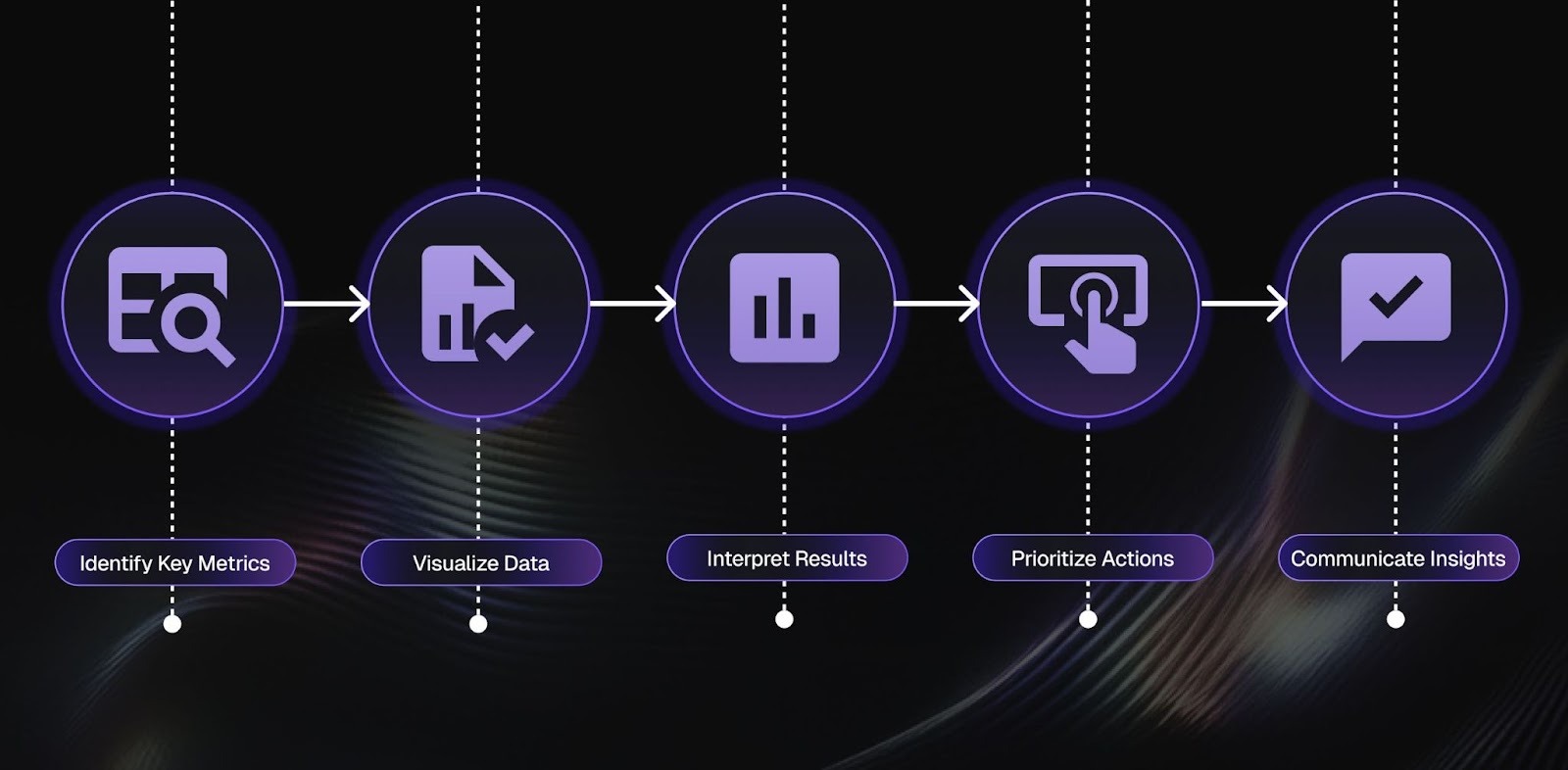
Insights without action are just observations. Here's how to move from data to decisions.
Step 1: Identify the metrics that matter
Before analyzing anything, get clear on what you're trying to improve. The metrics you focus on should connect directly to a business goal, churn reduction, expansion revenue, and onboarding completion. Without that anchor, you end up analyzing interesting data that never changes anything.
Step 2: Visualize the data
Transform complex data into charts, graphs, and dashboards that make patterns obvious at a glance. Good visualization makes insights accessible to everyone, not just the people who built the reports. When stakeholders can quickly see what the data shows, decisions get made faster and with more confidence.
Step 3: Interpret what it actually means
This is the step most teams skip. Moving from what the data shows to what it means requires context, connecting a signal to a cause, and a cause to a consequence. A drop in feature adoption isn't just a number. It's a question: why is this happening, and what does it mean for this customer's likelihood of renewing?
Step 4: Prioritize where to focus
Not every insight demands immediate action. Assess the potential impact of acting on each finding against the resources it would take to do something about it. Focus on high-value opportunities first, the signals that affect the most customers, carry the most revenue risk, or point to a problem that compounds if left unaddressed.
Step 5: Communicate findings across teams
Insights only drive change when the right people know about them. Share findings in a format each team can actually use, a real-time alert for an urgent account risk, a weekly digest for emerging patterns, a quarterly synthesis for product and roadmap decisions. Make it easy for stakeholders to understand both what you found and why it matters to their work.
How to implement customer insights into your customer success strategy
Understanding your customers is only valuable if it shapes how you serve them. Here's how to move insights from theory into practice.
Prioritize which insights to act on
Not every insight deserves immediate attention. When signals are coming in across multiple accounts and channels, triage is what keeps your team focused on what actually matters.
A simple framework:
- Act now — signals appearing across multiple accounts simultaneously, or insights tied to at-risk accounts with upcoming renewals
- Share with product — recurring feature friction or workflow blockers that no CS intervention will fix
- Backlog — valid feedback that isn't urgent and doesn't affect retention or expansion in the near term
- Ignore — one-off signals with no corroborating data from other sources
Weight insights by expected impact on retention or expansion, and elevate anything appearing consistently across multiple accounts; frequency is a signal in itself.
Route insights to the right team
Insights only drive change when they reach the people who can act on them. CS teams sit closest to the customer, which means they're often holding information that other teams need but never receive.
- CS → Product — feature friction, repeated request patterns, and workflow blockers that are showing up consistently across accounts
- CS → Marketing — expansion triggers, segment-specific success language, and accounts that are reference-ready
- CS → Sales — expansion signals, upsell timing, and referral-ready customers
The format matters as much as the content. Real-time alerts work for urgent signals. A weekly digest works for patterns and trends. A quarterly synthesis works for strategic input into roadmap and positioning decisions. Choosing the wrong format means the right information reaches the right team at the wrong time and gets ignored.
Build detailed action plans
Once you know what to act on and who needs to act on it, the insight needs a clear execution path. That means a defined next step, a named owner, and a timeline. Without that structure, even the most valuable insight sits unresolved.
Platforms like Velaris support this with Success Plans and task workflows that connect insights directly to action, so feedback doesn't just get noted, it gets resolved.
Personalize based on what you know
Apply insights directly to how you engage each customer. Use behavioral insights to identify where customers struggle and tailor your support accordingly. Let feedback shape how you approach onboarding for different segments. The data shows this matters, customers who receive personalized engagement after their first purchase exhibit 26% higher 12-month retention, and proactive onboarding sequences can increase first-year loyalty by over 30%.
Targeted engagement by segment
Generic outreach gets generic results. Use what you know about each customer segment, their goals, their friction points, and their usage patterns, to craft engagement that feels relevant rather than formulaic. The right message to the right customer at the right moment drives significantly better outcomes than a one-size-fits-all approach.
Challenges in gathering and utilizing customer insights
Even teams with strong data collection practices run into obstacles when it comes to turning insights into action. Here are the most common challenges and how to address them.
Data silos
When customer information lives in disconnected systems across departments, nobody gets the complete picture. One survey found that 92% of firms report key customer data remains outside their CRM systems, and 34% say fragmented data has directly harmed revenue.
The fix is centralization. Integrated platforms that give cross-functional teams shared access to the same customer data eliminate the version conflicts that slow decisions down. Customer Success platforms like Velaris serve as the connective layer between every post-sales function, bringing behavioral, attitudinal, transactional, and operational data into one place.
Data overload
Too much data can paralyze decision-making as easily as too little. Without effective filtering, important signals get buried in noise. Analytics dashboards that surface what matters most help teams focus on the metrics tied directly to business outcomes. The goal isn't collecting more data, it's extracting more value from what you already have.
For a closer look at the tools that can help you automate and scale your insight program, check out our guide to the top AI customer success tools.
Data quality
Inconsistent collection methods produce unreliable insights, and acting on poor data is worse than having no data at all. Establish clear standards for how customer data gets captured, formatted, and stored. Regular quality audits and validation rules that catch errors at entry keep your data trustworthy over time. As Gartner notes, data quality is foundational to any insight program worth building.
Stale insights
Not all insights age at the same rate. NPS trends stay directionally valid for around 90 days. A champion's stated frustration is actionable within days, not weeks. Acting on outdated signals is one of the quieter ways insight programs lose credibility; teams make decisions based on a customer reality that no longer exists.
Build freshness checkpoints into your process. Before acting on any insight, ask when it was collected and whether the conditions that produced it still apply. When in doubt, re-collect rather than act on something stale.
Signals that mask risk
Some of the most dangerous situations in CS are the ones that look fine on the surface. A customer with high NPS but declining product adoption. Strong QBR attendance with no expansion conversations. These combinations are worth reading against the grain; a strong signal in one area doesn't cancel out a weak signal in another. When two data points are pointing in opposite directions, that gap is usually the real insight.
Data literacy across teams
Analytics skills aren't evenly distributed. A team that can collect data but can't interpret it correctly will draw the wrong conclusions and make the wrong calls. Invest in building data literacy across CS, product, and leadership, not just among analysts. Well-trained teams turn good data into better decisions.
For a closer look at the tools that can help you collect and act on customer insights, check out our guide to the top customer success software tools.
Conclusion
Customer insights are what separate teams that understand their customers from teams that think they do. The data has always been there, in product usage, survey responses, support tickets, and renewal conversations. The difference is whether you have a system to collect it, analyze it, and turn it into decisions that actually improve the customer experience.
The teams that get this right don't just retain more customers. They build relationships that compound over time, customers who expand, advocate, and stay because they feel genuinely understood.
Book a demo to see how Velaris helps you turn customer data into decisions that matter.
Frequently Asked Questions
What is the difference between customer data and customer insights?
Customer data is the raw information you collect, including login timestamps, survey scores, support tickets, and contract values. Customer insights are what you get when you apply context and interpretation to that data. Data tells you what happened. Insights tell you why, and what to do about it.
What are the four types of customer insights?
The four core types are behavioral insights (what customers do), attitudinal insights (what customers think and feel), transactional insights (the commercial history of the relationship), and operational insights (how customers engage with your team and processes). Each type fills a gap the others leave, which is why the most complete picture comes from reading all four together.
How often should you collect customer insights?
Continuously. The most effective insight programs don't rely on periodic surveys or quarterly reviews; they collect signals across multiple channels on an ongoing basis. That said, different insight types have different freshness windows. NPS trends stay valid for around 90 days. A champion's stated frustration is actionable within days. Build freshness checkpoints into your process so you're always acting on current data.
How do you turn customer insights into action?
Start by identifying which insights are most likely to affect retention or expansion, and triage accordingly. Assign clear ownership to each action, set a timeline, and track progress. Route insights to the teams that can act on them, product for recurring friction, marketing for expansion signals, and sales for referral-ready accounts. The gap between insight and action is where most programs break down, so structure is what makes the difference.
What tools do you need to collect and act on customer insights?
Most teams need a combination of survey tools for structured feedback, product analytics for behavioral data, and a customer success platform to bring everything together. Platforms like Velaris unify data across sources, surface insights automatically using AI, and connect findings to workflows and action plans, so insights don't just get noted, they get resolved.

The Velaris Team
A (our) team with years of experience in Customer Success have come together to redefine CS with Velaris. One platform, limitless Success.





Velaris is an AI-native Customer Success Platform built for mid-market and enterprise B2B SaaS teams. From customer health scoring and churn prediction to onboarding automation, renewals, and expansion workflows, Velaris helps recurring revenue teams understand account health, reduce churn, and scale customer success with greater visibility and control.