We look forward to showing you Velaris, but first we'd like to know a little bit about you.


How To Choose A Customer Success Platform: A Complete Guide
A guide for CSMs on selecting the right Customer Success platform.
The Velaris Team
July 21, 2026
Choosing the right customer success platform can feel overwhelming with so many tools promising better retention, deeper insights, and smoother workflows, it’s hard to know which one truly fits your business.
This guide breaks down the evaluation process step by step, showing you exactly what criteria to consider, what questions to ask, and how to avoid common mistakes. By the end, you’ll have a clear framework to confidently select a platform that drives customer loyalty and long‑term growth.
Key takeaways
- Start by defining the outcomes you need the platform to support, such as reducing churn or improving onboarding.
- Evaluate how well the platform fits your existing customer model, team workflows, and technology stack.
- Compare the full cost over several years, including implementation, add-ons, integrations, and future growth.
- Test shortlisted platforms with real customer data and clear success criteria rather than relying on product demos alone.
- Involve customer success, finance, procurement, and other key teams early so the final choice works across the business.
What is a customer success platform
Think of a customer success platform (CSP) as a central “control center” for customer success teams. Instead of juggling spreadsheets, emails, and separate tools, a CSP brings everything about the customer journey together in one place. This makes it easier to track customer health, spot risks, and take proactive steps to help customers succeed.
Customer success platforms are often confused with other tools, but they serve a different purpose. CRM systems are built mainly for sales teams to manage pipelines and prospects. Support tools focus on handling tickets and solving problems after they happen.
Analytics tools provide raw data insights but don’t guide engagement strategies. A CSP combines elements of all three, but its unique focus is proactive success making sure customers continue to see value, stay loyal, and grow with the business.
Why evaluating a customer success platform is critical
Evaluating a customer success platform is critical because the right choice directly determines how effectively a business can retain customers, drive growth, and deliver measurable value.
A well‑selected CSP strengthens retention and growth by giving teams visibility into customer health, usage patterns, and engagement signals. This allows success managers to act early, reduce churn, and build stronger long‑term relationships that increase customer lifetime value.
Choosing the wrong platform, however, can create costly risks. Poor adoption, wasted investment, and fragmented customer data make it harder to deliver proactive support. These gaps often lead to missed opportunities and higher churn rates.
To make your choice easier, we’ve collected a list of the current top 10 customer success software tools in the market.
Criteria for evaluating customer success platforms
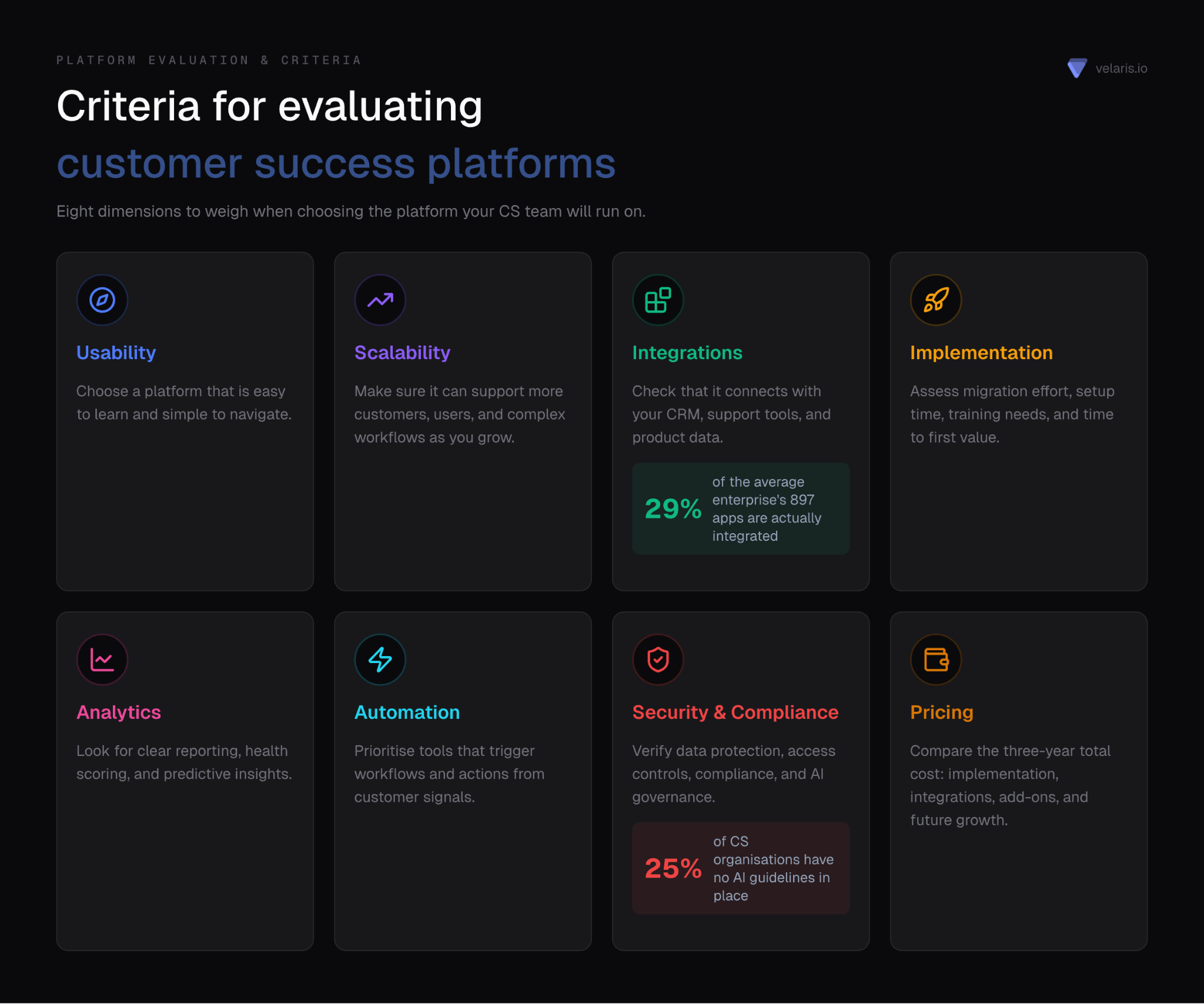
When choosing a customer success platform, it’s important to look beyond surface features and focus on the qualities that will truly support your team and customers. The following criteria provide a structured way to evaluate platforms and ensure you select the right fit.
Usability
Usability refers to how simple and intuitive the platform is. A CSP should offer clean dashboards, easy navigation, and features that don’t require extensive training. If the tool feels complicated, adoption will suffer and teams won’t get the full value. Platforms like Velaris, which is highly rated on G2, emphasize user‑friendly design to make adoption smoother across teams.
Scalability
The platform must grow with your business. As your customer base expands, the CSP should handle larger volumes of data, more users, and increasingly complex workflows without slowing down or becoming outdated.
Integration
The lack of integration is a widespread problem. MuleSoft found that the average enterprise manages 897 applications, but only 29% of them are integrated.
Integration is critical because a CSP must connect seamlessly with existing tools like CRM, support systems, and product data sources. Strong integrations prevent data silos and give customer success managers a complete view of the customer journey.
Implementation
Assess how much work is required to migrate data from your CRM or existing platform, configure workflows, train users, and reach go-live. Ask which parts require professional services and what the typical implementation timeline looks like.
The time-to-first-value by how quickly the team can use the platform for a meaningful outcome should be measured.
Analytics
Analytics provide the insights needed to make smart decisions. Look for platforms that offer reporting, customer health scoring, and predictive analytics. These features help teams identify risks, measure success, and act proactively.
Automation
Automation saves time and ensures consistency. A strong CSP should allow you to set up workflows, playbooks, and alerts that trigger automatically based on customer behavior, and with AI‑driven automation like Velaris AI, these playbooks can be intelligently activated based on behavior patterns to ensure timely, personalized engagement while reducing manual effort.
Security and compliance
Security and compliance protect both your business and your customers. The platform should meet industry standards for data protection, offer secure access controls, and comply with regulations relevant to your industry.
AI features also require clear governance, something which many orgs forget; 24.8% of CS businesses were found to not have any AI guidelines at all. Ask how customer data is used, which users can access AI outputs, and whether activity can be reviewed or audited.
Vendors such as Velaris highlight compliance responsible AI governance as core strengths, ensuring customer data is safeguarded while meeting global standards.
Pricing
Look beyond the headline subscription price. Customer success platforms may charge per seat, account, active user, or usage. And additional costs can include implementation, integrations, training, AI features, and paid modules.
Build a three-year cost model for each shortlisted platform. Include one-off fees, expected growth in users or accounts, and any add-ons you are likely to need so you can compare the true cost rather than the first-year price.
How to compare customer success platforms effectively
Comparing customer success platforms requires more than just looking at features on a website. To make the right choice, success managers need a structured approach that aligns the platform’s capabilities with business goals, team workflows, and customer needs.
Create a feature checklist aligned with business goals
Start by listing the features that matter most to your organization. Align this checklist with your customer success objectives, such as reducing churn, improving onboarding, or scaling engagement. This ensures you evaluate platforms based on what truly drives results.
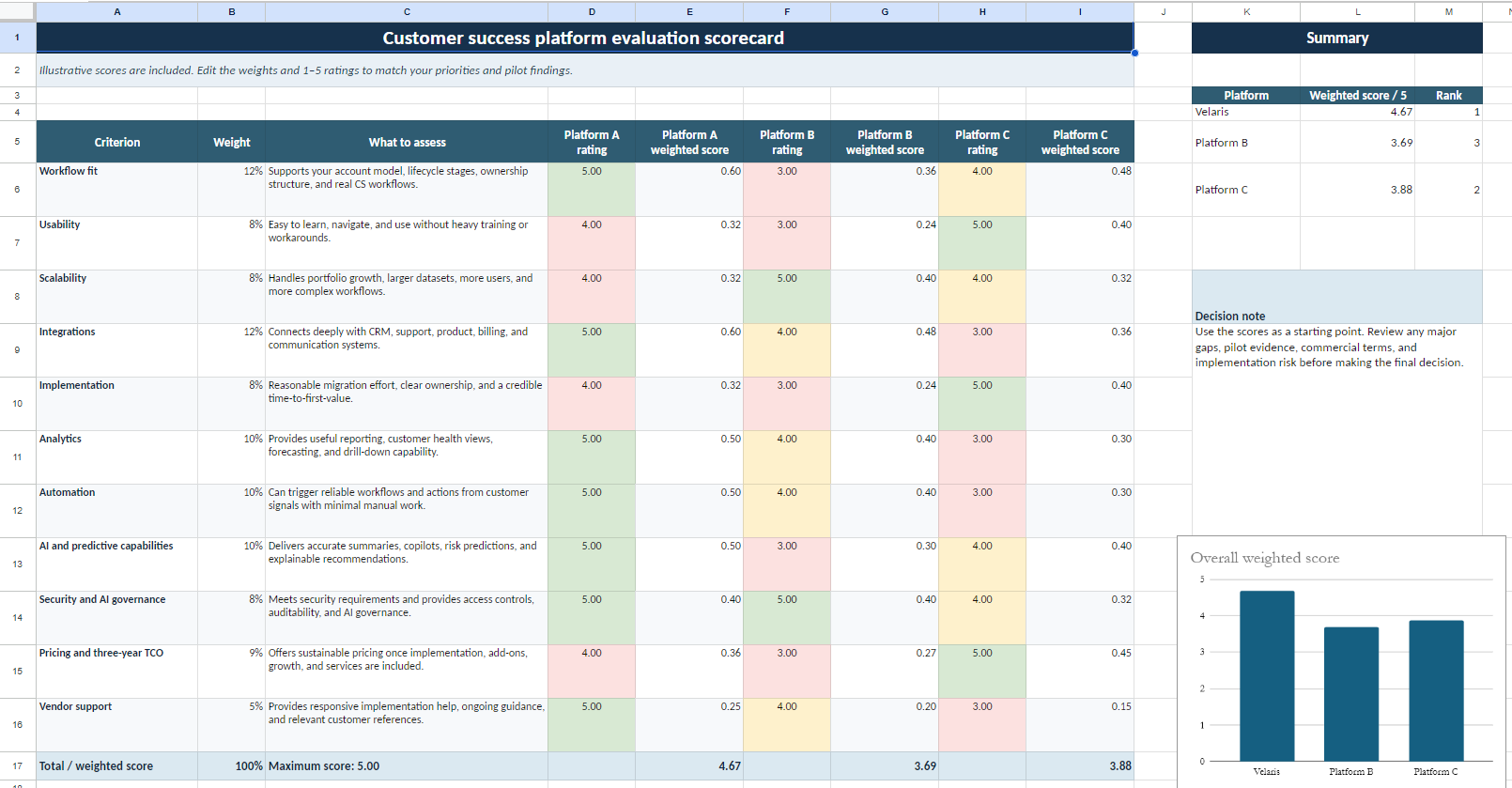
Use scorecards or weighted evaluation models
A scorecard helps you compare platforms side by side. Assign weights to criteria like usability, integration, and cost based on their importance to your business. This makes the evaluation process more objective and highlights the best overall fit. For example, Velaris offers advanced customer health scoring, which often ranks highly in weighted models because it directly supports proactive retention strategies.
Run pilot programs or proof of concept trials
Before committing, test the platform with a small group of customers or a limited team. Pilot programs reveal how well the tool works in real scenarios, uncover potential challenges, and provide data to support your decision.
Use a 30/60/90-day scorecard to test each shortlisted platform against real work. During the first 30 days, focus on setup and data readiness. Check whether the team can learn the platform quickly and whether core systems connect as expected.
By day 60, test the features that matter most to your team, i.e. health scoring, automation, reporting etc. By day 90, measure whether the platform has improved efficiency, visibility, and decision-making. Set clear success criteria before the pilot begins so the final choice is based on evidence rather than a polished demo.
Gather feedback from success managers and cross‑functional teams
Customer success managers, sales, support, and product teams all interact with the platform. Collecting feedback from these groups ensures the tool meets practical needs across the organization.
This collaborative approach increases adoption and long‑term success, especially when evaluating platforms like Velaris, which are designed to support multi‑team collaboration through shared dashboards and workflows.
Questions to ask before choosing a customer success platform
Before committing to a customer success platform, it’s important to ask the right questions. These help you uncover whether the tool truly fits your business needs, integrates smoothly with your systems, and delivers long‑term value.
Does the platform fit how our CS team actually works?
A platform should support your existing customer model rather than forcing the team into a process that does not suit the business. Check whether it can reflect your account tiers, ownership structure, lifecycle stages, and engagement approach. It should also fit the way CSMs manage tasks and collaborate with other teams.
Test this with real workflows during the evaluation. Ask the vendor to show how the platform would handle risk management, renewals, and expansion in your business. If every process requires heavy customisation or workarounds, the platform may create more friction than it removes.
What level of customer support does the vendor provide?
Vendor support can make or break your experience. Ask about onboarding, training, and ongoing support availability. Look for clear service level agreements (SLAs) and responsive support channels. A strong vendor partnership helps teams adopt the platform faster and resolve issues quickly.
Can the vendor provide relevant customer references?
Ask to speak with customers that have a similar team size, customer model, and level of complexity. Their experience can reveal implementation challenges and limitations that may not appear during a demo.
Does the platform have effective AI functionalities?
Evaluate AI features as a separate capability. Everything from predictive churn and health modelling to AI copilot and automated summaries, should be looked for in a CSP.
During a pilot, test the platform on real customer data and assess whether its predictions, summaries, and recommendations are accurate enough to support decisions.
If you’re looking for AI tools, we’ve made a guide to the top 10 AI customer success tools available.
Common mistakes to avoid when evaluating customer success platforms
Evaluating a customer success platform is a big decision, and many teams fall into avoidable traps. Being aware of these common mistakes helps you make a smarter choice and ensures the platform delivers long‑term value.
Focusing only on price instead of long‑term value
It’s tempting to choose the cheapest option, but focusing only on price often leads to missed opportunities. A platform that costs less upfront may lack critical features or scalability, resulting in higher costs later. Always weigh price against the value it brings over time.
Ignoring scalability and future needs
A platform that works today may not meet your needs tomorrow. Ignoring scalability can force you to switch tools as your business grows, which is costly and disruptive. Choose a CSP that can handle growth in customers, data, and workflows.
Overlooking user adoption and training requirements
Even the most feature‑rich platform is useless if teams don’t adopt it. Overlooking training and ease of use leads to poor engagement and wasted investment. Make sure the platform is intuitive and that the vendor provides strong onboarding support.
Disregarding replatforming costs
Do not underestimate the cost of replacing an existing customer success platform. Migration may involve moving historical data, rebuilding health scores and playbooks, reconnecting integrations, and retraining the team.
Reduce the risk by auditing what must be preserved, running both systems in parallel where necessary, and agreeing on clear validation checks before the old platform is retired.
Not involving cross‑functional stakeholders in evaluation
Customer success doesn’t operate in isolation. Sales, support, and product teams all rely on shared data and workflows. Failing to involve these stakeholders in the evaluation process can result in a platform that doesn’t meet everyone’s needs, reducing overall effectiveness
Involving finance and procurement too late
Bring finance and procurement into the process before creating a shortlist. They can help model the full cost over several years and flag contract terms that may affect future spend.
Early sign-off also prevents teams from selecting a preferred platform only to discover that it exceeds budget or fails procurement requirements.
Benefits of a thorough evaluation process
Taking the time to carefully evaluate a customer success platform pays off in multiple ways. A structured approach ensures you choose a tool that meets today’s needs and also supports long‑term growth and customer success.
Ensures platform aligns with business goals
A thorough evaluation helps confirm that the platform’s features match your company’s objectives, whether that’s reducing churn, improving onboarding, or scaling customer engagement. This alignment ensures the CSP directly supports your strategic goals.
Reduces risk of wasted investment
By evaluating carefully, you avoid spending money on a platform that doesn’t deliver value. A clear process helps identify hidden costs, gaps in functionality, or poor vendor support before committing.
Improves team adoption and satisfaction
When teams are involved in the evaluation process, they’re more likely to embrace the platform. Choosing a CSP with intuitive design and strong onboarding resources makes adoption smoother. For example, Velaris offers guided workflows and easy‑to‑use dashboards, which can significantly boost team satisfaction and reduce training time.
Strengthens customer relationships through better insights
A well‑evaluated platform provides accurate data and actionable insights. This allows customer success managers to understand customer health, anticipate risks, and deliver proactive support. Stronger insights lead to stronger relationships and higher retention.
Conclusion
Evaluating customer success platforms is a strategic move that impacts retention, growth, and customer loyalty. By following a structured process, asking the right questions, and avoiding common mistakes, businesses can select a platform that aligns with their goals and delivers measurable ROI.
A thorough evaluation ensures usability, scalability, integration, analytics, automation, and security are all considered, while involving cross‑functional teams to drive adoption. The result is reduced risk, stronger customer relationships, and improved team satisfaction.
Platforms like Velaris, which is highly rated on G2, with features such as guided workflows and advanced customer health scoring, demonstrate how the right CSP can turn proactive success into reality. Choosing wisely today sets the foundation for long‑term customer value and sustainable growth.
Ready to see it in action? Request a demo of Velaris to explore how it can support your customer success strategy and help your team deliver lasting results.
Frequently Asked Questions
How is a customer success platform different from a CRM?
A CSP focuses on proactive engagement and retention, while a CRM mainly tracks sales and customer interactions.
What role does data security play in choosing a CSP?
Since CSPs handle sensitive customer data, strong compliance (GDPR, SOC 2, ISO certifications) and encryption standards are essential.
Can a CSP integrate product usage analytics directly?
Yes. Advanced platforms can pull in product telemetry data to show how customers use features, helping teams identify adoption gaps or expansion opportunities.
What’s the difference between customer success software and customer support software?
Support tools focus on resolving issues reactively, while CSPs focus on proactive engagement, long‑term retention, and customer growth strategies.
How do CSPs impact revenue growth?
By reducing churn and identifying upsell opportunities, CSPs directly contribute to net revenue retention (NRR), a key SaaS growth metric.

The Velaris Team
A (our) team with years of experience in Customer Success have come together to redefine CS with Velaris. One platform, limitless Success.




Velaris is an AI-native Customer Success Platform built for mid-market and enterprise B2B SaaS teams. From customer health scoring and churn prediction to onboarding automation, renewals, and expansion workflows, Velaris helps recurring revenue teams understand account health, reduce churn, and scale customer success with greater visibility and control.