We look forward to showing you Velaris, but first we'd like to know a little bit about you.


10 Best AI CSAT Software Tools for 2026
The best CSAT software depends on where you collect feedback and what you want to do with it. We compare 10 leading tools for 2026, from support-focused options like Nicereply and Simplesat to enterprise platforms like Qualtrics and Medallia, covering what each does well, its limitations, pricing, and the type of team it suits best.
The Velaris Team
September 24, 2026
CSAT software helps businesses collect, analyze, and act on Customer Satisfaction Score feedback after important customer interactions. It is commonly used after support conversations, onboarding milestones, purchases, or other moments where teams want to understand how satisfied a customer is with the experience.
Collecting the score itself is the easy part. The harder part is understanding why satisfaction changed and making sure negative feedback reaches someone who can actually do something about it.
Different CSAT tools solve that problem in different ways. Some focus on post-support surveys and agent performance, while others specialize in in-app feedback, frontline coaching, enterprise Customer Experience, or connecting satisfaction with broader customer health.
In this guide, we compare 10 of the best CSAT software tools for 2026 based on the use cases they are best suited to.
Key takeaways
- Nicereply and Simplesat are strongest for support-driven CSAT.
- Survicate works well for SaaS and in-product feedback.
- Velaris connects CSAT with wider B2B customer health.
- AskNicely focuses on frontline and multi-location service teams.
- Qualtrics and Medallia suit enterprise Customer Experience programs.
- The best tool depends on where and why you collect feedback.
1. Nicereply
Overview
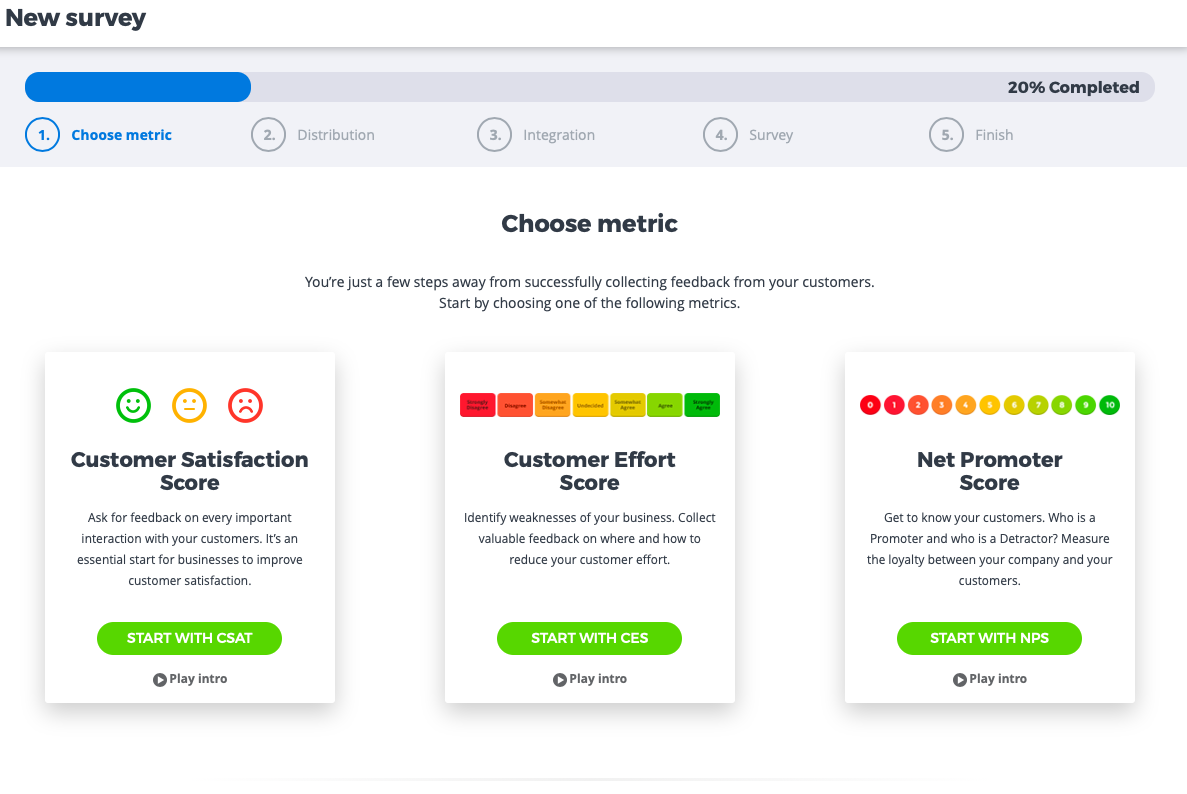
Nicereply is a customer feedback platform built around Customer Satisfaction Score, Customer Effort Score, and Net Promoter Score. Its biggest strength is collecting feedback directly around support interactions, either inside an agent's email signature or automatically after a ticket or conversation is resolved.
That makes it particularly useful for support teams that want to connect satisfaction scores back to individual agents, teams, and help desk conversations.
Best for
Customer support teams that want agent-level CSAT tightly connected to their help desk.
What it does well
- In-signature CSAT: Teams can place one-click satisfaction surveys directly inside agent email signatures and collect feedback during an ongoing conversation.
- Post-resolution surveys: Nicereply can automatically send surveys after a ticket, conversation, deal, or chat is closed.
- Flexible rating scales: Teams can use different CSAT formats, including smileys, thumbs up or down, five-star, and ten-star scales.
- Agent and team reporting: Dashboards show performance by agent, team, survey, and time period, with leaderboards for comparing results.
- Negative feedback follow-up: Poor ratings can be automatically flagged as unresolved issues so teams can respond before they are overlooked.
- Help desk integrations: Nicereply integrates with platforms including Zendesk, Front, Help Scout, and other help desk and CRM systems. Feedback can also be pushed back into customer records and tickets.
- CSAT, NPS, and CES: All paid plans include all three major customer feedback metrics, so teams can use the same platform for different survey programs.
Limitations and considerations
- Nicereply is primarily designed around support and service interactions, so it is less suited to broad enterprise Customer Experience programs.
- Its survey capabilities are more focused than general-purpose research platforms, which may matter if you need highly complex questionnaires.
- Pricing is based on both monthly survey responses and the number of users, so growing feedback volume can move teams into higher tiers.
Pricing
Nicereply's Starter plan costs $59 per month when billed annually and includes 100 responses per month and three users. Essential costs $119 per month, Growth $239, and Business $359, all on annual billing. Monthly billing is also available at higher rates.
2. Survicate
Overview
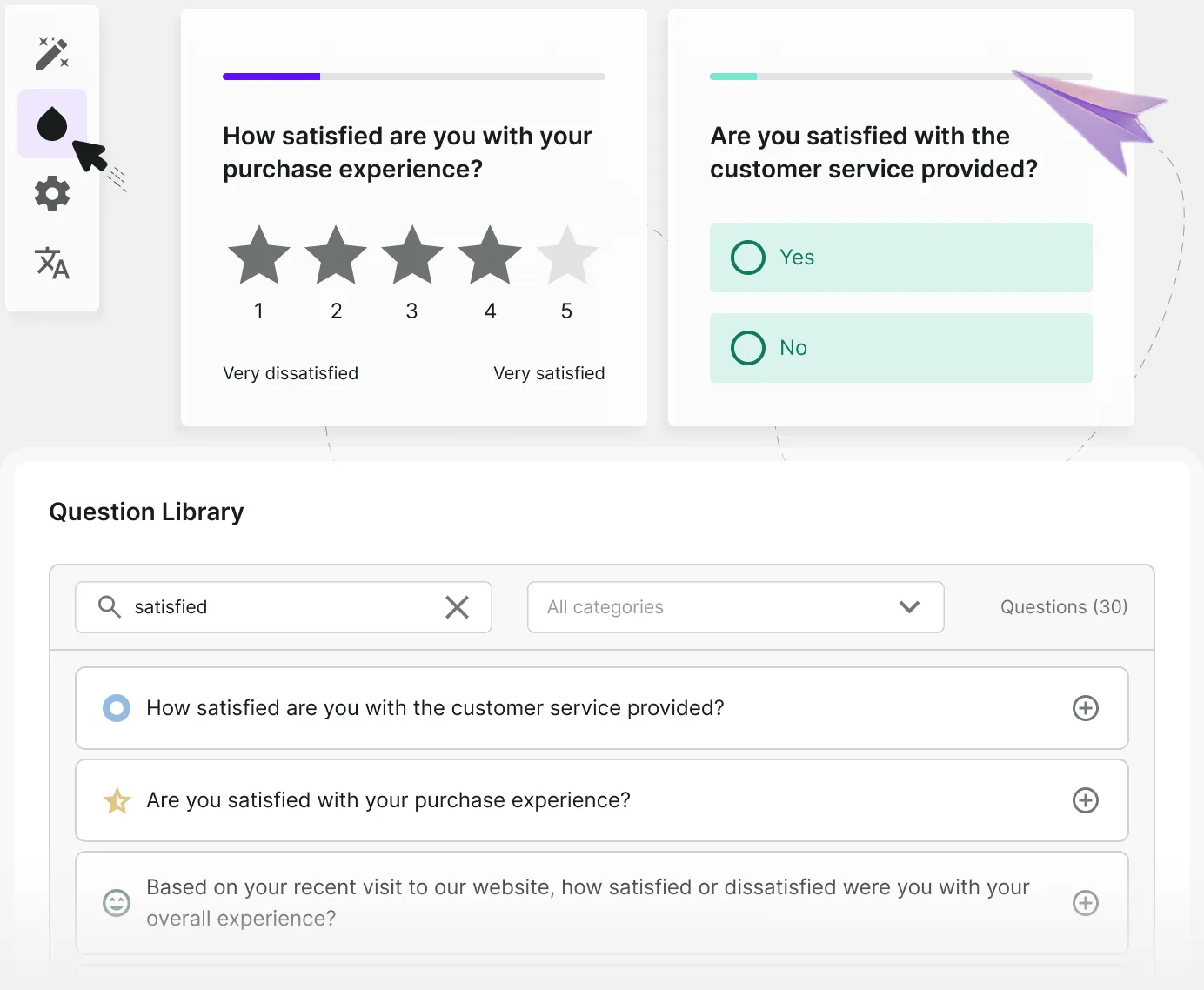
Survicate is a customer feedback platform that lets teams collect Customer Satisfaction Score feedback across email, websites, web apps, mobile apps, and shareable links. It can target surveys based on customer attributes or behavior, making it useful for collecting feedback at specific moments in the customer journey.
Its Research Hub also uses AI to bring survey responses together with other feedback sources such as support tickets, app reviews, and interview transcripts, helping teams identify recurring themes and sentiment.
Best for
SaaS, product, and Customer Experience teams that want flexible CSAT collection across digital channels.
What it does well
- Multi-channel CSAT: Surveys can be delivered through email, websites, in-product experiences, mobile apps, and shareable links.
- Behavioral targeting: Teams can trigger surveys using customer attributes, events, device type, traffic source, and other targeting criteria.
- Customer segmentation: Survey results can be filtered using CRM and marketing automation attributes to compare satisfaction across different customer groups.
- CSAT, NPS, and CES: Survicate supports the major customer feedback metrics alongside custom surveys.
- Research Hub: Feedback from surveys, support systems, app reviews, interviews, and other sources can be analyzed together in one research repository.
- AI feedback analysis: AI can automatically categorize feedback, identify themes, and help teams investigate patterns across large volumes of responses.
- Integrations: Survicate connects with tools including HubSpot, Intercom, Zendesk, Front, Amplitude, Salesforce, and other customer systems.
- Real-time analysis: Survey dashboards update as responses arrive, helping teams monitor changes in satisfaction without waiting for periodic reporting.
Limitations and considerations
- Survicate is less focused on agent-level support performance than dedicated tools such as Nicereply.
- Pricing increases as teams collect more responses and need more advanced analysis or integrations.
- More advanced logic, dashboards, integrations, and customization sit on higher-tier plans.
Pricing
Survicate offers a free plan alongside paid tiers. Its current pricing page lists Growth from $114 per month when billed annually, while Pro starts at $349 per month and Enterprise at $569 per month. Pricing varies with response volume and data usage.
3. Velaris
Overview
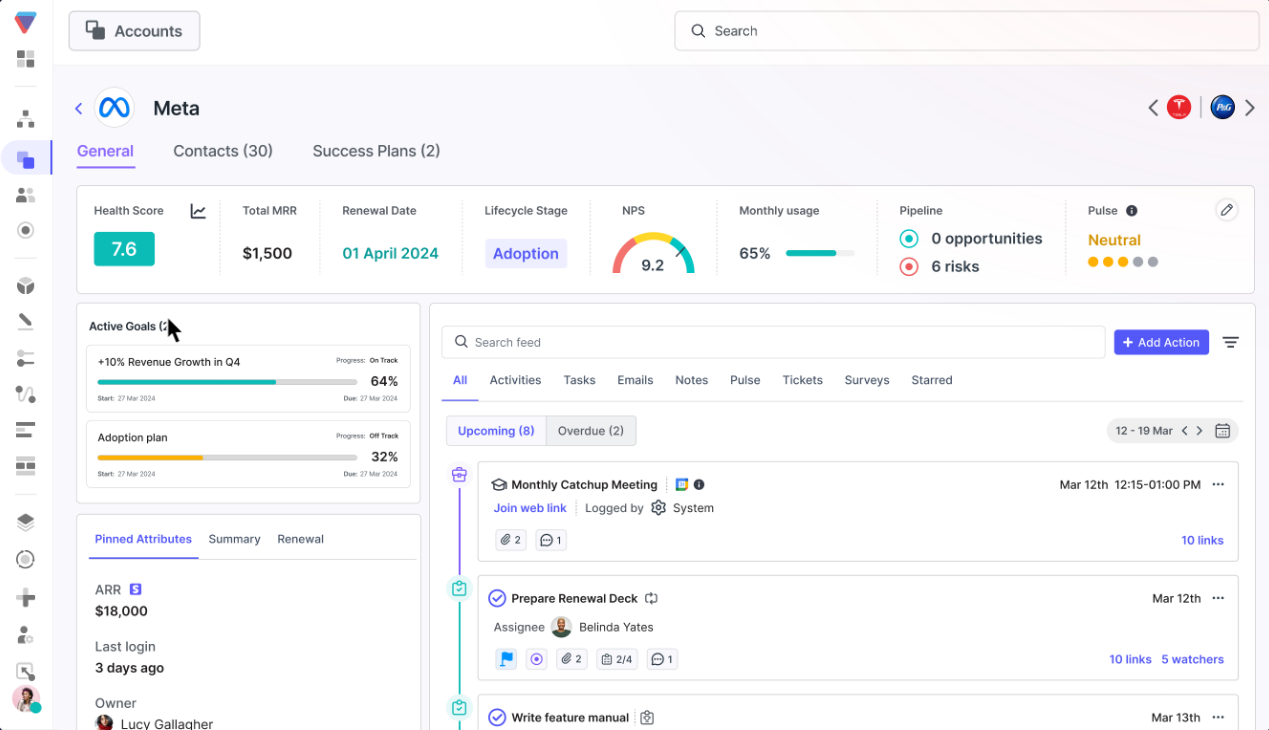
Velaris is an AI-native Customer Success Platform for mid-market and enterprise B2B teams. Unlike standalone CSAT tools, it lets teams collect satisfaction feedback and analyze it alongside customer health, product usage, support activity, conversations, and other account signals.
This makes CSAT more useful as an early indicator of account risk. Instead of treating a poor score as an isolated survey response, Customer Success teams can see what else is happening with the customer and decide how to respond.
Velaris currently has a 4.5 out of 5 rating on G2 across 126 reviews.
Best for
Mid-market and enterprise B2B businesses that want satisfaction data to feed directly into retention, risk, and Customer Success workflows.
What it does well
- Built-in surveys: Velaris supports CSAT, Net Promoter Score, and Customer Effort Score surveys within the Customer Success Platform.
- Email and web distribution: Surveys can be deployed through email or the web, allowing teams to collect feedback at different points in the customer journey.
- Automated and targeted surveys: Surveys can be automated and sent to specific customer segments, helping teams collect feedback at more relevant moments.
- Customer health context: Survey responses can be viewed alongside broader health and account data rather than being treated as standalone scores.
- Conversation intelligence: CallSense analyzes customer conversations for sentiment, risk, opportunities, and action items that can add context to satisfaction scores.
- AI Pulse: AI Pulse continuously analyzes communication, usage, and feedback signals to help teams spot changes in customer sentiment and health.
- Trending Topics: AI can identify recurring themes and track sentiment across customer conversations, helping teams understand what may be driving changes in satisfaction.
- Customer Success workflows: Feedback sits inside the same platform as health scores, automations, playbooks, Success Plans, and account reporting, making it easier to turn survey responses into action.
Limitations and considerations
- Velaris is designed primarily for B2B Customer Success teams rather than general-purpose market research.
- It is a broader Customer Success Platform, so teams that only need a basic CSAT survey may find a dedicated feedback tool simpler.
- It is not primarily designed for high-volume consumer feedback channels such as retail kiosks or large-scale public surveys.
Pricing
Velaris uses custom pricing based on the organization’s requirements. Its core license includes five users and unlimited viewers, with additional products and add-ons available depending on the use case.
4. Qualtrics
Overview
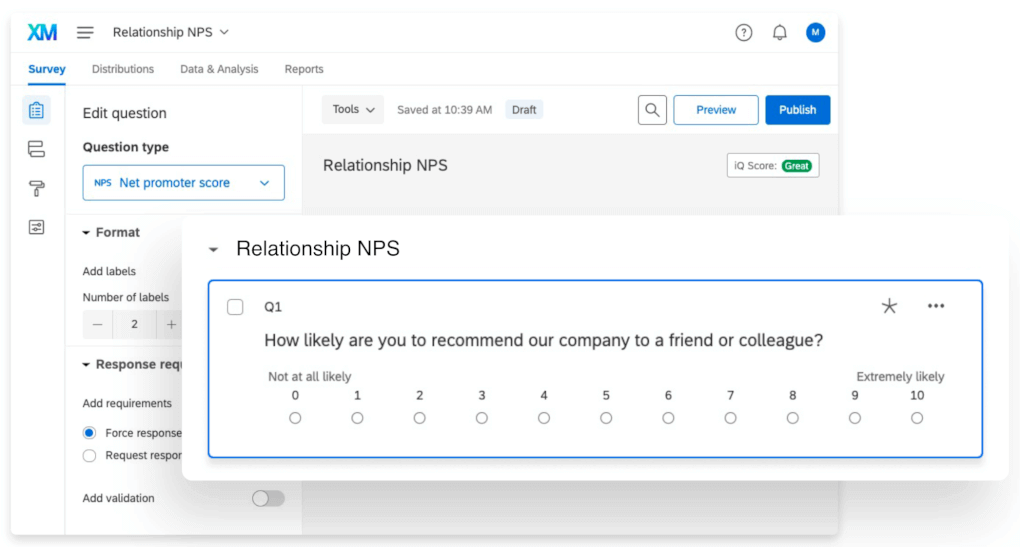
Qualtrics is an enterprise Experience Management platform that can run dedicated Customer Satisfaction Score programs while connecting those scores with broader Customer Experience data. Its CSAT solution is designed to measure satisfaction after specific interactions and help teams understand which parts of the experience are driving the result.
Its current Customer Experience offering also uses AI to analyze friction across channels and recommend or trigger actions when satisfaction falls.
Best for
Large enterprises running sophisticated Voice of the Customer and Customer Experience programs.
What it does well
- Dedicated CSAT programs: Qualtrics provides a purpose-built CSAT program for measuring satisfaction after important customer interactions.
- Omnichannel feedback: Feedback can be collected across surveys, websites, mobile apps, contact centers, and other digital touchpoints.
- Open-text analysis: Qualtrics can analyze qualitative feedback to identify recurring themes, sentiment, and areas of friction.
- Journey intelligence: Customer Experience data can be connected across different touchpoints to show where satisfaction is improving or deteriorating.
- Closed-loop workflows: Teams can use feedback and CSAT thresholds to trigger follow-up actions when customers report poor experiences.
- Experience Agents: AI agents can detect dissatisfaction inside surveys and, in some cases, resolve issues or take actions through connected systems.
- Enterprise dashboards: Qualtrics provides AI-guided dashboards and analytics designed to surface the experience gaps most likely to affect retention, conversion, or lifetime value.
- Research capabilities: The wider platform also supports formal market, product, brand, and Customer Experience research programs.
Limitations and considerations
- Qualtrics is built for broad enterprise Experience Management, so smaller teams may not need the full platform.
- Its range of products, dashboards, workflows, and governance options can require more specialist administration than lightweight CSAT tools.
- Customer Experience pricing is not publicly listed, which makes costs harder to estimate before speaking with the company.
Pricing
Qualtrics uses custom, interaction-based pricing for its Customer Experience products. Pricing is based on planned usage rather than the number of users, and teams need to request a quote for Customer Experience packages.
5. AskNicely
Overview
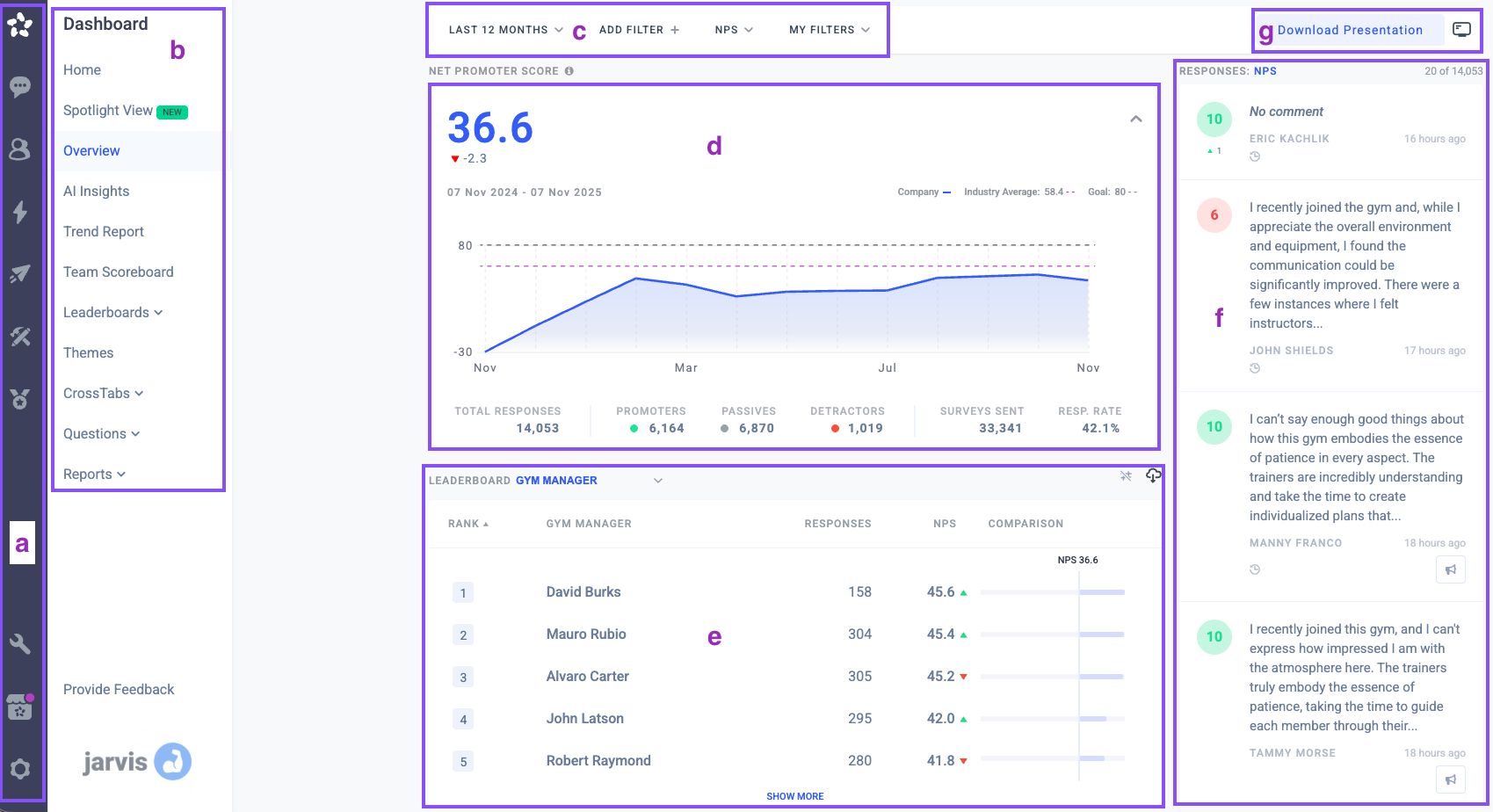
AskNicely is a customer experience platform built for service businesses with frontline teams. It combines CSAT, NPS, and CES surveys with coaching, recognition, case management, and performance reporting, so feedback can be used to improve how individual employees and locations serve customers.
Its biggest differentiator is what happens after the score. Customer feedback can feed team dashboards, manager coaching, recognition, automated follow-up, and improvement workflows rather than sitting in a reporting tool.
Best for
Multi-location service businesses that want CSAT to influence frontline performance.
What it does well
- Multi-channel CSAT: Feedback can be collected through email, SMS, web, mobile apps, QR codes, and other service touchpoints.
- Location and team reporting: Scorecards and leaderboards make it easier to compare customer experience across teams and locations.
- Frontline coaching: Customer feedback can be turned into personalized coaching and training for individual employees.
- Recognition: Managers can recognize strong performance and reinforce positive behavior using customer feedback and performance data.
- Case management: Negative feedback can be assigned, tracked against service-level agreements, and followed through to resolution.
- Automated workflows: Feedback can trigger alerts, follow-ups, and other actions so poor experiences reach the right person quickly.
- AI analysis: NiceAI analyzes customer sentiment and feedback to surface trends and recommend actions.
- CSAT, NPS, and CES: AskNicely supports the major customer experience metrics within the same platform.
Limitations and considerations
- AskNicely is strongly oriented toward frontline and multi-location service businesses, so some of its coaching and recognition features are less relevant to pure software or product teams.
- It is broader than a simple CSAT survey tool, which may be unnecessary for teams that only need basic feedback collection.
- Pricing scales with response volume, automation, and additional capabilities, so larger programs need a custom quote.
Pricing
AskNicely offers Learn, Grow, and Transform plans, all with unlimited users and pricing that scales with annual feedback volume. Advanced capabilities such as frontline coaching, white-label surveys, NiceAI, and reputation management vary by tier or are available as add-ons.
AskNicely does not publish a single fixed price for these plans on its current pricing page, so teams need to request a quote based on their expected response volume and required features.
6. Simplesat
Overview
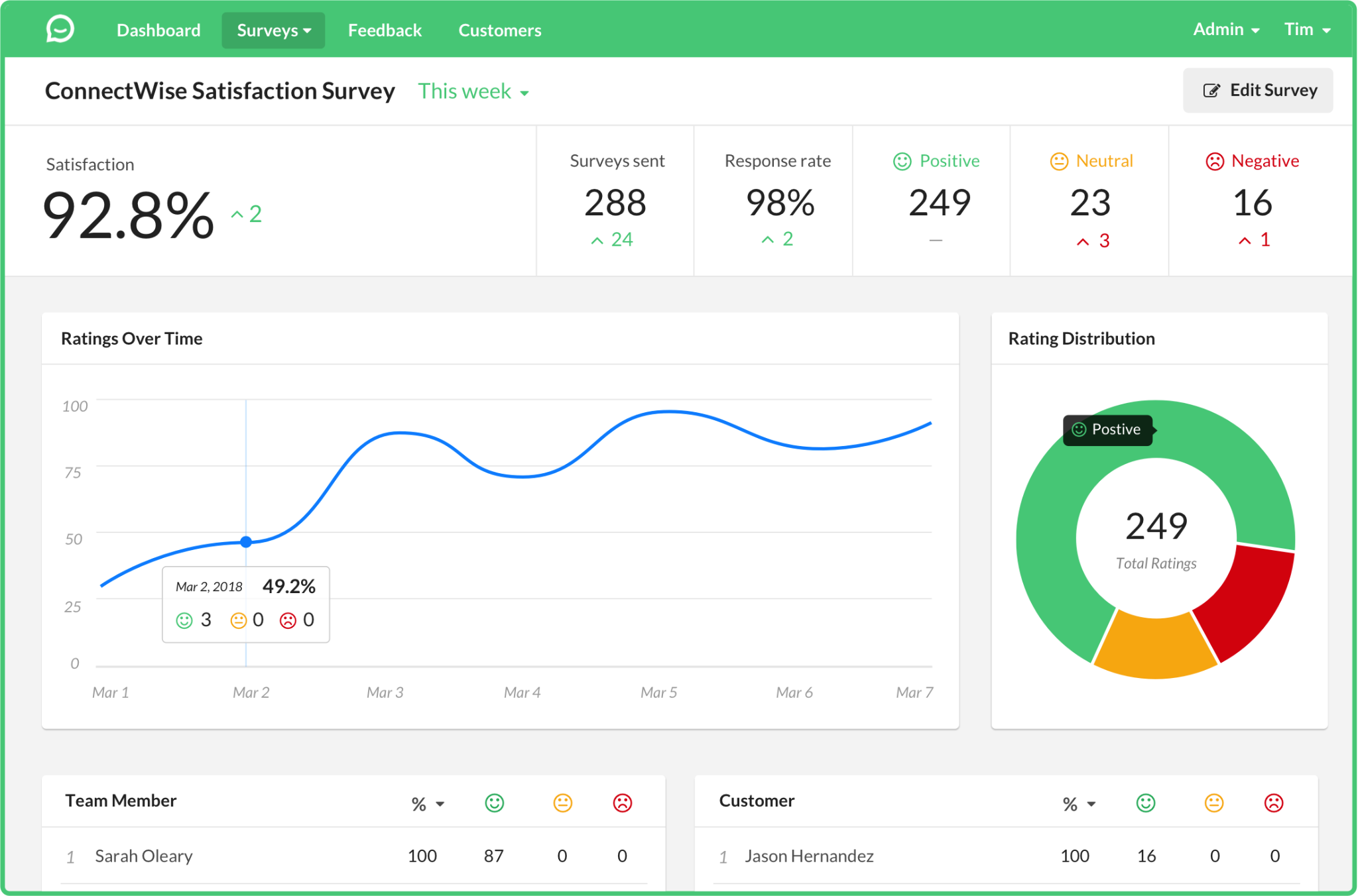
Simplesat is a customer feedback platform built around CSAT, NPS, and CES surveys for support and service teams. It integrates directly with help desks and CRMs so feedback can be tied back to the ticket, agent, account, or customer record that generated it. (simplesat.io)
Its current product goes beyond basic survey collection with conditional follow-up questions, segmentation, automated alerts, benchmarking, and AI-powered topic analysis.
Best for
Support teams, IT service providers, and managed service providers that want CSAT closely connected to their existing operational systems.
What it does well
- CSAT surveys: Teams can collect satisfaction feedback after support tickets, service interactions, and other customer touchpoints.
- Ticket-triggered surveys: Surveys can be sent automatically when tickets are closed or reach specific stages.
- CSAT, NPS, and CES: Simplesat supports the three most common customer feedback metrics in one platform.
- Help desk integrations: It connects with tools such as Zendesk, Intercom, HubSpot, ConnectWise, Autotask, and other service platforms. (simplesat.io)
- Conditional follow-ups: Survey questions can change based on the score a customer gives, making it easier to understand what drove satisfaction or dissatisfaction.
- Segmentation: Teams can break down results by brand, agent, customer type, team, or other attributes.
- AI topic detection: AI can categorize open-text feedback and surface recurring themes across responses.
- Automated alerts: Poor scores can trigger notifications or workflows so teams can follow up quickly.
- Benchmarking: Simplesat publishes benchmark data that teams can use to compare their CSAT and NPS performance with wider industry trends.
- Agent feedback: Results can be tied back to individual employees and support teams to help with coaching and performance management.
Limitations and considerations
- Simplesat is strongly oriented toward support and service operations, so it is less suited to broad enterprise market research.
- Its value is highest when teams want feedback integrated into help desk or service workflows rather than standalone survey analysis.
- Pricing scales with response volume, so costs can increase as survey programs grow.
Pricing
Simplesat plans currently start at $109 per month when billed annually, with higher tiers offering more responses and advanced features.
For benchmarking, Simplesat's 2026 CSAT and NPS Benchmark Report analyzed 3.5 million responses collected during 2025 and reported an overall CSAT benchmark of 87.8%.
7. Zonka Feedback
Overview
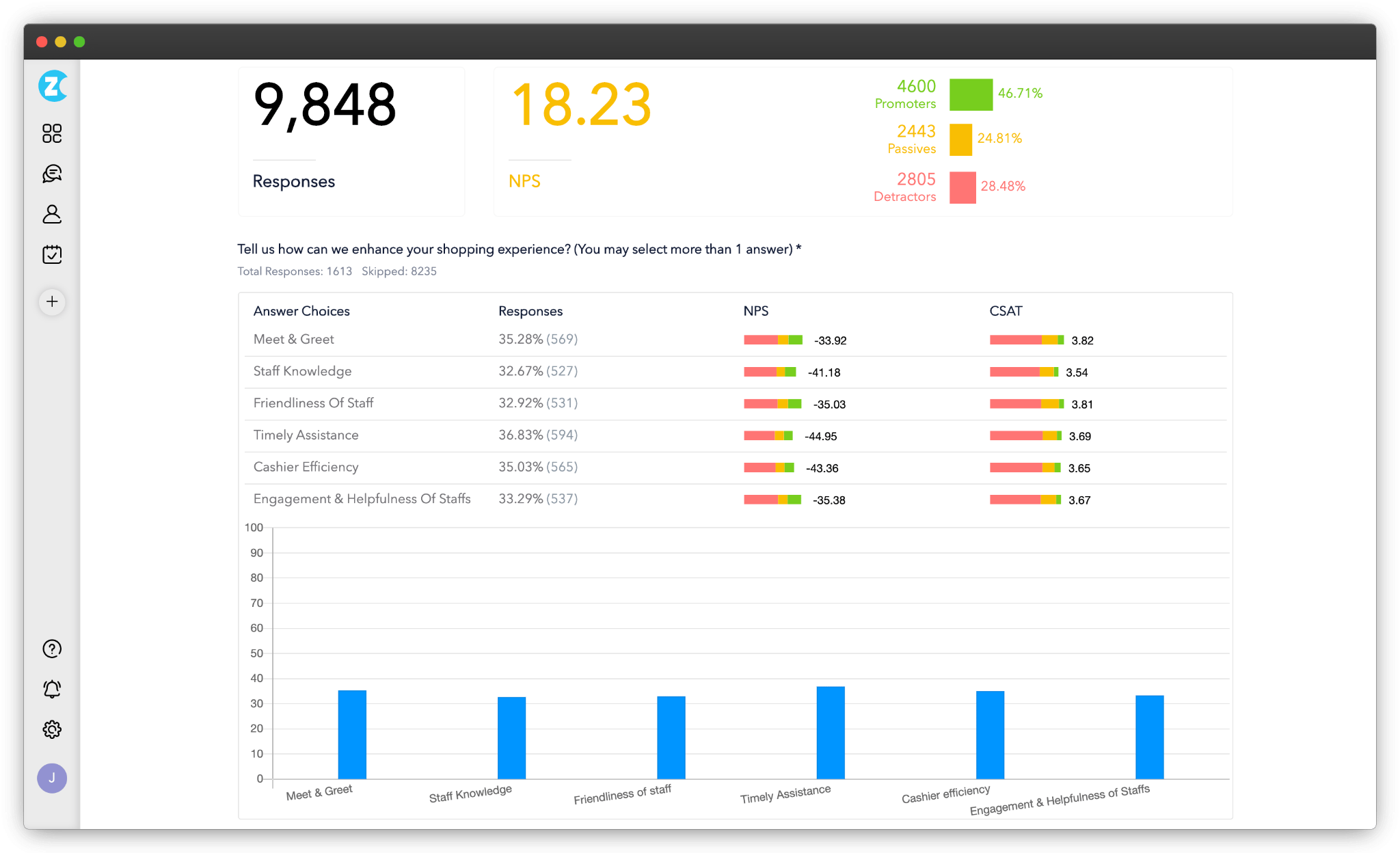
Zonka Feedback is a customer feedback platform built for collecting CSAT, NPS, CES, and other experience data across both digital and physical touchpoints. It supports channels such as email, SMS, web, in-app surveys, QR codes, tablets, and kiosks, making it particularly useful for businesses that collect feedback across multiple locations or environments.
Its other strength is closed-loop feedback management. Poor scores can trigger alerts, cases, and routing workflows so dissatisfied customers reach the right team quickly.
Best for
Mid-sized and enterprise businesses collecting satisfaction feedback across several channels or locations.
What it does well
- Omnichannel CSAT: Teams can collect feedback through email, SMS, websites, in-app surveys, QR codes, tablets, and kiosks.
- Offline surveys: Responses can be collected without an internet connection and synced automatically when the device reconnects.
- Kiosk feedback: Zonka can turn iPads and Android devices into unattended feedback kiosks for physical locations such as stores, hotels, hospitals, and events.
- Closed-loop workflows: Low scores can trigger automated routing and alerts so frontline teams can follow up quickly.
- Case management: Teams can assign issues, add notes, track follow-up, and manage dissatisfied customer responses through a shared response inbox.
- AI feedback analysis: AI can identify sentiment, themes, entities, urgency, and intent across customer feedback.
- Location and employee reporting: Businesses can compare satisfaction across locations and frontline staff using dedicated reports and leaderboards.
- SMS surveys: Surveys can be sent directly by SMS or triggered through integrations and APIs, with allowances varying by plan.
Limitations and considerations
- Zonka Feedback offers more functionality than teams running a simple email CSAT program may need.
- Multi-location, offline, and closed-loop programs can require more configuration than lightweight survey tools.
- Some usage, particularly SMS distribution, is volume or credit based, so costs can increase as feedback programs scale.
Pricing
Zonka Feedback's paid survey and Customer Experience plans currently start at $49 per month, with custom pricing available for high-volume and multi-location organizations.
A lower-cost offline-only option is also available, while more advanced survey distribution, automation, and enterprise requirements sit on higher tiers.
8. Medallia
Overview
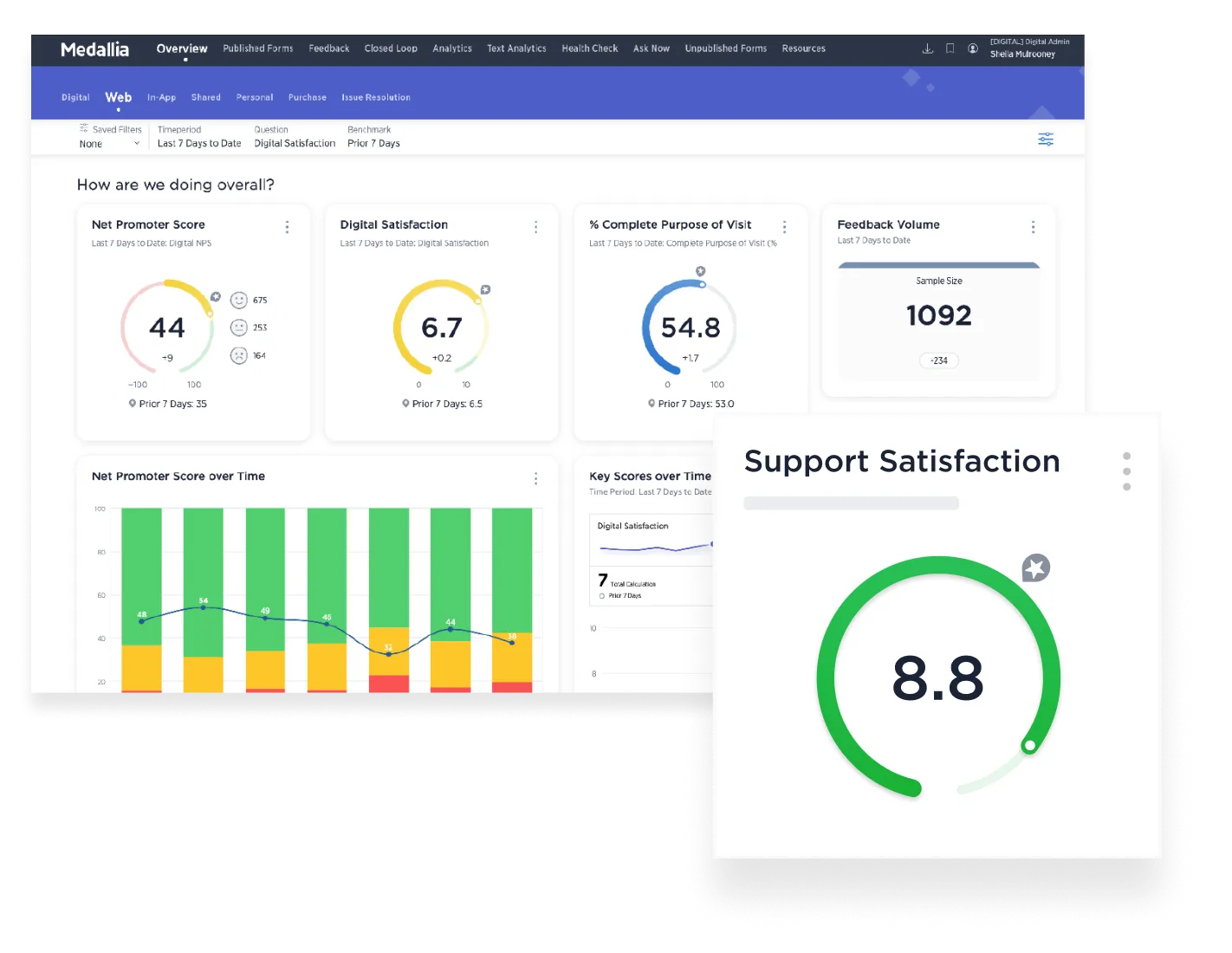
Medallia is an enterprise Experience Management platform that captures customer signals across surveys, digital experiences, contact centers, social channels, and other interactions. It combines those signals with analytics and workflows so organizations can understand satisfaction at both an individual and enterprise level.
For CSAT, that means the score becomes one part of a much broader Customer Experience program rather than a standalone survey metric.
Best for
Global enterprises that need to understand satisfaction across many customer touchpoints, markets, and business units.
What it does well
- Omnichannel experience data: Medallia can collect survey, digital, speech, social, and other customer signals in one platform.
- CSAT and customer feedback: Teams can run sophisticated survey programs and connect satisfaction scores with wider experience data.
- Text and sentiment analytics: Open-text responses, chat logs, and other unstructured feedback can be analyzed for themes, sentiment, and root causes.
- Journey intelligence: Feedback can be viewed in the context of the broader customer journey to show what happened before and after a satisfaction signal.
- Predictive insights: Medallia uses AI-driven analysis to surface important trends and help teams prioritize where to act.
- Closed-loop action: Alerts and case management workflows can route poor experiences to the right teams for follow-up.
- Role-based reporting: Dashboards and reports can be personalized by role, location, team, and organizational structure.
- Enterprise-scale analytics: Medallia is designed to analyze structured and unstructured experience data across large organizations.
Limitations and considerations
- Medallia is designed for large enterprise Experience Management programs, so implementation can be substantial.
- Its breadth makes it more than most teams need if they only want to run a simple CSAT survey.
- Pricing is custom, so costs are not easy to estimate before speaking with the company.
Pricing
Medallia uses custom pricing based on its Experience Data Record model. An Experience Data Record represents the data associated with a single customer or employee interaction.
Pricing is structured around annual tiers rather than the number of users or individual survey channels. The model includes signal collection, analytics, workflows, role-based reporting, alerting, case management, and closed-loop feedback.
9. SurveyMonkey
Overview
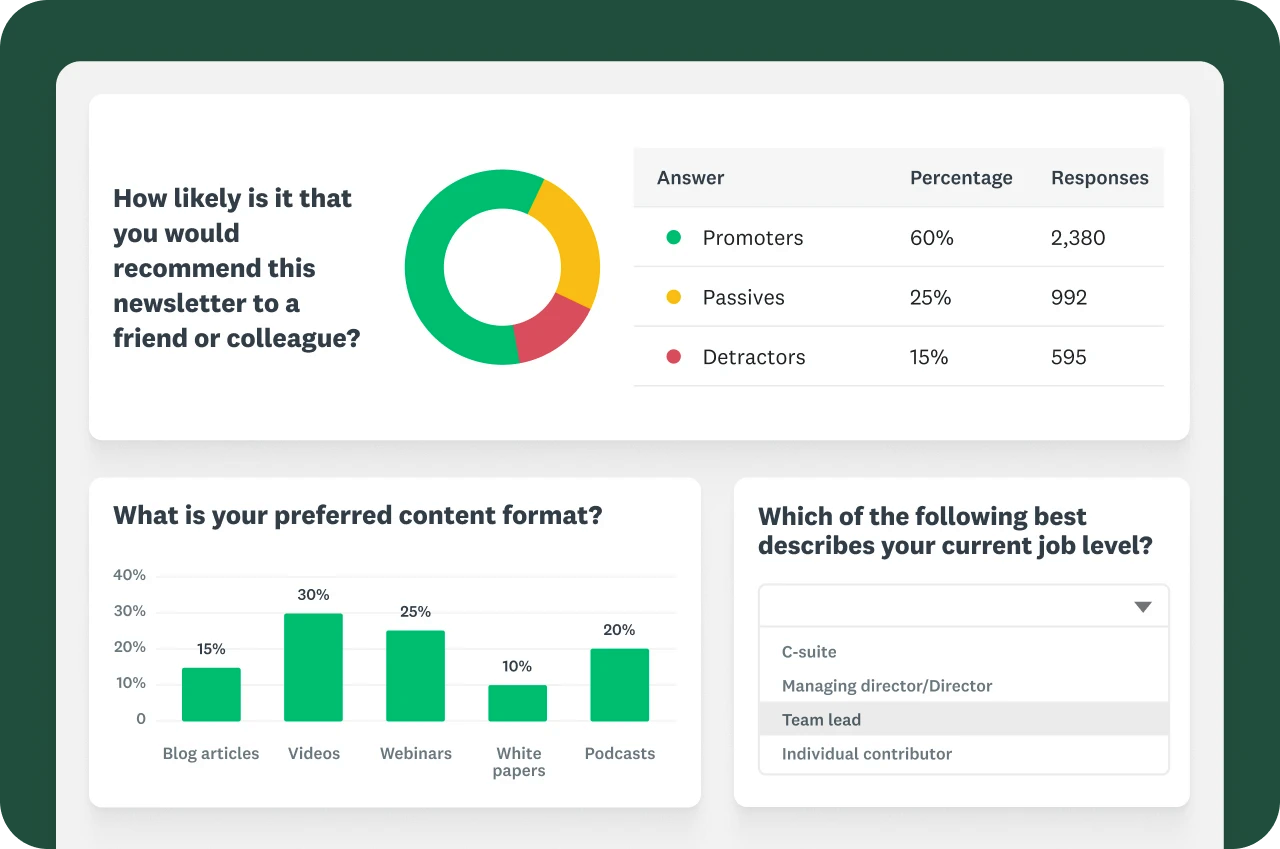
SurveyMonkey is a general-purpose survey platform that can be used for Customer Satisfaction Score alongside broader customer, product, employee, and market research programs. It offers dedicated CSAT templates, survey logic, multiple distribution methods, and analytics for tracking satisfaction over time.
Its main advantage is flexibility. Teams can use the same platform for one-off CSAT surveys or more structured Customer Experience programs without adopting a dedicated CSAT-only tool.
Best for
Businesses that want CSAT alongside a broader general-purpose survey platform.
What it does well
- CSAT templates: SurveyMonkey provides dedicated Customer Satisfaction Score templates and question formats that teams can customize for different touchpoints.
- Survey builder: Teams can build surveys manually or use AI to generate survey questions from a prompt.
- Flexible distribution: Surveys can be distributed through email invitations, web links, and other collectors, with separate response tracking for different channels.
- Multi-survey analysis: Teams can combine results from multiple surveys into one dashboard and track CSAT or other metrics over time.
- AI analysis: SurveyMonkey's AI Analysis Suite can answer questions about results and generate summaries, charts, and insights.
- Thematic and sentiment analysis: Open-text feedback can be grouped into recurring themes and classified by sentiment on eligible plans.
- Benchmarks and segmentation: Teams can filter results by segment or touchpoint and compare Customer Experience results over time.
- Team collaboration: Team plans allow multiple users to create, analyze, and manage surveys from the same account.
Limitations and considerations
- SurveyMonkey is less tightly connected to support workflows than dedicated CSAT platforms built around help desk tickets and agent performance.
- Its general-purpose design means it offers fewer CSAT-specific follow-up and case-management workflows out of the box.
- Paid plans include response allowances, and additional responses can incur extra charges.
Pricing
SurveyMonkey's Team Advantage plan costs $30 per user per month, while Team Premier costs $92 per user per month. Both are billed annually and require a minimum of three users. Enterprise plans use custom pricing.
10. Retently
Overview
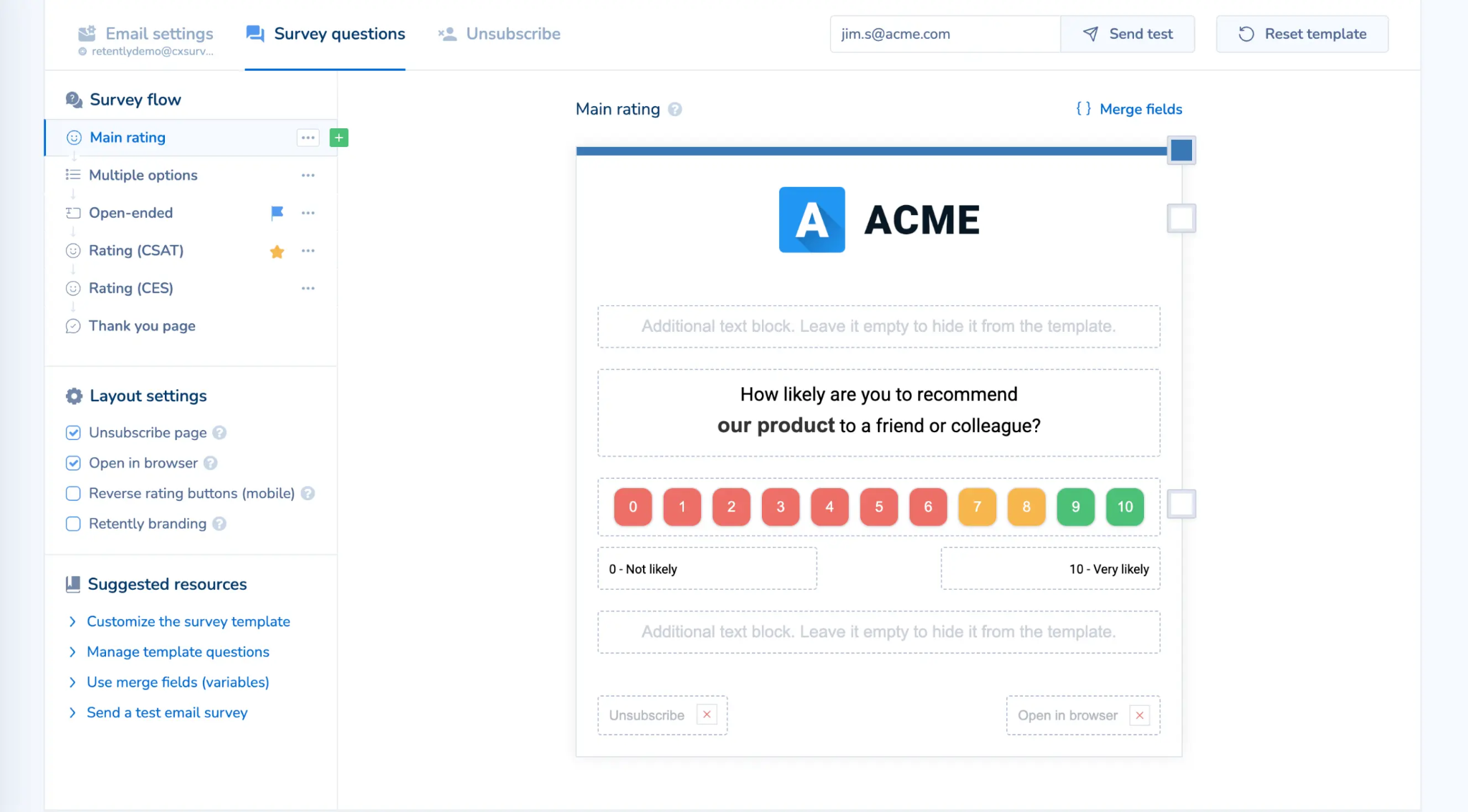
Retently is a customer experience platform built around CSAT, Net Promoter Score, and Customer Effort Score surveys. It combines automated survey campaigns with segmentation, AI-powered feedback analysis, alerts, and integrations, making it a focused option for teams that want structured feedback programs without moving into a full enterprise Experience Management suite.
Its current positioning is especially strong in ecommerce and retail, where surveys can be triggered after purchases, deliveries, returns, or support interactions and enriched with order or agent data.
Best for
Ecommerce and mid-market teams that want a dedicated CSAT, NPS, and CES platform with strong automation and feedback analysis.
What it does well
- CSAT, NPS, and CES: All plans support the three main customer feedback metrics.
- Automated campaigns: Surveys can be triggered after events such as an order, delivery, ticket closure, or product milestone.
- Multi-channel surveys: Feedback can be collected through email, SMS, in-app, link, and website surveys.
- Customer segmentation: Teams can compare feedback by customer segment, product, agent, location, or other attributes.
- AI topic and sentiment analysis: Open-text feedback is automatically classified into themes and sentiment to help teams identify recurring issues.
- Key drivers: Retently can highlight which topics are most associated with positive or negative satisfaction scores.
- Alerts and follow-ups: Low scores can trigger notifications through email, Slack, or Microsoft Teams, as well as automated follow-up actions.
- Ecommerce integrations: Native connections include Shopify, Gorgias, Klaviyo, Zendesk, HubSpot, Salesforce, and other customer systems.
Limitations and considerations
- Retently is more focused on structured feedback programs than broad enterprise Customer Experience or journey management.
- It is particularly well suited to ecommerce and recurring-revenue use cases, so organizations with highly complex global CX programs may need a broader platform.
- Survey limits, seats, integrations, and advanced capabilities vary by plan, so costs increase as feedback volume grows.
Pricing
Retently's Ecommerce Basic plan costs $99 per month and includes 2,500 surveys, 10 campaigns, and three seats. Ecommerce Pro costs $299 per month and includes 20,000 surveys, 10 campaigns, and 10 seats.
Enterprise pricing is custom and adds capabilities such as Salesforce integration and higher-volume requirements.
Conclusion: Which CSAT software is right for your team?
The best CSAT software depends on where you collect feedback and what you want to do with it.
Nicereply and Simplesat are strong for support-led CSAT, while Survicate works well for SaaS and in-product feedback.
AskNicely is better suited to frontline service teams, Zonka Feedback to omnichannel and offline collection, and Qualtrics or Medallia to large enterprise Customer Experience programs.
SurveyMonkey offers a more general-purpose survey platform, while Retently focuses on dedicated CSAT, NPS, and CES programs.
For B2B post-sales teams, Velaris, a well rated software on G2, takes it further by combining CSAT with customer health, product usage, conversations, sentiment, and commercial context.
If you want to connect customer satisfaction with broader Customer Success intelligence, book a demo to see Velaris in action.
Frequently Asked Questions
What is CSAT software?
CSAT software helps businesses collect and analyze Customer Satisfaction Score feedback, usually after a specific interaction or moment in the customer journey.
Depending on the platform, it may also include automated survey triggers, open-text analysis, alerts, segmentation, and workflows for following up on negative feedback.
How is Customer Satisfaction Score calculated?
Customer Satisfaction Score is usually calculated with the following formula:
Satisfied responses ÷ total responses × 100
On a five-point scale, responses of 4 and 5 are typically counted as satisfied. So if 85 out of 100 respondents select 4 or 5, the CSAT score would be 85%.
What is the difference between Customer Satisfaction Score and Net Promoter Score?
Customer Satisfaction Score measures how satisfied someone is with a specific interaction or experience.
Net Promoter Score measures broader customer loyalty by asking how likely someone is to recommend the company, product, or service.
CSAT is therefore better suited to measuring individual moments, while Net Promoter Score is usually used as a broader relationship metric.
When should you send a CSAT survey?
CSAT surveys work best when they are sent shortly after the experience you want to measure.
Common examples include after a support interaction, onboarding milestone, implementation stage, purchase, delivery, training session, or product experience.
The timing should make it easy for customers to connect their score with the specific interaction being measured.
What should you look for in CSAT software?
Look for software that fits the channels and workflows your customers already use.
Important capabilities include survey triggers, email or in-app distribution, integrations, customer segmentation, open-text analysis, automated alerts, closed-loop follow-up workflows, and reporting.
The strongest platforms also make it easy to connect the score with the customer context behind it.
What is a good Customer Satisfaction Score?
There is no universal Customer Satisfaction Score that is good for every company. Benchmarks vary by industry, customer type, survey timing, and the experience being measured.
It is usually more useful to compare your score with relevant industry benchmarks and track how it changes over time.

The Velaris Team
A (our) team with years of experience in Customer Success have come together to redefine CS with Velaris. One platform, limitless Success.




Velaris is an AI-native Customer Success Platform built for mid-market and enterprise B2B SaaS teams. From customer health scoring and churn prediction to onboarding automation, renewals, and expansion workflows, Velaris helps recurring revenue teams understand account health, reduce churn, and scale customer success with greater visibility and control.