We look forward to showing you Velaris, but first we'd like to know a little bit about you.


The Ultimate Guide to Crafting a Digital Customer Success Strategy
In the age of digital transformation, SaaS companies are shifting towards digitally oriented customer success strategies to enhance engagement, anticipate needs, and deliver exceptional service. A robust digital customer success strategy leverages technology to optimize customer journeys and maximize value, ensuring sustainable business success.
The Velaris Team
July 30, 2026
Customer success in SaaS has moved from manual, reactive support to proactive, scalable digital-first strategies. Still, many teams face familiar challenges such as constant firefighting, low adoption, rising churn, and difficulty personalizing at scale.
This article helps SaaS leaders and customer success teams tackle those pain points with practical frameworks and proven tactics to engage users, reduce churn, and drive adoption effectively.
Key takeaways
- Digital customer success uses technology to deliver personalized, proactive and scalable support that fits the customer based on their requirements.
- This helps SaaS companies reduce churn, build loyalty and drive sustainable growth by leveraging customer segmentation, automation, and analytics to deliver tailored, efficient, and proactive success efforts.
- Implementing a digital customer success strategy means setting clear goals, choosing the right tools, training teams, phasing rollout, and continuously adapting for retention and growth.
- Relying solely on automated digital customer success risks losing human touch,data dependency and over-automation.
- Blending digital and human engagement, maintaining data quality, and continuous optimization keep strategies effective.
Together, these takeaways highlight why digital customer success has become a cornerstone of modern business strategy.
Before diving into the specific tactics and tools, it’s important to first understand what digital customer success actually means and how it sets the foundation for scalable, proactive engagement.
What is digital customer success?
Digital customer success is the evolution of traditional (CS). Instead of relying on reactive, one to one support, it uses technology to deliver personalized journeys, proactive engagement, and efficient service across digital channels.
Customer expectations are already moving in this direction. McKinsey found that 71% of consumers expect companies to deliver personalized interactions, while 76% become frustrated when that does not happen.
Beyond efficiency, digital customer success is about scalability and consistency. It enables SaaS companies to reach thousands of customers with tailored experiences whether through in-app guidance, automated onboarding flows, or AI driven health monitoring without losing the human touch.
Why a digital customer success strategy matters
Digital customer success matters because without it, companies face constant churn firefighting, missed warning signs, and fragmented customer experiences.
With it, SaaS organizations can transform customer relationships into long term business value reducing churn, building loyalty, and fueling sustainable growth.
A well executed digital customer success strategy ensures:
- Personalized journeys that meet customers exactly where they are.
- Proactive engagement that anticipates needs before issues arise.
- Efficient service delivery that scales without sacrificing quality.
Customer success enablement is the pillar that makes digital CS work. It’s about training teams and giving them the right tools to handle tech driven workflows.
The goal is simple, build a scalable approach that helps customers achieve their outcomes, making renewals and long term loyalty far more likely.
Demonstrating ROI of your digital CS strategy to leadership
A digital customer success strategy is easier to fund when leadership can see the business impact. Do not frame the case only around better engagement.
Tie it to metrics executives already care about, such as net revenue retention, gross revenue retention, time-to-value, CSM-to-account ratio, renewal readiness, and expansion pipeline influenced by CS.
Metrics like these directly influence growth; for example, ChartMogul’s SaaS retention research found that companies with net retention above 100% or gross retention above 85% grow 1.5–3x faster. So executives are sure to pay attention.
Start by baselining the “before digital” numbers. Capture how many accounts each CSM manages today and how much manual work is involved in routine follow-up. Without this baseline, it becomes difficult to prove whether digital CS improved performance or simply changed the process.
The strongest business case often centres on capacity. Digital CS should help the same team support more customers without letting risks, renewals, or onboarding milestones fall through the cracks.
For leadership updates, use a simple before-and-after view: account coverage, time-to-value, risk response time, renewal outcomes, and CSM hours saved. This makes the value clear for budget owners who need to see both revenue protection and operational efficiency.
Mapping the customer journey and touchpoints before you build a digital strategy
Before segmenting customers or automating engagement, map where customers actually interact with your business. A digital customer success strategy should be built around real touchpoints, not assumptions about what customers need.
Start by inventorying every customer interaction across the lifecycle. This includes product usage, onboarding emails, support tickets, billing messages etc.
Map touchpoints by lifecycle stage
Once the touchpoints are listed, place them against the main lifecycle stages: onboarding, adoption, renewal, and expansion. This helps you see where customers receive too much communication as well as where they receive too little.
For example, onboarding may include kickoff calls, milestone emails, product training, and implementation support. Adoption may include usage nudges, help content, feature announcements, and CSM check-ins. Renewal may include value reviews, risk alerts, executive outreach, and commercial reminders.
Avoid automating the wrong moments
Segmentation is useful, but it can mislead teams if it happens before journey mapping. A customer may belong to a low-touch segment but still need human support during a complex onboarding moment. Another customer may be high-value but better served by digital education for routine adoption steps.
Without a journey map, teams often automate based on customer size rather than customer need. This can lead to generic messages, duplicated outreach, and missed intervention points.
Use a simple spreadsheet format
A one-page journey map is enough to start. Create columns for lifecycle stage, customer goal, touchpoint, channel, owner, trigger, customer signal, current gap, and recommended next action.
This gives the CS team a practical view of where digital engagement should support the customer journey. It also makes segmentation more useful because each customer group can be matched to the right touchpoints, at the right stage, with the right level of human involvement.
Now let’s move on to the 3 key foundational pillars to build a Digital Strategy:
- Customer segmentation.
- Leveraging automation for engagement and support.
- Utilizing analytics for proactive customer success.
1. How customer segmentation drives digital customer success
Customer segmentation drives digital customer success by tailoring engagement to different customer groups instead of using a “one size fits all” approach. By organizing customers by behavior, industry, size, or lifecycle stage, SaaS teams can deliver support that matches priorities and creates more meaningful customer experiences.
Think about it: a startup doesn’t need the same onboarding as an enterprise giant. The startup wants quick wins to get moving, while the enterprise needs guidance for complex workflows. Segmentation makes that distinction clear.
It also changes how your content and support land. Messages speak to the right industry, engagement feels proactive, customers feel understood, and your team saves time by giving the right help to the right people.
With Velaris, you can segment customer data and track revenue, usage, and health across custom segments. That means instant answers, sharper strategies, and stronger relationships turning segmentation into a real growth engine.
2. How automation enhances engagement and support in digital customer success
Automation and AI enhance digital customer success by taking routine tasks off the plate of customer success managers.
Velaris’ State of AI in Customer Success report found that 94.8% of CS teams use AI in some form. Instead of spending hours on reminders, check-ins, or repetitive workflows, these teams can focus on strategy, problemsolving, and building stronger relationships.
Here are some ways to transform your customer success operations:
- Data entry automation
Customer information from multiple systems can be integrated into a single dashboard. Health scores, usage metrics, and account details update automatically, giving customer success managers instant visibility while reducing the risk of human error.
- Onboarding automation
Effective onboarding is the fastest path to Time-to-Value. Automated emails and playbooks guide customers from day one, cutting delays and streamlining integration.
The payoff: faster outcomes, higher satisfaction, and stronger engagement right from the start. Studies showcase that 72% of organizations adopted AI in at least one business function by 2025, nearly doubling usage from the prior year.
For teams ready to act on this shift, our roundup of the top AI customer success tools breaks down which platforms are best equipped to deliver AI-driven automation and personalization across the customer journey.
- Renewal management
Contract timelines and customer health can be tracked automatically, with proactive alerts when renewals are approaching or risks are detected. This keeps renewals on schedule and allows customer success teams to focus on strengthening relationships rather than chasing deadlines.
For teams looking to systematize this further, our guide to renewal management software covers how purpose-built tools handle contract tracking, risk alerts, and automated renewal workflows end to end.
3. How analytics can be utilized for proactive customer success
Analytics powers proactive customer success by turning raw data into actionable insights. Instead of waiting for issues to surface, SaaS teams can track usage patterns, health scores, and engagement trends to spot risks early, identify growth opportunities, and deliver the right support at the right time.
The key metrics to keep an eye on include:
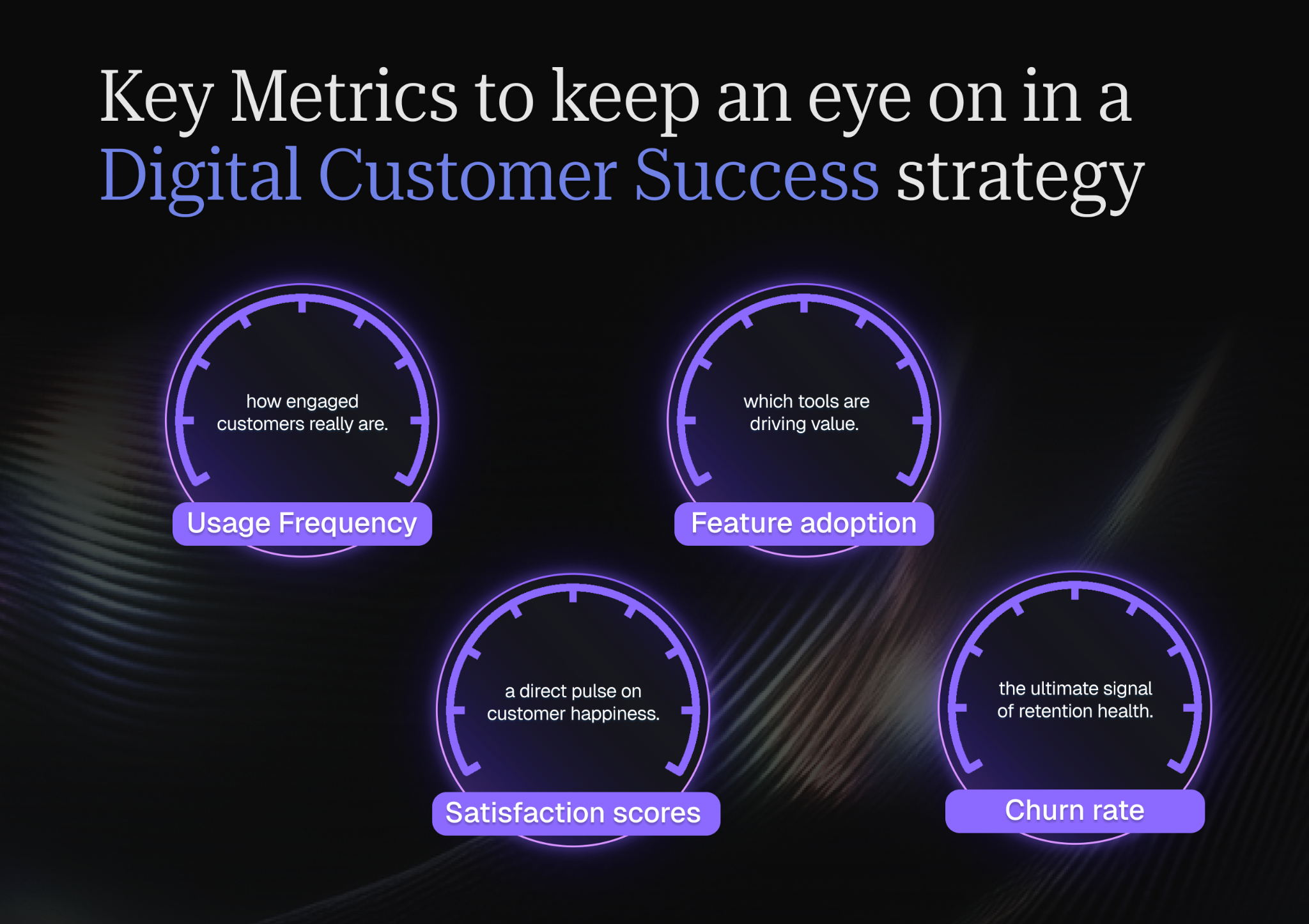
- Usage frequency which shows how engaged customers really are.
- Feature adoption that highlights which tools are driving value.
- Satisfaction scores, a direct pulse on customer happiness.
- Churn rate, the ultimate signal of retention health.
Advanced analytics go even further, predicting which customers might need extra support or are primed for upsell opportunities.
What tools support a digital customer success strategy
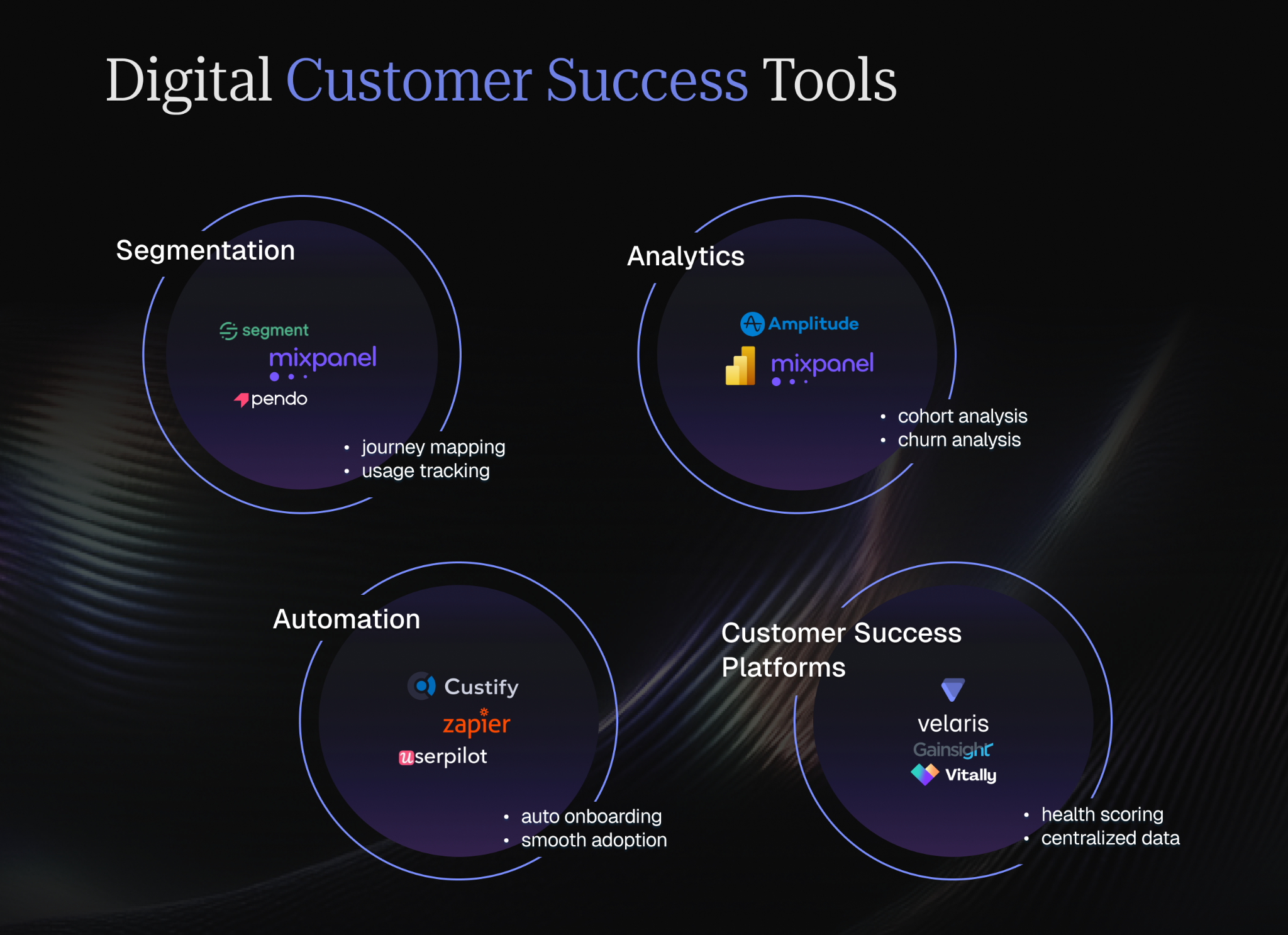
1. Customer segmentation tools
- Segment: Excellent for behavioral segmentation across apps, widely used in marketing, and adaptable for CS insights.
- Mixpanel: Provides detailed tracking of product usage funnels and customer journeys, offering valuable behavioral data.
- Pendo: Strong for in‑app behavior analysis and feedback segmentation, helping teams understand customer engagement patterns.
2. Automation tools
- Custify: Automates health monitoring and outreach, making it easier to stay proactive with customers.
- Userpilot: Specializes in automating in‑app onboarding flows, ensuring smooth customer adoption experiences.
- Zapier: Connects apps to automate tasks across systems, offering flexibility for a wide range of workflows.
3. Analytics
- Amplitude: Powerful for product analytics and retention cohorts, giving teams deep insights into customer behavior.
- Mixpanel: Provides strong funnel analysis and churn prediction, supporting data‑driven decision making..
- Tableau / Power BI: Robust business intelligence tools that can be tailored to deliver customer success insights.
4. Customer success platforms
Customer Success Platforms offer all the tools you need such as segmentation, automation, and analytics in one place so you don’t have to integrate multiple systems.
If you're weighing up which platform is the right fit for your team, our guide to the top customer success software tools compares the leading platforms across health scoring, automation depth, and ease of implementation.
Here’s the short version:
- Velaris: unifies segmentation, automation, and analytics in a single platform, tying every workflow directly to customer health and revenue. It delivers real‑time insights and flexible workflows that adapt to customer signals, making it both scalable and deeply personalized.
- ChurnZero: Strong for customer health tracking and automated playbooks, but less flexible in customization.
- Vitally: Focused on actionable insights and workflow automation, though narrower in scope.
- Custify: Offers automation and health monitoring features, but lacks the depth of analytics and integration.
- Gainsight: Enterprise grade with deep analytics, but complex to implement and often requires significant resources.
How to implement a digital customer success strategy
Simply put, it starts with smart planning. More tools don’t equal better success. True impact comes when everything works together and grows with your customers. Done right, it elevates experiences and drives retention. Here’s how to make it happen:
Define clear objectives
Start by deciding what the digital customer success strategy needs to improve. The goal might be reducing churn, improving onboarding completion, increasing product adoption, shortening time-to-value, or helping each CSM manage more accounts without lowering the quality of support.
Make each objective measurable. For example, instead of saying “improve onboarding,” set a target such as reducing average onboarding time by 20% or increasing milestone completion within the first 30 days.
Clear objectives make it easier to choose the right tools, workflows, and success metrics.
Select the right tools
Choose tools that match your customer success model, not just tools with the longest feature list.
A high-touch team may need strong account health views, success plans, and relationship intelligence. A digital-led team may need lifecycle automation, in-app engagement, self-service resources, and scalable alerting.
The tool should also connect with your existing systems. If customer data sits across your CRM, product analytics, support platform and communication tools, your digital CS platform needs to bring those signals together. Otherwise, automation will run on incomplete data.
Train your customer success team
A digital strategy only works if the team understands how to use it. CSMs need to know which workflows are automated, which signals they should monitor, and when they are expected to step in personally.
Training should focus on real customer scenarios, not just tool navigation. Show the team how to interpret health alerts and manage handoffs when automation surfaces risk or expansion signals.
Roll out in phases
Avoid launching every workflow at once. Start with a small number of high-impact use cases, such as onboarding nudges, renewal risk alerts, low-usage triggers, or automated customer education.
A phased rollout gives the team time to test what works before scaling. It also helps you catch issues early, such as incorrect lifecycle stages, duplicated outreach, weak data quality, or unclear workflow ownership.
Aligning cross-functional teams before rollout
Digital customer success depends on data and handoffs from multiple teams, so alignment needs to happen before an automation goes live.
Start by agreeing on a shared definition of customer stage. Sales, marketing, product, and CS should all understand what counts as onboarding, adoption, renewal, expansion, or risk. If each team uses different lifecycle labels, automation can trigger at the wrong time or send the wrong message.
A lightweight RACI can prevent this. Define who is responsible for each workflow, who approves changes, who needs to be consulted, and who simply needs to be informed. This keeps the rollout clear, reduces confusion, and helps teams trust the digital CS motion from the start.
Adapt for global mid-market accounts
Digital customer success gets harder when customers are spread across regions, time zones, and languages. A workflow that feels timely in one market may arrive overnight in another, while a message that works in English may feel too generic when translated.
Start by adapting outreach windows. For global mid-market accounts, this may mean creating region-based sending rules so customers in Europe, North America, and APAC receive communication at sensible times.
Language also matters. Translating copy is not enough if the message does not match local expectations around tone, formality, and response time. Build core templates centrally, then localise the wording for key markets where needed.
CS teams should also adjust cadence by region. Some markets may respond well to frequent digital nudges, while others may prefer fewer, more considered touchpoints. Track open rates, replies, meeting bookings, and opt-outs by region so the digital strategy reflects how customers actually engage.
For global accounts, localisation should be part of the tool setup. Look for systems that support time-zone rules, language variants, regional segmentation, and localised reporting. This keeps digital CS scalable while still making outreach feel relevant to each customer’s context.
Monitor and adapt
Once the strategy is live, track whether it is improving the outcomes you set at the beginning. Useful KPIs include time-to-value, product adoption, customer health movement, renewal readiness, response time, CSM capacity, and engagement quality.
Digital customer success should keep improving over time. Review the data regularly, gather feedback from CSMs, and adjust triggers, messages, segments, and workflows as customer behaviour changes.
By following these steps, organizations can ensure that their digital customer success strategy is effectively implemented and continuously optimized to meet evolving challenges and opportunities. At the core of this approach is a Customer Success plan. It standardizes actions, keeps teams aligned, and ensures consistency across every customer touchpoint.
Implementation is the starting point. It sets the foundation for customer success, but the real impact comes from continuous innovation, listening to feedback, and adapting strategies over time. By evolving beyond the initial rollout, companies keep their approach fresh and effective building stronger relationships and driving sustainable growth.
Limitations of a digital customer success strategy
A digital customer success strategy is powerful, but it does come with limitations. The biggest challenges include reduced human connection, heavy reliance on data accuracy, integration complexity, and the risk of over automation. While digital CS scales efficiently, it can’t fully replace the empathy and nuance of human led engagement.
- Loss of human touch
Automated workflows and dashboards are efficient, but customers may feel less valued if interactions lack personalization or empathy. Complex issues often still require human intervention to build trust and resolve problems effectively.
- Data dependency.
Digital CS relies on clean, reliable data to generate health scores and insights. If inputs are inaccurate or fragmented across systems, decisions can be misguided and customer experiences suffer.
- Integration hurdles.
Tools must connect seamlessly with CRMs, product platforms, and support systems. Poor integration leads to inefficiencies and inconsistent customer experiences.
- Risk of over-automation.
Too much reliance on automated playbooks can make engagement feel robotic. Customers may disengage if communication lacks personalization or fails to adapt to subtle signals of churn or dissatisfaction.
How to overcome limitations of digital customer success
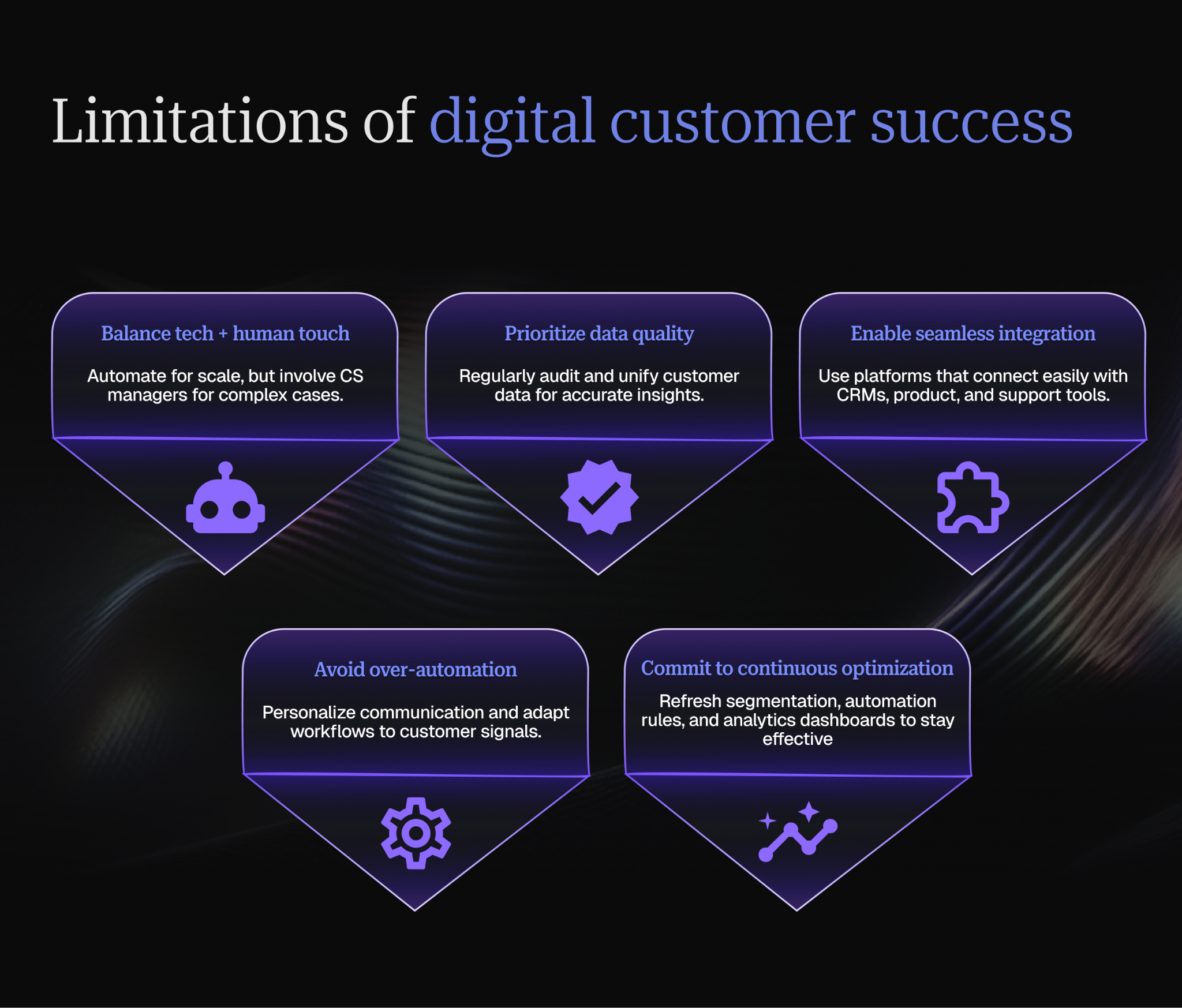
Digital customer success has its challenges, from data quality to over automation. The key is balancing technology with human touch, seamless integrations, and continuous optimization to keep strategies effective and scalable.The points below highlight practical ways to overcome these limitations and keep your strategy effective.
- Blend digital and human engagement : Use automation for scale, but keep human CS managers involved for complex or sensitive issues.
- Prioritize data quality : Audit and unify customer data regularly to ensure health scores and insights are accurate.
- Ensure seamless integration : Choose platforms that connect easily with CRMs, product systems, and support tools to eliminate isolation.
- Avoid over automation : Personalize communication, refine workflows continuously, and adapt playbooks to customer signals.
- Commit to ongoing optimization : Update segmentation models, automation rules, and analytics dashboards to keep pace with evolving customer needs.
Audit and retire outdated automation
Have you heard of digital debt? Automated touches that still run, but no longer reflect the customer’s current journey? Digital customer success workflows can become outdated over time.
Review automated playbooks and triggers on a fixed cadence, such as once a quarter. Check whether each workflow still has a clear purpose, accurate trigger logic, and a defined owner.
Look for signs that automation has gone stale. These include customers receiving irrelevant messages, duplicate outreach from different teams, workflows triggering from outdated data, or playbooks that CSMs regularly ignore. If an automation no longer leads to useful action, update it or retire it.
A decision checklist for when to keep a workflow human-led
Not every digital customer success workflow should be automated. Some moments need judgement, context, and relationship awareness that automation cannot reliably provide on its own.
Use a simple checklist before deciding whether a workflow should stay human-led:
- High deal size: Is the account high-ARR, strategic, or important to the business?
- Renewal risk: Is the account close to renewal, showing declining health, or already flagged as at risk?
- Expansion potential: Could the next interaction influence an upsell, cross-sell, or executive conversation?
- Sensitive context: Is there an open escalation, unresolved complaint, pricing discussion, or recent negative sentiment?
- Complex stakeholder dynamics: Are multiple decision-makers involved, or has the champion changed recently?
- Low data confidence: Is the automation based on incomplete, outdated, or unclear account data?
- Relationship impact: Would the customer expect a human response at this moment?
If the answer is yes to several of these questions, keep the workflow human-led or require CSM review before the message goes out. Automation can still support the process by gathering account context, drafting a response, or creating a task, but the final judgement should sit with the CSM.
This turns “balance automation with human touch” into a practical operating rule. Routine education, reminders, and low-risk nudges can be automated. Strategic, sensitive, or revenue-impacting moments should stay human-led.
Conclusion
The real win in customer success comes when companies exceed the expectations. Digital strategies like effective customer trends, analytics, and automation make that possible, while staying on top of Saas trends, keeps everything fresh and future-ready. And platforms like Velaris, which is highly rated on G2, amplify the impact by cutting the busywork and boosting efficiency.
As digital transformation gets more complex, weaving these approaches together is essential. With the right tools and mindset, CS teams can stay proactive, deliver personalized experiences, and make confident, data-driven decisions. In the end, embracing change and leveraging technology is what turns customer success into a true competitive advantage.
Book a demo today to see how Velaris transforms your customer success efforts into a significant competitive advantage.
Frequently Asked Questions
What industries benefit most from digital customer success strategies?
SaaS, subscription services, and industries with large customer bases benefit most because digital CS scales efficiently.
What metrics should be tracked to measure the success of a digital CS strategy?
Key metrics include customer health scores, churn rate, product adoption, net promoter score (NPS), and expansion revenue.
How does AI enhance digital customer success beyond basic automation?
AI provides predictive insights, personalized recommendations, and proactive alerts that go beyond rule-based workflows.
What role does customer feedback play in shaping digital success strategies?
Customer feedback adds context to data, helping refine segmentation, improve workflows, and align automation with real needs.
How do digital customer success platforms support upselling and cross-selling opportunities?
By tracking product usage and customer health, platforms identify expansion opportunities and trigger timely outreach.
What tools do I need for a digital customer strategy?
You need customer segmentation, automation, and analytics tools to manage relationships at scale. A customer success platform like Velaris combines all of these in one place, making it easier to unify data, workflows, and insights without juggling multiple systems.

The Velaris Team
A (our) team with years of experience in Customer Success have come together to redefine CS with Velaris. One platform, limitless Success.




Velaris is an AI-native Customer Success Platform built for mid-market and enterprise B2B SaaS teams. From customer health scoring and churn prediction to onboarding automation, renewals, and expansion workflows, Velaris helps recurring revenue teams understand account health, reduce churn, and scale customer success with greater visibility and control.