We look forward to showing you Velaris, but first we'd like to know a little bit about you.


Team Productivity: Best Practices for Customer Success Managers
Learn how to increase team productivity with actionable tips like automation, task management, and gathering regular customer feedback.
The Velaris Team
February 19, 2025
Team productivity in Customer Success is about designing workflows, systems, and habits that help the CS team deliver consistent customer outcomes without burning out. There have probably been times where you ever felt like your team is working harder than ever, but you're still falling short of meeting customer needs.
This guide is precisely for when you’re knee-deep in onboarding, renewals, and growing account volumes, with little of your hard work aligning with impacts. By focusing on smarter workflows, clear communication, and the right tools, you can minimize inefficiencies and deliver better outcomes for both your team and your customers.
In this blog, we’ll explore practical strategies for improving team productivity in Customer Success, with tips that can make a real difference in your day-to-day operations. Let’s dive in.
Key Takeaways
- Team productivity should be measured through metrics like adoption, renewal rate, and customer progress, not how busy the team is.
- Productivity breaks down when work becomes reactive and fragmented due to context switching, inconsistent processes, and siloed tools.
- Standardised playbooks and automated tasks reduce manual effort and dependency on individual knowledge.
- Visibility through real-time dashboards, shared goals, and clear ownership help teams spot bottlenecks early.
- Long-term performance improves when efficiency is balanced with realistic workloads and healthy work practices.
Why does productivity break down in Customer Success teams?
Customer Success productivity rarely breaks because teams aren’t working hard enough. It breaks when day-to-day work becomes reactive, fragmented, and difficult to prioritise.
Too much reactive work and constant context switching
Many CSMs spend their day responding to emails, chasing updates, and reacting to last-minute issues. Constant context switching between accounts, tools, and tasks makes it difficult to focus on strategic work and increases the risk of missing early warning signs. Over time, this rhythm turns hinders making positive progress, since the team is too busy putting out fires.
Inconsistent processes across onboarding, renewals, and support
When core workflows aren’t standardised, the same task gets handled differently by different team members. This inconsistency slows execution and creates confusion for both teams and customers.
Onboarding, renewals, and escalations becoming dependent on individual knowledge leads to uneven customer experiences and internal inefficiencies.
Fragmented tools and communication silos
Productivity suffers when customer information sits across disconnected systems. Notes in one tool, tasks in another, and conversations spread across email and chat force CSMs to piece together context manually. This fragmentation wastes time and makes collaboration across teams harder than it needs to be.
Burnout from growing account volumes and unclear priorities
As customer bases grow, CSMs are often asked to manage more accounts without clearer prioritisation. When you don’t have visibility into what matters most, teams default to treating everything as urgent. And so burnout becomes the obvious result, alongside missed opportunities and a sense of always being behind, even when the team is putting in maximum effort.
What best practices improve Customer Success Team productivity?
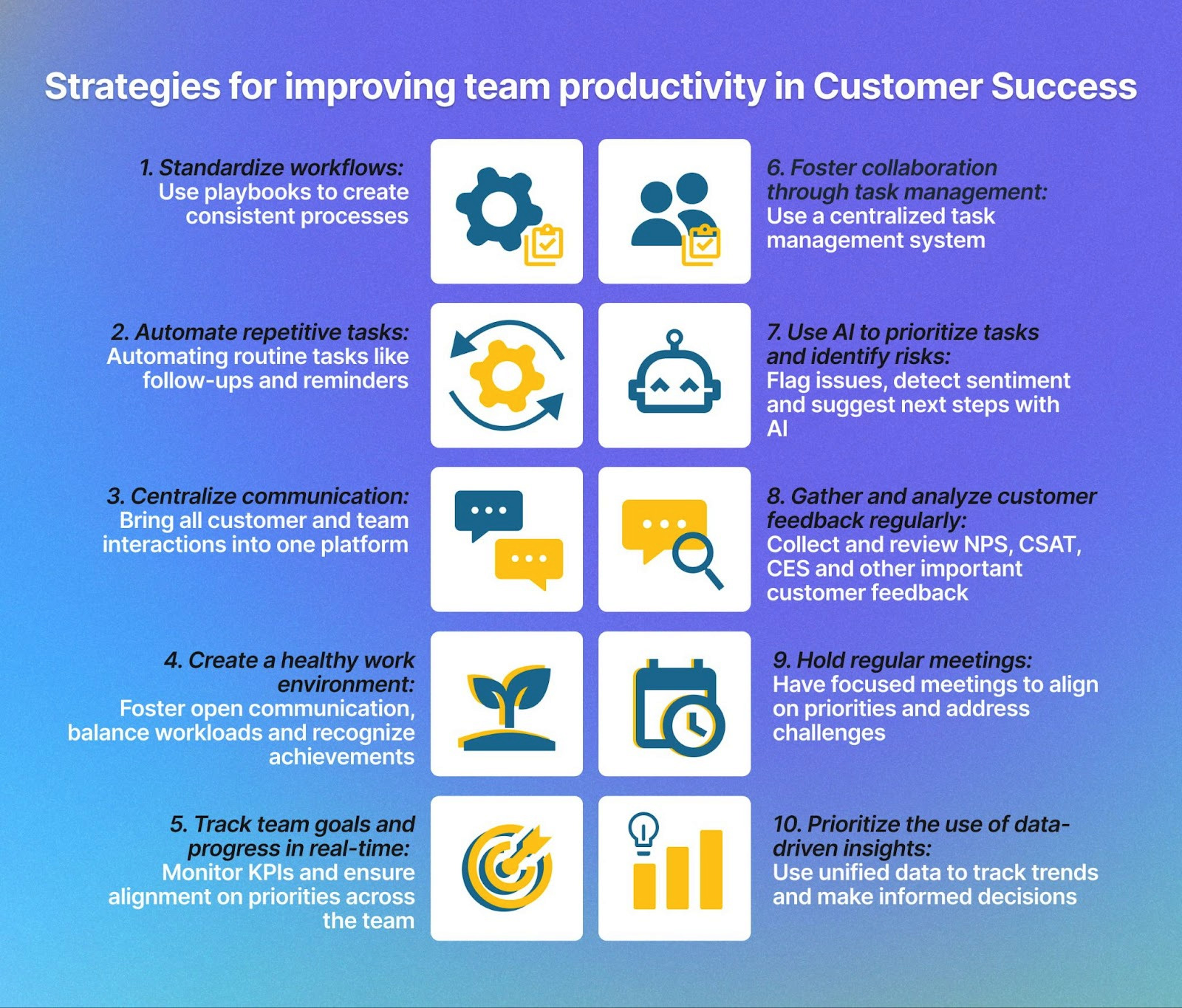
1. Standardize workflows
Inconsistent workflows often lead to confusion, delays, and errors. Without clear guidelines, team members might handle the same task differently, creating inefficiencies and increasing the likelihood of miscommunication.
Standardizing workflows ensures that tasks are completed consistently, no matter who is handling them, and reduces dependency on individual knowledge.
Playbooks can provide a framework for standardization by documenting step-by-step instructions for key processes such as customer onboarding, issue escalation, and account renewals.
They also make it easier to onboard new team members, ensuring everyone is aligned on best practices from day one.
A tool like Velaris, which is highly rated on G2, allows you to create Customer Success playbooks that include in-built checklists and progress tracking. These playbooks standardize processes, ensuring alignment across your team and helping everyone stay on track.
2. Automate repetitive tasks
Repetitive tasks like sending follow-up emails, scheduling meetings, or creating reminders can consume significant time and energy, preventing your team from focusing on more impactful work.
These tasks, while essential, don’t require manual intervention and are ideal candidates for automation. Automation not only reduces workload but also ensures accuracy and timeliness.
For example, follow-ups can be automatically sent at specified intervals, and recurring tasks can be scheduled without human input. This creates more bandwidth for team members to focus on activities that directly impact customer satisfaction and retention.
3. Centralize communication
When communication happens across multiple disconnected tools, it’s easy for important information to fall through the cracks. Fragmented communication can lead to duplicated effort, misaligned priorities, and delayed responses to customer needs.
Centralizing communication on a single platform ensures that your team has access to all necessary information in one place. This not only improves transparency but also enables faster decision-making and better collaboration.
With centralized communication, your team can work more cohesively and deliver better outcomes for customers.
Velaris consolidates customer and team communication into one platform. By providing a unified space for updates, notes, and interactions, Velaris helps your team stay aligned and respond quickly to customer needs.
4. Track team goals and progress in real-time
Without clear visibility into progress, it’s difficult for teams to identify bottlenecks or gauge their performance against goals. Misaligned efforts can lead to missed deadlines and reduced productivity.
Real-time tracking ensures that everyone knows where they stand and what adjustments are needed to stay on course.
Dashboards displaying KPIs like customer health scores, task completion rates, and renewal metrics give teams actionable insights. These insights empower managers and team members to collaborate effectively and prioritize activities that drive results.
5. Foster collaboration through task management
When task ownership is unclear, accountability suffers, and projects can stall. Misaligned efforts often lead to wasted time and duplicated work, especially in fast-paced Customer Success teams.
A centralized task management system ensures that every team member knows their responsibilities and deadlines. Effective task management improves collaboration by clarifying how individual contributions fit into larger team objectives.
A team that coordinates well together has been proven in studies to be more productive and create more profit for businesses. Therefore, it should be a priority to have a clear organizational system to reduce miscommunication and ensure that projects move forward smoothly.
6. Use AI to prioritize tasks and identify risks
Manually reviewing customer communications to prioritize tasks or flag risks can be overwhelming, especially for teams managing large volumes of interactions.
AI tools can analyze data, detect sentiment, and highlight potential issues, helping teams act proactively.
For instance, AI can identify at-risk accounts based on negative sentiment in emails or flag urgent issues based on customer behavior patterns. By leveraging AI, your team can focus their energy on addressing critical concerns and delivering exceptional customer experiences.
Velaris AI analyzes emails, tickets, and other communications to identify risks, suggest next steps, and prioritize tasks. This ensures that your team’s efforts are focused on what matters most.
7. Gather and analyze customer feedback regularly
Customer feedback offers invaluable insights into team performance and customer satisfaction. However, collecting and analyzing feedback can be resource-intensive without the right tools.
Using surveys like NPS, CSAT, and CES provides actionable data that helps your team address customer concerns proactively and improve their workflows.
Beyond individual scores, analyzing feedback trends over time can help your team identify recurring pain points or common areas of praise. For example, if multiple customers highlight delays in response times, you can use this information to optimize workflows or reallocate resources within the team.
It’s also important to integrate feedback analysis into your team’s regular processes. Conduct monthly or quarterly reviews to share insights from customer feedback and discuss actionable changes.
8. Hold regular meetings to align and improve team productivity
Regular meetings are an essential part of maintaining alignment, fostering collaboration, and driving team productivity.
While the idea of meetings often brings up concerns about wasted time, when structured effectively, they can provide clarity, improve communication, and empower your team to achieve their goals.
One of the main benefits of regular meetings is ensuring everyone is aligned on priorities. Weekly or bi-weekly team check-ins allow you to review progress, discuss upcoming tasks, and address any challenges.
To maximize the effectiveness of meetings, keep them focused and goal-oriented. Use an agenda to guide the discussion and make sure every attendee understands the purpose of the meeting.
Avoid meetings that could be replaced by a quick update or email and instead focus on discussions that require collaboration, brainstorming, or decision-making.
9. Prioritize the use of data-driven insights
Assumptions about productivity can lead to inefficiencies, misaligned priorities, and wasted resources. Data-backed insights provide a clear picture of your team’s performance, enabling more informed decisions.
Integrating data from tools across sales, marketing, support, and product teams creates a unified view of productivity metrics. Siloed data often results in fragmented insights, limiting your ability to see the bigger picture. By unifying data across functions, you can better understand how cross-departmental efforts impact Customer Success and overall productivity.
For instance, you might discover that delayed communication from the sales team is affecting the onboarding process, giving you the opportunity to address the issue collaboratively.
Velaris unifies data from multiple tools, providing a single source of truth for analyzing team productivity. With this information, you can confidently make decisions that improve performance and ensure alignment across teams.
10. Create a healthy work environment
A team’s productivity is heavily influenced by the work environment. A healthy work environment goes beyond physical space; it encompasses team dynamics, communication norms, and overall morale.
When employees feel supported, respected, and valued, they are more motivated to contribute effectively. On the other hand, a stressful or disorganized environment can lead to burnout, disengagement, and high turnover rates, all of which negatively impact productivity.
To create a healthy work environment, start by fostering open communication. Encourage team members to share ideas, provide feedback, and voice concerns without fear of judgment. Regular check-ins can help identify and address any challenges early.
Additionally, promote a culture of recognition by celebrating team and individual achievements. This not only boosts morale but also reinforces positive behaviors.
Another crucial aspect is ensuring work-life balance. Overburdened teams are unlikely to perform at their best. Be mindful of workloads, and encourage the team to take breaks, use vacation time, and disconnect after work hours.
By focusing on creating a supportive and balanced work environment, you can enhance team morale and productivity while reducing burnout.
How should Customer Success productivity be measured?
Measuring productivity in Customer Success requires precise tracking, and how busy a team is can’t be a benchmark. True productivity reflects whether the effort invested is driving customer and business outcomes.
The most effective CS teams measure progress using a mix of outcome-based indicators, real-time visibility, and customer health signals that connect day-to-day work to long-term success.
Activity vs outcome-based productivity
Activity metrics like number of emails sent or meetings held show effort, but they don’t always correspond with impact. Outcome-based productivity focuses on results, such as onboarding completion, product adoption, renewal readiness, and expansion progress.
Shifting measurement toward outcomes helps teams prioritise work that actually moves customers forward rather than optimising for volume.
Tracking progress with real-time dashboards
Without visibility, productivity issues often surface too late. Real-time dashboards give teams a shared view of progress across accounts, tasks, and goals. By tracking key indicators like task completion, overdue work, and customer milestones in one place, teams can spot bottlenecks early and adjust workloads before problems escalate.
Using customer health and renewal readiness as productivity signals
Customer health scores and renewal readiness are powerful indicators of whether CS work is effective. Improving health, stable engagement, and clear renewal signals suggest that team effort is well-directed. Declining health or late-stage renewal risk often indicates misaligned priorities, gaps in execution, or the need for earlier intervention.
What limits productivity improvements in Customer Success?
Many Customer Success teams struggle to see gains because of trade-offs and limitations that undermine otherwise good intentions. Understanding these constraints helps teams avoid common pitfalls and build more long-lasting productivity improvements.
Over-automation without clear process design
Automation can save time, but only when it supports a well-defined process. Automating unclear or broken workflows often creates more annoyance than value, triggering unnecessary alerts, tasks, or messages. There needs to be clear ownership and intent behind each workflow for automations to actually pay off.
Poor data quality and tool adoption gaps
Productivity depends on reliable data. Incomplete integrations, outdated records, or inconsistent data inputs make it difficult to trust dashboards, health scores, or task priorities. When teams don’t fully adopt the tools meant to support them, they revert to spreadsheets, emails, and manual work, limiting the impact of any productivity initiative.
Consider investing more in reliable tools and data sources, since the productivity boost it will lead to will quickly make the investment worth it.
Productivity at the cost of team wellbeing
Short-term efficiency gains can backfire when they push teams beyond sustainable limits. Measuring productivity purely by output encourages overloading CSMs, constant availability, and reduced focus time. Over time, this leads to burnout, disengagement, and turnover.
Besides the obvious harm to your team’s health, research from the University of Oxford suggests that a slight increase in employee happiness scores could lead to a $1.39 billion to $2.29 billion increase in annual profits.
So to keep your team both safe and productive, always balance efficiency with realistic workloads and team wellbeing.
Conclusion
Work smarter, and not harder to achieve true team productivity. By streamlining workflows, automating repetitive tasks, fostering collaboration, and creating a healthy work environment, you can empower your team to stay focused, aligned, and effective.
Productivity strategies like these not only make day-to-day operations smoother but also contribute to delivering better outcomes for your customers.
The right tools can make a big difference in implementing these strategies. Velaris, a highly rated platform on G2, is designed to simplify processes, enhance communication, and provide actionable insights, all of which help Customer Success teams perform at their best.
Book a demo today and explore how Velaris can help your team save time, stay organized, and achieve more.
Frequently Asked Questions
How does Customer Success productivity differ from productivity in other teams?
Customer Success productivity is constrained by customer timelines, external dependencies, and unpredictable inputs like support issues or stakeholder changes. Unlike internal teams, CS productivity depends on coordinating across functions and adapting work based on customer signals, in addition to internal output.
Is there a point where adding more CSMs stops improving productivity?
Yes. Adding headcount without improving processes, prioritisation, or visibility often increases coordination overhead. At scale, productivity gains usually come from better systems and decision signals, not more people.
How do you balance productivity with customer personalization?
Productivity improves when teams standardise how work is done while personalising what is delivered. Clear frameworks allow CSMs to spend less time deciding what to do next and more time tailoring conversations to customer goals.
What role should managers play in improving team productivity?
Managers influence productivity most through prioritisation and workload design, rather than task-level oversight. Clear expectations, realistic account distribution, and removing blockers often have more impact than monitoring activity.
When should Customer Success teams revisit their productivity approach?
Any major shift in customer mix, pricing model, product complexity, or team structure is a signal to reassess productivity. What worked for a smaller or simpler CS motion often breaks as the business scales.

The Velaris Team
A (our) team with years of experience in Customer Success have come together to redefine CS with Velaris. One platform, limitless Success.




Velaris is an AI-native Customer Success Platform built for mid-market and enterprise B2B SaaS teams. From customer health scoring and churn prediction to onboarding automation, renewals, and expansion workflows, Velaris helps recurring revenue teams understand account health, reduce churn, and scale customer success with greater visibility and control.