We look forward to showing you Velaris, but first we'd like to know a little bit about you.


Enhancing Customer Service with AI: A Guide for CSMs
Explore how AI enhances customer service for better satisfaction.
The Velaris Team
July 22, 2026
AI helps teams handle growing support volumes without sacrificing quality by automating routine interactions, surfacing customer sentiment, and prioritizing the work that needs human attention.
Handling a growing volume of customer interactions can often push Customer Success Managers (CSMs) to their limits. Customers expect fast, helpful responses, and it's a lot to deliver without letting quality slip.
Fortunately, AI is already transforming how support teams work, with tools like conversational AI, analytics, and predictive modeling. Gartner predicts these technologies could automate up to one in ten customer interactions by 2026.
In this blog, we’ll dive into how AI can improve your support strategy, make the workload easier to handle, and help your team deliver the experiences customers expect.
Key takeaways
- AI helps customer service teams handle higher volumes without sacrificing response quality.
- Automating routine tasks frees CSMs to focus on complex, high-impact customer interactions.
- AI-powered platforms like Velaris help teams turn customer interactions into clear signals by analysing conversations and surfacing trends in customer data.
- AI delivers the most value when introduced gradually, with clear ownership and human oversight.
- AI should not replace human judgement in sensitive, strategic, or relationship-driven situations.
- The biggest gains come when AI insights are embedded into daily workflows, instead of being in isolation.
How AI can be used in customer service
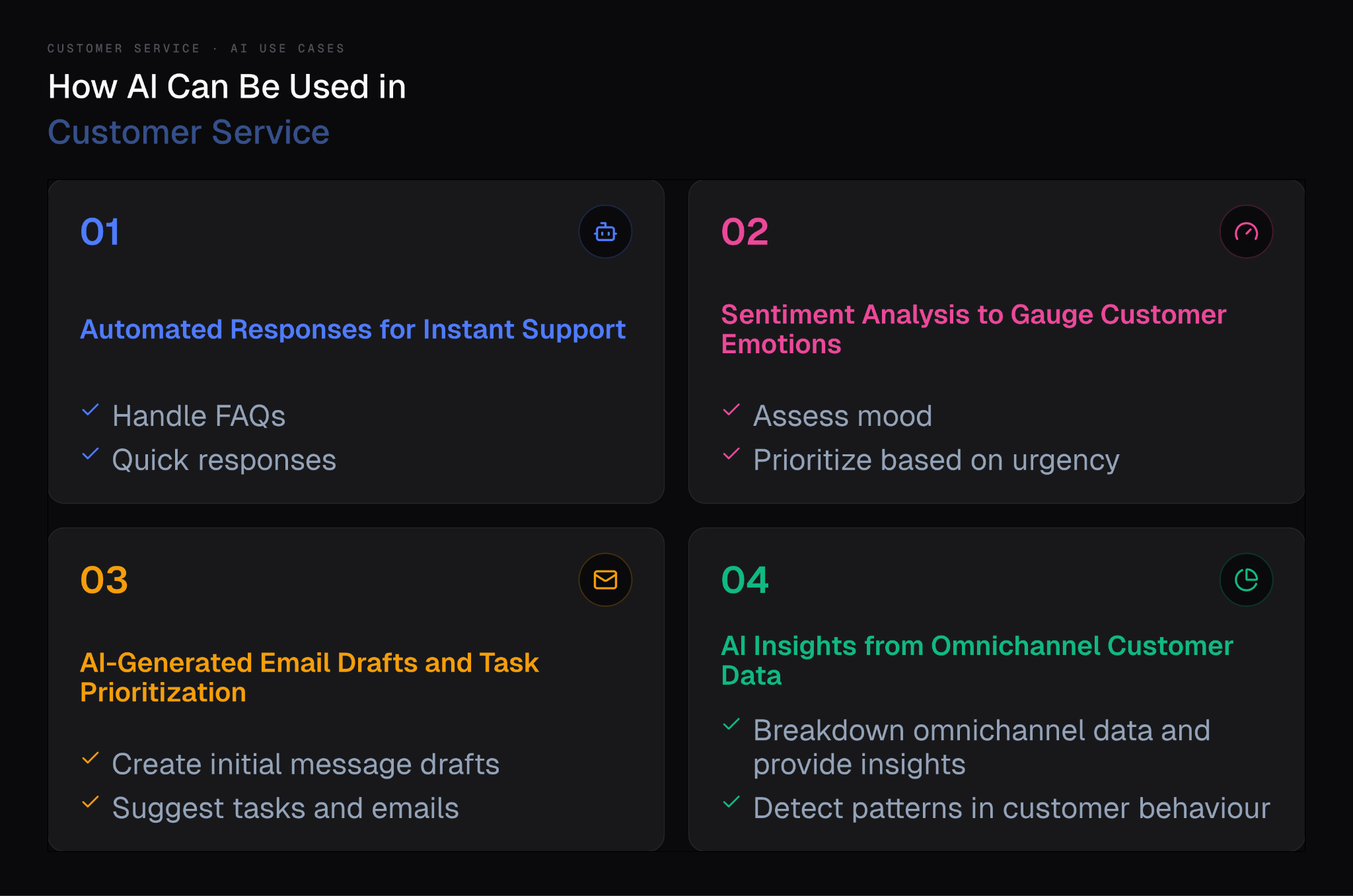
By automating repetitive tasks and enhancing communication, AI technologies allow Customer Success Managers (CSMs) to focus on building relationships and solving complex issues. Here are three specific ways AI can support your customer service efforts.
Automated responses for instant support
AI-powered automation, including chatbots and pre-set workflows, provides quick responses to common questions. This efficiency helps CSMs focus on more complex issues. For instance, automated replies can handle FAQs and repetitive queries, offering 24/7 support that ensures customers don’t have to wait for human assistance. This significantly improves response times and customer satisfaction.
Sentiment analysis to gauge customer emotions
Understanding customer emotions is crucial in delivering effective support. Sentiment analysis uses AI to assess customer mood and urgency by analyzing language and tone in messages. This capability helps CSMs prioritize empathetic responses, ensuring that they address customer concerns appropriately.
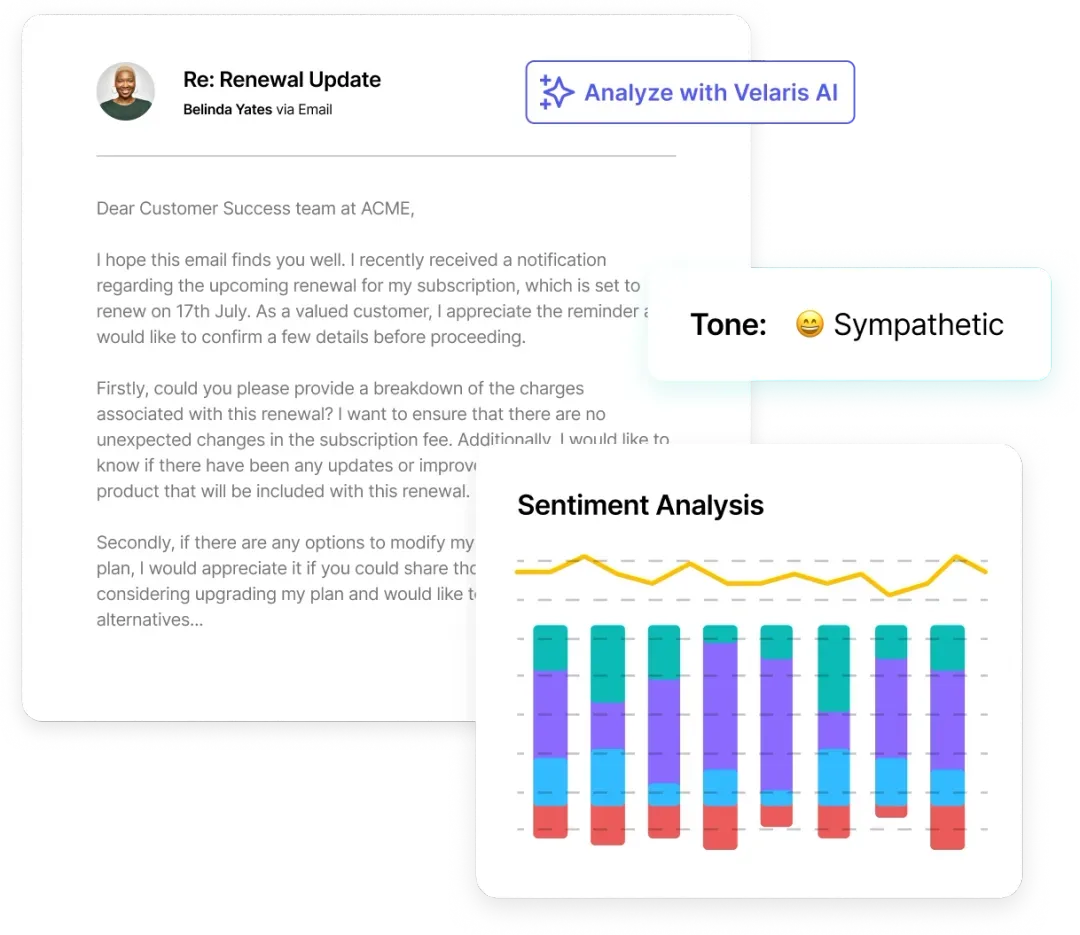
AI-driven sentiment insights can identify frustrated or satisfied customers, guiding CSMs in tailoring their interactions. Velaris, a highly rated platform on G2, has sentiment analysis features that can flag messages based on sentiment, allowing CSMs to adjust their approach according to the customer’s emotional state.
In addition to written communication, Velaris’s CallSense feature analyses customer calls and meetings to detect sentiment, risk signals, and opportunity cues. This ensures that critical signals aren’t lost in long call recordings or meeting notes, especially when customers raise concerns verbally rather than in writing.
AI-generated email drafts and task prioritization
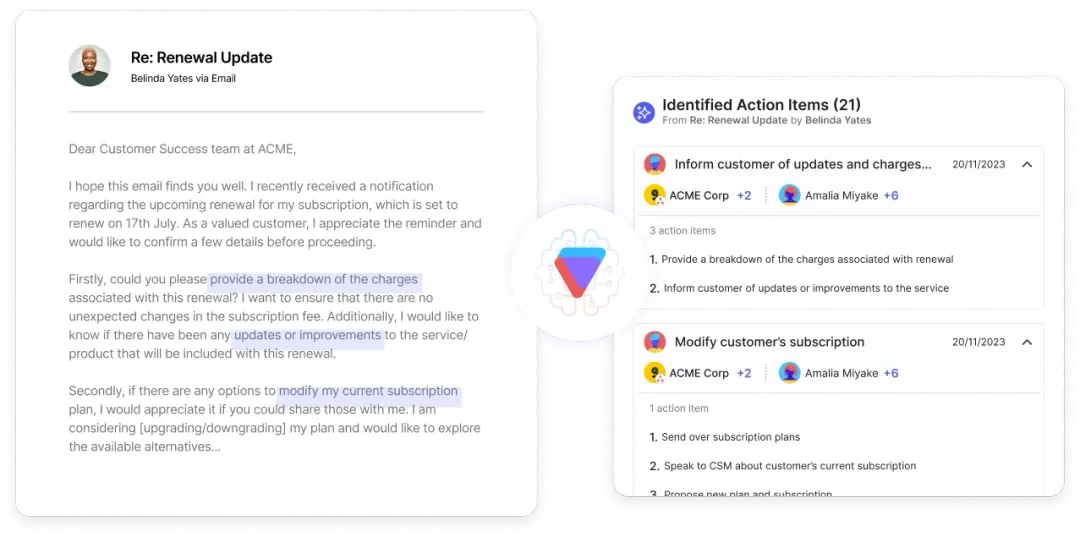
Time management is critical for CSMs, and AI can play a significant role in streamlining this process. AI tools can suggest next steps and create initial drafts for responses, saving time and ensuring effective communication.
Moreover, AI can prioritize tasks, helping CSMs stay on top of critical cases and address issues promptly. For instance, Velaris’s AI copilot analyzes previous customer interactions like call transcripts, emails, support tickets and suggests follow-up tasks or email drafts. This functionality enables CSMs to respond quickly while maintaining productivity.
AI insights from omnichannel customer data
AI has the capability to analyze data from multiple sources, such as emails, social media, and CRM platforms, to detect patterns in customer behavior. By harnessing these insights, organizations can proactively adjust product information and support resources to address recurring concerns.
Velaris’s AI Copilot takes this a step further by allowing teams to ask direct questions about their customer data in plain language. CSMs can ask questions like “Which customers have shown negative sentiment in the last 30 days?” or “What issues are coming up most often in support tickets this quarter?” and get instant, contextual answers.
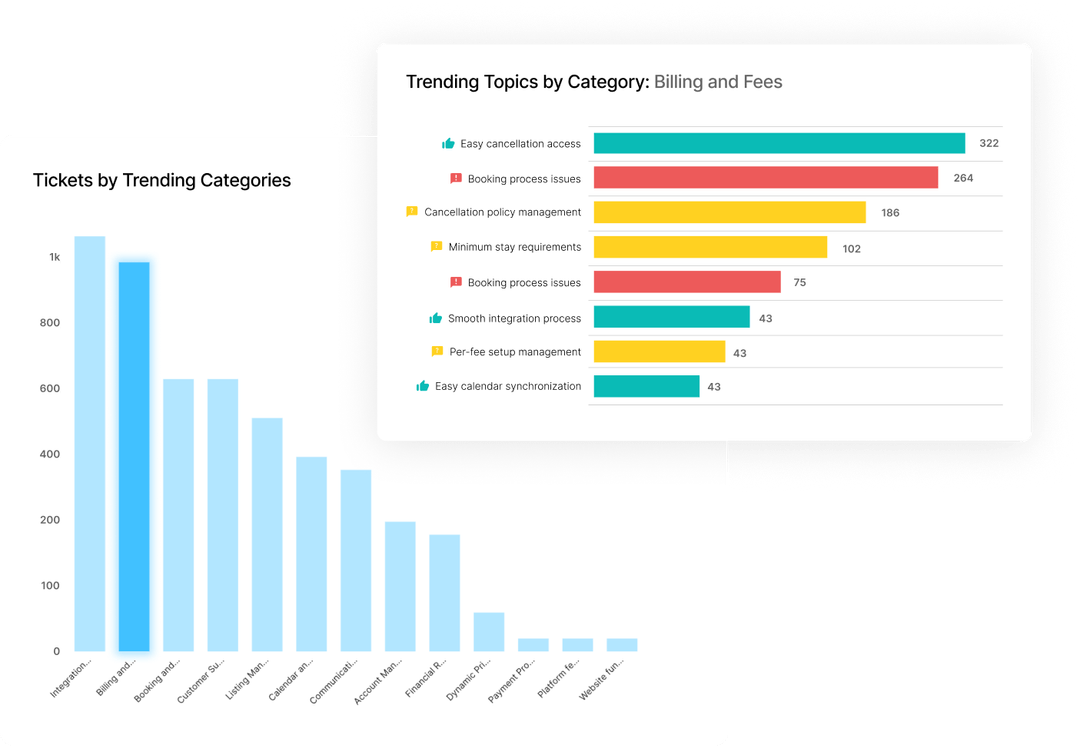
Another feature Velaris has is Trending Topics, which makes it easy to break down customer support tickets and communications from diverse sources using categorization and filters. This data-driven approach enables businesses to make informed decisions, enhancing their ability to meet customer needs effectively and improving overall service quality
These AI-driven solutions not only enhance efficiency but also enable CSMs to provide a more personalized and responsive customer experience. In the following section, we will explore the benefits of using AI in customer service, highlighting how these tools can enhance efficiency and improve overall customer satisfaction.
What are the benefits of using AI in customer service?
AI helps Customer Success teams manage higher volumes of customer interactions while maintaining speed, quality, and consistency. By automating routine work and surfacing real-time insights, AI enables CSMs to focus on meaningful customer conversations instead of manual effort.
Faster response times without sacrificing quality
AI can instantly handle common questions and repetitive requests, reducing wait times for customers. Customers tend to appreciate fast responses; IBM reports that mature adopters of AI in customer service achieved 17% higher customer satisfaction and 38% lower inbound call-handling times.
Additionally, faster responses allow human agents to focus on complex or sensitive issues that require judgement and context.
Better personalization at scale
By analysing customer history, behaviour, and sentiment, AI helps tailor interactions to individual customers. This allows teams to deliver more relevant, timely responses that feel personal, even as account volumes grow.
Early risk detection through sentiment and behaviour signals
AI analyses customer sentiment and behavioural patterns to surface early signs of risk. This helps teams understand how customers feel, not just what they say, and intervene sooner with more informed, empathetic outreach before issues escalate.
Embracing these benefits enhances your team’s efficiency and positions your organization as a forward-thinking leader in customer service. In the following section, we will explore best practices for effectively integrating AI into your Customer Success strategy.
Best practices for integrating AI into your Customer Success strategy
Integrating AI into your Customer Success strategy can streamline operations and enhance customer interactions. However, a thoughtful approach is essential for maximizing its benefits without overwhelming your team. Here are five best practices to consider when implementing AI solutions.
Start small and scale gradually
It’s wise to begin with one or two AI tools rather than attempting a full-scale implementation all at once. Starting small allows your team to acclimate to new technologies without feeling overwhelmed.
Prioritise work that happens frequently and follows a repeatable process. Start with low-risk tasks where the outcome can be measured clearly, such as conversation summaries or ticket routing. Delay sensitive customer-facing automation until the team has proved its accuracy and established suitable controls.
Train your team to use AI effectively
Investing in training for CSMs is crucial for maximizing the impact of AI. By understanding the capabilities of AI tools, CSMs can use them more effectively, leading to improved performance.
Prepare your data and knowledge foundation
AI outputs depend on the information available to the system. Before rollout, remove outdated guidance from your knowledge base and resolve conflicting information. Customer records should also be accurate enough to support the intended workflow.
Connect the systems AI needs to understand the customer. Where information conflicts, define which system should be treated as the source of truth.
Review and refine AI processes regularly
To ensure that AI tools remain effective, conduct periodic reviews to assess their performance. Analyzing AI-driven results provides valuable insights that help you make necessary adjustments.
Encourage collaboration between AI and human agents
AI should complement, not replace, human interaction. Encourage collaboration between AI systems and your Customer Success team to create a seamless customer experience.
Define when AI should escalate an interaction. Escalation may be necessary when confidence is low or the customer repeats the same question. Clear frustration should also trigger human involvement. Strategic accounts may require an earlier threshold.
The human should receive the full conversation history and a clear summary of what has already been attempted. This prevents customers from having to explain the issue again.
Address data privacy and compliance
Review how each AI tool handles customer data before connecting it to your workflows. Pay particular attention to personally identifiable information and conversation logs. Confirm where data is stored, how long it is retained, and whether it may be used to train external models.
Trust remains a significant barrier. Salesforce found that only 42% of customers trusted businesses to use AI ethically, down from 58% in 2023. Be transparent when customers are interacting with AI and give them a clear way to reach a human when needed.
Your use of AI should also comply with relevant regulations, including GDPR, CCPA, and the EU AI Act.
Gather customer feedback on AI interactions
Soliciting feedback from customers regarding their interactions with AI tools can provide valuable insights. Use this feedback to refine AI processes, ensuring that they evolve based on real customer experiences.
By following these best practices, your organization can create a robust AI integration that enhances customer support and overall satisfaction.
What customer service tasks should not be automated with AI?
Customer service tasks that involve trust, emotional judgement, or high business impact should not be automated with AI. AI can meaningfully improve speed, scale, and consistency in customer service. But the guiding principle is simple: AI should inform decisions, not make them on behalf of the team.
Here are some responsibilities that should always remain human-led:
High-stakes customer conversations
Renewals, pricing discussions, escalations, and churn-risk conversations should never be fully automated. These interactions involve trust, negotiation, and long-term relationship impact. While AI can flag risk or suggest talking points, a human must own the conversation.
Sensitive or emotionally charged interactions
When customers express frustration, disappointment, or urgency, empathy and situational judgement matter more than efficiency. AI can surface sentiment signals, but responding appropriately requires emotional intelligence and context that only a human can reliably provide.
Strategic decisions and trade-offs
AI is effective at highlighting patterns and surfacing insights, but it should not decide priorities, exceptions, or roadmap implications. Decisions that affect revenue, product direction, or customer commitments require accountability and business context beyond automation.
Customer-facing outputs without human review
AI-generated emails, summaries, or recommendations should not be sent directly to customers without validation. Treat AI outputs as drafts or inputs, not final answers. Human review protects accuracy, tone, and trust.
Used well, AI improves awareness, prioritization, and preparation. But ownership of judgement, relationships, and accountability should always stay with Customer Success and support teams.
How to measure AI's impact on customer service
AI should be measured by the outcomes it improves, not by the number of conversations it handles. A chatbot may reduce ticket volume, for example, but that result means little if customers receive incomplete answers or need to contact support again.
The strongest measurement approach combines operational service metrics with customer success outcomes. This shows whether AI is making support more efficient while also helping customers reach value and reducing risk.
Establish a baseline before rollout
Record current performance before introducing AI. Without a baseline, it is difficult to prove whether response times, resolution quality, or customer satisfaction have improved.
Measure the same channels and issue types over a consistent period. Account for seasonal changes or major product releases that could distort the comparison. You can then compare performance before and after rollout or test AI-assisted service against a control group.
Set targets before launch as well. This prevents teams from selecting whichever metric looks most positive after the implementation.
Deflection and containment rate
Deflection rate measures how many customer enquiries are prevented from becoming human-managed support cases. This may happen because an AI assistant provides the answer through chat, self-service content, or in-product guidance.
Deflection rate = AI-resolved enquiries ÷ total eligible enquiries × 100
Containment rate is more specific. It measures how many conversations started with AI were completed without being transferred to a human.
Containment rate = AI conversations resolved without transfer ÷ total AI conversations × 100
These metrics should be reviewed alongside repeat contact and CSAT. A high containment rate is not useful if customers leave without receiving a satisfactory answer.
First-contact resolution
First-contact resolution, or FCR, measures the percentage of issues solved during the first interaction. The customer should not need to reopen the case or contact the company through another channel.
FCR = Issues resolved on first contact ÷ total resolved issues × 100
AI can improve FCR by giving agents faster access to customer history and relevant knowledge. It can also suggest the next best action during the conversation. Track repeat contact within a defined period so cases are not incorrectly counted as resolved.
Average handle time
Average handle time, or AHT, measures how long an agent spends managing an interaction. This may include the conversation itself and any follow-up work completed afterwards.
AI can reduce AHT by summarising account history, drafting replies, or automatically updating records. However, lower handle time should not be treated as the goal on its own. Complex customers may require longer conversations to reach a useful outcome.
Compare AHT by issue type rather than relying only on a company-wide average. This helps show where AI is genuinely removing repetitive work.
Resolution time
Resolution time measures the total period between the customer raising an issue and the issue being fully resolved. Unlike AHT, it includes waiting time between interactions.
AI may improve this metric by routing cases more accurately or identifying relevant information earlier. It can also automate simple actions that would otherwise wait in an agent queue.
Track both the average and median resolution time. Averages can be distorted by a small number of unusually long cases.
Customer satisfaction
CSAT measures how satisfied customers are with a specific service interaction. It provides an important quality check against efficiency metrics.
Compare CSAT across AI-only, AI-assisted, and human-managed interactions. You should also examine the written feedback behind the score. This can reveal whether customers are frustrated by inaccurate answers, excessive handoffs, or a lack of personalisation.
A drop in CSAT may indicate that AI is being used for issues that still require human judgement.
Time to value
Customer success teams should also measure whether AI helps customers achieve meaningful outcomes faster. Time to value measures the period between the start of the customer relationship and the first agreed result.
AI may shorten time to value by providing immediate onboarding guidance or identifying adoption blockers sooner. It can also help CSMs prepare more effectively for customer conversations.
This metric is more useful than simply tracking whether onboarding tasks were completed. A customer can finish the onboarding process without receiving meaningful value from the product.
Risk-signal lead time
Risk-signal lead time measures how early a team identifies a potential customer problem before churn, escalation, or renewal risk becomes visible.
For example, an AI system may detect falling usage or negative sentiment several weeks before the customer raises a complaint. The additional warning time gives the CSM a greater opportunity to intervene.
Track the number of days between the first AI-generated risk signal and the eventual outcome. You should also measure how often the alert was accurate and whether the team acted on it.
The goal is not simply to produce more alerts. It is to surface reliable signals early enough to change the customer outcome.
Review metrics together
No single metric can show whether AI is improving customer service. Deflection and AHT measure efficiency, while FCR and CSAT indicate service quality. Time to value and risk-signal lead time show whether those improvements extend into customer success.
Review these measures together and segment them by channel, issue type, and customer tier. This helps teams identify where AI is creating value and where human support still produces better results.
What is the future of AI in customer service?
With advancements in technology, AI is poised to reshape how we interact with customers, improving efficiency and personalizing experiences
As we look ahead, the integration of AI into customer service continues to evolve, offering exciting opportunities for organizations to enhance their support strategies. Here are some key trends that highlight the future of AI in customer service:
Generative AI in customer service training
Generative AI is revolutionizing training programs by creating tailored scenarios for customer service teams. By simulating real-life situations, this technology equips agents with the necessary problem-solving skills and adaptability.
Since customer inquiries vary widely, training with generative AI prepares representatives to handle diverse challenges effectively. As a result, agents can respond quickly and competently, fostering a culture of continuous learning within the organization.
AI-driven personalization
With predictive models and advanced analytics, AI empowers organizations to anticipate customer needs before issues arise. By leveraging comprehensive customer data, businesses can deliver timely, personalized support.
For instance, AI can trigger customized onboarding emails based on individual profiles and behaviors. This proactive approach not only improves customer satisfaction but also fosters loyalty by making customers feel understood and valued.
Conversational AI for more human-like interactions
Conversational AI marks a significant leap forward from traditional chatbots. By utilizing natural language processing (NLP), these AI systems can respond to real-time inputs and provide more engaging experiences for self-service users.
This technology enables nuanced interactions, allowing for dynamic updates to responses based on ongoing conversations. Consequently, customers enjoy a more personalized and human-like experience, making self-service options feel intuitive rather than mechanical.
AI-enhanced call scripts and real-time support
AI-generated call scripts can now update in real time, equipping customer service agents with the most current information available.
This real-time assistance allows representatives to handle complex inquiries confidently and accurately, ultimately improving response times and customer satisfaction. With AI at their side, agents can deliver better service, leading to more positive interactions and a stronger overall customer experience.
AI-updated FAQs for dynamic customer support
In a fast-paced environment, static FAQs can quickly become outdated. AI continuously analyzes recent customer queries across various channels to keep FAQ content current.
This dynamic approach ensures that customers have access to accurate and relevant information quickly and independently. As a result, frustration is minimized, and the overall support experience is enhanced.
AI is not just a tool but a pivotal element in shaping the future of customer service. By leveraging AI-powered analytics and predictive modeling, organizations can enhance customer satisfaction and loyalty through personalized interactions. As we move forward, the role of AI in customer service will only continue to grow.
Conclusion
AI plays a crucial role in helping CSMs effectively manage high volumes of inquiries while ensuring high service quality. By leveraging AI, CSMs can enhance efficiency, deliver personalized experiences, and utilize predictive capabilities to anticipate customer needs.
Exploring tools like Velaris, which is well rated on G2 as a Customer Success platform, can provide valuable support in addressing these challenges. With its capabilities, you can streamline your customer service processes and improve your response times.
If you're looking to enhance your customer interactions and optimize your workflow, consider taking the next step. Book a demo today to see how Velaris can help you manage customer inquiries more effectively.
Frequently Asked Questions
Does AI work better for inbound support or proactive customer service?
AI is effective in both, but its biggest impact often comes from proactive use. By analysing patterns across conversations and tickets, AI helps teams reach customers before issues turn into support requests.
How is AI for customer success different from AI for customer support
Support AI responds to an issue that already exists. Usually, it is designed to resolve inbound issues faster. It helps answer questions, route tickets, and reduce the volume of cases handled by human agents.
AI for customer success helps CSMs understand what is happening across an account before the customer raises a problem, like identifying renewal risk.
Can AI reduce support volume, or does it just help teams respond faster?
When used well, AI can reduce volume by identifying root causes and recurring issues, which allows teams to fix problems upstream instead of repeatedly responding to them.
How do you know when a customer wants to talk to a human?
Signals such as repeated follow-ups, emotionally charged language, or stalled conversations often indicate a need for human involvement. AI helps surface these signals, but escalation decisions should remain human-led.
Is AI useful for complex or enterprise customer support?
Yes, especially for complexity. AI helps enterprise teams manage large volumes of interactions by summarising conversations, identifying trends across accounts, and highlighting risk, even when individual cases require human handling.
How do you prevent AI from creating more noise for support teams?
Clear thresholds and ownership are critical. AI should surface patterns and priorities, not every data point. Teams that define when AI insights trigger action versus observation see the best results.
How does AI affect collaboration between Support and Customer Success teams?
AI creates a shared source of truth by connecting support insights to broader customer health, sentiment, and engagement. This helps Support and CS align around risks, priorities, and follow-up actions.
What’s the biggest mindset shift teams need when adopting AI in customer service?
Treating AI as a decision-support layer, not a decision-maker. Teams that use AI to guide focus, rather than automate judgement, build more trust and see better outcomes.

The Velaris Team
A (our) team with years of experience in Customer Success have come together to redefine CS with Velaris. One platform, limitless Success.





Velaris is an AI-native Customer Success Platform built for mid-market and enterprise B2B SaaS teams. From customer health scoring and churn prediction to onboarding automation, renewals, and expansion workflows, Velaris helps recurring revenue teams understand account health, reduce churn, and scale customer success with greater visibility and control.