We look forward to showing you Velaris, but first we'd like to know a little bit about you.


The Ultimate Guide to Customer Success Goals
Learn how to unlock the power of Customer Success by setting clear goals that drive long-term growth and value.
The Velaris Team
March 27, 2026
Customer Success goals are measurable objectives that help teams ensure customers achieve value, stay retained, and grow over time. They give Customer Success teams a clear direction, helping them move beyond reactive support and focus on long-term customer outcomes.
These goals typically center on a few core areas: retention, adoption, satisfaction, and expansion. When defined well, they help teams understand what success looks like for both the customer and the business.
In this guide, we’ll break down the most important Customer Success goals, how to set them, and how to track them effectively.
Key takeaways
- Customer Success goals provide a clear framework for driving retention, adoption, satisfaction, and expansion
- Strong CS goals focus on measurable outcomes, not just activity
- Aligning goals with customer outcomes makes them more effective and easier to act on
- Core metrics like NRR, churn rate, and product adoption help track success consistently
- Teams that operationalize Customer Success goals see stronger retention and long-term growth
What are Customer Success goals?
Customer Success goals definition
Customer Success goals are measurable outcomes that ensure customers are consistently achieving value while using your product. These goals are designed to track not just activity, but impact, focusing on whether customers are progressing toward their desired outcomes.
In practice, they are closely aligned with key areas such as retention, product adoption, customer satisfaction, and expansion. Instead of simply tracking usage or support tickets, Customer Success goals help teams understand if customers are successful, engaged, and growing over time.
Why Customer Success goals matter
Customer Success goals give teams a clear direction and purpose. Without defined goals, it becomes easy to fall into reactive workflows, where teams are constantly responding to issues rather than preventing them.
Well-defined goals help:
- Align teams around outcomes, not just tasks
- Enable proactive decision-making based on data and signals
- Drive measurable business impact through improved retention and expansion
They also create accountability, making it easier to track performance and identify areas for improvement.
How CS goals differ from support or sales goals
Customer Success goals are fundamentally different from those of support or sales teams because they focus on long-term outcomes rather than short-term interactions.
- Customer Success focuses on long-term value, ensuring customers achieve their goals and continue to grow
- Support focuses on resolving issues quickly and efficiently
- Sales focuses on acquiring new customers and closing deals
While all three functions are interconnected, Customer Success acts as the bridge between initial purchase and long-term growth, making its goals more relationship-driven and outcome-focused.
The core goals of Customer Success
Improve customer satisfaction
Customer satisfaction is a foundational goal for any Customer Success team. It reflects how customers feel about your product, your team, and their overall experience.
This is typically measured through metrics like NPS and CSAT, along with qualitative feedback from conversations and interactions. High satisfaction signals that customers are seeing value, which increases the likelihood of retention and growth.
Reduce churn and increase retention
Retention is one of the most critical goals in Customer Success. According to the Harvard Business Review, increasing customer retention by 5% can increase profits by 25% to 95%. Losing customers directly impacts revenue, making it essential to identify and address risks early.
This involves monitoring signals such as declining usage, negative sentiment, or reduced engagement. By acting on these signals proactively, teams can resolve issues before they lead to churn.
Maximise customer lifetime value (CLV)
Customer Success plays a key role in growing the value of each account over time. This goes beyond retention and focuses on expansion through upselling, cross-selling, and increased usage.
By helping customers adopt more features or expand into new use cases, teams can increase lifetime value while delivering more meaningful outcomes.
Drive product adoption
Product adoption is a strong indicator of whether customers are getting value. The more deeply a product is integrated into a customer’s workflow, the more likely they are to stay and grow.
This includes tracking feature usage, engagement levels, and the number of active users. Driving adoption ensures customers are not just using the product, but using it effectively.
Enable customer advocacy
Customer advocacy is often an overlooked goal, but it can have a significant impact on growth. Satisfied customers can become champions who promote your product through referrals, testimonials, and case studies.
Building strong relationships and delivering consistent value increases the likelihood that customers will advocate for your product, creating additional opportunities for acquisition and expansion.
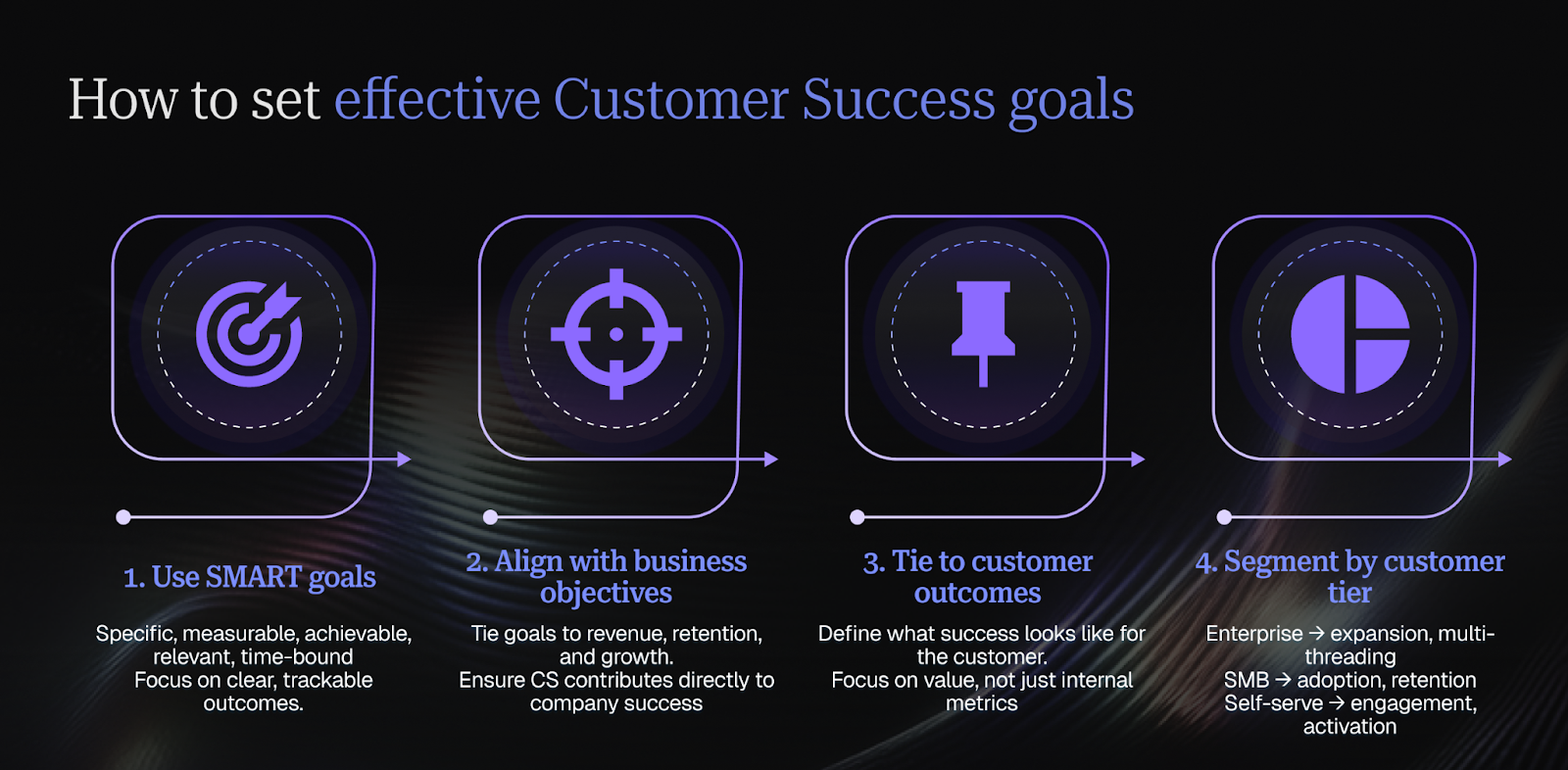
How to set effective Customer Success goals
Use the SMART goals framework
Customer Success goals should be clearly defined and easy to track. The SMART framework helps ensure goals are practical and actionable.
Goals should be:
- Specific
- Measurable
- Achievable
- Relevant
- Time-bound
For example, instead of aiming to “improve adoption,” a SMART goal would be to “increase feature X adoption by 20% within the next quarter.”
Align CS goals with business objectives
Customer Success goals should directly support broader business priorities such as revenue growth, retention, and expansion.
When CS goals are aligned with business outcomes, it becomes easier to demonstrate impact and justify investment in Customer Success initiatives. This also ensures that teams are working toward the same overarching objectives rather than operating in silos.
Tie goals to customer outcomes
Effective Customer Success goals are not just internal metrics. They should reflect what success looks like for the customer.
This means understanding customer objectives and aligning goals accordingly, whether that’s improving efficiency, increasing revenue, or achieving a specific milestone. When goals are tied to customer outcomes, they become more meaningful and easier to act on.
Segment goals by customer tier
Not all customers should be measured in the same way. Goals should be tailored based on customer segments such as enterprise, mid-market, SMB, or self-serve.
For example:
- Enterprise accounts may focus on expansion and multi-threading
- SMB accounts may focus on adoption and retention
- Self-serve users may prioritize engagement and activation
Segmenting goals ensures that expectations are realistic and aligned with the level of investment and opportunity within each account.
Key metrics for Customer Success goals
Customer retention rate
Customer retention rate measures the percentage of customers who continue using your product over a given period. It’s one of the clearest indicators of whether customers are consistently receiving value.
A high retention rate suggests strong product-market fit and effective Customer Success engagement, while a declining rate signals underlying issues that need attention.
Churn rate
Churn rate tracks the percentage of customers who stop using your product within a specific timeframe.
This metric helps identify how quickly customers are leaving and highlights potential gaps in onboarding, adoption, or ongoing support. Reducing churn is a core focus for Customer Success teams, as even small improvements can have a significant impact on revenue.
Net revenue retention (NRR)
Net revenue retention (NRR) measures how much revenue is retained and expanded from existing customers, accounting for churn, contraction, and expansion.
NRR provides a more complete view of Customer Success performance. When NRR is above 100%, it means expansion revenue is outweighing losses, allowing the customer base to grow without relying solely on new acquisition.
Customer lifetime value (CLV)
Customer lifetime value (CLV) represents the total revenue a customer generates over the duration of their relationship with your business.
Customer Success directly influences CLV by improving retention and driving expansion. Increasing CLV indicates that customers are staying longer and investing more over time.
Product adoption metrics
Product adoption metrics track how customers are using your product and how deeply it is embedded in their workflows.
This can include feature adoption, frequency of use, number of active users, and engagement trends. Strong adoption is a leading indicator of retention and expansion, while low adoption often signals risk.
Customer satisfaction (NPS, CSAT)
Customer satisfaction metrics such as NPS and CSAT measure how customers feel about their experience with your product and team.
These metrics provide valuable qualitative and quantitative insights into customer sentiment. High satisfaction often correlates with retention and advocacy, while negative feedback can highlight areas that need immediate improvement.
For ideas on how to visualize and report on these metrics, exploring customer success dashboard examples can help teams structure their reporting effectively.
How to achieve Customer Success goals
Use data to drive decisions
Customer Success goals are much easier to achieve when decisions are grounded in data rather than intuition.
This includes analyzing product usage, customer sentiment, and engagement patterns to understand where customers are succeeding and where they may be at risk. Data provides the context needed to act early and prioritize the right accounts.
Build proactive engagement strategies
Reactive support limits impact. The most effective teams focus on anticipating customer needs and addressing issues before they escalate.
This can involve setting up check-ins at key milestones, monitoring early warning signals, and triggering outreach based on changes in usage or sentiment. Proactive engagement helps maintain momentum and reduces the likelihood of churn.
Personalize customer interactions
Customers expect experiences that are relevant to their specific goals and use cases.
Personalization means tailoring communication, recommendations, and support based on each customer’s context. This makes interactions more meaningful and increases the chances of driving adoption, satisfaction, and expansion.
Create repeatable playbooks
Consistency is key to scaling Customer Success. Playbooks help standardize how teams handle common scenarios such as onboarding, risk management, and expansion.
By defining clear workflows, teams can ensure that best practices are followed across the board, reducing variability and improving overall performance.
Foster cross-functional collaboration
Customer Success goals cannot be achieved in isolation. Collaboration across teams such as Sales, Product, and Support is essential.
Aligning on customer context, sharing insights, and coordinating actions ensures a seamless experience for the customer. It also helps teams address issues more effectively and identify new opportunities for growth.
Common challenges in achieving CS goals
Lack of visibility into customer data
Customer data is often spread across multiple tools, making it difficult to get a complete view of each account.
Without a unified perspective, teams struggle to connect signals like product usage, sentiment, and engagement. This lack of visibility leads to missed risks and overlooked opportunities.
Reactive workflows instead of proactive
Many Customer Success teams operate in a reactive mode, responding to issues only after they arise.
This limits their ability to prevent churn or drive growth. Without proactive strategies in place, teams spend more time firefighting than creating long-term value.
Misalignment between teams
Customer Success goals often depend on collaboration with Sales, Product, and Support.
When teams are not aligned on customer context, priorities, or ownership, it can lead to inconsistent experiences and missed opportunities. Clear communication and shared objectives are essential to avoid this.
Difficulty scaling personalization
Personalization is critical for effective Customer Success, but it becomes harder as the customer base grows.
Without the right systems and processes, teams may fall back on generic communication, which reduces engagement and impact. Scaling personalization requires both structure and the right tools.
Poor tracking of outcomes
Tracking activity is not the same as tracking outcomes.
Many teams focus on metrics like calls made or emails sent, rather than whether customers are actually achieving value. Without clear outcome-based tracking, it becomes difficult to measure success or improve performance.
How to scale Customer Success goals with systems
Centralize customer data
Scaling Customer Success starts with having a single source of truth.
When customer data is centralized, teams can access a complete view of each account, including usage, engagement, sentiment, and revenue context. This makes it easier to identify patterns, prioritize actions, and make informed decisions without switching between tools.
Automate workflows and playbooks
Manual processes don’t scale.
Automating workflows and playbooks ensures that key actions such as onboarding steps, risk alerts, and follow-ups happen consistently and on time. This reduces the operational burden on teams and allows them to focus on higher-value activities.
Use AI to identify risks and opportunities
AI enables teams to move from reactive to predictive Customer Success.
By analyzing patterns across product usage, communication, and sentiment, AI can surface early signals of churn risk or expansion potential. This helps teams act sooner and with greater confidence, rather than relying on hindsight.
Continuously refine goals
Customer Success goals should evolve over time.
Regularly reviewing performance data and customer feedback helps teams understand what’s working and where adjustments are needed. Refining goals ensures they remain aligned with both customer needs and business objectives as the company grows.
Tools that help manage Customer Success goals
Customer success platforms
Customer success platforms act as the central hub for managing Customer Success goals.
They help teams track customer health, manage workflows, and monitor outcomes across the entire lifecycle. By bringing data and processes into one place, these platforms make it easier to stay aligned and act consistently.
Product analytics tools
Product analytics tools provide visibility into how customers are interacting with your product.
They surface insights around feature usage, engagement trends, and adoption patterns. This helps teams understand whether customers are getting value and where additional support or guidance may be needed.
Feedback tools
Feedback tools capture customer sentiment through metrics like NPS and CSAT.
They provide both quantitative scores and qualitative insights that help teams understand how customers feel about their experience. This context is essential for identifying risks and improving satisfaction.
AI-powered tools
AI-powered tools help teams go beyond reporting and into prediction.
By analyzing large volumes of data, these tools can identify patterns, surface risks, and highlight opportunities that may not be immediately obvious. This allows Customer Success teams to act earlier and more strategically.
How Velaris supports CS goals
Velaris, a highly rated software on G2, brings these capabilities together into a single platform designed for post-sales teams.
It unifies customer data across systems, giving teams a complete view of each account without switching between tools. Its AI capabilities, including Headlines, CallSense, and AI Topics, analyze customer interactions to surface key signals around sentiment, engagement, and potential risks.
Velaris also supports configurable health scoring and highlights expansion opportunities, helping teams prioritize where to focus. With Copilot, teams can quickly understand account context and get recommendations for next actions, making it easier to stay proactive and aligned with Customer Success goals.
Customer Success goals examples by stage
Onboarding stage goals
The focus during onboarding is helping customers reach value as quickly as possible.
Key goals include reducing time to value and ensuring successful activation. This means getting customers to their first meaningful outcome early, setting a strong foundation for long-term success.
Adoption stage goals
Once customers are onboarded, the priority shifts to driving consistent and effective product usage.
Goals at this stage focus on feature adoption, engagement levels, and ensuring the product becomes part of the customer’s daily workflow. Strong adoption indicates that customers are seeing ongoing value.
Retention stage goals
At the retention stage, the goal is to maintain satisfaction and prevent churn.
This includes tracking renewal rates, monitoring customer health scores, and identifying risks early. The focus is on sustaining value and addressing any issues before they impact the relationship.
Dedicated customer health dashboards make it easier to surface these signals at a glance and act before risks escalate.
Expansion stage goals
In the expansion stage, the focus is on growing the account.
Goals include increasing revenue through upsells, cross-sells, and expanded usage. At this point, customers are already seeing value, so the opportunity lies in helping them achieve even more with the product.
According to Invesp, existing customers are 50% more likely to try new products and spend 31% more compared to new customers, so it’s important to capitalize in this stage.
Conclusion
Customer Success goals are what turn day-to-day activity into long-term growth. When teams are clear on what they’re working toward, it becomes easier to prioritize the right actions and deliver consistent value to customers.
The combination of data, alignment, and consistency is what drives results. Teams that operationalize their goals, rather than treating them as guidelines, are able to move faster, act proactively, and scale their impact across the entire customer base.
Platforms like Velaris, a highly rated software on G2, help bring this to life by centralizing customer data, surfacing AI-driven insights, and guiding teams toward the next best actions. This makes it easier to track progress, identify risks and opportunities early, and stay aligned with both customer and business outcomes.
Book a demo to see how Velaris helps teams track goals, surface insights, and drive better customer outcomes.
Frequently Asked Questions
What are the most important CS metrics?
The most important Customer Success metrics typically include customer retention rate, churn rate, net revenue retention (NRR), customer lifetime value (CLV), product adoption metrics, and customer satisfaction scores like NPS and CSAT. Together, these provide a complete view of customer health, value, and growth.
How do you set Customer Success goals?
Customer Success goals should be set using a structured approach like the SMART framework. They should align with broader business objectives, be tied to customer outcomes, and be segmented based on customer tiers. This ensures goals are both realistic and impactful.
How do you measure success in Customer Success?
Success in Customer Success is measured by how effectively customers achieve value and continue to grow. This is reflected in metrics such as high retention, strong adoption, positive customer sentiment, and expansion revenue. Tracking outcomes rather than just activity is key.
What tools help manage CS goals?
Customer success platforms, product analytics tools, feedback tools, and AI-powered solutions all play a role in managing CS goals. These tools help centralize data, surface insights, and automate workflows, making it easier for teams to stay proactive and consistent.

The Velaris Team
A (our) team with years of experience in Customer Success have come together to redefine CS with Velaris. One platform, limitless Success.




Velaris is an AI-native Customer Success Platform built for mid-market and enterprise B2B SaaS teams. From customer health scoring and churn prediction to onboarding automation, renewals, and expansion workflows, Velaris helps recurring revenue teams understand account health, reduce churn, and scale customer success with greater visibility and control.