We look forward to showing you Velaris, but first we'd like to know a little bit about you.


Operational Clarity at Scale: How Kato Transformed Customer Success

B2B SaaS, CRM for Real Estate
51-200 employees
Hybrid
2
managerial hours saved per week
18
CSM hours saved per week
$9000
per year saved in tooling
Kato’s Challenge
Category Leader, Operational Strain
Kato is a CRM tool powering the European commercial real estate market, with roughly 80% UK market penetration and more than 1,500 active accounts across EMEA regions.
Behind that dominance sits a 9-member post-sales org managing a hybrid Customer Success motion.
Having found product market fit, Kato's next challenge was to streamline operations in preparation for new products and new geographies.
However, Chris Hill, the Director of Customer tasked with leading and scaling Kato’s post-sales operations, saw the downstream risk immediately:
The team couldn’t sustain a growing number of customers with their existing setup.
Nearly two hours per day were being lost to administrative work, and renewal preparation required about an hour per account just to assemble the full customer picture. Chris spent far too much time bridging context gaps and aligning teams.
Customer data lived across multiple tools and documents. CSMs had to manually put together account context before every renewal. Risks were harder to detect early. Onboarding lacked consistent structure. Assessing customer health depended too heavily on individual knowledge rather than shared systems.
“We had to dig through Intercom, Gmail, HubSpot — all of those places — just to understand what was going on.”
Expanding into new markets and product lines without fixing these foundations would simply scale the inefficiencies alongside the business.
And so, Chris began evaluating options.
The Best Tool For The Job
Chris realized that patching together existing tools would not be scalable as they grew. HubSpot was too basic for advanced Customer Success visibility. Custom internal builds would require significant engineering time and ongoing maintenance.
For long term efficiency, Chris needed a tool that could provide:
- A single source of truth for accounts: Customer data, onboarding progress, renewal timelines, support history and product signals needed to live in one place.
- Deep integration flexibility: The platform had to pull from Jira, Intercom, Gmail, HubSpot and other existing systems without forcing a full tech stack replacement.
- Structured renewal and onboarding workflows: They needed repeatable processes that reduced manual preparation and ensured nothing slipped through the cracks.
- Health visibility and early risk detection: Surfacing risk before renewal season, not during it.
- Adaptability to their hybrid CS model: Freemium and high-touch accounts required different engagement approaches. The system had to support both.
Velaris stood out not just for its flexibility, but for the partnership approach to implementation and integrations.
Rather than asking Kato’s team to manage integrations internally, the Velaris team took ownership of the setup. There was no expectation that their engineering or CS teams would run a heavy internal project to get it live.
“You guys were more willing to work with us from an integrations perspective to get all of our systems connected up, which was something we definitely needed.”
That removed a major barrier.
Kato needed structure, not another time-consuming rollout. Knowing that implementation and integration would be handled externally made the decision straightforward.
The Implementation
Once the decision was made, speed mattered.
Kato didn’t want a drawn-out rollout that dragged on for months. They needed to start seeing structure quickly, without disrupting day-to-day operations. Within roughly a month, part of the team was already live in Velaris.
From Decision to Live in Weeks
The rollout began with a kickoff that immediately set the tone for execution. Kato provided system access early, aligned on priorities, and partnered closely with the Velaris implementation team to define exactly what success should look like.
Chris, Director of Customer, led the initiative internally, ensuring the project stayed focused on solving real operational challenges rather than becoming a theoretical exercise.
Alongside him, Ross Damerell, Head of Revenue Operations, prepared their HubSpot environment.
From the outset, both teams aligned on key questions:
- How should renewals and expansions be modelled?
- What visibility did leadership need without creating information overload?
- Which automations would reduce manual work immediately?
- How should customer data be structured for segmentation and reporting?
Within weeks, the team was hitting their implementation milestones.
Core systems (Jira, Intercom, Gmail, and HubSpot) were integrated, and over a hundred CRM fields were mapped to ensure account-level context was immediately accessible inside Velaris.
Instead of toggling between platforms to reconstruct the story of an account, teams could now see renewal history, support activity, product context, and communications in one place.
Work that had previously lived across spreadsheets, Word documents, ClickUp, HubSpot, and inbox threads was consolidated into a single operating environment.
Customer Success and onboarding teams began working from the same system, creating shared visibility into account status, ownership, and next steps.
According to the team, the support they received from the Velaris implementation team gave them early confidence that the system would reflect how they actually operated.
“[The Velaris implementation manager] was amazing — really knowledgeable. He understood what we needed and got things implemented pretty quickly.”
The Transformation
The switch didn’t happen overnight. But within weeks, the way the team worked started to feel different.
1. Establishing health visibility and earlier risk detection
One of Chris’ biggest priorities post implementation was to use Velaris to surface risks they previously “weren’t wholly aware of” and reduce renewal surprises.
Kato began using health signals in Velaris to identify risk well before renewal windows approached. Instead of discovering problems late in the cycle, the team could see warning signs early enough to intervene.
This fundamentally changed the posture of the team. Renewal preparation became proactive rather than reactive, allowing CSMs to engage customers from a position of awareness rather than urgency.
2. Systematizing renewal management
One of the most immediate operational improvements came from automating the renewal process.
Chris set up a workflow where ninety days before a contract date, structured Slack notifications would deliver a consolidated account summary directly to the responsible team members.
Activity signals, recent developments, and key context are surfaced automatically, prompting preparation at exactly the right moment.
Previously, assembling this view required roughly an hour of manual effort across multiple systems. Now, the starting point arrives pre-built.
3. Using AI to compress preparation time
AI quickly became part of Kato’s daily operating model.
Before entering customer conversations, CSMs generate account summaries that provide an immediate understanding of current conditions, recent activity, and potential risks.
Managers no longer spend hours gathering updates, and senior team members can self-serve the context they need without escalating internally.
“It became a lot quicker to get everything you need from the account — and really quick to get a heartbeat of what’s going on.”
4. Turning insights into structured renewal strategy
Account insights generated within Velaris were paired with our team’s training and sales methodology.
By feeding structured customer data into a model aligned with their sales framework, the team produces renewal strategies grounded in both evidence and discipline.
What once depended heavily on individual experience is becoming more repeatable across the organization.
Renewal planning has shifted from reactive interpretation to a structured, data-informed process, one that scales as the business grows.
The Results
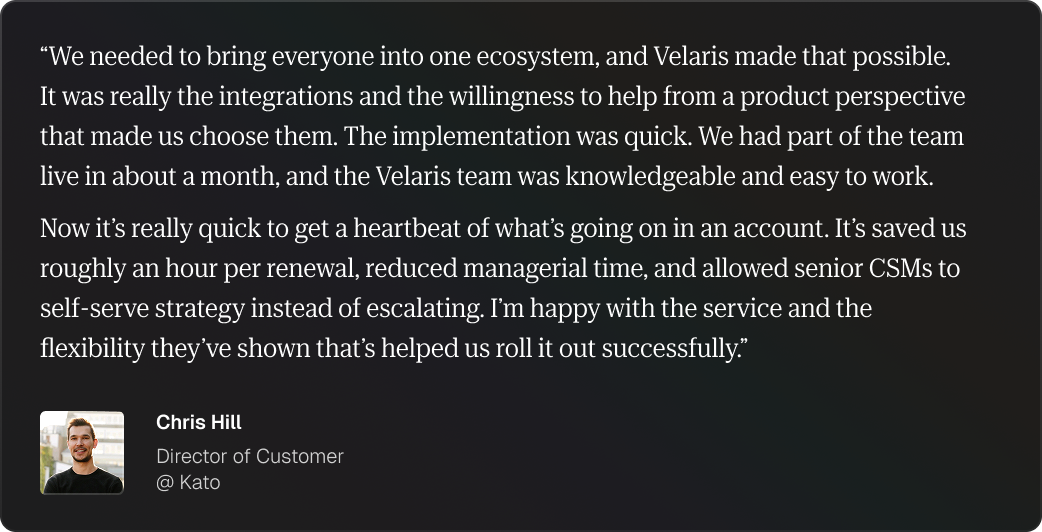
“It saves roughly an hour per renewal, saves managerial time each week, and lets people self-serve strategy instead of escalating.”
Quantitative Impact
The operational savings were immediate:
- ~1 hour saved per renewal previously spent compiling account data
- ~2 hours per day of admin reduced
- Time saved across 9 people × 2 hours = 18 hours saved per day
- 90 hours per week
- 2 hours of managerial time saved weekly for Chris
- Senior CSMs now self-serve renewal strategy without escalation
- ~$9,000 in software cost saved through tool consolidation, moving all project management activities from ClickUp to Velaris
Across 1,500+ accounts, those efficiencies compound quickly. Renewal preparation no longer starts from scratch.
Qualitative Impact
Risk management
Better visibility translated into stronger revenue control. Early risk surfacing reduced renewal surprises. Health triggers created more structured risk identification. Renewals became proactive rather than reactive.
Leadership visibility
The executive team now has structured insight into account health and renewal readiness, enabling earlier intervention.
Scalability unlocked
Velaris created the platform for scale the business needed.. When headcount was reduced, operations held steady. Onboarding became more organized and repeatable.

The Velaris Team





Velaris is an AI-native Customer Success Platform built for mid-market and enterprise B2B SaaS teams. From customer health scoring and churn prediction to onboarding automation, renewals, and expansion workflows, Velaris helps recurring revenue teams understand account health, reduce churn, and scale customer success with greater visibility and control.