We look forward to showing you Velaris, but first we'd like to know a little bit about you.


The Top 9 AI Customer Engagement Tools to Elevate Your Strategy
Learn about the best customer engagement tools, their features, pros, and cons, and how they help improve communication and customer satisfaction.
The Velaris Team
July 8, 2026
Customer engagement tools help Customer Success teams centralize communication, analyze customer behavior, automate outreach, and proactively improve retention.
For many Customer Success teams, engagement has become reactive rather than strategic. Customer signals are often buried across tools and CRM systems, making it difficult to see the full picture. As a result, CSMs spend more time piecing together data than acting on it.
The right customer engagement tool can overhaul this dynamic for the better. In this guide, we’ll explore the top customer engagement tools available today, what makes each one effective, how they differ, and how to choose the right platform to support a scalable, high-impact Customer Success strategy.
Key Takeaways
- Velaris is best for teams ready to move toward predictive, AI-driven engagement with unified customer signals and automated next-best actions.
- Intercom and Zendesk excel at conversational and support-led engagement, making them strong choices for teams prioritizing real-time communication.
- Pendo and Appcues help drive adoption through in-app guidance, onboarding flows, and product-led engagement strategies.
- Mixpanel provides deep behavioral analytics that inform smarter engagement decisions, even though it does not execute outreach directly.
- HubSpot Service Hub is ideal for organizations already operating within the HubSpot ecosystem and wanting CRM-connected engagement.
- HelpScout and Typeform offer lightweight but effective engagement through collaborative messaging and interactive feedback collection, especially for growing teams.
1. Intercom

What it is
Intercom is a customer messaging platform built to help businesses communicate with customers in real time through live chat, chatbots, and automated conversational workflows. Widely used by product, support, and growth teams, it enables companies to engage users directly inside their applications or websites.
Why it stands out
Intercom excels at making customer engagement feel immediate and contextual.
Its combination of live chat, automation, and behavioral triggers allows teams to reach customers at the exact moment support or guidance is needed. This creates more natural, conversation-driven experiences rather than delayed follow-ups.
Key engagement capabilities
- Messenger and Fin AI Agent: The Messenger gives customers access to live support and self-service content. Additionally, Fin AI can answer questions using approved support content and hand conversations to a teammate when human involvement is needed.
- Customer data and event tracking: Captures user activity and attributes to inform conversations with relevant context.
- Multichannel campaigns through Series: Intercom’s visual Series builder connects several outbound messages into one customer journey. For example, a user who ignores an in-app announcement could receive an email later, while someone who completes the intended action can exit the campaign.
- Workflow triggers based on behavior: Enables targeted messages when users complete actions, stall in workflows, or revisit key features.
Considerations
Intercom requires thoughtful configuration and governance. Without clear messaging rules, teams risk overwhelming customers with too many automated prompts or notifications.
Some advanced proactive engagement features, including Product Tours, Surveys, In-app Posts, Mobile Push, and Mobile Carousels, require the Proactive Support Plus add-on. Message-based usage charges may also make campaign volume an important consideration.
Pricing
Intercom offers three main plans when billed annually: Essential starts at $29 per seat per month, Advanced at $85, and Expert at $132. All three include Fin AI Agent, which is charged separately at $0.99 for each resolved outcome.
The overall cost can rise once usage and add-ons are included. Proactive Support Plus costs $99 per month and includes 500 outbound messages, while Copilot starts at $29 per agent per month when billed annually.
Best for
Teams prioritizing chat-based engagement, in-app communication, and real-time support experiences that guide customers while they are actively using the product.
2. Zendesk

What it is
Zendesk is a customer service platform designed to help businesses manage support interactions across multiple channels while maintaining consistent, high-quality engagement. Known for its powerful ticketing system, it enables teams to organize, prioritize, and resolve customer inquiries efficiently.
Why it stands out
Zendesk stands out for its depth and flexibility in support operations. Its ability to customize workflows, automate routing, and provide self-service resources allows organizations to scale customer engagement without sacrificing responsiveness.
Key engagement capabilities
- Agent Workspace and omnichannel routing: Zendesk brings email, web-form, messaging, and voice requests into the Agent Workspace. Its omnichannel routing system can assign work according to agent capacity and availability. Depending on the plan, it can also consider ticket priority, required skills, and how close a request is to breaching its SLA.
- Knowledge base + self-service widgets: Empowers customers to find answers independently, reducing support volume while improving satisfaction.
- Intelligent triage: New tickets can be automatically classified by topic, sentiment, language, and named entities such as products. Teams can then use these classifications in routing and automation rules.
- Action Builder: Zendesk’s visual Action Builder creates workflows that operate across Zendesk and external systems. For example, an incident ticket could automatically be marked urgent, create an issue in Jira, add the Jira link to the ticket, and notify the relevant team in Slack.
Considerations
Zendesk can feel complex for teams without dedicated administrative support. Proper setup and ongoing management are often required to fully leverage its customization capabilities.
It is also primarily organised around customer service interactions rather than full account engagement management. Customer success teams may still need a separate platform for health scoring, renewal forecasting, success plans, stakeholder management, and portfolio-level risk analysis.
Pricing
Zendesk starts at $19 per agent per month for Support Team, while Suite Team costs $55 and Suite Professional costs $115 when billed annually. Enterprise pricing is customised, and a 14-day free trial is available.
Additional costs may apply for features such as Copilot, workforce management, contact centre capabilities, AI-agent resolutions, and voice usage. Teams should therefore compare the total cost of their required setup rather than the base subscription alone.
Best for
Customer support teams seeking scalable engagement infrastructure with strong service workflows, particularly organizations managing high ticket volumes across multiple channels.
3. Velaris
What it is
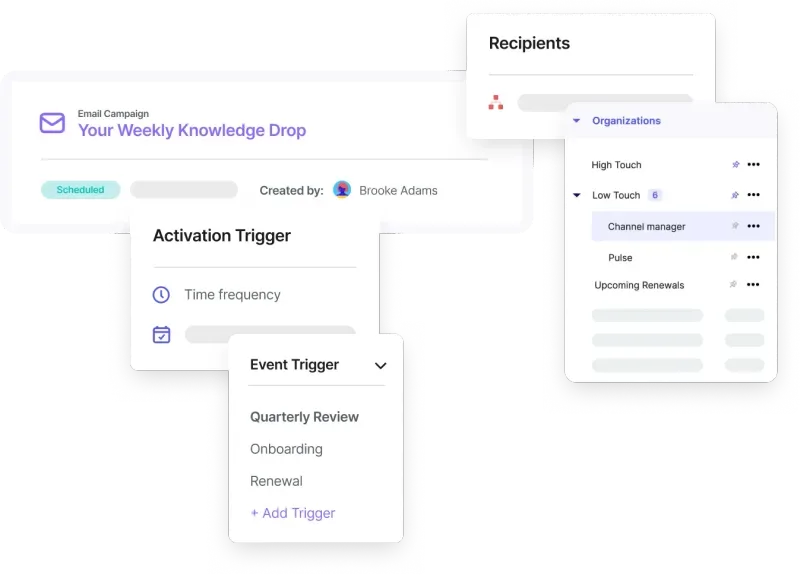
Velaris, a highly rated software on G2, is an AI-first Customer Success platform designed to unify customer signals and convert them into prioritized actions and automated workflows. By bringing together behavioral data, communication insights, and lifecycle context, the platform helps teams move from reactive engagement to a more predictive, intelligence-driven approach.
Why it stands out
While many platforms present dashboards that require manual interpretation, Velaris focuses on understanding customer behavior for you.
Its AI continuously analyzes interactions, usage patterns, and sentiment to surface risks, highlight opportunities, and recommend the next best step. This allows CSMs to spend less time investigating accounts and more time acting on meaningful insights.
Key engagement capabilities
- Customer 360 and Headlines AI: Customer 360 brings key account information into one view. Headlines AI reviews recent activity and produces a concise briefing with the main themes and recommended next steps.
- CallSense conversation intelligence: CallSense turns customer calls into structured summaries and follow-up actions. It also captures risks, opportunities, and sentiment, then adds them to the account record.
- Trending Topics: Velaris identifies recurring themes across customer conversations without manual tagging. Leaders can see which issues are growing and how customer sentiment is changing.
- Velaris Copilot: CSMs can ask questions about an account or their portfolio in natural language. Copilot can also create plans, prepare reports, update documents, and surface priority work.
- Context-aware AI agents: Velaris agents monitor customer activity and act when important signals appear. They can support meeting preparation, onboarding, handovers, renewals, and other repeatable workflows.
- Cross-platform automations: The visual automation builder triggers workflows when customer conditions change. It connects with more than 100 tools and supports AI-powered analysis and content generation.
- MCP: Velaris MCP gives external AI tools secure access to connected customer context, so teams can work with Velaris data from tools like ChatGPT and Claude.
Considerations
Velaris is designed for teams looking to operate proactively rather than reactively. Teams whose main requirement is high-volume ticketing or live-chat support may need a customer service platform alongside the core customer success product.
Furthermore, organizations heavily reliant on manual processes may need to evolve their workflows to fully benefit from Velaris’s AI-driven capabilities.
Pricing
Velaris uses tailored pricing rather than publishing a fixed starting price. Its standard licence includes five users and unlimited viewers, with core features across customer visibility, health and analytics, automation, playbooks, success plans, and task management.
Add-ons are available, so teams need to request a custom estimate based on their requirements.
Best for
Mid-market to enterprise Customer Success teams focused on predictive engagement, early risk detection, and scaling personalized interactions without increasing operational complexity.
4. Pendo
What it is
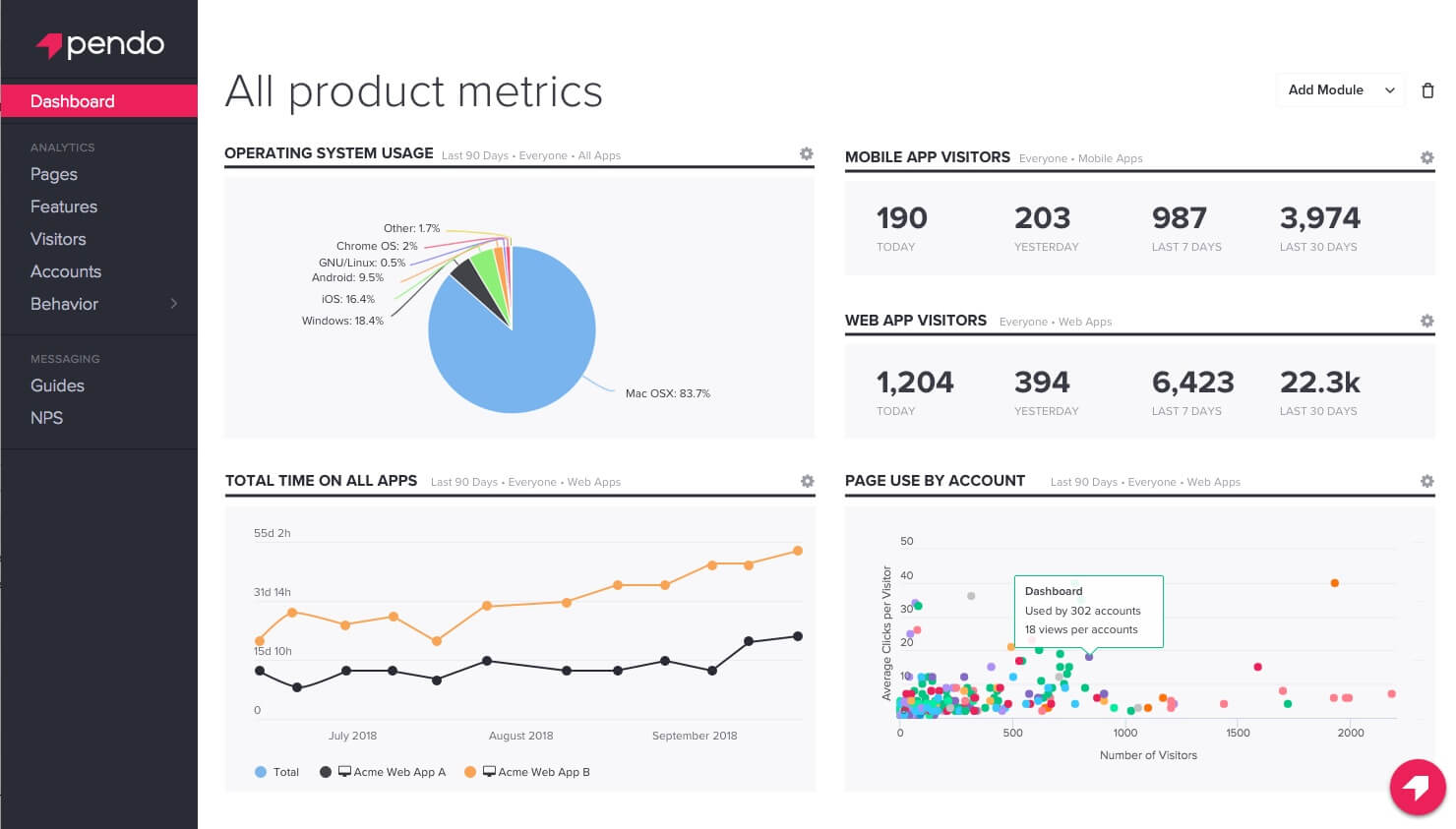
Pendo is a product experience platform that helps teams drive engagement directly within their application. By combining behavioral analytics with in-app messaging, it enables organizations to guide users toward key features and accelerate time-to-value.
Why it stands out
Pendo bridges the gap between understanding user behavior and acting on it. Teams can see how customers interact with the product and immediately deploy walkthroughs, guides, or announcements to encourage adoption without relying heavily on external communication.
Key engagement capabilities
- In-app guidance and tooltips: Deliver contextual walkthroughs, feature announcements, and prompts exactly when users need them, reducing friction during onboarding and feature discovery.
- Session Replay: Integrated replays show the behaviour behind an analytics result. Teams can filter sessions using product data and investigate problems such as rage clicks, failed workflows, or confusing guides.
- Product analytics: Tracks feature usage, engagement patterns, and user flows so teams can identify drop-offs and optimize the product experience.
- Pendo Listen: Listen brings feedback and feature requests into one place. AI helps organise recurring themes so product teams can connect customer demand with roadmap decisions.
- Pendo Orchestrate: Orchestrate combines in-app guides with email journeys. Messages can be triggered by what a user does—or fails to do—and measured against outcomes such as feature adoption.
Considerations
Pendo is primarily optimized for in-product engagement. Teams looking for robust outbound communication, lifecycle automation, or cross-channel engagement may need complementary tools.
Pricing
Pendo Free supports up to 500 monthly active users and includes product analytics, in-app guides, and Pendo-branded NPS surveys. Paid Base, Core, and Ultimate plans use custom pricing based on the number of monthly active users and the selected functionality.
Advanced capabilities vary by plan. Session Replay is included from Core, while Ultimate includes Sentiment, Listen, Orchestrate, and Data Sync. Pendo also offers a 30-day trial of the wider platform.
Best for
Product-led organizations focused on improving onboarding, feature adoption, and in-app engagement through behavioral insights.
5. Appcues

What it is
Appcues is a no-code platform designed to help teams create in-app onboarding and engagement experiences without relying on engineering resources. It enables faster deployment of user flows that guide customers toward meaningful product interactions.
Why it stands out
Appcues lowers the barrier to improving adoption. Teams can quickly design and launch onboarding experiences, announcements, and feature tours, making it easier to influence user behavior without waiting on development cycles.
Key engagement capabilities
- Onboarding and feature discovery flows: Build interactive tours, checklists, and modals that help users reach value faster and understand key features.
- Launchpads: Add an in-app resource centre where customers can replay guides or access help content without leaving the product.
- Segmented experiences triggered by user behavior: Target specific user groups based on attributes or actions to deliver more relevant in-app messaging.
- Checklists: Break activation goals into clear tasks and track progress automatically using product events. Users who complete a task independently can still receive credit.
- Visual flow builder: Design and iterate engagement flows through an intuitive interface, allowing teams to test and optimize experiences continuously.
Considerations
Appcues focuses heavily on in-product engagement. Organizations seeking deeper analytics, cross-channel communication, or lifecycle automation may need to integrate additional tools.
The tool also requires an initial technical installation and reliable product-event tracking. Poorly defined events or segments can lead to irrelevant messaging.
Pricing
Appcues uses custom pricing based on monthly active users and the number of installations. Its Start plan supports up to 3,000 MAUs, Grow supports up to 50,000, and Enterprise accommodates custom volumes. Limits also apply to published experiences and email usage.
All plans include the core platform and integrations. Appcues offers a sales-assisted free trial with no credit card required, as well as a Spark programme for smaller teams.
Best for
Product and Customer Success teams that want to accelerate onboarding and feature adoption without depending on developer support.
6. Mixpanel

What it is
Mixpanel is a product analytics platform built to help teams understand how users interact with their product. By tracking behavioral data at a granular level, it enables organizations to identify patterns, optimize journeys, and make data-backed engagement decisions.
Why it stands out
Mixpanel excels at turning raw usage data into actionable insight. Rather than guessing why customers disengage or drop off, teams can pinpoint exactly where friction occurs and refine their engagement strategies accordingly.
Key engagement capabilities
- Funnel analysis: Visualize conversion paths to identify where users abandon workflows and where engagement can be improved.
- Retention and behavioural cohorts: Teams can measure how often users return and compare retention based on actions they completed. Cohorts can also be shared with connected engagement tools for targeted campaigns.
- Mixpanel AI: Teams can ask questions in natural language, generate reports, and investigate changes without building every analysis manually. Mixpanel AI can also surface unexpected trends and suggest areas to investigate.
- Cohort segmentation: Group users by shared behaviors or attributes to uncover trends and inform targeted engagement strategies.
- Warehouse Connectors: Mixpanel can analyse product activity alongside backend data from platforms such as Snowflake and BigQuery. Mirror Mode keeps Mixpanel in sync when warehouse records change.
Considerations
Mixpanel is designed primarily for analytics, not execution. Teams will typically need complementary tools for messaging, automation, or lifecycle orchestration.
Pricing
Mixpanel’s free plan includes up to one million monthly events, five saved reports per seat, and 10,000 monthly session replays. The Growth plan also starts at $0 for the first one million events, then charges $0.28 per additional 1,000 events. Enterprise pricing is customised.
Costs can rise with event volume, additional session replays, and add-ons such as account-level behavioural analytics.
Best for
Data-driven Product and Customer Success teams that want to shape engagement strategies based on real behavioral insight rather than assumptions.
7. HubSpot Service Hub

What it is
HubSpot Service Hub is a customer service and engagement platform built within the broader HubSpot ecosystem. It helps teams manage support interactions, gather feedback, and strengthen customer relationships while keeping data tightly connected to CRM and marketing workflows.
Why it stands out
Service Hub bridges the gap between customer support and revenue teams by centralizing communication, feedback, and automation in one system. Because it is native to HubSpot, teams gain a unified view of the customer without needing heavy integrations.
Key engagement capabilities
- Shared inbox: Centralizes customer conversations so teams can collaborate efficiently and respond faster.
- Breeze Customer Agent: Uses approved company content to answer customer questions across connected support channels. It can handle routine enquiries before passing more complex cases to the support team.
- Surveys (NPS, CSAT): Collect structured feedback to understand satisfaction trends and identify at-risk customers.
- Knowledge base and customer portal: Customers can search support content and track their open requests without contacting an agent for every update.
- Workflow automation: Automate follow-ups, ticket routing, and customer communications to maintain consistent engagement.
Considerations
Many of the platform’s more advanced automation and reporting features are only available in higher-tier plans. This includes the Help Desk Workspace, Customer Success Workspace, health scores, and more advanced automation. So the rising costs as teams scale must be considered.
Best for
Organizations already operating within the HubSpot ecosystem that want integrated engagement across CRM, marketing, and support without introducing additional platforms.
8. Help Scout
What it is
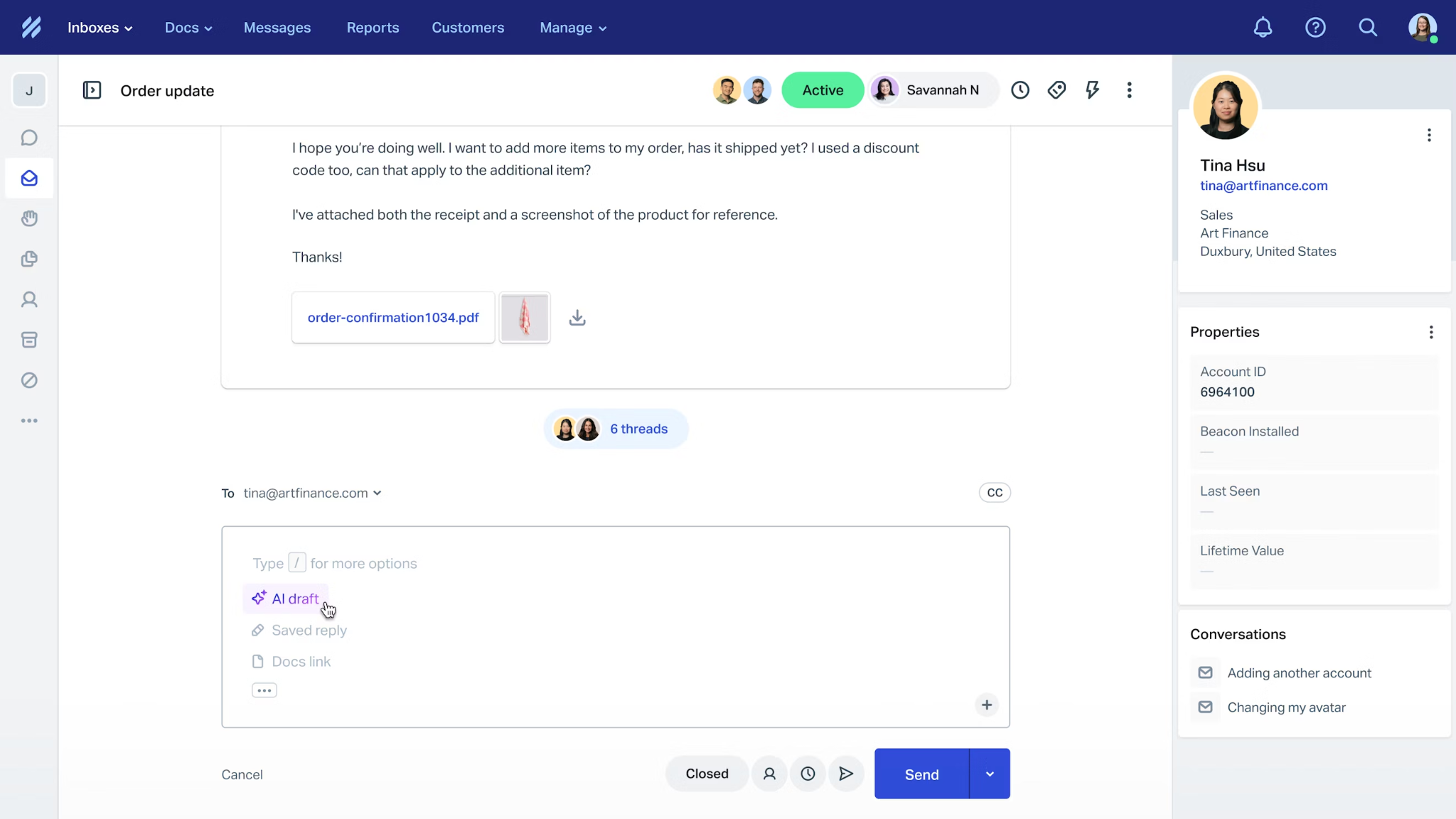
Help Scout is a customer communication platform built around collaborative inboxes, enabling teams to manage customer conversations in an organized, human-centered way. It focuses on email-based support and proactive messaging without overwhelming teams with complex configurations.
Why it stands out
Help Scout is known for its simplicity and usability. It delivers essential engagement capabilities without the operational overhead of larger enterprise systems. Teams can collaborate in a shared inbox while maintaining a consistent, personalized customer experience.
Key engagement capabilities
- Shared Inbox: Teams can assign conversations, leave private notes, use saved replies, and see when a colleague is already responding. Snooze and Send Later help manage follow-ups without leaving messages sitting in the queue.
- Beacon: The embeddable Beacon widget gives customers access to live chat, email support, help content, and previous conversations inside a website or application.
- AI Answers and Inbox AI: AI Answers responds using approved help content and charges only when it resolves the conversation without human assistance. Inbox AI can draft replies, summarise long threads, translate messages, and adjust tone.
- Proactive Messages: Teams can display targeted banners, modals, onboarding prompts, and surveys through Beacon. This includes contextual NPS collection and announcements inside the product.
- Docs knowledge base: Help Scout includes a branded self-service site that can be embedded in Beacon. Customer searches and contact options remain connected to the same support experience.
Considerations
While ideal for simplicity, Help Scout offers limited advanced automation, predictive insights, or deep behavioral analytics compared to more comprehensive engagement platforms. Larger organizations may outgrow its capabilities.
Pricing
Help Scout offers a free plan for up to five users. When billed annually, Standard costs $25 per user per month, Plus costs $45, and Pro costs $75. AI Answers is an additional $0.75 per successfully resolved conversation.
Additional inboxes and knowledge-base sites may also incur fees, so teams should consider their required channels and support structure when comparing plans.
Best for
Small to mid-sized Customer Success or support teams that want lightweight, easy-to-adopt engagement tools without enterprise complexity.
9. Typeform

What it is
Typeform is a survey and form platform designed to create highly engaging feedback experiences. Its conversational interface encourages higher response rates, helping teams gather deeper customer insights without making surveys feel tedious.
Why it stands out
Typeform transforms feedback into an interactive experience rather than a transactional one. Its design-first approach improves completion rates and helps teams capture more thoughtful responses from customers.
Key engagement capabilities
- Conditional logic: Branching changes the questions shown based on earlier answers. Its visual Logic Map helps teams understand and edit more complicated survey paths.
- Typeform AI: AI can generate questions, adjust the tone, and build logic from a prompt. It can also ask relevant follow-up questions based on a respondent’s answers.
- Branded and multimedia forms: Teams can customise layouts and apply brand kits. Surveys can also collect video or audio responses when written answers are not enough.
- Feedback analytics: Results include response summaries and completion data. Higher tiers add drop-off tracking, while AI can identify sentiment and recurring themes in open responses.
- Workflow Builder: Submissions can trigger emails, Slack alerts, and other actions. Typeform also connects with more than 300 applications, including HubSpot and Salesforce.
Considerations
Typeform specializes in feedback collection and does not provide broader engagement capabilities such as lifecycle automation, messaging workflows, or behavioral triggers. Most teams will need to pair it with other platforms.
Pricing
Typeform offers a free plan with limited responses. When billed annually, Basic starts at $28 per month, Plus at $56, and Business at $91. These plans include 100, 1,000, and 10,000 monthly responses respectively.
Enterprise pricing is customised. Typeform also charges separately for some workflow and automation capabilities.
Best for
Customer Success, product, and experience teams looking to gather richer customer insights through engaging, high-completion surveys.
Conclusion
Customer engagement is no longer just about responding quickly. It is about anticipating needs, recognizing risk early, and delivering the right interaction at the right moment. As Customer Success evolves, engagement is becoming predictive rather than reactive.
While many tools help teams communicate or analyze behavior, future-ready platforms go a step further by turning customer signals into action. Velaris, a highly rated platform on G2, combines behavioral data, sentiment analysis, and AI-driven recommendations.
Through this, Velaris enables Customer Success teams to move from scattered outreach to intelligence-driven engagement that scales with the business.
Book a demo to see how Velaris helps Customer Success teams deliver proactive, data-driven engagement at scale.
Frequently Asked Questions
What is a customer engagement platform?
A customer engagement platform is software that helps businesses manage interactions across the customer lifecycle. It centralizes communication, analyzes behavior, and often automates outreach so teams can deliver timely, relevant experiences that improve retention and satisfaction.
What is the difference between engagement and support tools?
Support tools are primarily reactive. They help teams respond to customer issues through tickets or chat. Engagement tools are proactive, enabling teams to guide customers, encourage adoption, monitor sentiment, and prevent churn before problems escalate.
Which engagement tool is best for SaaS?
The best tool depends on your strategy. Product-led companies often prioritize in-app platforms like Pendo or Appcues, while support-heavy organizations lean toward Zendesk or Intercom. AI-native platforms like Velaris are increasingly preferred by Customer Success teams that want predictive insights, automated workflows, and unified customer intelligence.
Are AI engagement platforms worth it?
Yes. AI platforms reduce manual analysis, surface hidden risks, and recommend next-best actions, allowing teams to focus their time where it matters most. As customer expectations rise, AI-driven engagement is quickly becoming a competitive advantage rather than a luxury.
How much do engagement tools cost?
Pricing varies widely based on capabilities and scale. Entry-level tools may start around $20–$50 per user per month, while enterprise platforms can cost significantly more depending on automation, analytics, and AI features. Most vendors offer custom pricing based on customer volume and feature requirements.

The Velaris Team
A (our) team with years of experience in Customer Success have come together to redefine CS with Velaris. One platform, limitless Success.




Velaris is an AI-native Customer Success Platform built for mid-market and enterprise B2B SaaS teams. From customer health scoring and churn prediction to onboarding automation, renewals, and expansion workflows, Velaris helps recurring revenue teams understand account health, reduce churn, and scale customer success with greater visibility and control.