We look forward to showing you Velaris, but first we'd like to know a little bit about you.


The Role of the Digital CSM: Goals and Responsibilities in Modern Customer Success
Learn how a Digital CSM leverages automation and insights to manage growing customer bases while maintaining consistent, proactive engagement.
The Velaris Team
February 27, 2026
A Digital Customer Success Manager (Digital CSM) uses automation, data, and AI-driven insights to engage customers at scale while maintaining proactive, personalized experiences.
If you’re a CSM today, chances are you’re juggling more accounts than ever before. Hundreds. Sometimes thousands. You’re expected to deliver personalized engagement, detect churn risk early, drive adoption, and prepare renewals, all while switching between product analytics, support tools, CRM data, and email threads.
The Digital Customer Success Manager is the solution, as a role designed for scale. In this article, we’ll break down what a Digital CSM is, when your organization needs one, the responsibilities that define the role, how AI is reshaping digital Customer Success, and how to operationalize the function with the right tools and structure.
Key Takeaways
- A Digital CSM enables scalable engagement without sacrificing customer experience.
- The role shifts Customer Success from reactive support to proactive lifecycle management.
- Automation, health scoring, and AI insights are foundational to digital CS.
- Digital and traditional CSM roles should complement each other, not compete.
- Platforms like Velaris help operationalize the Digital CSM model with automation and intelligence.
What is a Digital Customer Success Manager?
A Digital Customer Success Manager (Digital CSM) is a Customer Success professional who uses automation, data insights, and AI to manage customer relationships at scale, typically across low-touch or tech-touch segments.
Instead of relying primarily on one-to-one interactions, Digital CSMs design systems that deliver the right message, guidance, and intervention at the right time.
Digital CSM vs Traditional CSM
While both roles share the same ultimate goal, driving customer outcomes, their operating models differ significantly.
High-touch vs scalable engagement
Traditional CSMs focus on deep relationships with a smaller portfolio of strategic accounts. Digital CSMs focus on creating scalable engagement models that can support hundreds or thousands of customers without compromising experience quality.
Relationship-led vs system-led
Traditional Customer Success is powered by direct interaction: calls, QBRs, and personalized outreach. Digital CS is powered by systems such as lifecycle automation, behavioral triggers, and AI-driven prioritization that ensure no customer is overlooked.
Manual vs automated workflows
Where traditional CSMs may manually schedule check-ins or track onboarding progress, Digital CSMs build automated journeys that guide customers proactively.
Importantly, this is not a replacement dynamic. The strongest CS organizations combine both approaches, using Digital CS to handle scale while freeing traditional CSMs to focus on strategic relationships.
Where the Digital CSM Fits in a Modern CS Organization
As customer bases expand, most organizations naturally segment their engagement models. The Digital CSM plays a critical role in this structure.
Supports traditional CSMs
By owning automated journeys and tech-touch programs, Digital CSMs reduce the operational burden on high-touch teams. This allows traditional CSMs to spend more time on revenue-driving activities like expansion and executive alignment.
Owns tech-touch segments
Not every customer requires dedicated human management, but every customer expects value. Digital CSMs ensure smaller accounts still receive structured onboarding, education, and proactive engagement.
Drives lifecycle automation
From welcome sequences to adoption nudges and renewal reminders, Digital CSMs operationalize the customer lifecycle so progress does not depend on manual intervention.
Digital CSM vs Tech-Touch Customer Success
Tech-touch is often misunderstood as the role itself. In reality, tech-touch is the strategy, and the Digital CSM is the operator who brings that strategy to life.
Tech-touch Customer Success focuses on scalable engagement through automation and digital channels. The Digital CSM designs, implements, and optimizes these programs. They decide which signals trigger outreach, how journeys are structured, and where human intervention should step in..
Why the Digital CSM role Is growing rapidly
The Digital CSM role is expanding because Customer Success teams must scale engagement without proportionally increasing headcount. As customer bases grow and expectations rise, the traditional high-touch model alone can no longer sustain consistent, proactive experiences.
Customer bases are expanding faster than CS teams
Many companies are acquiring customers faster than they can hire CSMs. Product-led growth models, freemium tiers, and global expansion have dramatically increased the number of accounts CS teams must support.
Without a digital layer, this growth often leads to uneven engagement. High-value accounts receive attention, while smaller customers may only hear from the company when something goes wrong. Digital CSMs solve this by creating structured, automated journeys that ensure every customer is guided toward value, regardless of segment size.
Customers expect proactive experiences
Modern customers do not want reactive support. They expect companies to anticipate needs, remove friction, and provide guidance before issues escalate.
Meeting these expectations manually is nearly impossible at scale. A Digital CSM enables proactive engagement through trigger-based outreach, health monitoring, and lifecycle automation.
Manual workflows no longer scale
Tasks like onboarding emails, adoption check-ins, renewal reminders, and survey follow-ups quickly become operational bottlenecks when handled manually.
As these workflows multiply, CSMs spend more time managing processes than influencing outcomes. This is often the tipping point that pushes organizations toward a digital model.
According to Kissflow, 94% of companies perform repetitive, time-consuming tasks. Automation has improved jobs for 90% of knowledge workers and productivity for 66% of them. By automating repeatable motions, Digital CSMs allow teams to focus human effort where it creates the most strategic impact.
Core responsibilities of a Digital CSM
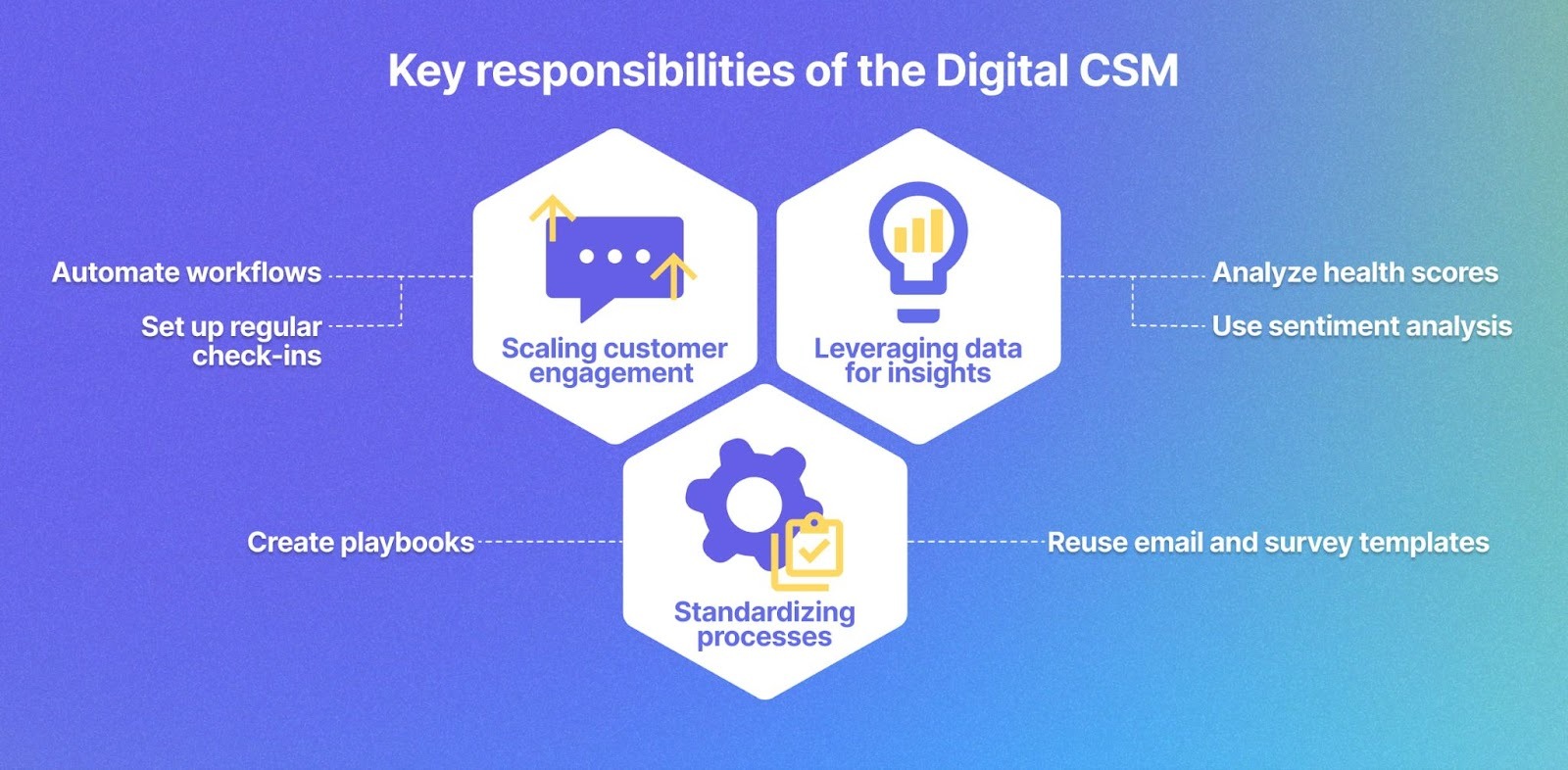
A Digital CSM is responsible for scaling engagement, operationalizing customer data, standardizing workflows, and driving proactive lifecycle outcomes. Their role is to ensure that every customer experiences structured, value-driven engagement even when human interaction is limited.
Scaling customer engagement
One of the primary responsibilities of a Digital CSM is to make engagement scalable without reducing quality.
This includes:
- Automated onboarding journeys that guide customers step-by-step through setup and activation
- Lifecycle messaging aligned to adoption milestones, usage thresholds, and renewal timelines
- Trigger-based education that activates when customers reach key product moments or show signs of friction
Instead of relying on manual check-ins, the Digital CSM builds structured systems that ensure customers consistently move toward value realization.
Leveraging data for prioritization
Digital CSMs operate through data. Their effectiveness depends on identifying which accounts need attention and when.
They rely on:
- Customer health scores to assess risk and engagement levels
- Engagement metrics such as feature usage, survey responses, and communication activity
- Behavior tracking to identify drop-offs, inactivity, or expansion signals
When health scoring incorporates both usage and sentiment, risk becomes more visible earlier. Platforms that combine behavioral signals with AI-powered sentiment detection make it easier to spot subtle warning signs before churn becomes obvious.
Standardizing customer journeys
Consistency is essential when managing customers at scale. A Digital CSM ensures the customer journey is not dependent on individual memory or ad hoc processes.
This involves:
- Building playbooks for onboarding, adoption, and renewals
- Creating email templates and communication frameworks to maintain consistency
- Deploying automated surveys such as NPS or CSAT at defined lifecycle moments
Standardization reduces variability, ensures quality control, and allows teams to improve processes over time based on measurable outcomes.
When automation is properly structured, it connects signals directly to workflows. If adoption slows, engagement sequences activate. If health declines, alerts trigger intervention. This orchestration ensures that customer success becomes systematic.
Signs your team needs a Digital CSM
If your Customer Success team is constantly reacting to issues, struggling to scale engagement, or relying heavily on manual outreach, it is likely time to introduce a Digital CSM role.
Below are some of the clearest signals that your organization is ready for Digital Customer Success.
Growing low-touch segments
When a large portion of your customer base falls into low-touch or tech-touch tiers, it becomes difficult for traditional CSMs to maintain consistent engagement.
Without automation, these customers often receive minimal guidance after onboarding, which can slow adoption and increase churn risk.
A Digital CSM ensures these segments are supported through automated onboarding flows, lifecycle messaging, and proactive education so customers continue progressing toward value even without frequent human interaction.
Inconsistent customer journeys
If customers are experiencing different onboarding paths, irregular follow-ups, or varying levels of support depending on who manages the account, your processes likely lack standardization.
Inconsistency creates confusion, delays time-to-value, and weakens trust.
Digital CSMs solve this by building repeatable playbooks and lifecycle workflows that ensure every customer receives a structured, predictable experience regardless of segment size.
Late risk detection
Many teams only recognize churn risk when a renewal is already in jeopardy. By that point, options are limited.
If your organization frequently discovers disengagement too late, it typically indicates a lack of continuous health monitoring and signal tracking.
A Digital CSM introduces automated health scoring, engagement alerts, and behavioral triggers so teams can intervene earlier, when recovery is still realistic.
CSM bandwidth constraints
When CSMs spend most of their time on manual onboarding emails, follow-ups, reporting, and administrative coordination, strategic work suffers.
Digital Customer Success reduces this operational burden by automating repetitive workflows, allowing traditional CSMs to focus on high-value conversations, expansion opportunities, and relationship building.
Fragmented customer data
If customer signals are scattered across product tools, support platforms, CRM records, and communication channels, gaining a complete picture of account health becomes difficult.
Fragmentation slows decision-making and forces teams to spend time gathering context instead of acting on it.
A Digital CSM model prioritizes unified visibility so engagement decisions are based on real-time insights rather than partial information.
Digital CSM vs hiring more CSMs
When Customer Success teams feel stretched, the instinct is often to hire more CSMs. While adding headcount can relieve short-term pressure, it does not always solve the underlying scalability challenge.
A Digital CSM model increases operational leverage rather than simply expanding capacity. Instead of growing linearly with your customer base, your team gains the ability to support more accounts through automation, structured workflows, and intelligence-driven prioritization.
Here is how the two approaches typically compare:
Why hiring alone doesn’t scale
Bringing on additional CSMs helps distribute workload, but it also introduces complexity. More people means more coordination, greater variability in execution, and higher operational expenses.
Without structured systems in place, new hires often inherit the same manual processes that created the bottleneck in the first place.
As customer expectations for proactive engagement continue to rise, simply increasing headcount becomes unsustainable.
How AI is transforming the digital CSM role
AI is redefining what it means to operate digitally in Customer Success. Instead of spending time compiling reports, reviewing activity logs, or manually identifying risk, Digital CSMs can now rely on intelligence systems that surface insights automatically.
It's important for either the Digital CSM themselves, or someone specifically designated, to take on the role of an AI champion. Our State of AI in CS in 2026 report found that having a named AI champion roughly doubles the likelihood that a CS team member feels more satisfied in their role since AI adoption.
From dashboards to intelligence
Traditional CS tools present data. AI interprets it.
Rather than forcing teams to analyze dozens of metrics, modern platforms identify meaningful changes in customer behavior and highlight what requires attention. This reduces cognitive load and allows Digital CSMs to focus on outcomes instead of investigation.
AI-driven insights help answer questions such as:
- Which accounts are disengaging?
- Where is adoption slowing?
- Which customers are showing expansion signals?
Instead of reacting late, teams can intervene while there is still time to influence the outcome.
Conversation-level understanding
Customer intent is often hidden inside emails, calls, tickets, and meeting notes. AI can analyze this unstructured data at scale, turning everyday interactions into actionable insight.
Platforms like Velaris, a highly rated platform on G2, enable this through capabilities such as CallSense and AI Topics, which extract sentiment, detect risk language, and surface recurring customer issues automatically.
This gives Digital CSMs a clearer picture of customer health without requiring them to manually review every conversation.
Predictive risk detection
One of AI’s most valuable contributions is the ability to identify churn risk before it becomes visible through traditional metrics.
By analyzing engagement patterns, usage trends, and sentiment signals together, AI can flag accounts that are drifting long before renewal discussions begin.
This transforms Customer Success from reactive firefighting into proactive risk management.
Digital CSMs can then prioritize outreach based on likelihood of impact rather than guesswork.
Next-best-action systems
Knowing there is a problem is only half the battle. AI increasingly helps teams understand what to do next.
Solutions such as Velaris Copilot recommend outreach strategies, suggest escalation paths, and guide Digital CSMs toward the actions most likely to improve customer outcomes.
This shortens decision cycles and creates more consistent execution across the team.
Best practices for building a digital CSM function
Successful Digital Customer Success programs are not built overnight. They require alignment to business goals, the right operational structure, and technology that enables scale without sacrificing customer experience.
Align the role with business outcomes
A Digital CSM function should be tied directly to measurable business objectives, not just operational efficiency.
Common outcome areas include:
- Retention improvement through earlier risk detection
- Expansion growth via adoption and value realization
- Product adoption lift across low-touch segments
- Improved engagement rates at scale
Without clear success metrics, Digital CS becomes a workflow engine rather than a revenue lever. Define what success looks like before building processes.
Choose a unified platform
Digital CS relies heavily on automation, analytics, and customer data. If these systems live across disconnected tools, scale becomes harder, not easier.
Instead of stitching together separate solutions for:
- Health scoring
- Automation
- Surveys
- Sentiment analysis
- Reporting
Choose a unified platform that centralizes customer signals and connects intelligence directly to workflows.
Platforms like Velaris are built with this unified architecture in mind, combining automation, health scoring, sentiment analysis, and AI-driven recommendations in one workspace. This reduces complexity and prevents siloed execution.
Start with a pilot segment
Introducing a Digital CSM function across the entire customer base at once can create confusion.
Start small.
Select a clearly defined low-touch or tech-touch segment and:
- Build lifecycle workflows
- Implement automated onboarding
- Activate health monitoring
- Test trigger-based outreach
A pilot allows you to measure impact, refine processes, and demonstrate ROI before expanding the model across additional segments.
Clearly define ownership
One of the most common challenges when introducing Digital CS is overlap with traditional CSM roles.
Define clearly:
- Which segments the Digital CSM owns
- What triggers escalate accounts to high-touch
- How lifecycle automation supports, rather than replaces, traditional CSM engagement
Digital and traditional CSMs should complement each other. Digital CS drives scale and structure, while traditional CSMs deepen strategic relationships.
Measure impact early and often
A Digital CSM function must prove its value quickly.
Track metrics such as:
- Adoption rate improvements
- Engagement lift
- Churn reduction in tech-touch segments
- Reduction in manual workload
- Time-to-intervention for at-risk accounts
Early measurement ensures continuous improvement and builds internal confidence in the Digital CS model.
Tool capabilities that enable a Digital CSM
Digital Customer Success cannot operate effectively without the right technology. Because the role is designed to scale engagement, detect risk early, and automate lifecycle moments, Digital CSMs rely on platforms that unify data, surface insights, and trigger action automatically.
At a minimum, your tech stack should reduce manual effort while increasing visibility across the customer journey. Here are some required capabilities for tools to help with Digital Customer Success:
Automation workflows
Digital CSMs need the ability to orchestrate customer journeys without manual intervention. This includes automated onboarding sequences, milestone-based messaging, renewal reminders, and re-engagement campaigns.
Strong workflow engines ensure that every customer receives consistent guidance regardless of segment size.
Customer health scoring
Health scoring provides a real-time indicator of customer risk and opportunity. Effective platforms calculate health using multiple signals such as product usage, engagement patterns, support activity, and feedback. This allows Digital CSMs to prioritize outreach instead of reacting after problems surface.
For a closer look at how to visualize and act on these signals, see our guide to customer health dashboards and what effective health monitoring looks like in practice.
Sentiment analysis
Understanding how customers feel is just as important as understanding what they do. Sentiment analysis helps Digital CSMs detect dissatisfaction early by analyzing emails, support tickets, call transcripts, and survey responses. Emotional context often reveals risk before behavioral metrics do.
Lifecycle orchestration
Digital CS depends on structured customer journeys. Platforms should allow teams to design lifecycle stages from onboarding to adoption to renewal, with automated triggers guiding customers toward value at each phase.
Unified customer data
Fragmented data is one of the biggest blockers to scalable Customer Success. Digital CSMs need a single source of truth that consolidates product data, communication history, support interactions, and feedback into one workspace. Unified data improves decision-making and prevents blind spots.
AI-driven recommendations
As Customer Success becomes more intelligence-led, AI is emerging as a critical capability. Rather than forcing teams to interpret dashboards manually, modern platforms analyze signals and recommend next steps automatically. This shifts Digital CSMs from data gathering to strategic execution.
For a breakdown of what's available in this space, see our roundup of the top AI customer success tools and how they compare on key capabilities.
Common Mistakes When Adopting Digital Customer Success
Digital Customer Success can significantly improve scalability, consistency, and proactive engagement. However, many organizations fail to realize its full value because of avoidable strategic and operational mistakes. Understanding these pitfalls early can help your team build a stronger, more sustainable digital CS function.
Treating automation as a replacement for relationships
Automation should enhance the customer experience, not depersonalize it. One of the biggest mistakes teams make is assuming that digital means impersonal.
Customers still expect relevance, empathy, and timely human intervention when it matters. The goal is not to remove people from the process, but to reserve human attention for high-impact moments while automation handles routine interactions.
Avoid this by:
- Designing escalation paths for high-risk accounts
- Combining automated outreach with human follow-ups
- Personalizing messages using behavioral data
Launching without data readiness
Automation and AI are only as effective as the data behind them. If customer data is fragmented, outdated, or inconsistent, digital workflows can trigger the wrong messages or miss critical risk signals.
Before scaling digital engagement, ensure your foundation is strong.
Avoid this by:
- Unifying customer data across product, support, and CRM systems
- Establishing clear data governance practices
- Regularly auditing health score inputs and lifecycle fields
Clean, connected data is what turns automation into intelligence.
Over-automating communication
Sending too many automated emails, alerts, or prompts can overwhelm customers and reduce engagement rather than improve it. When everything is automated, nothing feels important.
Digital Customer Success should prioritize precision over volume.
Avoid this by:
- Triggering communication based on meaningful signals
- Mapping outreach to lifecycle moments
- Monitoring engagement metrics to identify fatigue
Well-timed communication builds trust. Excessive communication erodes it.
Failing to define ownership
Digital CS introduces new responsibilities that often sit between operations, Customer Success, and RevOps. Without clear ownership, workflows become inconsistent and accountability suffers.
Everyone should understand who designs journeys, who manages automation, and who responds when risks surface.
Avoid this by:
- Assigning a clear owner for digital programs
- Documenting responsibilities between digital and traditional CSMs
- Establishing governance for workflow changes
Using disconnected tools
Many teams attempt digital Customer Success by stitching together multiple point solutions for automation, analytics, messaging, and health scoring. The result is fragmented insights, duplicated work, and delayed action.
Digital CS is most effective when signals and workflows live in the same operational system.
Avoid this by:
- Prioritizing platforms that unify data and engagement
- Reducing tool sprawl wherever possible
- Ensuring insights connect directly to automated actions
Conclusion
Digital Customer Success is no longer a forward-looking concept. It is quickly becoming the operational standard for teams that need to scale without sacrificing customer experience.
As customer bases grow and expectations rise, manual workflows and reactive engagement simply cannot keep up. Teams must be able to detect risk earlier, personalize engagement automatically, and act on customer signals in real time.
This is where AI-native platforms make a meaningful difference. Instead of forcing teams to search for insights across fragmented tools, platforms like Velaris, a highly rated software on G2, unify customer data, surface priorities, and connect intelligence directly to action.
Book a demo to see how Velaris helps modern CS teams engage customers intelligently and operate at scale.
Frequently Asked Questions
What does a Digital Customer Success Manager do?
A Digital Customer Success Manager uses automation, data insights, and AI to manage customer relationships at scale. Their role focuses on delivering proactive engagement, standardizing customer journeys, and ensuring low-touch segments still receive consistent value.
How is a Digital CSM different from a traditional CSM?
Traditional CSMs typically manage smaller portfolios with high-touch relationships. Digital CSMs focus on scalability, using systems and automation to engage broader customer segments while freeing traditional CSMs to focus on strategic accounts.
When should a company hire a Digital CSM?
Organizations should consider introducing a Digital CSM when customer growth begins to outpace team capacity, engagement becomes reactive, or manual workflows limit scalability. It is often a signal that Customer Success needs operational leverage rather than additional headcount.
What tools does a Digital CSM need?
A strong Digital CS function relies on platforms that unify customer data, automate lifecycle workflows, monitor health, analyze sentiment, and provide AI-driven recommendations. These capabilities enable teams to detect risk early and engage customers proactively.
How does AI support Digital CSMs?
AI helps Digital CSMs identify patterns humans might miss. It can surface churn signals, analyze sentiment from conversations, prioritize accounts, and recommend next-best actions. This allows teams to shift from reactive support to predictive engagement.
What metrics should a Digital CSM own?
Common metrics include customer health, product adoption, engagement rates, retention, expansion revenue, and lifecycle progression. Many teams also track automation impact, such as reduced manual workload and faster response times, to measure operational efficiency.

The Velaris Team
A (our) team with years of experience in Customer Success have come together to redefine CS with Velaris. One platform, limitless Success.




Velaris is an AI-native Customer Success Platform built for mid-market and enterprise B2B SaaS teams. From customer health scoring and churn prediction to onboarding automation, renewals, and expansion workflows, Velaris helps recurring revenue teams understand account health, reduce churn, and scale customer success with greater visibility and control.