We look forward to showing you Velaris, but first we'd like to know a little bit about you.


Customer Retention Software: A Buyer's Guide
Discover key strategies and features for effective customer retention management
The Velaris Team
July 23, 2026
Customer Success leaders and CSMs know that retaining customers is far harder than closing them. Yet many teams still rely on disconnected tools, manual health tracking, and reactive renewal workflows.
When customer data lives in multiple systems, warning signs are easy to miss. Churn comes as a surprise, and teams have no time to build proactive strategies when they are stuck putting out the fires.
Customer retention management software solves this by centralizing customer data, automating lifecycle workflows, and surfacing risks early.
In this guide, we break down how to implement retention software, what the best customer retention software available today is, what each platform is best for, and how to choose the right solution for your team.
Key Takeaways
- Velaris: Best for AI-native, proactive Customer Success teams that want automation, predictive insights, and unified customer intelligence.
- Gainsight: Best for large enterprises needing deep configurability and mature CS operations.
- Totango: Best for structured success programs with flexible segmentation.
- ChurnZero: Best for SaaS teams prioritizing engagement and in-app communication.
- HubSpot Service Hub: Best for teams already embedded in HubSpot seeking lightweight retention capabilities.
Things to Consider When Buying Customer Retention Software
The best customer retention platforms help you detect churn early, automate engagement, unify customer data, and scale proactive success.
Before evaluating vendors, focus on the capabilities that directly impact retention outcomes.
1. Proactive customer health monitoring
Look for platforms that combine usage data, engagement signals, and sentiment to give you a real-time understanding of account health.
Static dashboards are no longer enough. Modern teams need systems that surface risk automatically.
2. Automation built for the post-sale lifecycle
Retention software should orchestrate onboarding, success plans, renewal workflows, and expansion plays without requiring manual intervention.
Automation should reduce CSM workload, not create operational complexity.
3. AI-driven insights
AI tools are rapidly becoming the line between reactive and proactive Customer Success.
Leading platforms now:
- Detect churn signals
- Analyze conversations
- Identify adoption blockers
- Recommend next-best actions
If a platform only reports on what happened, your team will always be behind.
4. Unified customer data
Retention is impossible without context. Choose software that integrates with product, CRM, support, and billing systems to create a single source of truth.
Fragmented data leads directly to missed risk signals.
5. Ease of adoption
Even powerful software fails if teams do not use it. Prioritize platforms with intuitive workflows that embed naturally into how CSMs already operate.
Opt for software with a user-friendly interface that requires minimal training. This ensures your team can quickly leverage the software to its full potential.
6. Cost
Customer retention software may be priced per seat, per account, by usage, or as a platform fee. Check how the cost will scale as your CS team grows, your customer base expands, or AI usage increases.
The clearest way to justify the investment is to compare it against the revenue value of protected accounts. If the platform helps prevent churn across even a small number of high-value customers, the retained ARR may outweigh the software cost.
Ask vendors about costs beyond the headline price, including implementation, integrations, training, support, and paid modules. For Finance, build a simple ROI case that shows current churn, target churn reduction, retained ARR, and expected payback period.
7. Churn prediction accuracy
Churn-prediction accuracy can sound impressive in a vendor demo, but buyers should understand how that number was measured. Ask whether the model was tested on historical data it had not seen before and which churn definition was used.
Also ask what the model compares against. Useful questions include: “What is your false-positive rate?”, “How often does the model miss churned accounts?”, and “Can CSMs see which signals drove the prediction?”
Finally, ask how accuracy changes by segment. A model may work well for SMB accounts but perform poorly for enterprise customers with longer buying cycles and more complex stakeholder dynamics.
The best vendors will show the logic behind each prediction, explain its limits, and allow CSMs to override the risk assessment when account context is missing.
7. Scalability
Your retention strategy will evolve as your customer base grows. Select a platform that supports both high-touch and digital success motions without forcing a migration later.
Look for platforms that offer flexible features and plans that can accommodate an increasing number of customers without compromising performance or requiring significant overhauls.
Even a small improvement to customer retention goes a long way, as proved by research from Bain & Company, which shows increasing customer retention rates by 5% increases profits by 25% to 95%. Implementing the right Customer Retention Management Software has the potential to go far beyond this.
Best Customer Retention Management Software
The best customer retention platforms include Velaris, Gainsight, Totango, ChurnZero, and HubSpot Service Hub. Each supports retention differently, from AI-driven risk detection to structured success programs and enterprise-scale analytics.
Choosing the right platform depends largely on your team’s maturity, customer complexity, and how proactive you want your Customer Success motion to be.
1. Gainsight
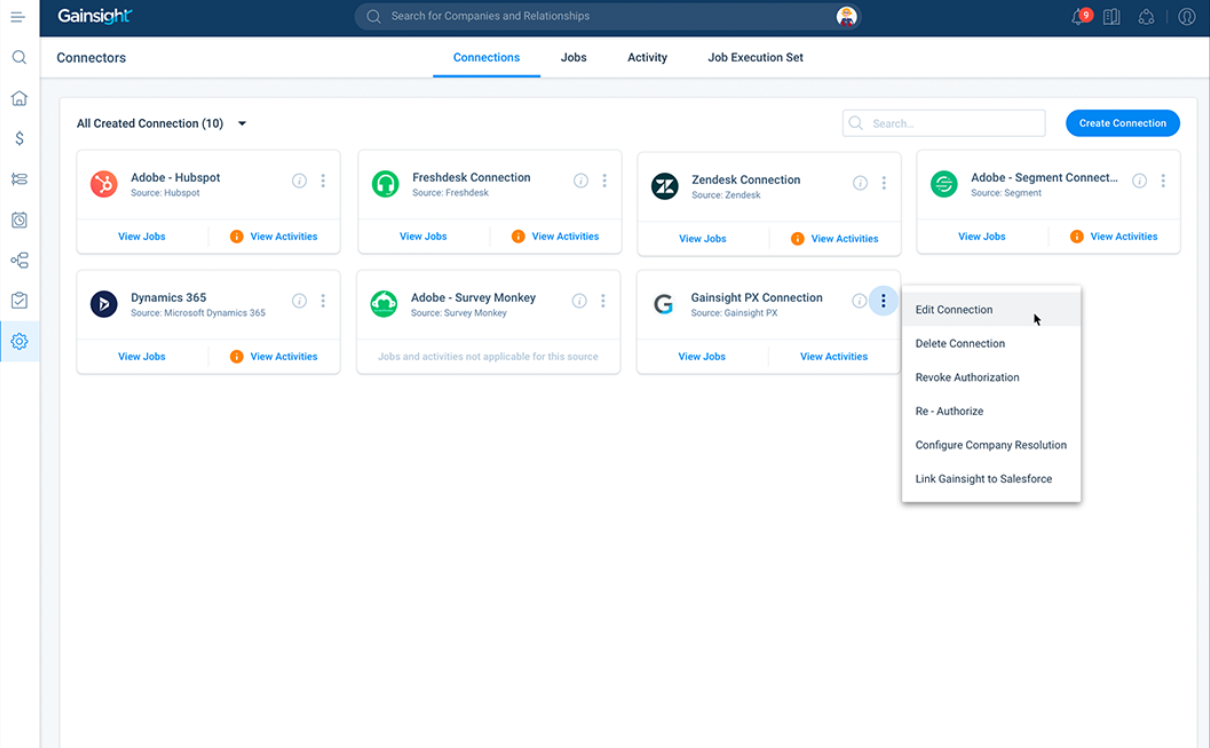
What it is
Gainsight is one of the most established Customer Success platforms, known for its depth, configurability, and enterprise-ready capabilities. It provides tools for health scoring, workflow automation, and advanced reporting across large customer portfolios.
Strengths
- Extensive customization options to support complex CS operations
- Powerful analytics and reporting for executive visibility
- Mature partner ecosystem and integrations
- Scales well across global teams
Considerations
Gainsight’s flexibility often comes with operational overhead. Implementation can be lengthy, configuration may require specialized expertise, and many organizations rely on dedicated admins to manage the platform effectively.
Best for
Large enterprises with sophisticated Customer Success programs, complex hierarchies, and the resources to support a highly configurable system.
2. Velaris
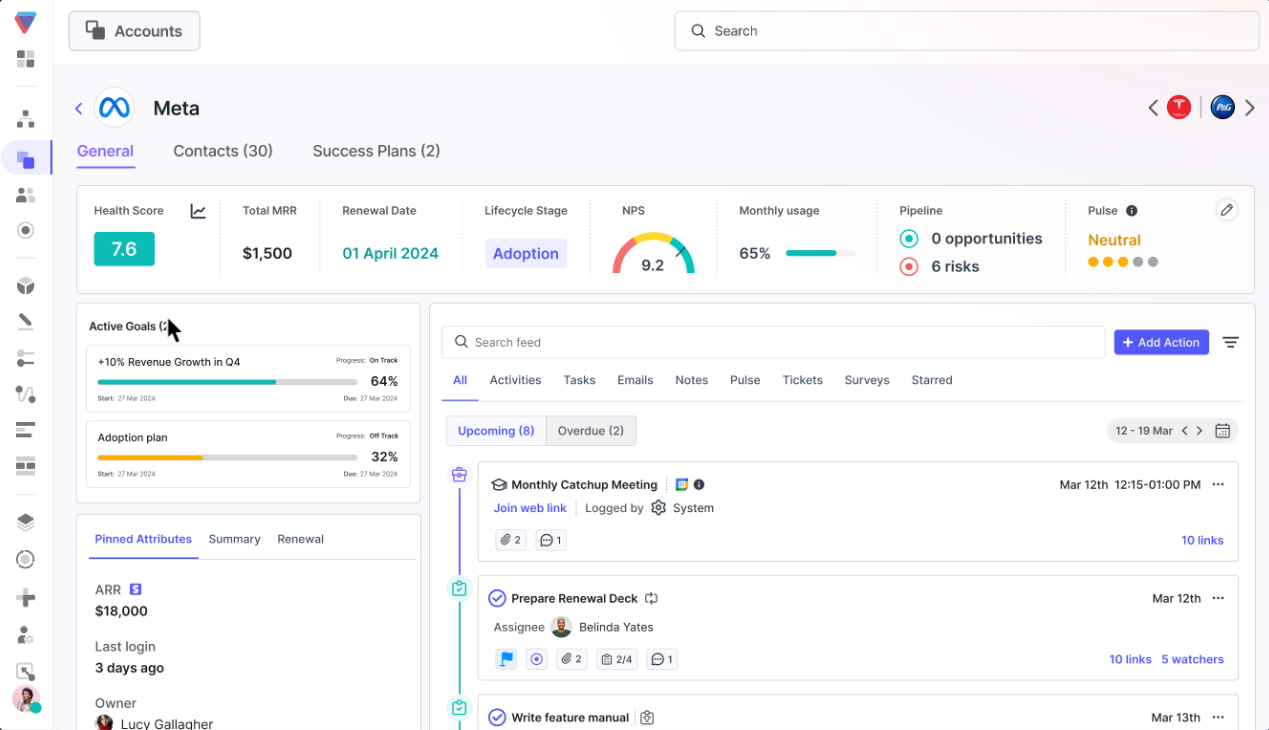
What it is
Velaris, a highly rated platform on G2, is an AI-native Customer Success platform built to help teams prevent churn, automate lifecycle workflows, and transform customer data into proactive engagement strategies. Rather than functioning as a passive system of record, Velaris acts as an intelligence layer that continuously interprets customer signals.
Many retention tools focus on dashboards that require manual interpretation. Velaris shifts this model by embedding AI directly into daily workflows, allowing teams to detect risk earlier, prioritize accounts faster, and act with greater confidence.
Key strengths
- AI Copilot: Recommends next-best actions based on real-time customer context, helping CSMs respond strategically instead of relying on intuition.
- CallSense: Converts customer calls into structured insights by identifying sentiment, risks, objections, and opportunity signals.
- Trending Topics: Automatically clusters feedback and conversations to reveal recurring issues across accounts.
- Health + sentiment fusion: Combines behavioral signals with emotional context for more accurate health scoring.
- Signal-based automation: Playbooks trigger directly from risk indicators, adoption drops, or engagement changes.
- Canvas: A unified customer workspace that provides cross-functional visibility so that customers and internal teams can operate from the same context.
Considerations
Velaris is designed for proactive Customer Success organizations. Teams transitioning from spreadsheets or heavily manual workflows may need to rethink processes to fully benefit from automation and AI-driven insights.
Best for
Mid-market and enterprise Customer Success teams looking to scale intelligently, improve forecasting, and build a predictive retention strategy powered by AI.
3. Totango
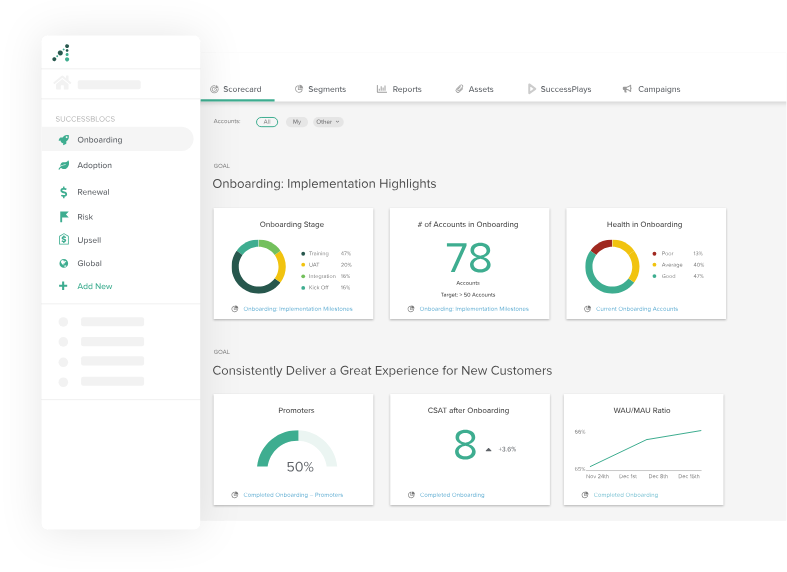
What it is
Totango is a modular Customer Success platform designed to help teams operationalize structured customer journeys through pre-built success programs and segmentation.
Strengths
- Flexible architecture that adapts to different success motions
- Strong segmentation for targeting customer cohorts
- Pre-configured templates that accelerate program setup
- Supports both digital and high-touch engagement models
Considerations
While Totango provides strong structure, advanced workflows often require thoughtful configuration. Teams seeking faster time-to-value may need to invest upfront in designing their programs.
Best for
Organizations that value repeatable frameworks and want to formalize Customer Success processes without building everything from scratch.
4. ChurnZero
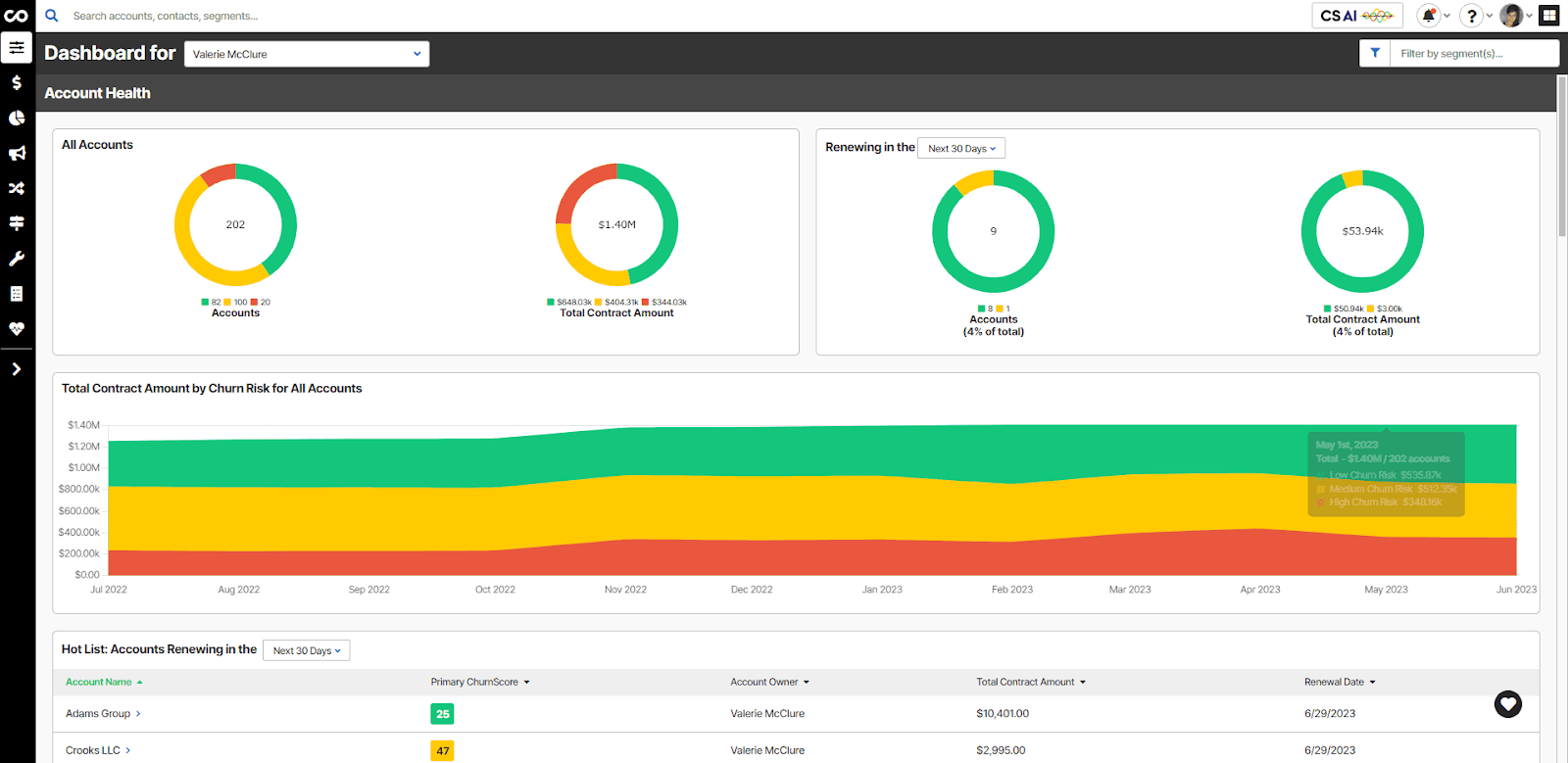
What it is
ChurnZero is a Customer Success platform built with SaaS companies in mind, emphasizing real-time engagement, product adoption, and automated communication.
Strengths
- In-app messaging that connects directly with users inside the product
- Strong automation for lifecycle outreach
- Real-time alerts that help teams respond quickly
- Tools geared toward improving adoption and engagement
Considerations
To unlock its full potential, teams often need clearly defined processes and operational discipline. Without strong strategy, automation alone may not deliver meaningful retention gains.
Best for
SaaS businesses prioritizing product usage, customer engagement, and scalable communication strategies.
5. HubSpot Service Hub
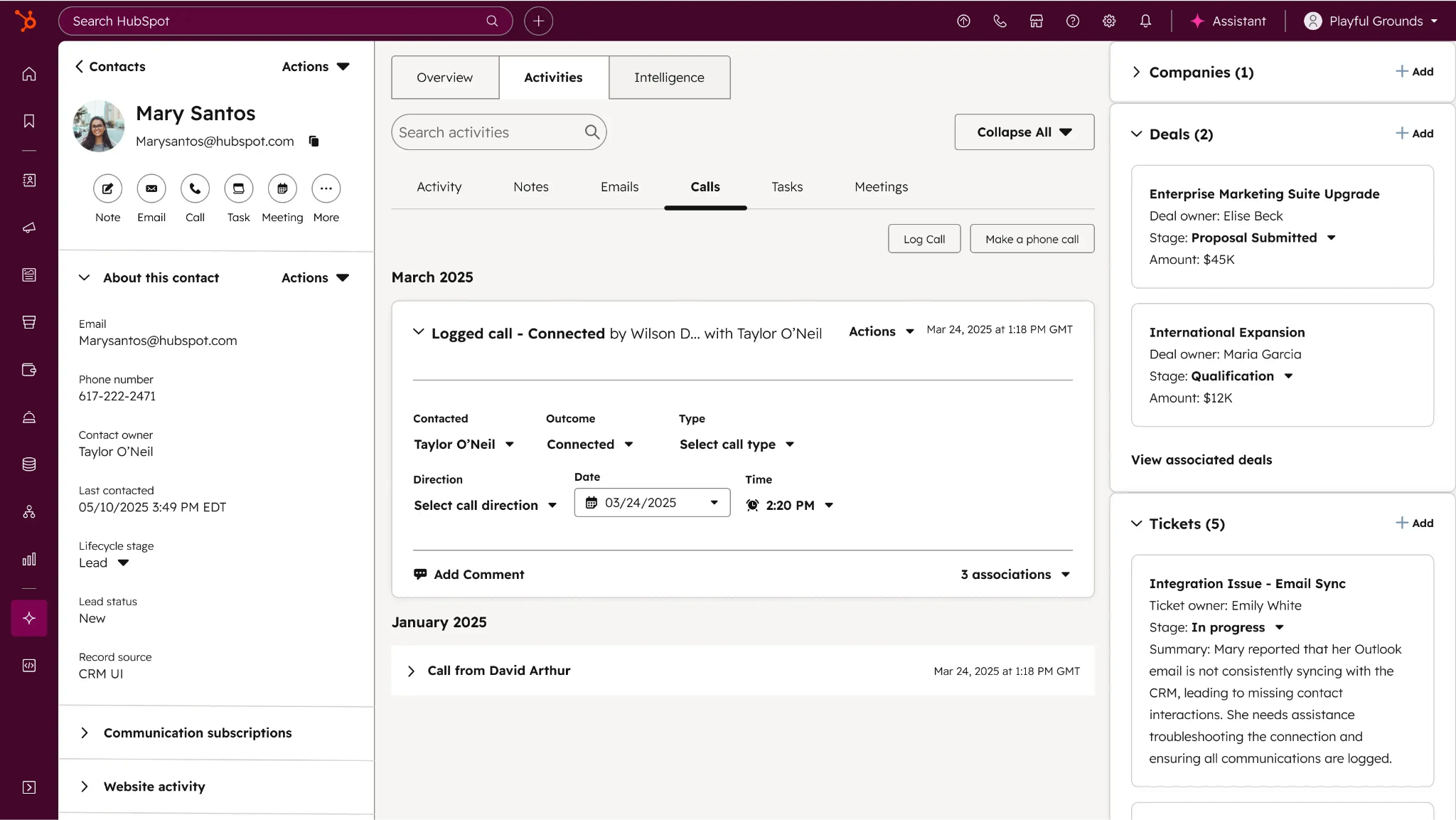
What it is
HubSpot Service Hub extends HubSpot’s ecosystem into customer support and retention, offering tools like ticketing, knowledge bases, and feedback collection within a familiar interface.
Strengths
- Native integration with HubSpot CRM
- Intuitive, easy-to-adopt user experience
- Strong customer support infrastructure
- Ideal for teams already standardized on HubSpot
Considerations
Service Hub is not purpose-built for Customer Success. Advanced capabilities such as predictive health scoring, lifecycle automation, and deep retention analytics are more limited compared to dedicated CS platforms.
Best for
Growing companies already operating within HubSpot that want lightweight retention functionality without introducing another platform.
Building the internal business case for retention software
Customer retention software is rarely approved just because CS asks for better visibility. Finance needs to understand how the spend protects revenue and reduces risk.
Translate churn into revenue risk
Start by showing the current cost of churn. Calculate lost ARR from churned accounts, downgraded accounts, and late-stage renewal risks. Then compare that number against the cost of the software.
This reframes the purchase from “another CS tool” to a revenue protection investment. If the platform helps the team identify risk earlier, improve renewal readiness, or protect even a few high-value accounts, the business case becomes much easier to justify.
Show the cost of manual retention work
Finance will also care about efficiency. Show how much time CSMs currently spend updating spreadsheets, searching for account context, manually reviewing risks, or preparing renewal reports.
This helps connect the platform to capacity. The goal is not always to reduce headcount. It may be to help the same team manage a larger customer base without letting risk, handoffs, or renewal preparation fall behind.
Separate upfront and ongoing costs
Build the case with the full cost included. Ask vendors about implementation, integrations, training, support, paid modules, AI usage, and future seat or account growth.
This avoids surprises during procurement. It also helps Finance compare vendors on total cost of ownership, not just the headline subscription price.
Define how ROI will be measured
Agree on the success metrics before purchase. These might include retained ARR, reduction in gross churn, improved renewal forecast accuracy, faster alert-to-action time, lower manual reporting effort, or higher CSM-to-account coverage.
The strongest business case does not promise that software alone will fix retention. It shows how the platform will help the CS team act earlier, work more consistently, and protect revenue that is already at risk.
Retention metrics to track before and after implementation
Customer retention management software should improve visibility, prioritisation, and retention outcomes. To prove whether it is working, baseline your key metrics before implementation and track how they change after the platform is live.
Baseline core retention metrics before purchase
Before choosing a platform, capture the current state of your retention motion. Track gross revenue retention, net revenue retention, gross churn, customer churn rate, renewal rate, customer lifetime value, and CSM-to-account ratio.
This gives you a clear “before” picture. Without it, it becomes difficult to prove whether the software improved retention or whether performance changed because of pricing, product updates, new hires, or shifts in customer mix.
Track early leading indicators in the first 90 days
Retention outcomes take time to show up, so the first 90 days should focus on leading indicators. Track whether health scores are accurately identifying risk, how quickly alerts turn into action, how often playbooks are triggered, and whether CSMs are spending less time manually searching for account context.
Alert-to-action time is especially useful. If a risk signal used to sit unnoticed for two weeks and is now reviewed within two days, the software is already improving the team’s ability to intervene earlier.
Compare against realistic retention benchmarks
Benchmarks vary by company stage, ACV, market, and customer segment. ChartMogul reports that a median early-stage SaaS company under $300k ARR has a customer churn rate of 6.5%, while median early-stage net MRR churn is 6.2% and gross MRR churn is 9.1%. For more mature bootstrapped B2B SaaS companies with $3M–$20M in ARR, SaaS Capital’s 2026 benchmarks show median NRR of 103% and GRR of 91%.
Separate software impact from process changes
Retention software rarely works in isolation. Teams often implement it alongside new playbooks, revised health scores, better onboarding, or clearer renewal ownership. That makes attribution tricky.
To separate the impact, document what changed during implementation. Compare pre- and post-launch cohorts, track adoption by CSM team, and note whether improvements came from faster risk detection, better task follow-through, or broader process changes.
The goal is not to prove that the software did everything on its own. It is to understand whether the platform helped the team act earlier, work more consistently, and improve the retention metrics that matter most.
How to roll out retention software: a step-by-step implementation plan
Choosing customer retention software is only the first step. The rollout matters just as much. A rushed implementation can create messy data, low CSM adoption, and health scores that no one trusts.
Start with your biggest gap
Before connecting every system, define the main problem the software needs to solve. That might be missed churn signals, inconsistent renewal preparation, weak onboarding visibility, or too much manual account tracking.
This helps you prioritise setup. A team struggling with churn risk may focus first on health scoring and alerts. A team struggling with onboarding may start with milestone tracking and playbooks.
Connect core data sources first
Start with the systems that give the clearest view of customer risk. CRM data should usually come first because it contains account ownership, contract value, renewal dates, lifecycle stage, and commercial history.
Next, connect product usage data so the platform can understand adoption and engagement. After that, bring in support tickets, customer communications, survey responses, and other signals that add context.
Avoid turning on health scoring before the core data is reliable. A health score built on incomplete CRM, usage, or support data will create more confusion than clarity.
Run a parallel scoring period
If your team already uses a spreadsheet, legacy platform, or manual health model, do not switch it off immediately. Run both systems in parallel for a defined period so you can compare outputs.
During this phase, check whether the new platform flags the same risks your team already knows about. Also look for accounts the old process missed. This helps build trust before the new system becomes the official source of truth.
Pilot with a small group of CSMs
Choose a pilot group before rolling the software out to the whole team. The group should include CSMs who manage different account types, lifecycle stages, and customer segments.
Train them on the workflows that matter most: reading health scores, responding to alerts, updating account records, using playbooks, and logging next steps. Their feedback can help refine fields, dashboards, automations, and handoff rules before wider launch.
Roll out in phases based on team size
A small CS team may reach usable adoption in two to four weeks if the data model is simple. A mid-sized team may need four to eight weeks to validate workflows, train users, and migrate from old processes. Larger teams may need eight to twelve weeks or more, especially if there are multiple regions, segments, or integrations involved.
Use these timelines as planning benchmarks, not fixed rules. Adoption depends on data quality, process complexity, and how much change the team is being asked to absorb.
Run legacy health scoring in parallel before switching over
If your team already uses a spreadsheet or manual health scoring process, do not replace it overnight. Run the old process and the new retention platform in parallel for a short transition period so scores do not diverge.
During this phase, compare which accounts each system marks as healthy, at risk, or unclear. Look for gaps in the new model, such as missing product usage data, outdated CRM fields, or support tickets that are not yet synced.
CSMs should review any major differences and document the reason. If the spreadsheet catches a risk the new platform misses, update the health score logic before rollout. If the platform flags risks the old process missed, use those examples to build trust with the team.
Make adoption measurable
Track whether CSMs are actually using the platform after launch. Useful adoption signals include completed playbooks, alert response time, updated account notes, health score review frequency, and reduction in spreadsheet usage.
Conclusion
Customer retention has become a defining factor in long-term business growth. As customer expectations rise and post-sale journeys grow more complex, relying on manual processes or fragmented tools is no longer sustainable.
While several strong retention management platforms exist, the biggest shift in Customer Success is toward intelligence-driven operations. AI-native platforms are helping teams move beyond static dashboards by interpreting customer signals and recommending actions before issues escalate.
Velaris, a highly rated software on G2, represents this next evolution. If you're evaluating customer retention software and want a platform built for modern, AI-powered Customer Success, book a demo to see how Velaris can help you prevent churn, uncover growth opportunities, and turn customer insights into action.
Frequently Asked Questions
What is customer retention management software?
Customer retention management software helps businesses monitor customer health, detect churn risk, automate engagement, and manage the post-sale lifecycle. It centralizes customer data so teams can act proactively instead of reacting after problems arise.
How should contract cycle length affect retention software priorities?
Contract cycle length should influence which retention software features you prioritise first. If most customers are on annual contracts your team needs early warning signals because there is less time to recover at-risk accounts before renewal.
For multi-year contracts, renewal risk still matters, but the bigger challenge is spotting disengagement long before the final contract year. So prioritise long-term adoption tracking, success plans, and value reporting.
When should a company invest in retention software?
Companies should consider retention software once customer volume increases, renewals become a meaningful revenue driver, or manual tracking starts causing missed risks and inconsistent engagement.
How is retention software different from a CRM?
CRMs primarily support sales by managing contacts, deals, and pipelines. Retention platforms focus on post-sale success, helping teams track health scores, automate onboarding and renewals, and strengthen long-term relationships.
What features matter most in a retention platform?
Look for automation, customer health scoring, strong integrations, lifecycle workflows, analytics, and increasingly, AI capabilities that surface risks and recommend next steps.
What results should teams expect after implementing retention software?
Most teams see earlier risk detection, improved renewal planning, more consistent customer engagement, and reduced manual workload, all of which contribute to stronger retention and expansion outcomes.

The Velaris Team
A (our) team with years of experience in Customer Success have come together to redefine CS with Velaris. One platform, limitless Success.




Velaris is an AI-native Customer Success Platform built for mid-market and enterprise B2B SaaS teams. From customer health scoring and churn prediction to onboarding automation, renewals, and expansion workflows, Velaris helps recurring revenue teams understand account health, reduce churn, and scale customer success with greater visibility and control.