We look forward to showing you Velaris, but first we'd like to know a little bit about you.


Analyzing Customer Feedback and Data for Businesses
Learn how to analyze customer feedback and data to improve your product.
The Velaris Team
August 7, 2026
Most businesses collect customer feedback, but the real struggle is knowing what to do with it. Emails, calls, surveys, and social media comments pile up quickly, leaving teams overwhelmed and unsure how to turn scattered opinions into clear direction.
Forrester reports that only around one in five voice-of-the-customer and measurement teams believe they have effective processes for prioritizing customer experience initiatives or acting on insights.
Without proper analysis, valuable insights get lost, and opportunities to improve customer satisfaction slip away.
This guide shows how businesses can organize, analyze, and act on feedback effectively transforming raw data into strategies that reduce churn, strengthen loyalty, and drive growth.
Key takeaways
- Customer feedback is a business superpower that drives growth, loyalty, and reputation.
- Feedback comes in different forms: direct, indirect, behavioral, and support interactions.
- Smart collection methods like NPS, CSAT, polls, and CRM tools make feedback easy and actionable.
- Analysis methods such as quantitative, qualitative, sentiment, and comparative turns data into insights.
- Winners follow best practices: collect continuously, respond to customers, share insights, and track improvements.
Why customer feedback is your business superpower
Customer feedback is the information businesses receive from customers about their experiences, opinions, and expectations. It includes data from surveys, reviews, emails, calls, and even social media comments, and it helps companies understand what customers truly want.
Feedback drives growth because it highlights what’s working and what needs improvement. 70% of executives say customer expectations are changing faster than their company can adapt (PwC, 2025). Therefore, when businesses act on this data, they can refine products, improve services, and make smarter decisions that lead to higher revenue.
It also builds loyalty. Customers feel valued when their voices are heard, and this strengthens long‑term relationships. Loyal customers are more likely to recommend your brand, reducing churn and boosting retention.
Customer feedback enhances reputation. 29% of consumers stopped using a brand due to poor customer experience (PwC, 2025). Companies that listen and respond are seen as trustworthy and customer‑centric, which attracts new customers and sets them apart from competitors.
Types of customer feedback
Customer feedback comes in different forms, and understanding each type helps businesses collect the right data and act on it effectively.
- Direct feedback includes surveys, interviews, and focus groups where customers share their opinions openly. This type of feedback is structured and intentional, giving businesses clear answers to specific questions.
- Indirect feedback comes from sources like social media mentions, online reviews, and forums. Customers may not be speaking directly to the business, but their comments still reveal valuable insights about satisfaction and reputation.
- Behavioral data refers to actions customers take, such as website visits, purchase history, or churn rates. Instead of words, this feedback shows patterns in customer behavior that highlight preferences and pain points.
- Support interactions include emails, live chats, and call transcripts. These conversations often uncover recurring issues and give businesses a real‑time view of customer needs.
Direct surveys capture only part of the customer voice. Qualtrics’ 2025 consumer research, based on nearly 24,000 respondents across 23 countries, found that fewer than one-third of consumers provide feedback directly to a company.
This makes reviews, support conversations and behavioral data essential for understanding customers who never complete a survey.
Smart ways to collect feedback that customers actually give
The smartest way to collect customer feedback is to make it simple, accessible, and relevant. Businesses need methods and tools that encourage customers to share their thoughts without friction, while ensuring the feedback is useful and actionable.
Methods
- NPS (Net Promoter Score): measures customer loyalty by asking how likely they are to recommend your business.
- CSAT (Customer Satisfaction Score): captures immediate satisfaction after a purchase or interaction.
- Polls and short surveys: quick, focused questions that encourage higher response rates.
Tools
- CRM systems: centralize customer data and feedback for easy tracking.
- Feedback widgets: embedded on websites or apps to capture real‑time input.
- Social listening platforms: monitor mentions and reviews across social media and online channels.
Best practices
- Keep surveys short and simple to respect customer time. SurveyMonkey’s analysis of 100,000 surveys found that respondent drop-off increased as additional questions were added.
- Ask specific questions that lead to actionable insights.
- Allow anonymous responses to encourage honesty.
- Follow up to show customers their feedback is valued.
Analyzing customer feedback
Analyzing customer feedback means turning raw opinions and data into actionable insights. Businesses use different approaches to understand customer needs and make better decisions.
Quantitative analysis
- Focuses on numbers and measurable data.
- Tracks trends, KPIs, and percentages over time.
- Helps identify patterns such as rising satisfaction scores or declining retention rates.
Qualitative analysis
- Examines open‑ended feedback like comments and interviews.
- Identifies recurring themes and pain points customers mention.
- Provides context behind the numbers, showing why customers feel a certain way.
Sentiment analysis
- Uses AI‑driven tools to detect tone and emotion in feedback.
- Classifies responses as positive, neutral, or negative.
- Helps businesses quickly gauge overall customer mood.
Comparative analysis
- Benchmarks feedback against competitors or industry standards.
- Highlights where a business is performing better or worse.
- Guides strategy by showing how customer perception stacks up in the market.
Finding the root cause behind a feature request
A repeated feature request does not always mean the product needs a new feature. Customers may be struggling with an existing workflow, missing a configuration option or lacking the training needed to achieve their goal.
Questions such as “What outcome are you trying to reach?” and “What would this feature allow you to do differently?” help separate the stated request from the underlying problem.
Escalate the request to product when multiple customers face the same unresolved limitation, the issue blocks a core use case or the workaround creates significant effort or risk.
Include the affected workflow, business impact, frequency and customer segments rather than submitting the requested solution alone.
Avoiding bias: recency, vocal minority, and the silent majority
Customer feedback can be misleading when the loudest or most recent comments receive disproportionate attention. Recency bias may cause teams to overreact to the last complaint they heard, even when it is not representative of a wider pattern.
Feedback is also rarely distributed evenly. Power users, highly engaged champions and dissatisfied detractors are often more likely to respond than customers who are satisfied but silent.
This can make an issue appear more widespread than it is, or hide problems among less engaged accounts that do not provide feedback at all.
Before drawing conclusions, compare feedback across a defined time period and segment it by account size, customer tier, tenure, lifecycle stage and product usage. Check whether the same theme appears across multiple sources, such as surveys, support tickets, calls and behavioral data.
When quantitative and qualitative feedback tell different stories
A healthy NPS or CSAT score does not always mean the customer experience is healthy. Respondents may give a positive rating while using open-text comments to describe recurring friction, missing functionality or concerns about value.
When the signals conflict, examine who submitted the feedback, which part of the experience they evaluated and whether the score is improving or declining. A positive CSAT score after a resolved ticket may coexist with broader frustration about the product, while a strong relationship NPS from a champion may hide concerns from users or the economic buyer.
Treat specific qualitative comments as investigation triggers rather than allowing the headline score to override them. Compare the feedback with product usage, support activity, stakeholder role and renewal timing to assess its significance.
The aim is not to decide whether the number or comment is “correct.” Use the score to understand the strength of the signal and the qualitative feedback to explain its cause and guide the next action.
Collecting and analyzing customer feedback with Velaris
Velaris, which is highly rated on G2, makes feedback collection and analysis simple by centralizing multiple channels into one platform. It helps businesses capture customer opinions, organize them, and turn insights into action.
Feedback collection
- Collects feedback through emails making it easy for customers to respond directly.
- Uses built‑in NPS (Net Promoter Score) surveys to measure loyalty and satisfaction.
- Supports CSAT (Customer Satisfaction Score) and CES (Customer Effort Score) surveys for deeper insights.
Centralized dashboard
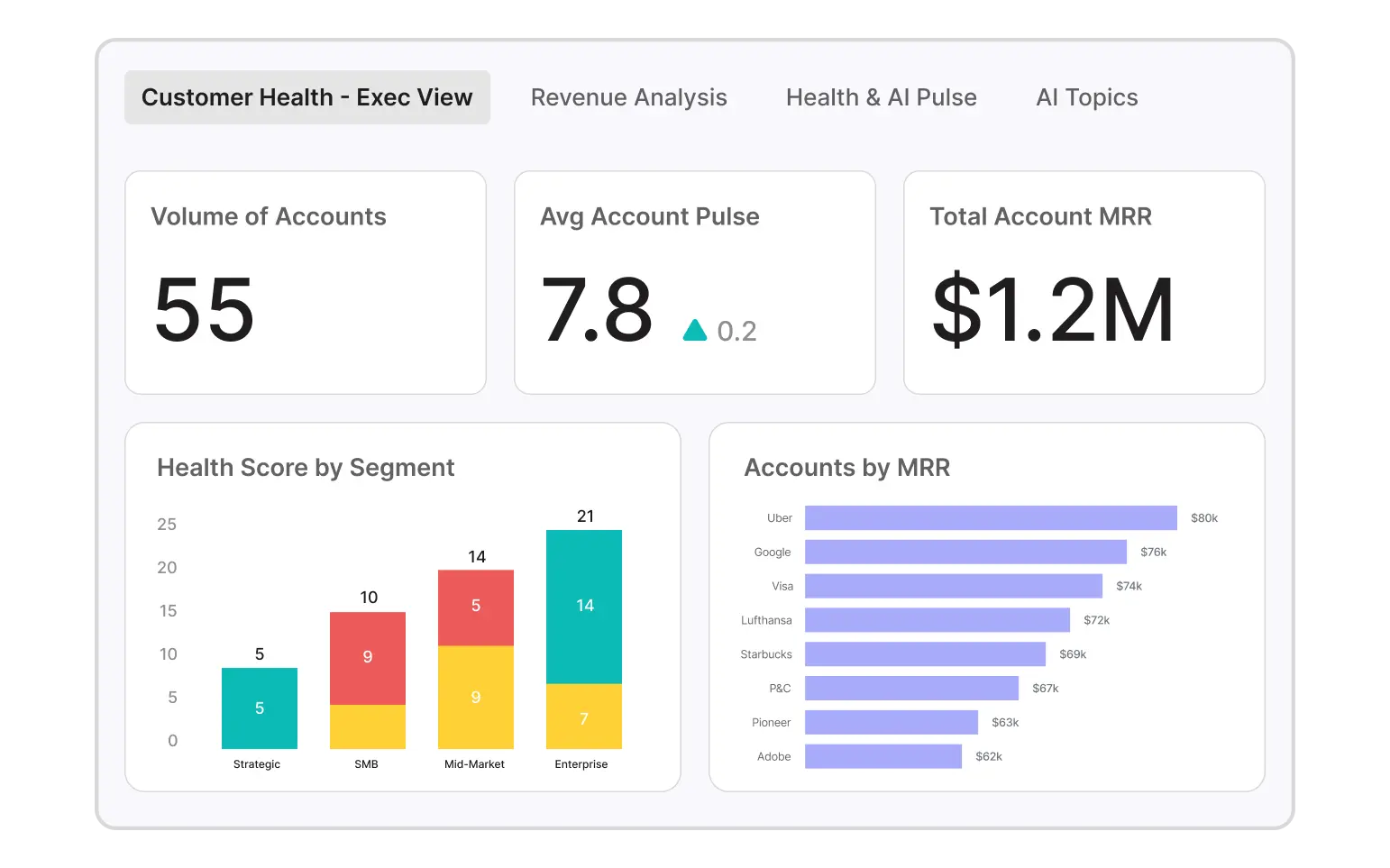
- Consolidates all feedback into a single dashboard for easy tracking.
- Provides a clear overview of customer sentiment across channels.
- Simplifies reporting and trend monitoring.
Analysis features
- Trending Topics analysis highlights recurring themes and issues.
- Sentiment analysis classifies feedback as positive, neutral, or negative.
- Tracks historical trends to monitor changes in customer sentiment over time.
- Enables comparisons and benchmarking against past performance.
Team alignment
- Shares insights across support, product, and marketing teams.
- Ensures cross‑functional alignment on customer priorities.
- Provides alerts and reports when negative feedback spikes.
Action and improvement
- Integrates feedback with customer journey mapping to pinpoint pain points.
- Helps prioritize improvements based on frequency and impact.
- Supports closing the loop by responding directly to customers through Velaris.
What happens to feedback context when your champion churns mid-cycle
When a customer champion leaves, valuable context can disappear with them. Feedback may be buried in call notes, tickets and personal inboxes, while the new stakeholder inherits the account without understanding which issues were raised, what was promised or why certain priorities mattered.
Velaris keeps this history attached to the account rather than the individual relationship. CSMs can review previous feedback, recurring themes, stakeholder sentiment, agreed actions and unresolved requests before engaging the replacement contact.
The handover should separate facts from assumptions. Record what the previous champion reported, the business impact they described, any commitments made and the current status of each action. The new stakeholder can then confirm whether those priorities still apply or whether the account’s goals have changed.
From insights to action: making feedback count
Collecting feedback is only the first step-what truly matters is turning those insights into action. Businesses can use feedback analysis to improve products, enhance service, refine marketing, and prioritize changes that deliver the biggest impact.
Spotting product improvement opportunities
- Identify recurring complaints or feature requests.
- Use feedback to guide product updates and innovation.
- Validate new ideas by testing them against customer expectations.
Enhancing customer service processes
- Detect common issues raised in support interactions.
- Train teams to address pain points more effectively.
- Streamline processes to reduce customer effort and frustration.
Adjusting marketing strategies
- Analyze feedback to understand customer perceptions of campaigns.
- Refine messaging to align with customer needs and values.
- Highlight positive feedback in testimonials and case studies.
Prioritizing changes by frequency and severity
- Rank issues based on how often they appear in feedback.
- Address high‑impact problems first to improve satisfaction quickly.
- Balance quick wins with long‑term strategic improvements.
Setting a feedback-to-roadmap SLA
Customers should know when they can expect a response after submitting meaningful feedback. Without a defined process, requests can disappear into a backlog, leaving customers unsure whether the issue was reviewed or ignored.
A feedback-to-roadmap SLA does not promise that every request will be built. It sets a timeframe for acknowledging the feedback, assessing its impact and communicating the next step.
For example, the team might confirm receipt within two business days and provide an initial decision or status update within 30 days.
The response should explain whether the request is being investigated, added to the roadmap, addressed through an existing capability or declined. Where no firm decision is available, provide a date for the next update rather than leaving the customer waiting indefinitely.
Track SLA compliance by request owner, customer segment and commercial importance. This creates internal accountability while giving CSMs a clear answer to take back to customers. Even when the outcome is not what the customer hoped for, a timely and transparent response helps preserve trust.
Best practices that separate winners from losers
The businesses that succeed with customer feedback are the ones that treat it as an ongoing process, not a one‑time task. Following best practices ensures feedback is collected consistently, acted upon, and used to drive measurable improvements.
Collect feedback continuously
- Gather input across multiple touchpoints (emails, surveys, reviews).
- Avoid waiting for issues to escalate and make feedback part of daily operations.
- Use automation to keep the process consistent and scalable.
Close the loop: respond to customers
- Acknowledge feedback promptly to show customers they’re heard.
- Share updates when changes are made based on their input.
- Build trust by demonstrating that feedback leads to real action.
Share insights across departments
- Distribute findings to product, marketing, and support teams.
- Ensure everyone works from the same customer data.
- Align strategies across departments to improve the overall experience.
Track improvements over time
- Monitor KPIs like NPS, CSAT, and retention rates.
- Compare current performance with past results to measure progress.
- Use trend analysis to identify long‑term shifts in customer sentiment.
Feedback fatigue from your best customers
Your most engaged customers are often the first to raise problems, suggest improvements and explain what would help them get more value. But when a champion repeats the same feedback several times without seeing action or receiving an update, their willingness to contribute can quickly decline.
The damage is not limited to the unresolved issue. Silence may signal that their input is not valued, weakening trust and turning an advocate into a passive or frustrated stakeholder.
Track repeated feedback at the stakeholder level, not only as an account-wide theme. When the same person raises an issue again, acknowledge the history, explain what has happened since the last conversation and provide an honest next step.
This may be a planned product change, a workaround or a clear explanation that the request will not be prioritized.
What this looks like in practice
Consider a B2B SaaS company receiving repeated complaints about a reporting feature. The issue first appears in support tickets, where customers say exports are slow and difficult to configure. Similar comments then appear in NPS responses, while several CSMs record the same frustration in QBR notes.
Instead of treating each comment separately, the team tags every instance under a shared theme such as Reporting and exports. The feedback is then assessed using factors such as frequency, severity, customer segment and revenue impact.
A minor usability suggestion from one account may remain low priority, while a recurring blocker affecting several enterprise customers approaching renewal should be escalated.
Ownership is divided according to the action required. Product receives the consolidated feature feedback and supporting examples. CS operations maintains the tagging structure and reporting dashboard.
Account teams manage communication with affected customers and track any immediate renewal risk.
In this example, the product team simplifies the export workflow and improves processing speed. CSMs then contact affected customers, explain what changed and offer guidance on the updated feature.
One at-risk account renews after confirming that the original blocker has been resolved, while another expands usage to an additional team because reporting is now easier to manage.
The result is more than a product fix. The business can trace a recurring customer signal from its original sources through prioritization, ownership and commercial impact.
A simple template to follow
Use the following structure when documenting your own feedback example:
Signal: What issue or opportunity did customers raise?
Sources: Where did it appear, such as tickets, surveys, calls or QBRs?
Priority: How frequent and severe was it, and which customers or revenue were affected?
Owner: Which team was responsible for investigating and acting?
Action: What product, service or process change was made?
Outcome: Did the action improve adoption, protect a renewal, reduce support demand or create expansion?
Conclusion
Customer feedback is the superpower that separates thriving businesses from those that fall behind. By collecting input continuously, analyzing it with methods like sentiment and trend analysis, and acting on insights, companies can transform scattered opinions into strategies that drive growth, loyalty, and reputation.
Velaris, which is highly rated on G2, makes this process seamless by centralizing feedback, surfacing recurring themes, and enabling teams to respond quickly. The businesses that win are those that listen, adapt, and show customers their voices truly matter.
Ready to see how Velaris can help you turn feedback into action? Request a demo today.
Frequently Asked Questions
What’s the difference between NPS, CSAT, and CES surveys?
- NPS: measures loyalty and likelihood to recommend.
- CSAT: gauges immediate satisfaction after an interaction.
- CES: shows how easy or difficult it was for customers to get what they needed.
How can businesses ensure customers actually give feedback?
Keep surveys short, ask specific questions, allow anonymity, and use convenient tools like widgets or email prompts.
How does sentiment analysis help in feedback management?
It uses AI to classify feedback as positive, neutral, or negative, helping businesses quickly gauge overall customer mood.
What role does feedback play in customer journey mapping?
It pinpoints pain points along the journey, showing where customers struggle and where improvements matter most.
How can feedback be shared across departments effectively?
Centralized dashboards and automated reports ensure product, marketing, and support teams align around customer needs.

The Velaris Team
A (our) team with years of experience in Customer Success have come together to redefine CS with Velaris. One platform, limitless Success.





Velaris is an AI-native Customer Success Platform built for mid-market and enterprise B2B SaaS teams. From customer health scoring and churn prediction to onboarding automation, renewals, and expansion workflows, Velaris helps recurring revenue teams understand account health, reduce churn, and scale customer success with greater visibility and control.