We look forward to showing you Velaris, but first we'd like to know a little bit about you.


Account Prioritization in Customer Success: A Complete Guide
Account prioritization in Customer Success is a strategic method that helps businesses identify and concentrate their efforts on the most valuable customer accounts. This approach not only optimizes resource allocation and enhances the customer experience but also differentiates thriving businesses from those struggling to retain their customer base.
The Velaris Team
May 29, 2026
Account prioritization is the process of identifying which customers need the most attention based on their value, risk level, and growth potential. Not all accounts require the same level of effort, and spreading resources evenly often leads to missed opportunities and unmanaged risk.
By prioritizing the right accounts at the right time, customer success teams can focus their efforts where they have the greatest impact. This leads to better retention, more targeted expansion, and a more efficient use of time and resources across the entire portfolio.
Key takeaways
- Account prioritization ensures your team focuses on the customers that drive the most impact, based on value, risk, and growth potential
- Not all accounts should be treated equally. Spreading effort evenly leads to missed opportunities and unmanaged risk
- Effective prioritization combines multiple signals such as health, engagement, CLV, and upsell potential, not just revenue
- A strong framework includes segmentation, scoring, and clear mapping to engagement strategies, making prioritization consistent and scalable
- Prioritization should evolve across the customer lifecycle, from onboarding and adoption to renewal and expansion
What is account prioritization in customer success?
Account prioritization is the process of strategically ranking customer accounts based on their value, needs, and potential impact on the business. Instead of treating every account equally, teams allocate time and resources based on factors like revenue contribution, churn risk, and growth opportunities.
Without prioritization, customer success teams often spread themselves too thin. High-value or at-risk accounts may not get the attention they need, while lower-impact accounts consume time that could be better spent elsewhere. Prioritization helps teams focus on the accounts that drive retention, expansion, and overall business outcomes.
Research from Harvard Business Review, based on Bain & Company data, shows that a 5% increase in customer retention can increase profits by 25% to 95%. This makes it essential to focus effort where it will have the greatest long-term impact.
Why account prioritization is critical for scaling customer success
As the customer base grows, it becomes impossible to manage every account with the same level of attention. Prioritizing accounts correctly allows teams to effectively define where to invest high-touch efforts, where to automate, and where to maintain a lighter level of engagement. This ensures consistency without sacrificing impact.
It also ensures that at-risk accounts are identified and supported early. It drives expansion by focusing on accounts with growth potential. It also enhances the overall customer experience by allowing Customer Success Managers to deliver the right level of engagement at the right time.
How to prioritize customer accounts effectively
Define prioritization criteria
The first step in account prioritization is deciding what actually makes an account important.
This typically goes beyond just revenue. Revenue potential helps identify accounts that contribute the most today or have the capacity to grow.
But true strategic value includes factors like brand influence, long-term partnerships, or alignment with your product vision. Combining these criteria gives a more balanced view, ensuring you’re not just focusing on size, but also on risk and opportunity.
Segment accounts using proven methods
Once criteria are defined, accounts need to be segmented in a way that makes them actionable.
RFM (recency, frequency, monetary value)
This works well for segmentation when you have a large book of business and limited qualitative data. Its strength is that it's entirely behavioral. It tells you what customers are doing, not what they say they need. But, the limitation is that it treats all activity equally, so an account logging in to raise support tickets scores the same as one actively expanding usage.
Health scoring
This is the most commonly used in CS, but scores reflect inputs you chose to weight, so it can confirm your existing assumptions rather than surface surprises. It's most useful when you're tracking change over time (velocity) rather than point-in-time scores.
Lifecycle stage segmentation
This is underused and often more actionable than either of the above. Grouping accounts by where they are in their journey (like onboarding, adoption, mature, pre-renewal) tells you what the job to be done right now is, which is more useful for deciding what action to take than knowing their revenue tier.
Firmographic segmentation
Segmenting by industry, company size, tech stack is more of a sales-side lens, but in CS it's useful for spotting systemic issues. For example, if every churned account in the past two quarters was a 50–200 person SaaS company using a specific integration, that pattern doesn't show up in health scores.
Engagement-depth segmentation
Segmenting based on engagement depth is the one most teams skip. Rather than just tracking whether someone logs in, look at which features they use and how deeply they use it. A customer using three core features daily is fundamentally different from one using ten features occasionally. This is the best predictor of expansion readiness.
The honest answer is that no single method works alone. The most useful approach is usually a two-axis model: lifecycle stage on one axis (what do they need right now?), engagement depth or health trajectory on the other (how well are they getting it?). That gives you four meaningful quadrants to act on rather than a ranked list that doesn't tell you what to do differently.
Assign tiers and engagement models
After segmentation, accounts should be categorized into tiers that determine how they are managed.
- High-touch accounts typically receive dedicated support, regular check-ins, and strategic guidance.
- Low-touch accounts are managed with lighter, more periodic engagement.
- Tech-touch accounts rely on automation, such as triggered emails or in-product messaging, to scale communication.
Clear tiering ensures that each account receives the right level of attention without overwhelming the team or under-serving key customers.
Balance portfolios by lifecycle phase, not just tier
A CSM with eight Tier-1 accounts all simultaneously onboarding is in a workload crisis even if their portfolio looks balanced on paper. High-touch phases demand a disproportionate amount of time. A portfolio of ten accounts where three are onboarding and two are approaching renewal is a fundamentally different job than ten accounts in stable adoption.
Define which phases in your customer journey are genuinely high-load, set a ceiling on how many a single CSM can carry simultaneously, and flag when anyone is approaching it.
Key metrics to consider when prioritizing accounts
Customer health score
Customer health score is one of the most important indicators when prioritizing accounts. It combines signals like product usage, support interactions, and sentiment to show how likely a customer is to succeed or churn. Accounts with declining health should be prioritized for intervention, while healthy accounts may present opportunities for expansion.
Customer lifetime value (CLV)
CLV helps identify which accounts generate the most value over time. High-CLV customers often deserve more attention because retaining and growing them has a direct impact on revenue. Prioritizing based on CLV ensures that resources are aligned with long-term business impact, not just short-term activity.
Net Promoter Score (NPS)
NPS provides insight into how customers feel about your product and overall experience. Low scores can signal dissatisfaction and potential churn risk, while high scores may indicate strong relationships and opportunities for advocacy or expansion. When used alongside other metrics, NPS helps uncover gaps that may not be visible in usage data alone.
Engagement level
Engagement reflects how actively customers are interacting with your product and team. This can include login frequency, feature adoption, meeting participation, or responsiveness. Low engagement often signals risk, even if other metrics appear stable, making it a key factor in prioritization.
Upsell potential
Upsell potential highlights accounts that are likely to grow. This can be based on product usage patterns, unmet needs, or alignment with higher-tier offerings. Prioritizing these accounts allows teams to focus on expansion opportunities that drive additional revenue without requiring new customer acquisition.
Prioritizing by velocity
Velocity (or the rate of change in health score over a rolling 30 or 60-day window) is what separates accounts that are stable from accounts that are falling. A steady 65 often needs less attention than a 75 in rapid decline. The most practical way to operationalize this is to surface the fastest-declining accounts as a standing item in weekly portfolio reviews.
How account prioritization evolves across the customer lifecycle
Account prioritization is not static. The factors that make an account important change as the customer moves through different stages of their journey. What matters during onboarding is very different from what matters at renewal or expansion, and prioritization needs to reflect that.
Onboarding stage
During onboarding, prioritization is driven by time-to-value. Accounts that are slow to activate, unclear on next steps, or not engaging early should be prioritized. At this stage, the goal is to ensure customers reach their first meaningful outcome as quickly as possible. Early friction is one of the biggest predictors of future churn, so intervention here has a high impact.
Adoption stage
Once onboarding is complete, the focus shifts to product adoption and engagement. Accounts with low usage, limited feature adoption, or declining activity should move up in priority. At the same time, highly engaged accounts may also require attention to deepen adoption and reinforce value. Prioritization here is about ensuring customers are consistently realizing value from the product.
Growth and expansion stage
In the growth phase, prioritization is based on expansion potential. Accounts that are actively using the product, achieving outcomes, and showing signs of maturity are strong candidates for upsell or cross-sell opportunities. These accounts should be prioritized for strategic conversations, additional use cases, and long-term planning.
Renewal stage
As accounts approach renewal, prioritization shifts toward risk management and value reinforcement. Accounts with declining engagement, unresolved issues, or unclear ROI should be prioritized for immediate attention. Even healthy accounts benefit from proactive engagement to ensure alignment and avoid last-minute surprises.
Post-renewal and advocacy stage
After renewal, prioritization focuses on strengthening the relationship and unlocking advocacy. Satisfied customers can become references, provide testimonials, or participate in case studies. Prioritizing these accounts helps build long-term value beyond revenue and contributes to broader growth efforts.
By aligning prioritization with the customer lifecycle, teams can focus on the right outcomes at the right time. This ensures that effort is not only targeted, but also relevant to where the customer is in their journey.
How to triage your account portfolio during a company-wide incident
A product outage or security incident can invalidate your prioritization logic entirely. Health scores, lifecycle stages, and tier rankings were built for normal operating conditions. In a crisis, every account is potentially affected and CSM capacity is finite. In this event, the question shifts from “who needs attention?” to “who needs a human in the next four hours and who can be covered by automated communication while that's happening?”.
The accounts that get immediate personal outreach are determined by two factors: strategic value and current vulnerability.
Tier-1 accounts get a call regardless. So do any accounts currently in onboarding or approaching renewal. These are the customers with the least goodwill buffer and the most legitimate reason to walk if they feel ignored during an incident.
Everyone else receives fast, standardized communication via email or in-app messaging. The message matters more than the channel: state what happened, what's being done, and exactly when the next update will come. Vague reassurance can make things worse.
Once the incident is contained, assign a temporary Crisis Impact Score to each affected account based on actual exposure. For example: how long they were down, whether it hit a critical workflow, whether they were mid-onboarding when it happened.
This score replaces the standard health score for the first week post-recovery and dictates the sequence of follow-up conversations. Accounts that were moderately healthy before the incident but severely affected by it should rank above accounts that were struggling before but barely noticed the outage.
After that first week, retire the Crisis Impact Score and return to normal prioritization, but treat the health scores as lagging data. Sentiment damage from an incident typically shows up in usage and engagement metrics two to four weeks later, and not immediately.
How to build an account prioritization framework
A clear framework ensures that account prioritization is consistent, scalable, and not dependent on individual judgment. According to Bain & Company, 70% of companies fail to effectively execute their revenue strategies due to poor alignment between processes and systems. A clear prioritization framework helps bridge this gap by connecting data, decisions, and actions.
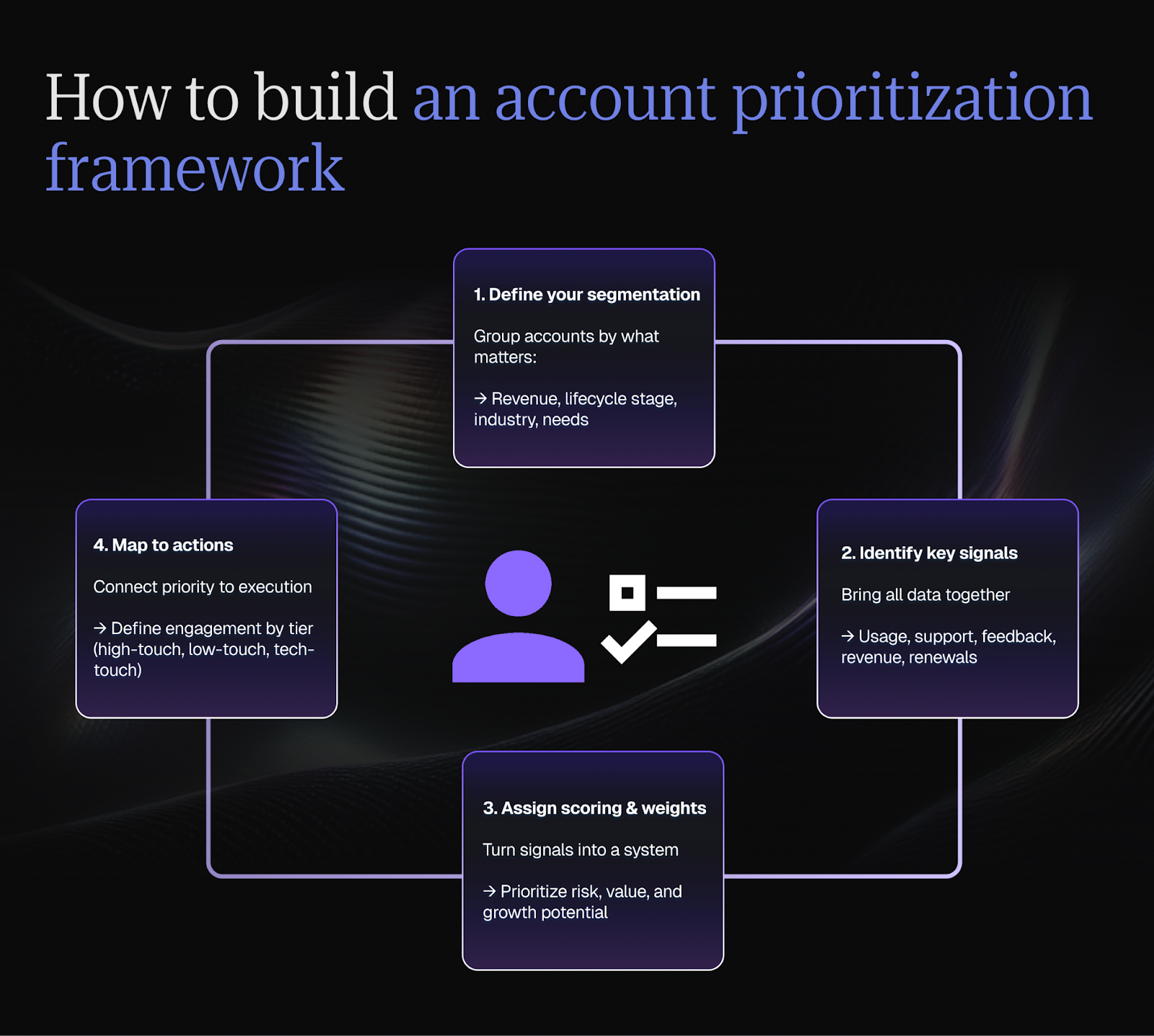
Step 1: Define your segmentation model
Start by deciding how you want to group your accounts. This could be based on revenue tiers, lifecycle stages, industry, or customer needs. The goal is to create segments that reflect meaningful differences in how accounts should be managed, rather than grouping them arbitrarily.
Step 2: Identify key signals and data sources
Next, determine which data points will inform your prioritization. This can include product usage, support tickets, customer feedback, communication history, and commercial data like contract value or renewal dates. Bringing these signals together gives a more complete view of each account and helps avoid decisions based on incomplete information.
Step 3: Assign scoring and weights
Once you have your signals, weigh them. Health score typically anchors the model because it's the most direct read on risk and satisfaction. Sales models tend to anchor on ICP fit instead; CS models anchor on health because the customer already bought, and the question is whether they're succeeding. Layer in revenue and CLV, engagement depth, expansion potential, and churn risk signals to fill out the rest.
Recalibrate the weights when something meaningful changes, such as a new product tier, a shift in your customer base, a change in what "good" looks like for your segment. Three or four factors with clear definitions outperform a 12-factor model every time. The more variables you add, the less any individual CSM trusts the output.
Step 4: Map accounts to engagement strategies
Finally, connect your prioritization model to clear actions. Define what each tier or score means in terms of engagement, such as frequency of check-ins, type of outreach, or level of support. This ensures that prioritization doesn’t just exist on paper but directly influences how your team interacts with customers.
To make these mappings actionable, teams often define explicit combinations of tier and required action:
How to operationalize account prioritization in daily workflows
Account prioritization only drives impact when it’s embedded into how teams work every day. Without clear execution, even the best prioritization model becomes a static exercise. The goal is to translate priority signals into concrete actions that shape how CSMs plan their time, communicate with customers, and review their portfolio.
Task planning and time allocation
Prioritization should directly influence how CSMs structure their day or week. High-priority accounts should drive the majority of planned work, whether that’s preparing for key meetings, addressing risks, or progressing strategic initiatives. Lower-priority accounts can be managed through lighter-touch activities,automation, or AI.
Velaris’ State of AI in Customer Success report found that teams with any intentional AI ownership (whether a formal champion or shared responsibility) are 2.8x more likely to report that their work has become more strategic. Even an informal champion delivers a 2.1x uplift. For CS leaders thinking about how to operationalize prioritization with AI tools, assigning someone to own how AI fits into workflows could be crucial.
Outreach and engagement
Prioritization also determines how and when CSMs engage with customers. High-priority accounts should receive more proactive and personalized outreach, especially during critical moments like onboarding milestones, usage dips, or renewal windows.
For lower-priority segments, outreach can be standardized or automated while still maintaining relevance. The key is ensuring that no important moment is missed, while avoiding unnecessary manual effort for accounts that don’t require it.
Portfolio reviews and account focus
Regular portfolio reviews help CSMs stay aligned with changing priorities. Instead of reviewing all accounts equally, prioritization allows teams to focus on the accounts that need attention most.
This could involve weekly reviews of at-risk accounts, identifying expansion opportunities, or tracking progress on high-value accounts. By consistently revisiting priorities, teams can adjust quickly as customer behavior changes.
Aligning actions with signals
Operationalizing prioritization means connecting signals to actions. For example, a drop in health score should trigger a check-in, while increased usage might prompt an expansion conversation.
When prioritization is tied to clear workflows, CSMs don’t have to decide what to do next every time. The system guides them toward the most relevant actions, making their work more efficient and consistent.
By embedding prioritization into daily workflows, teams move from reactive account management to a more structured and proactive approach. This ensures that the right accounts get the right attention at the right time.
Common mistakes in account prioritization
Over-prioritizing revenue alone
Focusing only on current revenue can lead to a narrow view of account importance. High-revenue accounts may appear stable but could still be at risk, while smaller accounts with strong growth potential may be overlooked. Effective prioritization balances revenue with risk, engagement, and future opportunity.
Ignoring churn risk signals
Some teams prioritize accounts based on size or activity without factoring in early warning signs. Signals like declining usage, negative sentiment, or repeated support issues often appear before churn becomes obvious. Ignoring these indicators can result in reactive firefighting instead of proactive intervention.
Static segmentation that doesn’t update
Account priorities change over time, but many teams rely on fixed segments that don’t reflect real-time behavior. As customer needs evolve, segmentation should update accordingly. Without this, teams may continue treating accounts the same way even when their risk or potential has shifted.
Lack of alignment across teams
When sales, customer success, and product teams operate with different priorities or data, the customer experience becomes inconsistent. Misalignment can lead to conflicting messaging, missed opportunities, and gaps in ownership. A shared understanding of account priority ensures that everyone is working toward the same outcomes.
When green health scores hide disengagement
A green health score on an account that has stopped engaging with a CSM is a warning sign that standard tiering models consistently miss. These accounts often look fine on paper with steady usage and no read flags. But when a customer stops initiating contact, skips QBRs, or goes quiet between check-ins, they're frequently evaluating alternatives.
The fix is to decouple product usage from CSM engagement in your prioritization logic. High product health combined with low strategic contact should flag as a risk, not read as a stable low-priority account.
How AI is changing account prioritization
Predictive health scoring
AI makes health scoring more accurate and dynamic by analyzing patterns across multiple data sources. Instead of relying on static rules, it can detect early signs of churn or expansion based on behavior, sentiment, and engagement trends. This allows teams to prioritize accounts before issues become visible.
Automated segmentation
Automated segmentation is one of the clearest places where moving up that maturity curve pays off, replacing a manual process that goes stale the moment it's finished. Manual segmentation quickly becomes outdated as customer behavior changes. AI can continuously group accounts based on real-time data, such as usage patterns, lifecycle stage, or risk level. This ensures that prioritization reflects current reality rather than outdated assumptions.
Identifying hidden risks and opportunities
AI can surface signals that are easy to miss, such as subtle drops in engagement, recurring support themes, or shifts in customer sentiment. It can also highlight accounts showing expansion potential based on usage trends or unmet needs.
Real-time prioritization updates
Account priority is not static, and AI enables it to update continuously. As new data comes in, whether from product usage, conversations, or support interactions, priorities can shift automatically. This ensures that teams are always working on the most important accounts at any given moment, without needing to manually reassess their entire portfolio.
Tools that support account prioritization
Customer Success platforms
Customer success platforms bring together key data points needed for prioritization, such as health scores, segmentation, and workflows. They help teams identify which accounts need attention, standardize how accounts are managed, and ensure that prioritization translates into consistent action across the customer lifecycle.
CRM systems
CRM systems provide visibility into customer data, contract value, and pipeline activity. They are useful for understanding account value, tracking renewals, and identifying expansion opportunities. However, they often need to be combined with other tools to capture product usage and customer sentiment.
Product analytics tools
Product analytics tools offer insights into how customers are actually using the product. Metrics like feature adoption, login frequency, and usage trends help identify both engaged accounts and those at risk. These insights are critical for understanding behavior beyond surface-level data.
How Velaris helps
Velaris, a tool which is well-rated on G2 brings together customer data from multiple systems into a single, unified view, making it easier to prioritize accounts with full context. AI-powered insights like Headlines, CallSense, and AI Topics surface key signals from conversations, support, and usage data.
Health scoring and prioritization signals update dynamically based on real-time inputs, helping teams stay ahead of risk and opportunity. Copilot then recommends the next best actions, allowing teams to move from insight to execution without manual effort.
Conclusion
Account prioritization is what allows customer success teams to use their time and resources effectively. Not every account requires the same level of attention, and without a clear approach, teams risk spreading themselves too thin and missing what matters most.
When prioritization is driven by data, including health, engagement, risk, and growth potential, teams can make better decisions about where to focus. This leads to stronger retention, more targeted expansion, and a more consistent customer experience across the portfolio.
Tools like Velaris, a highly rated software on G2, help make this possible by unifying customer data, surfacing prioritization signals through AI, and guiding teams toward the next best actions. Instead of manually piecing together insights, teams can focus on executing where it matters most.
Book a demo to see how Velaris helps teams prioritize accounts, surface risks, and act faster.
Frequently Asked Questions
How often should the account prioritization framework be updated?
Account prioritization should not be treated as a one-time setup. At a minimum, frameworks should be reviewed monthly or quarterly to ensure criteria and scoring still reflect business goals. However, in practice, prioritization should update continuously based on real-time signals like changes in health, engagement, or upcoming renewals.
What is the best way to balance high-touch and low-touch accounts?
The best approach is to align engagement levels with account value, risk, and growth potential. High-value or at-risk accounts typically require high-touch engagement, while lower-value or stable accounts can be managed through low-touch or tech-touch models. The goal is to maximize impact without overwhelming the team.
Can small teams benefit from account prioritization?
Yes, account prioritization is especially important for small teams with limited resources. It helps ensure that time is spent on the accounts that matter most, rather than trying to give equal attention to every customer. Even simple prioritization models can significantly improve focus and outcomes.
What are early warning signs that an account should be reprioritized?
Common signals include declining product usage, reduced engagement, negative feedback, repeated support issues, or changes in key stakeholders. Upcoming renewals or missed milestones can also indicate that an account needs more immediate attention.
What is the difference between account prioritization and customer segmentation?
Customer segmentation groups accounts based on shared characteristics such as size, industry, or use case. Account prioritization builds on this by determining which of those accounts require the most attention at a given time. Segmentation defines the structure, while prioritization drives action.

The Velaris Team
A (our) team with years of experience in Customer Success have come together to redefine CS with Velaris. One platform, limitless Success.





Velaris is an AI-native Customer Success Platform built for mid-market and enterprise B2B SaaS teams. From customer health scoring and churn prediction to onboarding automation, renewals, and expansion workflows, Velaris helps recurring revenue teams understand account health, reduce churn, and scale customer success with greater visibility and control.